- 370 pages
- English
- ePUB (mobile friendly)
- Available on iOS & Android
eBook - ePub
British Pan-Arab Policy, 1915-1922
About this book
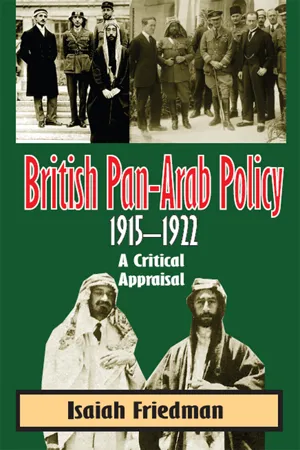
In this myth-shattering study Isaiah Friedman provides a new perspective on events in the Middle East during World War I and its aftermath. He shows that British officials in Cairo mistakenly assumed that the Arabs would rebel against Turkey and welcome the British as deliverers. Sharif (later king) Hussein did rebel, but not for nationalistic motives as is generally presented in historiography. Early in the war he simultaneously negotiated with the British and the Turks but, after discovering that the Turks intended to assassinate him, finally sided with the British. There was no Arab Revolt in the Fertile Crescent. It was mainly the soldiers of Britain, the Commonwealth, and India that overthrew the Ottoman rule, not the Arabs. Both T.E. Lawrence ("Lawrence of Arabia") and Sir Mark Sykes hoped to revive the Arab nation and build a new Middle East. They courted disappointment: the Arabs resented the encroachment of European Powers and longed for the return of the Turks. Emir Feisal too became an exponent of Pan-Arabism and a proponent of the "United Syria" scheme. It was supported by the British Military Administration who wished thereby to eliminate the French from Syria. British officers were antagonistic to Zionism as well and were responsible for the anti-Jewish riots in Jerusalem in April 1920. During the twenties, unlike the Hussein family and their allies, the peasants (fellaheen), who constituted the majority of the Arab population in Palestine, were not inimical towards the Zionists. They maintained that "progress and prosperity lie in the path of brotherhood" between Arabs and Jews and regarded Jewish immigration and settlement to be beneficial to the country. Friedman argues that, if properly handled, the Arab-Zionist conflict was not inevitable. The responsibility lay in the hands of the British administration of Palestine.
Table of contents
- Cover
- Half Title
- Title Page
- Copyright Page
- Dedication
- Table of Contents
- Acknowledgments
- Introduction
- 1. The Illusion
- 2. Arabs in the War
- 3. The Controversy about the Capture of Damascus
- 4. Sir Mark Sykes: His Vision and Disillusionment
- 5. The Miscalculation
- 6. Article 22 of the Covenant of the League of Nations and the Principle of Self-Determination
- 7. The Anglo-French Declaration of 8 November 1918
- 8. Cooperation or Confrontation?
- 9. On a Collision Course
- 10. An Elusive Ally
- 11. Trans-Jordania* and Palestine
- 12. Wrestling with the Palestinians
- Appendices
- Index
Trusted by 375,005 students
Access to over 1.5 million titles for a fair monthly price.
Study more efficiently using our study tools.
Frequently asked questions
Yes, you can cancel anytime from the Subscription tab in your account settings on the Perlego website. Your subscription will stay active until the end of your current billing period. Learn how to cancel your subscription
No, books cannot be downloaded as external files, such as PDFs, for use outside of Perlego. However, you can download books within the Perlego app for offline reading on mobile or tablet. Learn how to download books offline
Perlego offers two plans: Essential and Complete
- Essential is ideal for learners and professionals who enjoy exploring a wide range of subjects. Access the Essential Library with 800,000+ trusted titles and best-sellers across business, personal growth, and the humanities. Includes unlimited reading time and Standard Read Aloud voice.
- Complete: Perfect for advanced learners and researchers needing full, unrestricted access. Unlock 1.5M+ books across hundreds of subjects, including academic and specialized titles. The Complete Plan also includes advanced features like Premium Read Aloud and Research Assistant.
We are an online textbook subscription service, where you can get access to an entire online library for less than the price of a single book per month. With over 1.5 million books across 990+ topics, we’ve got you covered! Learn about our mission
Look out for the read-aloud symbol on your next book to see if you can listen to it. The read-aloud tool reads text aloud for you, highlighting the text as it is being read. You can pause it, speed it up and slow it down. Learn more about Read Aloud
Yes! You can use the Perlego app on both iOS and Android devices to read anytime, anywhere — even offline. Perfect for commutes or when you’re on the go.
Please note we cannot support devices running on iOS 13 and Android 7 or earlier. Learn more about using the app
Please note we cannot support devices running on iOS 13 and Android 7 or earlier. Learn more about using the app
Yes, you can access British Pan-Arab Policy, 1915-1922 by Isaiah Friedman in PDF and/or ePUB format, as well as other popular books in History & European History. We have over 1.5 million books available in our catalogue for you to explore.