- 331 pages
- English
- ePUB (mobile friendly)
- Available on iOS & Android
eBook - ePub
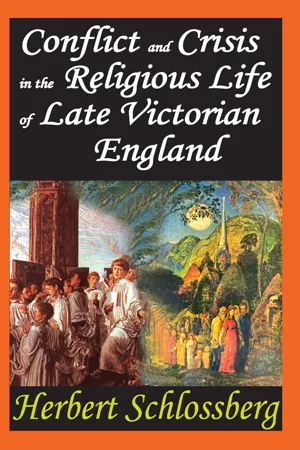
Conflict and Crisis in the Religious Life of Late Victorian England
About this book
Contrary to its popular image as dull and stodgy, the Victorian period was one of revolutionary change. In its politics, its art, its economic aff airs, its class relationships, and in its religion, change was constant. A half-century after Queen Victoria's death, it was said that she was born in one world and died in another. Th e most interesting and valuable studies of the period take the long view, as does Schlossberg, in his fascinating analysis of religious life in this period. For the Victorians, religion was not cordoned off from the push and shove of real life. Th e early evangelicals got off to a shaky start, beset by hostility, but the movement spread within the churches despite the suspicion in which it was held. Evangelicals, frequently called Puritans by those who opposed them, called for fundamental reforms in both the Church and the society; a social ethic was part of their program of religious renewal. Th eir moral sense explains the social activism of both Church of England Evangelicals and Dissenters, including the half-century crusade for the abolition of slavery. Schlossberg shows how religion in England dealt with such issues as science and the eff ect of German scholarship on religious thinking. Church history cannot simply be explained by its response to external forces as much as by the internal responses to those challenges. Th e nature of the religious enterprise itself, its theologians, clergy, lay people--like all people and all institutions--all responded with alternatives. Schlossberg helps us understand the Victorian period, as well as the increasing secularity of English life today.
1
The Setting for the Coming Struggles
In 1897 the satirical novelist and essayist Samuel Butler, writing anonymously in the guise of a perplexed clergyman, described the years between 1844 and 1859 as being of apparent religious calm with no obvious challenge to traditional religion. “But I need hardly say that the calm was only superficial. Those who watched the course of events more narrowly must have known that the wave of skepticism then breaking over Germany was setting towards our own shores also; nor, indeed, was it long before it reached them.”1
Biblical Criticism
That wave of skepticism centered on the reliability of the Christian scriptures, and Germany was not the only source of doubt. The ancient Hebrew writings collected in the Old Testament were a substantial source for the teachings of Jesus Christ and the early Christian church. The components of the New Testament were collected and codified into an official canon some time in the fourth century, although a growing consensus had given it shape much earlier. Both Testaments, which together make up the Bible, are the sources of the Christian faith; being the original documents that define Christianity they have always been taken as more authoritative than later religious works, many of which are glosses on the two Testaments. Very early on, the Bible was taken by all parts of the church to have transcendent authority, a status that remained through the centuries–notwithstanding variant understandings of the canon, different translations, disagreements about interpretation, and the various definitions of the sense in which they were said to be “inspired” by God. Just as historians instinctively go back to original documents for authoritative knowledge of what actually happened in the past, so Christian theology goes back to its sources in those ancient writings. That explains the immense effort that has always gone into collating texts, seeking to find the most authoritative on which to base translations, the large and expensive collaborative translation projects, the ongoing explication of texts in relation to current issues, the millions of copies that are published, bought, and read. Those realities account for the sense of abandonment and betrayal that accompanied the kind of critical scholarship that became more common in the nineteenth century, some of it malicious debunking, but much of it serious and capable.
A distinction is usually made between lower and higher criticism. There may be no hard and fast definitions of the two, but in general the first is concerned with determining issues of authorship, dating, and context, and the second applies that kind of evidence to the truth claims of the text, a process which lends itself to a far greater level of speculation and controversy. If the entire corpus of biblical literature has its authority questioned in this fashion, there are potentially serious consequences for the future of the faith based on that literature.
It was taken for granted by some observers that Christianity was negated by challenges to the integrity of the biblical text, such challenges often being called the “Tübingen theology” from the university that was associated with it. The eminent biologist T. H. Huxley, for example, took the Old Testament as a series of ancient myths which, however, were true representations of the state of thinking at the time they were devised.2 Liberal theologians adopted a similar theory, although seldom going as far as Huxley. J. R. Seeley, author of a widely praised life of Christ, Ecce Homo (1865), regarded historical facts as having a universal interest, but of no practical value to any generation except through a process of reinterpretation. The Bible contains many historical facts, but also a philosophy interpreted by its writers in the various societies in which those writings appeared; each age must similarly interpret those facts for itself. It is only to be expected that a society, any society, will interpret them differently than its predecessors had.3
German theology was one of the influences on the criticism practiced by John Colenso, missionary bishop of Natal. Trained as a mathematician, Colenso was disturbed by some of the large numbers mentioned in the Old Testament narratives, the implausibility of which caused him to question much else in the Bible. His ruminations on these issues were published in a series of volumes during the period 1862–79 under the title Critical Examination of the Pentateuch. These were taken by the orthodox to be highly destructive of the faith of ordinary Christians, as Archbishop Tait informed Colenso in a confrontation we have already considered.
It is one of the ironies of the subject we are dealing with that German came to be associated in the minds of the orthodox with infidel, when earlier it was associated with a religious approach to life as opposed to a secular one. John Stuart Mill, in his celebrated essay on Coleridge, praised what he called the “Germano-Coleridgian school” for having departed from the practice of the eighteenth-century philosophers to denigrate both religion and morality as subjects of serious and practical study.4 Coleridge was one of the early champions of biblical criticism. An orthodox if amateur theologian (also a poet and philosopher), Coleridge asserted that the Bible had a vital message for the preservation and furtherance of Christian faith, but he believed that too many of its champions held theories about it that could only undermine its staying power in the battles that were sure to come. Coleridge had studied in Germany, and he believed that when critical ideas he learned of there came to England, doctrines of infallibility or inerrancy would collapse and leave the faith of the people stranded. His Confessions of an Inquiring Spirit, published posthumously in 1840, maintained the basis for Christian piety while holding that it did not depend on theories of inspiration that would shortly come under irresistible challenge.5
Of the numerous German theological works that made their way to England, possibly none had a greater influence than David Friedrich Strauss’s book, translated by the future novelist George Eliot as The Life of Jesus Critically Examined. Even the Germans found Strauss’s position too much to take, and his teaching career at the Universities of Tübingen and Zürich was sharply curtailed. In his preface, Strauss explicitly opposed his interpretation to the conflicting positions of both naturalism and supernaturalism. He called the new point of view he was advancing the “mythical.” Rejecting equally the ideas that the relaters of miraculous events were liars and that the events never really happened, he concluded that the witnesses mistook natural causes for supernatural. Jesus the Messiah, predicted by the Jewish scriptures, in this treatment became a moral genius. Strauss’s explanation for the transmuting of the natural into the supernatural was the romantic theory of myth. The myth-makers were the churches, and the chief myth was the messianic expectations that had been fostered by accepting the Hebrew Scriptures. Strauss claimed to be able to produce a work of this nature even though far more able theologians had failed because he had developed, through the study of philosophy, the facility of liberating his feelings from dogmatic presuppositions. If other theologians regard his work as un-Christian, he regards theirs as unscientific.6
It is clear that Strauss had in mind that his was not just another theology book, but an entirely new method of thinking about theology. And that method was the absolute separation of the historical facts from the doctrines of the faith. The facts can be false, and the doctrines based upon them remain true. “The supernatural birth of Christ, his miracles, his resurrection and ascension, remain eternal truths, whatever doubts may be cast on their reality as historical facts.” Strauss excoriated the rationalists of the eighteenth century because their method destroyed the faith that he was defending, while purifying it of unhistorical accretions. With his method, “no injury is threatened to the Christian faith.”7
Strauss returned to this theme at the end of the book. He acknowledged what any reading of his work would quickly conclude: that it is on the surface destructive of Christian faith.
The results of the inquiry which we have now brought to a close, have apparently annihilated the greatest and most valuable part of that which the Christian has been wont to believe concerning his Saviour Jesus, have uprooted all the animating motives which he has gathered from his faith, and withered all his consolations. The boundless store of truth and life which for eighteen centuries has been the aliment of humanity, seems irretrievably dissipated; the most sublime leveled with the dust, God divested of his grace, man of his dignity, and the tie between heaven and earth broken.
So far everything the reader has come to expect from the general thrust of the book is confirmed by that conclusion. But Strauss did not leave it that way; he went on to proclaim what he held to be a satisfactory solution to the dilemma of maintaining faith in the midst of the destruction of its historical bedrock: “Piety turns away with horror from so fearful an act of desecration, and strong in the impregnable self-evidence of its faith, pronounces that, let an audacious criticism attempt what it will, all which the scriptures declare, and the church believes of Christ, will still subsist as eternal truth, nor needs one iota of it to be renounced. Thus at the conclusion of the criticism of the history of Jesus, there presents itself this problem: to re-establish dogmatically that which has been destroyed critically.”8 We have from Strauss a kind of gnostic defense of the faith, inasmuch as he believed he destroyed the historical basis, the entire evidentiary structure, of Christianity, while enjoining his readers to believe it anyway. But just what is the substance of what is to be believed? The entire historical faith always taught by the churches, according to Strauss, only not on the same basis. “Hitherto our criticism had for its object the data of Christianity, as historically presented in the evangelical records; now, these data having been called in question in their historical form, assume that of a mental product, and find a refuge in the soul of the believer; where they exist, not as a simple history, but as a reflected history, that is, a confession of faith, a received dogma.”9 There is no historical basis for what you have been taught from childhood, but let your believing heart dictate to your doubting mind.
Whether or not Strauss was sincere about his suggestion to behave irrationally and let the heart believe what the mind proclaims to be false, we have abundant testimony that his strategy proved destructive to the faith of many Victorians. Dr. Thomas Arnold’s son, also Thomas, whose instability led him from Anglicanism to Roman Catholicism, then back to Anglicanism and again to Roman Catholicism, found Strauss dee...
Table of contents
- Cover
- Half Title
- Title Page
- Copyright Page
- Dedication
- Table of Contents
- Dedicatory Note
- Introduction
- 1. The Setting for the Coming Struggles
- 2. The Decay of the Evangelical Party in the Church of England
- 3. The Waning of the Nonconformist Spirit
- 4. The High Church on the Way to Ascendency
- 5. Truth, Freedom, and the Fratricide of the Orthodox
- 6. The Diffusive Religion of the Late Victorians
- 7. Alternatives to Christianity
- 8. Conclusions
- Index
Trusted by 375,005 students
Access to over 1.5 million titles for a fair monthly price.
Study more efficiently using our study tools.
Frequently asked questions
Yes, you can cancel anytime from the Subscription tab in your account settings on the Perlego website. Your subscription will stay active until the end of your current billing period. Learn how to cancel your subscription
No, books cannot be downloaded as external files, such as PDFs, for use outside of Perlego. However, you can download books within the Perlego app for offline reading on mobile or tablet. Learn how to download books offline
Perlego offers two plans: Essential and Complete
- Essential is ideal for learners and professionals who enjoy exploring a wide range of subjects. Access the Essential Library with 800,000+ trusted titles and best-sellers across business, personal growth, and the humanities. Includes unlimited reading time and Standard Read Aloud voice.
- Complete: Perfect for advanced learners and researchers needing full, unrestricted access. Unlock 1.5M+ books across hundreds of subjects, including academic and specialized titles. The Complete Plan also includes advanced features like Premium Read Aloud and Research Assistant.
We are an online textbook subscription service, where you can get access to an entire online library for less than the price of a single book per month. With over 1.5 million books across 990+ topics, we’ve got you covered! Learn about our mission
Look out for the read-aloud symbol on your next book to see if you can listen to it. The read-aloud tool reads text aloud for you, highlighting the text as it is being read. You can pause it, speed it up and slow it down. Learn more about Read Aloud
Yes! You can use the Perlego app on both iOS and Android devices to read anytime, anywhere — even offline. Perfect for commutes or when you’re on the go.
Please note we cannot support devices running on iOS 13 and Android 7 or earlier. Learn more about using the app
Please note we cannot support devices running on iOS 13 and Android 7 or earlier. Learn more about using the app
Yes, you can access Conflict and Crisis in the Religious Life of Late Victorian England by Herbert Schlossberg in PDF and/or ePUB format, as well as other popular books in History & World History. We have over 1.5 million books available in our catalogue for you to explore.