eBook - ePub
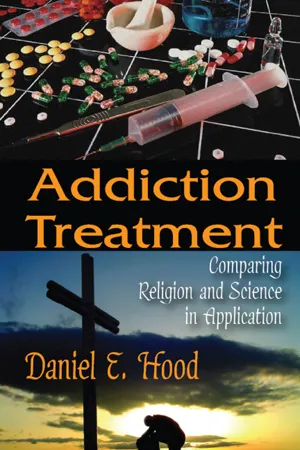
Addiction Treatment
Comparing Religion and Science in Application
- 261 pages
- English
- ePUB (mobile friendly)
- Available on iOS & Android
eBook - ePub
About this book
Addiction Treatment is an ethnography that compares two types of residential drug-free treatment programs-religious, faith-based programs and science-based, secular programs. Although these programs have originated from significantly different ideological bases, in examining the day-to-day operations of each, Daniel E. Hood concludes that they are far more alike than they are different. Drug-free treatment today, whether in secular or religious form, is little more than a remnant of the temperance movement. It is a warning to stop using drugs. At its best, treatment provides practical advice and support for complete abstinence. At its worst, it demeans users for a form of behavior that is not well understood and threatens death if they do not stop. Hood argues that there is no universal agreement on what addiction is and that drug abuse is little more than a catch-all term of no specific meaning used to condemn behavior that is socially unacceptable. Through extensive participatory observations, intimate life history interviews, and informal conversations with residents and staff, Hood shows how both programs use the same basic techniques of ideological persuasion (mutual witnessing), methods of social control (discourse deprivation), and the same proposed zero tolerance, abstinent lifestyle (Christian living vs. Right living) as they endeavor to transform clients from addicts to citizens or from sinners to disciples.
Information
1
Two Houses: People, Places, and Programs
“I want [the men] to have minds washed with the Word of God. Salvation is the primary goal.”
—Harry Evans, director, Redemption House
“The principle goal is global change in lifestyle; the encounter group is the cornerstone method … it uses positive coercion to raise client awareness.”
—George DeLeon, director, Center for Therapeutic Community Research
In this first chapter, I attempt an initial description of the people and places, methods and operations, ideas and meanings that make up the two programs at the heart of this book. I call the programs Recovery House and Redemption House. After introducing these settings and their people, I explain some “backstage” matters of this study: how I went about the business of collecting the “raw” data that grounds it and how I processed that data to create the descriptions and analyses that make up this and the following chapters.
Redemption House
Redemption House is a faith-based Christian discipleship center that serves homeless men, most of whom are seriously involved in illicit drug use. The House is located in a marginally poor neighborhood in the Bronx, the northern-most borough of New York City.1 It operates in a modest but ample three-story brick house (circa 1910) less than a dozen blocks south of Fordham Road, the north-south dividing line of the borough. This building, which contains the entire program, includes a full basement and an enclosed, wooden front porch with windows that run across its entire front wall. There is a small yard in the back that is paved over for use as a basketball court, with a single hoop and backboard affixed to a ten-foot-high brick retaining wall at the rear. (The house sits at the foot of a hill that rises sharply to the street behind.) The program’s twelve-seat van, along with three or four other cars belonging to staff members or visitors, is often crowded into the uncovered driveway that leads from the street to the backyard.
The blocks surrounding Redemption House are a mixture of similar houses, in various states of repair and renovation. They are bookended by sprawling eight-floor apartment buildings that face each other across almost every intersection. Most of the individual houses and small yards fronting them are clean and well kept, although they no longer belong to a burgeoning middle class that is suggested by their large capacities and other architectural features and proportions.
The immediate vicinity of Redemption House includes a community college, a small branch of the public library, and a number of churches. There are no storefronts for at least two blocks, and then only to the south, toward Recovery House that lies a dozen long blocks beyond. Just one block east, however, looms another kind of neighborhood—the kind that, deserved or not, gives the South Bronx its desperate and dangerous reputation. While I rarely had any objective reason to be concerned about my physical safety on the main thoroughfare that fronts Redemption House, the side streets I walked between there and the elevated train always lent an air of uncertainty to my travels to and from Manhattan. Mine was always the only white, “anglo” face on those blocks, and therefore the only one obviously out of place.
The Redemption House windowed front porch is usually locked for security reasons. Its interior is filled with stacks of furniture in various states of disrepair and refinishing. Each piece is ready either to be worked over by the men in residence or returned to its original home in the “outside world” after having been completely refurbished. This is the raw material for the main vocational element of the program, a furniture rehabilitation “factory” in the basement. In one of our many, long conversations, Martin Davis, the house manager, described the porch as a metaphor for the entire House and its residents: the working over of tired and tattered men and their return to the “outside world” in completely redeemed condition.
My first visit to Redemption House was arranged through a personal contact, a local minister and member of the Redemption House board of trustees, with whom I had worked some twenty-five years ago, prior to my academic reincarnation. As would happen scores of times in the early mornings of the next four months, I was buzzed into the unlighted porch and walked past the tangle of tables, chairs and bureaus that, especially on dark winter mornings, gives the impression of passing through a tunnel. At times, in my recollections of the House, my passage through the porch takes on the appearance of Lewis Carroll’s Alice entering the rabbit hole. At the other end of the hallucinatory tunnel emerges a world seemingly as different from, yet as revealing of, the one outside as Alice’s Wonderland was vis-à-vis Victorian England. The world that lies at the end of this shadowy passageway is ultimately, like Alice’s, a realm of light, not of darkness. But its light is of various sorts or hues. What light one perceives there depends on one’s angle of vision. For this ethnographer, several angles of vision were illuminated, as well as illuminating.
I spent four months visiting Redemption House several times each week. On those dark winter mornings, just across the porch-divide, I always found a brightly lit universe brimming with activity. As on that first, exploratory visit, the foyer is the point of entry to the world of Redemption House. Architecturally, this room is quite modest. At ten feet wide by twenty-five feet deep, it is not large, though its ten-foot ceiling gives a sense of spaciousness that is aided by two leaded glass windows where the right (northeast) wall meets the ceiling. Nevertheless, this oversized vestibule is quite literally the crossroads of activity in Redemption House.
As I entered the foyer on that first visit, it seemed as if faces and/or voices of greeting or inquiry appeared from every conceivable direction. A sturdy oaken desk sits just inside the door, to the left. Behind the desk on this first visit sat a pleasant black man about thirty years of age. His greeting was typical of the House’s operating staff: “Welcome to the Redemption House; the Lord bless you. How may I help you, sir?” Before I could answer, a head popped out from the top of the stairway at the far end of the room, as if from the ceiling, and said, “He’s here to see Harry, send ‘im on up.” Then this dangling, seemingly disembodied head (also African American, as are the great majority of men here) looked in my direction and said, “Welcome to the Redemption House, brother. I was the one who gave you directions when you called from the subway. Come on up. Harry is waiting for you.”
Off to the left, as I walked toward the stairs, I looked through an open double doorway that led into the large dining room fitted with six long tables, each capable of seating a dozen men. Several men were seated about, singly or in small clusters, just finishing their noon meal. As I came in, several looked up and nodded a greeting, then resumed eating. Though they were pleasant enough, I was struck by a certain prison-like appearance to the scene, with its long tables filled mostly with black and brown faces of varied hues. The bodies were of equally varied shapes and sizes, several of them obviously sculpted by untold hours of exercise and pumping iron, perhaps in littered public playgrounds and dismal gyms or yards at other sorts of penitentiaries.
As I stepped further into the room, I heard muffled voices through a closed door at the far left corner. It sounded like a number of people all speaking at once. This room, as I soon learned, is identified as the chapel. It is a multi-purpose room used for morning chapel, prayer meetings, Bible classes, and other collective functions.2 The prayer meeting that divides the noon meal from the afternoon work period was just getting under way. Another three or four men, including the now-embodied head that spoke to me a minute ago, were descending the stairs on their way to the chapel. They all nodded greetings. As the diners finished their meals, each one carried his plate and other utensils through the open door at the back of the foyer.
Through that door is a spacious kitchen, well outfitted to cook for the twenty-five or more men who eat at every meal. A neatly hand-lettered sign on cardboard above the kitchen entrance reads: “Staff Only: All others need permission.” This is in keeping with the aura of the entire center, but especially the foyer. The walls of this room bear several paintings and hand-lettered posters, all with biblical motifs. One large poster lists the books of the Bible together with their central themes as perceived by evangelical interpretation. These rooms: the foyer, the dinning room, the chapel, and the kitchen were where I spent most of my time over the next four months, interviewing, observing, participating, and conversing informally with the men of Redemption House.
After my initial interview with the director that afternoon, I was granted complete access to the program. I was allowed to come and go, as I wanted. I attended all program functions whenever and as often as I pleased: classes, chapel services, church services, work periods, prayer meetings, meals, staff meetings (with prior permission), and even a couple out-of-town trips to the Teen Challenge Training Center, something of a parent organization at the time. I was permitted to interview any resident or staff member who agreed to participate. No resident refused me; some sought me out to offer their cooperation. The director introduced me to his staff and the residents (at separate sessions), explained my reason for being there, and assured everyone that all were free to participate or not as they wished. However, it was clear to me that his friendliness and cooperation were instrumental in the ready reception and cooperation I received from all members of the program. Over the next four months I became a regular, almost daily, visitor and participant. In several of the relationships I was able to forge with residents, I often felt “taken under the wing” of men somewhat younger than myself, but much wiser in the ways of the street and of the rehabilitation program, and certainly more knowledgeable about the nature of the transformational experience they were undergoing. As it turned out, I interviewed almost every resident who stayed more than a week during my four months at Redemption House.
Evangelical Culture
Redemption House is a privately operated, non-profit, evangelical Christian organization, officially licensed by the state of New York as a men’s shelter. It is not officially designated as, nor does it consider itself a “drug treatment.” It is a self-described Christian “discipleship training” program.3 The program answers to a board of directors that consists of local ministers and laymen—most of them associated with evangelical or Pentecostal churches.
Ideologically, Redemption House is situated within the American evangelical culture. Evangelicals are a loose-knit collection of groups and organizations: denominations, independent churches, mission boards, schools, colleges, seminaries, publishing houses, radio and television stations, hospitals, charities, retirement communities. They share a relatively singular, conservative Christian culture that revolves around “living the Christian life” and “bringing the Gospel to others.” While some usages of the term “evangelical” omit Pentecostal and fundamentalist groups as too extreme, mine includes both as well as the more “centrist” denominational organizations such as Baptists, Methodists, and Mennonites. The evangelical umbrella also covers innumerable “independent Bible churches” and other smaller and regional denominations and associated institutions.
While no single definition of “the Christian life” is likely to dovetail perfectly with any other, all evangelicals believe that it begins with being “born again through faith in Jesus Christ.” This is ideally followed by continuous “spiritual growth” through a “personal relationship” or “daily walk with the Lord.” This “walk” involves regular church membership and participation, often referred to as “fellowship with like-minded believers.” It also requires regular attention to scripture reading and prayer (“personal devotions”), which are seen as the central communicative elements in a “personal relationship with God.” Collective or group prayer is also central to this walk. For ethical prescriptions, most evangelicals draw from a similar pool of “dos and don’ts.” The various groups approximate one another fairly closely in their adherence to specific moral and ethical elements as well as in their overall outlooks. This homogeneity in general, with some heterogeneity in the particulars, is one of the elements that makes for much internal organizational diversity. Many groups, for example, find the practice of speaking in tongues too sensationalist, others—particularly Pentecostal or holiness groups—consider it essential to proper spirituality. At Redemption House, the practice of tongues-speaking is accepted, but not required. This undoubtedly stems from its close association with local and regional Pentecostal churches, which are common in New York City’s numerous black and Latino neighborhoods where most of the Redemption House residents were raised.
For almost all evangelicals, abstinence from illegal psychoactive substances is taken for granted. The consensus is almost as complete regarding the prohibition of tobacco and alcohol. A few groups include caffeine in their taboos. Some groups tolerate the use of tobacco, especially in places like the Carolinas, where tobacco farming and the tobacco industry dominate the regional economy. Some more sophisticated evangelicals, especially the professional and educated elites, tolerate moderate use of alcohol and an occasional cigar.4 Redemption House tolerates neither tobacco nor alcohol use. In this and most other ways, it fits squarely within the evangelical mainstream.
The Training Rationale
The faith community process of rehabilitation—that is, redemption—entails a religious conversion, variously identified as “getting saved,” “being born again,” “being filled with the (Holy) Spirit,” “giving one’s life to the Lord.” This personal transformation is believed to create a new spiritual nature, which allows the individual—with assistance of the now “in-dwelling Spirit of God”—to avoid the sinful habits that had previously characterized his life. At the core of the process at Redemption House, however, is an intensive “discipleship” training period of a year or more that includes a daily schedule of Bible classes, chapel and other religious services, prayer meetings, other educational and vocational trainings, household duties, and work in the program’s furniture refinishing operation. All of this occurs within a residential setting of fifteen to twenty-five male residents who live together twenty-four hours a day, seven days a week. (Redemption House serves only adult men, but has a “sister program” that trains women to be disciples.) The training staff consists of four to six men; most are graduates of this or a similar discipleship program. (See chapter 2 for more details.)
I have pseudonymously christened the director of Redemption House Harry Evans. Harry is a stocky, middle-aged, white man about 5’ 9” tall who occasionally makes self-effacing jokes about his stature. Before taking over the program more than thirty years ago, he worked as a probation officer for New York City.5 During his tenure as director, Harry has also been one of the leaders of a highly respected evangelical collective (or house church) located only half-a-dozen doors from the training program. Harry was born and raised in the Midwest and spent two years in the Navy during the Viet Nam era. He has a graduate degree in philosophy from New York University. He is a pleasant man, easy to talk to, whose manner with residents drifts somewhere between businesslike and paternal.
Without too much overstatement, I could refer to Harry as a benevolent despot. Almost always dressed in dungarees and flannel shirts (most of my research was done during the winter months, when the program runs at full strength), Harry displays a relaxed, informal, friendly style, yet he always seems conscious to maintain an appropriate ministerial distance. He is an authoritative, yet approachable figure. He is regularly involved in the daily activities of the training program and, because he is its author, it evidences his personal stamp in many ways. Harry gets to know each (long-term) resident of Redemption House individually, including much of the detail of each man’s personal story. He is a dedicated and charismatic leader (in the classic Weberian sense of the term). He is clearly the authority that Redemption House residents and staff look to for guidance and instruction. For many of the successful graduates, he remains an important spiritual guide and confidant for many years. He is unquestionably the program’s central role model, despite the fact that he is not a former drug user, a matter that is of much less consequence here than it would be at Recovery House.
Harry’s purpose in life is “to follow God’s plan.” His goal at Redemption House is to “preach the Word of God to the poor as commissioned by Christ in the New Testament.” As Harry explains, the intention of the discipleship program is not primarily to combat drugs or drug addiction. It just happens that in carrying the message of the Gospel to the poor, drug addiction is one of the “afflictions” that accompanies the condition of poverty. In other words, problem drug use is ...
Table of contents
- Cover
- Half Title
- Title Page
- Copyright Page
- Dedication
- Table of Contents
- Preface and Acknowledgements
- Introduction: Redemption and Recovery as Addiction Treatment
- 1. Two Houses: People, Places, and Programs
- 2. Parallels in Redemption and Recovery: A Prima Facie Case
- 3. Redemption House: The Social Construction of a Calling
- 4. Recovery House: The Social Construction of Pathology
- 5. Ritual, Miracle, and Myth: Reinforcing Faith in Redemption and Recovery
- 6. Recovery and Redemption: Conclusions, Previews, and Alternatives
- Bibliography
- Author Index
- Subject Index
Trusted by 375,005 students
Access to over 1.5 million titles for a fair monthly price.
Study more efficiently using our study tools.
Frequently asked questions
Yes, you can cancel anytime from the Subscription tab in your account settings on the Perlego website. Your subscription will stay active until the end of your current billing period. Learn how to cancel your subscription
No, books cannot be downloaded as external files, such as PDFs, for use outside of Perlego. However, you can download books within the Perlego app for offline reading on mobile or tablet. Learn how to download books offline
Perlego offers two plans: Essential and Complete
- Essential is ideal for learners and professionals who enjoy exploring a wide range of subjects. Access the Essential Library with 800,000+ trusted titles and best-sellers across business, personal growth, and the humanities. Includes unlimited reading time and Standard Read Aloud voice.
- Complete: Perfect for advanced learners and researchers needing full, unrestricted access. Unlock 1.5M+ books across hundreds of subjects, including academic and specialized titles. The Complete Plan also includes advanced features like Premium Read Aloud and Research Assistant.
We are an online textbook subscription service, where you can get access to an entire online library for less than the price of a single book per month. With over 1.5 million books across 990+ topics, we’ve got you covered! Learn about our mission
Look out for the read-aloud symbol on your next book to see if you can listen to it. The read-aloud tool reads text aloud for you, highlighting the text as it is being read. You can pause it, speed it up and slow it down. Learn more about Read Aloud
Yes! You can use the Perlego app on both iOS and Android devices to read anytime, anywhere — even offline. Perfect for commutes or when you’re on the go.
Please note we cannot support devices running on iOS 13 and Android 7 or earlier. Learn more about using the app
Please note we cannot support devices running on iOS 13 and Android 7 or earlier. Learn more about using the app
Yes, you can access Addiction Treatment by Daniel E. Hood, Daniel Hood in PDF and/or ePUB format, as well as other popular books in Social Sciences & Sociology. We have over 1.5 million books available in our catalogue for you to explore.