- 400 pages
- English
- ePUB (mobile friendly)
- Available on iOS & Android
eBook - ePub
About this book
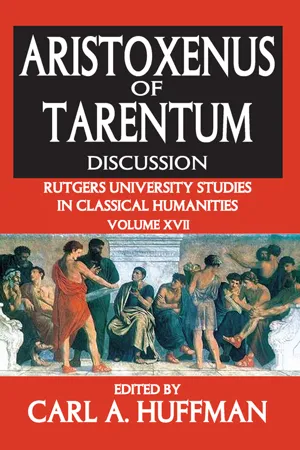
Aristoxenus of Tarentum was reported to have been bitterly disappointed when Theophrastus was chosen instead of him to succeed Aristotle as the head of the Peripatetic School. He had a truly phenomenal output of some 453 volumes, most of which survive only in fragments. He was the most famous music theorist in antiquity and came to be referred to simply as "the musician." In addition, he was a founder of Greek biography and wrote the life histories of Pythagoras, Archytas, Socrates, and Plato among others. This volume includes eleven selections, which are almost evenly divided between his work in music theory and biography. There is a chapter on his general biographical method as well as chapters on his specific treatments of the Pythagoreans, Socrates, and Plato. There are chapters evaluating the extent to which Aristoxenus was a historian of music, his account of music therapy, his views on musical "character," the use of instruments and empiricism in his harmonic theory, and his relation to the "Neoclassical" Greek composers of the fourth century. This volume includes: "Did Aristoxenus Write Musical History?, " Andrew Barker; "Instruments and Empiricism in Aristoxenus' Elementa harmonica," David Creese; "Aristoxenus and Musical Ethos," Eleonora Rocconi; "Aristoxenus and Music Therapy: Fr. 26 Wehrli Within the Tradition on Music and Catharsis," Antonella Provenza; "Aristoxenus and the "Neoclassicists," Timothy Power; "Apollonius on Theophrastus on Aristoxenus," William W. Fortenbaugh; "Aristoxenus' Biographical Method," Stefan Schorn; "Aristoxenus and the Pythagoreans," Leonid Zhmud; "Aristoxenus' Life of Socrates," Carl A. Huffman; "Aristoxenus' Life of Plato," John Dillon; and "Aristoxenus and the Early Academy," Andrew Barker. Spanning close to three full decades, Transaction's Rutgers University Studies in Classical Humanities Series continues to pioneer in the field of classical studies.
Information
Table of contents
- Cover
- Half Title
- Title Page
- Copyright Page
- Table of Contents
- Preface
- Contributors
- Remembering Robert William Sharples
- 1 Did Aristoxenus Write Musical History?
- 2 Instruments and Empiricism in Aristoxenus’
- 3 Aristoxenus and Musical Ēthos
- 4 Aristoxenus and Music Therapy: Fr. 26 Wehrli within the Tradition on Music and Catharsis
- 5 Aristoxenus and the “Neoclassicists”
- 6 Apollonius on Theophrastus on Aristoxenus
- 7 Aristoxenus’ Biographical Method
- 8 Aristoxenus and the Pythagoreans
- 9 Aristoxenus’ Life of Socrates
- 10 Aristoxenus’ Life of Plato
- 11 Aristoxenus and the Early Academy
- Frequently Used Abbreviations
- Works Cited
- Index of Ancient Sources
- General Index
Trusted by 375,005 students
Access to over 1.5 million titles for a fair monthly price.
Study more efficiently using our study tools.
Frequently asked questions
Yes, you can cancel anytime from the Subscription tab in your account settings on the Perlego website. Your subscription will stay active until the end of your current billing period. Learn how to cancel your subscription
No, books cannot be downloaded as external files, such as PDFs, for use outside of Perlego. However, you can download books within the Perlego app for offline reading on mobile or tablet. Learn how to download books offline
Perlego offers two plans: Essential and Complete
- Essential is ideal for learners and professionals who enjoy exploring a wide range of subjects. Access the Essential Library with 800,000+ trusted titles and best-sellers across business, personal growth, and the humanities. Includes unlimited reading time and Standard Read Aloud voice.
- Complete: Perfect for advanced learners and researchers needing full, unrestricted access. Unlock 1.5M+ books across hundreds of subjects, including academic and specialized titles. The Complete Plan also includes advanced features like Premium Read Aloud and Research Assistant.
We are an online textbook subscription service, where you can get access to an entire online library for less than the price of a single book per month. With over 1.5 million books across 990+ topics, we’ve got you covered! Learn about our mission
Look out for the read-aloud symbol on your next book to see if you can listen to it. The read-aloud tool reads text aloud for you, highlighting the text as it is being read. You can pause it, speed it up and slow it down. Learn more about Read Aloud
Yes! You can use the Perlego app on both iOS and Android devices to read anytime, anywhere — even offline. Perfect for commutes or when you’re on the go.
Please note we cannot support devices running on iOS 13 and Android 7 or earlier. Learn more about using the app
Please note we cannot support devices running on iOS 13 and Android 7 or earlier. Learn more about using the app
Yes, you can access Aristoxenus of Tarentum by Carl Huffman in PDF and/or ePUB format, as well as other popular books in Philosophy & Ancient & Classical Philosophy. We have over 1.5 million books available in our catalogue for you to explore.