- 212 pages
- English
- ePUB (mobile friendly)
- Available on iOS & Android
eBook - ePub
On Multiple Selves
About this book
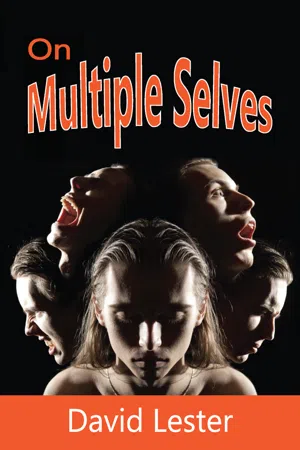
On Multiple Selves refutes the idea that a human being has a single unified self. Instead, David Lester argues, the mind is made up of multiple selves, and this is a normal psychological phenomenon. Lester expands on his earlier work on the phenomenon, illuminating how a "multiple-self theory of the mind" is critically necessary to understanding human behavior. Most of us are aware that we have multiple selves. We adopt different "facade selves" depending on whom we are with. Lester argues that contrary to the popular psychological term, "false self," these presentations of self are all part of us, not false; they simply cover layers of identity. He asserts that at any given moment in time, one or another of our subselves is in control and determines how we think and act. Lester covers situations that may encourage the development of multiple selves, ranging from post-traumatic stress resulting from combat to bilinguals who speak two (or more) languages fluently. Lester's views of multiple selves will resonate with readers' individual subjective experience. On Multiple Selves is an essential read for psychologists, philosophers, and social scientists and will fascinate general readers as well.
Information
1
A Multiple Self Theory of the Mind
A perusal of most textbooks designed for courses on theories of personality reveals the influence of two themes. The first is that many psychologists believe that human behavior is determined in part, and some believe completely, by stimuli in the environment. This is evident from the inclusion of a chapter on Skinner’s learning theory, which may be appropriately described as a theory of no mind. Textbooks also usually present the ideas of Walter Mischel (1968), who argued that people behave differently because of the different situations in which they find themselves and because of their different histories of learning. Mischel later modified this extreme view, but its influence persists today.
The second is the notion that humans have a single self. Some theorists argue that this is always the case, while others argue that integrating the various components of the mind into a single self is a task for the second half of life. This view has been argued most forcefully by Baumeister (1998), who stated: “The multiplicity of selfhood is a metaphor. The unity of selfhood is a defining fact” (p. 682). Baumeister presented no facts to back up his assertion, so it could just as appropriately be asserted that the unity of the self is a metaphor whereas the multiplicity of the self is a fact. Proulx and Chandler (2009) noted that philosophers from Hobbes and Locke to Kierkegaard and Camus have argued for a single unified self, best summarized by Flanagan (1996, p. 52) as the one self per customer rule.
A contrasting view, that the mind is made of a multiplicity of selves, was stated most clearly by Andras Angyal (1965) whose theory of the mind is, unfortunately, rarely mentioned in personality textbooks. (www.panarchy.org/angyal/personality.html) Although a holistic theorist, Angyal proposed that the mind is made up of subsystems which interact, resulting in setting and shifting set, as one after another subsystem takes over control of the mind, and which sometimes conflict, resulting in symptoms of pressure, intrusion, and invasion. Angyal’s presentation of his theory remained abstract, but later theorists provided illustrations of Angyal’s ideas without, however, acknowledging Angyal’s contribution. For example, Eric Berne (1961) proposed the existence of ego states (Parent, Adult, and Child) that control the mind at different times (that is, each assumes executive power temporarily) and that come into conflict (leading to contamination, a situation that resembles Angyal’s concept of intrusion).
The theory that mind is made up of multiple selves has been proposed most forcefully in recent years by John Rowan (1990: www.JohnRowan.org.uk) and myself (Lester 2010: www.drdavidlester.net). Rowan prefers to use the term subpersonalities, whereas I use the term subselves or multiple selves. My theory is the most formal presentation, and I laid out my theory in ten postulates and fifty corollaries, presented later in this chapter.
What is interesting is the role that serendipity plays in the progress that each of us makes in our scholarly work. Since publishing my version of the multiple self theory of the mind, I have come across others who have had similar ideas and commentators who describe multiple selves in their discussion of human behavior. My goal in the present book is to assume that the reader has read (or will read) the formal presentation of the theory (Lester 2010) and here present the work of others who have proposed a similar idea and some interesting applications of a multiple self theory of the mind. In order to help readers understand the formal theory, a summary of my theory is presented below.
A Subself Theory of Personality1
Accordingly it is not surprising that some people have great resistance to seeing their personality as other than one monolithic coherent unit. Something inside them resists the awareness that their personality is made up of many different parts—as if to admit such a breakdown would cause the breaking down into non-being of their identity itself. (Vargiu 1974, p. 53)
Many of the major theorists of personality have proposed that the mind is made up of many subselves. For example, Eric Berne (1961) talked of ego states, Carl Jung (Progoff, 1973) of complexes, Abraham Maslow (1970) of syndromes, Gordon Allport (1961) of traits, Henry Murray (1959) of themata, and Andras Angyal (1965) of subsystems. However, despite this agreement on the usefulness of the concept of the subself, very little theoretical discussion has appeared using this concept. The present section explores the past use of the concept and proposes postulates and corollaries for a formal subself theory of the mind.
Other scholars interested in this topic have taken a cognitive approach to the multiple self (e.g., Higgins, Klein, & Strauman, 1985) or focused on scales to measure aspects of self-complexity (e.g., Campbell, Trapnell, Heine, Katz, Lavallee, & Lehman, 1996), and they seek to ground their writings in the earlier ideas of William James (1890) and George Mead (1934). The present paper, however, is grounded in the major theories of personality which are usually ignored by these other approaches.
It should be noted that many writers appear to be talking of the structure or the architecture of the personality or the mind, but close examination indicates that they are not. For example, Cervone (2005) entitled his article “Personality Architecture,” but his examples include the five-factor model (McRae & Costa, 1999). The five-factor model simply proposes five basic dimensions (or traits) of personality. Individuals may have profiles on these five factors, much as they can on the MMPI, but there is no organization or structure. In contrast, Eric Berne’s ego states have structure and interactive properties. It is this type of “architecture” that the present theory explores.
Subselves in the Major Theories of Personality
Carl Jung
Jung’s term for the totality of psychological processes was the psyche. Jung proposed that complexes exist within the psyche, autonomous partial systems that are organizations of psychic contents. Complexes are subsystems of the whole. (The complexes in the collective unconscious are the archetypes.) In particular, Jung identified several complexes that he felt were of particular use for a discussion of human behavior.
The ego consists of our conscious psychic contents and contains percepts, memories, thoughts, desires, and feelings. The persona is a subsystem within the ego and is the self that we present to others, the mask we wear in daily intercourse with others. It consists of the roles we play in our lives.
The shadow consists of those psychic contents in the personal (and to a lesser extent the collective) unconscious that are in opposition to the contents of the ego. These contents are less developed and less differentiated than the contents of the ego, but their presence is made apparent to the ego whenever the boundaries between the systems break down and the contents from the shadow intrude into the ego.
In addition, the subsystem in the collective unconscious that is in opposition to the persona subsystem of the ego is called the anima in males and the animus in females. By modern standards, Jung erred here in identifying the core of human behavior in terms of the sexual stereotypes of his day. Jung described males as “masculine” and females as “feminine,” in what today would be considered a gender-biased fashion. For example, Jung described the unconscious animus of females as rational and discriminating, showing that Jung believed females to have an irrational and emotional conscious ego. Today, there is no need to accept all of Jung’s ideas wholesale. The anima and animus can be conceptualized more appropriately as the subsystems of the shadow that are in opposition to the persona, and their content can vary depending upon the psychic contents of the particular persona. (Perhaps these should both be called “animum,” using the Latin neuter gender?)
Eric Berne
Whereas psychoanalytic theory usually uses the terms id, ego, and superego to characterize particular wishes, Eric Berne (1961) followed Paul Federn (1952) and Edoardo Weiss (1950) in defining ego states. An ego state is a coherent system of feelings and behavior patterns. Complete ego states can be retained in the memory permanently. The defense mechanisms can operate upon complete ego states, and, for example, ego states can be repressed as a whole. Ego states from earlier years remain preserved in a latent state, with the potential to be resurrected (recathected in Berne’s terminology).
The Parent ego state is a judgmental ego state, but in an imitative way (primarily, of course, by imitating the person’s parents). It seeks to enforce borrowed standards. The Parent ego state parallels the superego in psychoanalytic theory. The Adult ego state is concerned with transforming stimuli into information and then processing that information. It corresponds to the ego in psychoanalytic theory. The Child ego state reacts impulsively, using prelogical thinking and poorly differentiated and distorted perception. It corresponds to the id in psychoanalytic theory. However, although this simple correspondence is worth noting, the id, ego, and superego are sets of wishes, whereas the Child, Adult, and Parent are integrated and coherent ego states. People are always in some ego state, and they shift from one to another (a process which Angyal [1941] called setting and shifting set).
Abraham Maslow
Abraham Maslow (1970), an important influence in the development of humanistic psychology, urged a holistic approach to the study of personality. Behavior, he argued, is an expression or creation of the whole personality, which in turn is the result of everything that has ever happened to it. Personality is composed of syndromes— that is, structured, organized, and integrated complexes of diverse specificities (behavior, thoughts, impulses, perceptions, and so on) that have a common unity. The total personality and the syndromes tend to be well-organized, and they resist change, instead seeking to re-establish themselves after forced changes and to change as a whole because of tendencies to seek internal consistency. Behavior is an expression of the whole integrated personality (and thus, an expression of all of the personality syndromes).
Other Proposals for Subselves
Decision Theorists
In discussing the phenomenon of self-deception, some decision theorists have proposed a model of the mind like “the older medieval city, with relatively autonomous neighborhoods, linked by small lanes that change their names half way across their paths, a city that is a very loose confederation of neighborhoods of quite different kinds, each with its distinctive internal organization…” (Rorty, 1985, p. 116). Rorty views the self as a loose configuration of habits—habits of thoughts, perception, motivation, and action, acquired at different stages, in the service of different goals. Margolis (1982) proposed that the person can be viewed as two selves, one concerned with selfish benefits and the other with group benefits.
Lynne (1999) applied Eric Berne’s proposal of three ego states (Parent, Adult, and Child) to economic decision-making, where the Adult mediates between the competing self-interests and we-interests. Steedman and Krause (1985) talked of a multifaceted individual having different points of view, while others (de Sousa, 1976; Dennett, 1978; Hofstadter & Dennett, 1981; Lycan, 1981) have argued in favor of picturing the self as a hierarchical structure of ever-simpler homunculi. Finally, Elster (1985) proposed what may be a fitting analogy—the mind as a computer with different programs (software) being loaded and taking control at different times, to which might be added a further analogy for subsubselves, that is, different routines of the software being called up, for example, the crosstabs routine of SPSS.
W. R. D. Fairbairn
Fairbairn (1954) is one of the group of psychoanalysts who have become known as object-relations theorists. Fairbairn proposed that the infant, when faced with a frustrating parent, tries to control this aspect of his environment. In his mind, the infant splits the object into its good and bad aspects and introjects or internalizes the bad aspect. This makes the environment good and the infant bad. Even in extreme cases, abused children see themselves as bad and their parents as good. Fairbairn proposed that these internalized aspects, or objects, become dynamic structures which are capable of acting as independent agents within the mind. These structures are located in the ego, and the situation is as if there were a multiplicity of egos at war with one another. Fairbairn called this the endopsychic situation.
Fairbairn described the libidinal ego, those parts of the mind that feel needy, attacked, and persecuted; the internal saboteur (the antilibidinal, or attacking, ego), which is aggressive and attacking, especially toward the libidinal ego and which resembles the classic Freudian superego; and the central ego, which tries to repress these subsidiary egos. The goal of psychotherapy is to make the bad objects conscious so that their emotional power can be dissolved.
Georges Gurdjieff
Ouspensky (1949) has Described the Teachings of Gurdjieff, an Armenian Mystic, Whom He Met in the Early Part of the Twentieth Century in Russia. Many of Gurdjieff’s Ideas Concerned the Structure of Personality, and He Saw People as Containing Many Different People.
We think that if a man is called Ivan he is always Ivan. Nothing of the kind. Now he is Ivan, in another minute Peter, and a minute later he is Nicholas, Sergius, Matthew, Simon. And all of you think he is Ivan. You know that Ivan cannot do a certain thing. He cannot tell a lie for instance. Then you find he has told a lie and you a...
Table of contents
- Cover
- Half Title
- Title Page
- Copyright Page
- Table of Contents
- Preface
- Prologue: What Is the Self?
- 1 A Multiple Self Theory of the Mind
- 2 Robert Lifton’s Concept of the Protean Self
- 3 The Metaphor of the Greek Gods
- 4 Multiple Selves versus Meta-Preferences
- 5 Mendlovic’s Psychoanalytic Approach to the Multiple Self
- 6 Rita Carter and Multiplicity
- 7 Gestalt Therapy and the Multiple Self
- 8 A Plethora of Similar Ideas
- 9 Bilinguals and the Multiple Self
- 10 Shifting
- 11 Psychotherapists and the Multiple Self
- 12 The Multiple Self in Fairy Tales
- 13 Economists’ Views of the Multiple Self
- 14 What is Not a Multiple Self
- 15 Empirical Studies of the Multiple Self
- 16 Conclusions and Final Thoughts
- References
- Senior Author Index
- Subject Index
Trusted by 375,005 students
Access to over 1.5 million titles for a fair monthly price.
Study more efficiently using our study tools.
Frequently asked questions
Yes, you can cancel anytime from the Subscription tab in your account settings on the Perlego website. Your subscription will stay active until the end of your current billing period. Learn how to cancel your subscription
No, books cannot be downloaded as external files, such as PDFs, for use outside of Perlego. However, you can download books within the Perlego app for offline reading on mobile or tablet. Learn how to download books offline
Perlego offers two plans: Essential and Complete
- Essential is ideal for learners and professionals who enjoy exploring a wide range of subjects. Access the Essential Library with 800,000+ trusted titles and best-sellers across business, personal growth, and the humanities. Includes unlimited reading time and Standard Read Aloud voice.
- Complete: Perfect for advanced learners and researchers needing full, unrestricted access. Unlock 1.5M+ books across hundreds of subjects, including academic and specialized titles. The Complete Plan also includes advanced features like Premium Read Aloud and Research Assistant.
We are an online textbook subscription service, where you can get access to an entire online library for less than the price of a single book per month. With over 1.5 million books across 990+ topics, we’ve got you covered! Learn about our mission
Look out for the read-aloud symbol on your next book to see if you can listen to it. The read-aloud tool reads text aloud for you, highlighting the text as it is being read. You can pause it, speed it up and slow it down. Learn more about Read Aloud
Yes! You can use the Perlego app on both iOS and Android devices to read anytime, anywhere — even offline. Perfect for commutes or when you’re on the go.
Please note we cannot support devices running on iOS 13 and Android 7 or earlier. Learn more about using the app
Please note we cannot support devices running on iOS 13 and Android 7 or earlier. Learn more about using the app
Yes, you can access On Multiple Selves by David Lester in PDF and/or ePUB format, as well as other popular books in Psychology & Cognitive Psychology & Cognition. We have over 1.5 million books available in our catalogue for you to explore.