- 356 pages
- English
- ePUB (mobile friendly)
- Available on iOS & Android
eBook - ePub
About this book
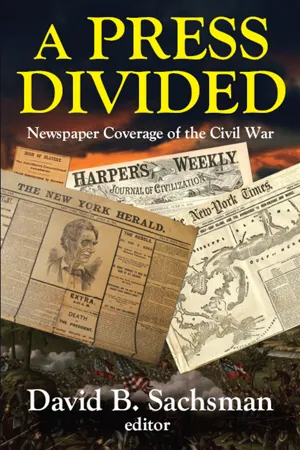
A Press Divided provides new insights regarding the sharp political divisions that existed among the newspapers of the Civil War era. These newspapers were divided between North and South, and also divided within the North and South. These divisions reflected and exacerbated the conflicts in political thought that caused the Civil War and the political and ideological battles within the Union and the Confederacy about how to pursue the war. In the North, dissenting voices alarmed the Lincoln administration to such a degree that draconian measures were taken to suppress dissenting newspapers and editors, while in the South, the Confederate government held to its fundamental belief in freedom of speech and was more tolerant of political attacks in the press. This volume consists of eighteen chapters on subjects including newspaper coverage of the rise of Lincoln, press reports on George Armstrong Custer, Confederate women war correspondents, Civil War photojournalists, newspaper coverage of the Emancipation Proclamation, and the suppression of the dissident press. This book tells the story of a divided press before and during the Civil War, discussing the roles played by newspapers in splitting the nation, newspaper coverage of the war, and the responses by the Union and Confederate administrations to press criticism.
Part I
Splitting a Nation
Newspaper Coverage of the Rise of Lincoln in 1860: Cooper Union, the Republican Convention, and the Election
In 1860, Abraham Lincoln experienced one of the most rapid transformations of a political figure in American history. Lincoln went from being a relatively unknown attorney from Illinois to sixteenth president of the United States. Before 1860, Lincoln had achieved little that would have suggested he was destined to become the nation’s chief executive. He had been a congressman for a single term in the 1840s and had run unsuccessfully for the US Senate against Stephen A. Douglas in 1858. Even when he started becoming popular in Illinois in the fall of 1859, Lincoln said: “I must, in candor, say I do not think myself fit for the Presidency.”1 However, 1860 was a tumultuous year. In nine months time, between his February 26 speech at Cooper Union in New York and Election Day on November 6, this self-educated Western man, with no pedigree to speak of, would become president. This unlikely event was due partly to a fractured Democratic Party that quite literally committed political suicide by splitting into rival camps supporting three different candidates: Stephen A. Douglas, John C. Breckinridge, and John Bell.
Lincoln’s ascent was the story of that year, which would end ominously with South Carolina seceding in December. The newspapers of the nation covered his climb to the presidency, and this study looks at how a political press covered Lincoln in 1860. In particular, it looks at news coverage of three events, the Cooper Union lecture in February, the Republican convention in Chicago in May, and the general election in November, in fifteen newspapers located in twelve different states. The attempt was to include both Democratic and Republican newspapers and to have representation from large cities, smaller cities, the Southern press, the Midwest press, and newspapers from the border states.2
In October 1859, James A. Briggs invited Lincoln to speak at the Plymouth Congregational Church in Brooklyn, New York. The church was the pastoral home of Henry Ward Beecher, an abolitionist. Briggs said that the honorarium would be $200. Somehow the negotiations did not work out, and new plans were made. Instead of Briggs, the Young Men’s Central Republican Union of New York became the sponsor of Lincoln’s talk. A date of February 27, 1860, was agreed upon, and Lincoln insisted on giving a political speech.3 The lecture was moved from the Brooklyn church to the Cooper Union Institute in Manhattan.
In the speech, Lincoln wanted to deny the radical characterization used against the Republicans by critics in the Democratic Party. Lincoln said of the Democrats: “You say we are sectional. We deny it.”4 Keying on a reference in a speech that Illinois Senator Stephen A. Douglas had given in Columbus, Ohio, in the fall of 1859, Lincoln looked at the thirty-nine signers of the Constitution on the issue of slavery in the territories.5 Twenty-one favored Congress having control of slavery in these regions. Therefore, Lincoln argued, the Republicans were more in line with the founders than they were made out to be by Democrats. Lincoln closed the speech by saying: “Neither let us be slandered from our duty by false accusations against us, nor frightened from it by menaces of destruction to the Government nor of dungeons to ourselves.”6
Although historians have pointed to the Cooper Union speech as a turning point for Lincoln, coverage in the press was relatively limited. The pro-Republican newspapers in New York provided the most extensive coverage, and Lincoln could always count on the Chicago Press & Tribune to cover any of his political exploits. Most Democratic newspapers North and South completely ignored the Cooper Union lecture. The rest of the newspapers noted it in passing. Indeed, a sizable number of the newspapers examined in this study put more emphasis on a speech that same day by Senator William H. Seward of New York before the Senate in Washington, DC. In February 1860, Seward was the front-runner for the Republican nomination for president and would be Lincoln’s closest competitor at the party convention in Chicago in May.
The New-York Tribune called the Cooper Union speech “one of the happiest and most convincing ever made in this city.”7 The Tribune editors said: “No man ever before made such an impression on the first appeal to a New York audience.” Accompanying the editorial was what the Tribune claimed was a full and accurate transcription of the speech. Indeed, Lincoln was allowed to go over the transcript before it was printed.8 So impressed were the Tribune editors that they promised to reprint the speech in pamphlet form for the campaign season to come.
The Chicago Press & Tribune called the lecture a “striking accomplishment” and that Lincoln’s convictions as presented in the talk came from a “pure, unselfish, honest, patriotic heart.”9 The Chicago newspaper said that Lincoln ably enunciated Republican principles and compared him favorably to “the model statesmen of our Revolutionary era.” The Press & Tribune also ran editorials from Republican newspapers in New York and reprinted the New-York Tribune’s transcript of the talk.
The pro-Republican Cincinnati Daily Commercial put the lecture on the front page of its March 2 edition. M.D. Potter, the Commercial publisher, and his editors praised Lincoln for his “systematic array of clearly stated facts.”10 Richard Smith’s Cincinnati Daily Gazette, although firmly in the Republican camp, made no mention of the Cooper Union lecture.
In South Bend, Indiana, the St. Joseph Valley Register did not carry a Cooper Union speech story. However, early in March, Schuyler Colfax’s newspaper did reprint a biography of Lincoln that had first appeared in the New-York Tribune, edited by Colfax’s friend Horace Greeley. The Register said that many of Lincoln’s friends were urging him to run for the Republican nomination. Its report said: “That movement seems to be growing in strength and popular favor.”11 At this point, Colfax favored Edward Bates of Missouri. The Springfield Republican in Massachusetts had no story on Lincoln’s New York lecture. Rather, Samuel Bowles’s newspaper had an excerpt from Seward’s Senate speech. Bowles commented that Massachusetts Republicans favored Seward for the presidential nomination, “if there is reasonable assurance of success with his name.”12
Typical of the Democratic newspapers in the North, the Cleveland Plain Dealer and Detroit Free Press made no mention of Lincoln’s speech. The Plain Dealer editors called Seward’s speech in the Senate “great” and commended him for not ranting and raving “like most Abolition leaders.”13 The Free Press used the occasion of Seward’s speech to take a swipe at Hinton Helper’s book The Impending Crisis, noting that Helper called slave owners the basest of criminals. Wilbur F. Storey, the editor, wrote that John Brown and his followers had read Helper’s book, and the journalist wondered if Seward in recommending its reading “countenanced the invasion of Virginia” by Brown.14
In the newspapers in the South, the Cooper Union speech received scant attention at best. There is no mention of the speech in the Augusta Chronicle & Sentinel, Atlanta Daily Intelligencer, or Columbus (GA) Enquirer. On the other hand, the Augusta newspaper did have an editorial on March 1 about a shoemakers’ strike in Boston. “Our Northern friends are just now enjoying a foretaste of worse things to come,” the Georgia newspaper observed.15 Having free labor also meant having to deal with labor negotiations—something the Southern slaveholders avoided in their economic system.
Likewise, the press of the border states generally ignored Lincoln’s New York talk. The Baltimore Sun had only a single sentence in its February 28 edition: “Hon. A. Lincoln of Ill., addressed a republican meeting at the Cooper Institute last evening.”16 There was no commentary, no attempt to run a transcript—which was highly unusual for a penny paper of the Sun’s quality, since it prided itself in comprehensive coverage of national politics as well as commercial and local news.
The Louisville Daily Courier made no mention of the speech. Even the pro-Republican Daily Missouri Democrat in St. Louis did not have anything about the speech. Likewise, there was no mention of the speech in the pro-Democratic Daily Missouri Republican.
In only its second national nominating convention, the Republicans convened at the recently built Wigwam in Chicago on May 16–18. The new facility, which looked like a large barn, could hold approximately 10,000 people in a Western city of more than 100,000. The primary candidates were William H. Seward of New York, Salmon P. Chase of Ohio, Simon Cameron of Pennsylvania, Edward Bates of Missouri, and Lincoln. Seward was the favorite and led after the first two rounds of balloting on Friday, May 18. However, after the second ballot, Lincoln only trailed Seward by three and one-half votes. On the third ballot, Lincoln, with a large and loud following in the Wigwam, gained victory, in large part thanks to the work of Press & Tribune editor Joseph Medill. A former resident of Ohio, Medill worked the Buckeye State contingent and got votes slated for Chase converted to Lincoln.
The Chicago Press & Tribune had extensive coverage of the Republican Convention in May 1860. The narration of each day’s proceedings covered four columns on the front page and ran into the inside of the newspaper. On May 16, the newspaper had an editorial titled “Abraham Lincoln, the Winning Man.” That set the tone for the hometown Republican newspaper’s coverage of the convention. The journalistic dignitaries in town included Horace Greeley of the New-York Tribune, Henry J. Raymond of the New York Times, Thurlow Weed of the Albany (NY) Evening Journal, and Murat Halstead of the Cincinnati Daily Commercial.
On May 17, the Press & Tribune opened the paper with this stacked headline: “The President of the United States/ABRAHAM LINCOLN/Subject to the decision of the Chicago Convention.”17 After Lincoln received the nomination, the newspaper wrote that the Springfield attorney was the leader of the “Friends of Freedom” and that the “age of purity returns.”18 Lincoln would guarantee a return to the “sterling honesty and Democratic simplicity which marked the Administrations of Jefferson, Madison, Adams and Jackson.”19 The editors said Lincoln would “command the respect of the North and the South,” but if a dis-union effort came after he were elec...
Table of contents
- Cover
- Half Title
- Title Page
- Copyright Page
- Table of Contents
- Preface
- Introduction
- Part I: Splitting a Nation
- Part II: Covering the Conflict
- Part III: Dissension and Suppression North and South
- About the Editor
- List of Contributors
- Illustrations
- Index
Trusted by 375,005 students
Access to over 1.5 million titles for a fair monthly price.
Study more efficiently using our study tools.
Frequently asked questions
Yes, you can cancel anytime from the Subscription tab in your account settings on the Perlego website. Your subscription will stay active until the end of your current billing period. Learn how to cancel your subscription
No, books cannot be downloaded as external files, such as PDFs, for use outside of Perlego. However, you can download books within the Perlego app for offline reading on mobile or tablet. Learn how to download books offline
Perlego offers two plans: Essential and Complete
- Essential is ideal for learners and professionals who enjoy exploring a wide range of subjects. Access the Essential Library with 800,000+ trusted titles and best-sellers across business, personal growth, and the humanities. Includes unlimited reading time and Standard Read Aloud voice.
- Complete: Perfect for advanced learners and researchers needing full, unrestricted access. Unlock 1.5M+ books across hundreds of subjects, including academic and specialized titles. The Complete Plan also includes advanced features like Premium Read Aloud and Research Assistant.
We are an online textbook subscription service, where you can get access to an entire online library for less than the price of a single book per month. With over 1.5 million books across 990+ topics, we’ve got you covered! Learn about our mission
Look out for the read-aloud symbol on your next book to see if you can listen to it. The read-aloud tool reads text aloud for you, highlighting the text as it is being read. You can pause it, speed it up and slow it down. Learn more about Read Aloud
Yes! You can use the Perlego app on both iOS and Android devices to read anytime, anywhere — even offline. Perfect for commutes or when you’re on the go.
Please note we cannot support devices running on iOS 13 and Android 7 or earlier. Learn more about using the app
Please note we cannot support devices running on iOS 13 and Android 7 or earlier. Learn more about using the app
Yes, you can access A Press Divided by David B. Sachsman in PDF and/or ePUB format, as well as other popular books in History & American Civil War History. We have over 1.5 million books available in our catalogue for you to explore.