- 260 pages
- English
- ePUB (mobile friendly)
- Available on iOS & Android
eBook - ePub
About this book
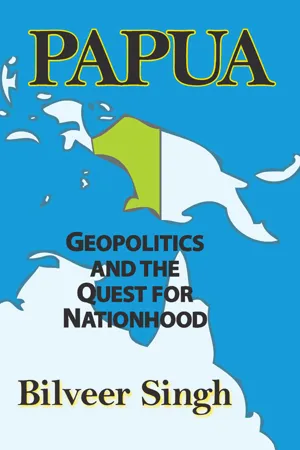
The Papuan conflict has been on the international radar screen since Indonesia became an independent state in 1945. Since the surrender of the territory of Papua to Indonesia in 1962, a low-intensity military conflict has been building. Most Papuans believed that their right to self-determination was sacrificed on the altar of geopolitics. Later, when East Timor seceded peacefully from Indonesia, Papuans expected the same right. When this did not happen, the conflict intensified. In this pivotal work, Bilveer Singh examines the history of the Papuan struggle, and approaches to conflict resolution through the framework of its geopolitical implications. Asserting that the Papuans were treated unjustly by Indonesia and the international community, it is not surprising that many have come down squarely on the side of Papuan independence as a way out of the imbroglio. While to some extent the Papuan's case cannot be denied, definite political and strategic realities should not be ignored. Unfortunately for the Papuans, their territory has immense geopolitical, geostrategic, and economic significance - not only for Indonesia, but also for others such as the United States, China, Australia, and a number of European countries. Papua is wealthy, under-populated and backward in terms of human resource development. Its future as a distinct entity is in real danger as the Papuans are becoming the minority in their own homeland. Due to the asymmetry of power, the Papuans' struggle has not made a breakthrough that would force Indonesia to rethink the future of the territory in any fundamental way. In order to unravel the dynamics involving Papuan separatism, this study describes the Papuan political landscape. Singh explains what makes Papua unique, and how its makeup has affected the territory's political dynamics. He analyzes the emergence of Papua as a geopolitical trophy, calling into question the degree to which Papuan nationalism has crystallized. Finally, he questions whether Papua is emerging as a regional flashpoint, and, in view of its geopolitical importance, the various options available. "Papua: Geopolitics and the Quest for Nationhood" will be of interest to scholars of international relations, comparative politics of Indonesia and the Asia-Pacific, and policymaking.
Information
1
Papua: A Political Portrait
The emergence of nations, states and nation-states requires the presence of many variables and attributes. Depending on one’s history, geography, ethnic-religious makeup, strategic underpinnings, and relations with other political entities, different factors will interplay differently in bringing about a sense of nationhood and statehood. In order to understand the political anatomy of Papua and its claimed sense of nationhood, it is first vital to understand and answer the question, what is Indonesia?
A “Construct” Called Indonesia
Historically, the territory that is known as the Republic of Indonesia today was once the home of various large and small kingdoms with a number of empires that dominated the region. Prior to the emergence of European domination in the region, Indian, Chinese, and Arab traders were extremely influential in the region. The Indians were among the earliest migrants to reach the islands of Sumatra and Java. The adoption of various Indian scripts, including Pallawa and Devanagari, as inscribed on tombstones and unearthed copper wares bore testimony of this relationship. Traditionally, the Indians referred to Sumatra as Swarm Dwipa and Java as Java Dwipa, “island of gold” and “island of rice” respectively. Religious, cultural, and trading relations are believed to have existed between the Sriwijaya Kingdom in Sumatra and the Nalandas in southern India. From the first to the seventh centuries AD, Indian settlers are believed to have migrated in great numbers with Indian cultural practices and religion spreading peacefully throughout the archipelago. As a result of increasing “Indianization,” many Hindu and Buddhist kingdoms emerged in the region lasting right up to sixteenth century AD. Indian cultural and religious practices were merged and syncretized with local customs and traditions. For that reason this period is often referred to as the Hindu-Indonesian Era. In addition to Indian systems of government and administration, Indian religious practices and literary works, including the Vedas, Mahabharata, and Ramayana were adopted, with the Wayang Kulit or shadow play continuing to this day, especially in Java. The main Hindu-Buddhist kingdoms that ruled parts of present-day Indonesia were Sriwijaya, Sailendra, Singasari, Mataram, Kediri, and Majapahit.
From the fourteenth century onwards, Islamic kingdoms began to dominate the archipelago, with present-day Indonesia directly tracing its social-cultural and religious character from that period. Muslim traders began arriving in the archipelago from Gujarat, India, the Middle East, China, and Persia from the thirteenth century onwards. Concentrating on the northern coastal regions of Java such as Demak, Banten, Cirebon, and Gresik, these were among the first areas to be exposed to Islamic influences. Large-scale conversion occurred when the political elites, upper classes, and eventually the rulers embraced Islam. The once largely Hindu-Buddhist archipelago became predominantly Islamic. The downfall of the Majapahit Empire (1293–1520) expedited the spread of Islam throughout the archipelago with Sumatra, especially Aceh and Sulawesi and the surrounding islands, including Tidore and Ternate, adopting the new faith. Islamic dominance of the archipelago lasted until the European powers bent of colonization entered the region.
In search of spices, the Portuguese became the first Europeans to enter the region. In the coming decades, the Spanish and Dutch followed suit. Following their conquest of Malacca, the Portuguese arrived in Indonesia in 1511 and succeeded in gaining control of the spice trade in the Moluccas. The Spanish had also established trading posts in various parts of eastern Indonesia. Though somewhat late, the entry of the Dutch into the region was to have a lasting impact, as they eventually marginalized the presence and influence of both the Portuguese and Spanish, and effectively dominated the archipelago. Motivated mainly by profit, the Verenigde Oostindische Compagnie, VOC or the Dutch East India Company, was established in 1602. Dutch warships accompanied their merchants to protect them from pirates and other kinds of attacks. By the time the Dutch landed in Indonesia, the Islamic Mataram Kingdom under the leadership of Sultan Agung was the most powerful. Following the seizure of Ambon in 1605 and Banda Island in 1623, the Dutch succeeded in monopolizing the spice trade in the region. Through a policy of “divide and rule,” the archipelago was gradually brought under Dutch control. Various rebellions and challenges, such as that of Sultan Hasanuddin and Prince Trunojoyo ...
Table of contents
- Cover
- Half Title
- Title Page
- Copyright Page
- Dedication
- Table of Contents
- List of Figures
- Preface
- Acknowledgements
- Abbreviations
- Introduction: The Papua Problematique
- 1. Papua: A Political Portrait
- 2. Papua as a Geopolitical Trophy, 1945–1962
- 3. Papua and Indonesia: The Ties that Do Not Bind, 1962–2007
- 4. Papuan Nationalism and the Struggle for Nationhood since 1998
- 5. The Geopolitical Implications of Papua’s Quest for Nationhood and the Road Ahead
- Appendix: West Irian Émigré Organizations Supporting Papuan Independence
- Selected Bibliography
- Index
Trusted by 375,005 students
Access to over 1.5 million titles for a fair monthly price.
Study more efficiently using our study tools.
Frequently asked questions
Yes, you can cancel anytime from the Subscription tab in your account settings on the Perlego website. Your subscription will stay active until the end of your current billing period. Learn how to cancel your subscription
No, books cannot be downloaded as external files, such as PDFs, for use outside of Perlego. However, you can download books within the Perlego app for offline reading on mobile or tablet. Learn how to download books offline
Perlego offers two plans: Essential and Complete
- Essential is ideal for learners and professionals who enjoy exploring a wide range of subjects. Access the Essential Library with 800,000+ trusted titles and best-sellers across business, personal growth, and the humanities. Includes unlimited reading time and Standard Read Aloud voice.
- Complete: Perfect for advanced learners and researchers needing full, unrestricted access. Unlock 1.5M+ books across hundreds of subjects, including academic and specialized titles. The Complete Plan also includes advanced features like Premium Read Aloud and Research Assistant.
We are an online textbook subscription service, where you can get access to an entire online library for less than the price of a single book per month. With over 1.5 million books across 990+ topics, we’ve got you covered! Learn about our mission
Look out for the read-aloud symbol on your next book to see if you can listen to it. The read-aloud tool reads text aloud for you, highlighting the text as it is being read. You can pause it, speed it up and slow it down. Learn more about Read Aloud
Yes! You can use the Perlego app on both iOS and Android devices to read anytime, anywhere — even offline. Perfect for commutes or when you’re on the go.
Please note we cannot support devices running on iOS 13 and Android 7 or earlier. Learn more about using the app
Please note we cannot support devices running on iOS 13 and Android 7 or earlier. Learn more about using the app
Yes, you can access Papua by Bilveer Singh in PDF and/or ePUB format, as well as other popular books in Politics & International Relations & Politics. We have over 1.5 million books available in our catalogue for you to explore.