- 220 pages
- English
- ePUB (mobile friendly)
- Available on iOS & Android
eBook - ePub
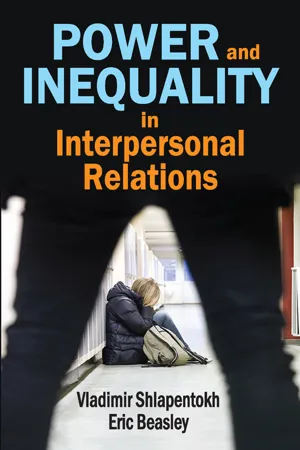
Power and Inequality in Interpersonal Relations
About this book
This book explores interpersonal situations in which weak or vulnerable people find themselves and the ways in which others help create, sustain, and eradicate such social dynamics. Vladimir Shlapentokh and Eric Beasley demonstrate that people can gain power over each other and then abuse this power because of unequal resource conditions. The authors define resources as the means necessary for satisfaction or achievement of needs or goals, such as wealth, physical strength, intellectual capacity and information, sexual attractiveness, and status. This volume is different from existing social science books on inequality and vulnerability, which address relations between people of different social positions, races, genders, ages, and places of residence confronting each other in political, economic, and cultural battles. This book focuses on people who become the victims of those whom they know personally-relatives, colleagues, neighbors. The authors argue that unequal resource distribution among members of social units is the main cause of conflict and ultimately creates situations where members of a social unit can abuse other members of the same unit.
Information
1
Weak People and Dependence on Others
BELLUM OMNIUM CONTRA OMNES
INSIDE EACH SOCIAL UNIT1
Since the eighteenth century, the enduring struggle between the Hobbesian and Lockean perspectives has taken place in the arena of political and economic development, through a lens calibrated to see society at the macro level (see Parsons 1977; Burger 1997).
The debates between the two theoretical perspectives mostly deal with the interactions between the government and its subjects, between rivals of social, economic, and/or political actors—such as the barons of the Middle Ages—or between contemporary multinational mega-corporations and their competitors and naysayers. In fact, Hobbes applied his famous formula “homo hominem lupus est,” which characterizes the menacing relationship between men in their most natural state almost exclusively to big politics. The conflicts among ordinary people inside social and political units—in the family, inside the feudal estate, in the city, and in the peasant community—were outside of Hobbes’s interests. Hobbes wrote nothing on either the issue of people’s security inside social units or the abuse of power between people who essentially belonged to the same social or political class.
Weak People as a Concept
In this project, we take on the task of analyzing the social condition of the special class of people whom we will name “weak people”—those who lack the resources to defend themselves against others within social units. Social scientists such as Zygmunt Bauman (2001) or Johnatan Litelle were inclined to use the term weakness in the same sense we do, whereas the American media and mainstream society opt for political correctness, using the label vulnerable people.
There are two radically different approaches to the definition of weak, or vulnerable, people. One of them, the “genetic” or “anthropological” approach, describes weak people as those who were born (or became) unable to survive in this world without the help of “strong” people who are entitled to command over these not-so-fortunate members of society. Another approach—we call it the “resource” view (this view most closely approximates the authors’ viewpoint)—sees weak people as the product of various circumstances that deprive them of certain resources, without which they become dependent on others and exposed to abuses of power in both the macro and micro worlds. The most renowned theorist of the first approach was, of course, Friedrich Nietzsche.
Nietzsche and his followers never gave a sociologically clear definition of “weak people using several other terms including the masses, slaves, crowds, or herds. These were all terms they used to delineate the object of their contempt. Nietzsche described them as making up the majority of the population. He asserted that they were pessimistic and cynical, and that, using their numerical majority, “the slaves” were able to convince “the masters” that their weakness was not chosen by them but imposed on them from the outside by “evil”. Nietzsche (2003) demanded the segregation of “healthy people the masters, from “sick people” because the healthy can confound themselves with the sick if they observed their morals. According to Nietzsche (1973), weak people used Christian morality, which was also invented by them, in order to impose the importance of humility, charity, pity, and equality on society. Nietzsche hated the state mostly because it usually became the instrument of the slaves. For the same reason, much of Nietzsche’s hatred of democracy lays in his conviction that, because of their numerical majority, weak people could force society and the state to serve their interests—so close to the heart of today’s Tea Party activists. Nietzsche (1999) preached the creation of a new aristocracy, consisting of supermen who would be totally different from “the crowd”.
The deeply antidemocratic and antiegalitarian spirit of Nietzsche was accepted by Josè Ortega y Gasset in his book The Rebellion of the Masses (1929). Ortega y Gasset insisted on illuminating the imposition of the values of the barbaric masses on everybody who tried to be excellent, individual, and original. Ortega y Gasset’s (1994) “mass man” took his convenient life for granted without being grateful to the creative people who provided it. Ortega y Gasset called these men who took without gratitude “spoilt children:” The masses, affirmed Ortega y Gasset (1994), imagined “their role [was] limited to demanding these benefits peremptorily, as if they were natural rights:” The author continued writing about “the sovereignty of the unqualified individual, the idea that democratic procedures [were] put at the service of the masses, who can satisfy their needs without thinking about the future” (13–14).
The famous hater of “weak people Ayn Rand, essentially repeated Ortega y Gasset. Rand (1966) argued that weak people can survive (tem-porarily) only by looting the goods created by others. In fact, the main pathos of Rand’s major books is an echo of this slogan in the form of the uncompromising condemnation of “unearned income one of the most frequently used terms in Atlas Shrugged and in many of the publications created in the iconic novel’s wake. Still, for the first time in the history of law, it was the Bolsheviks who introduced the concept of a societal “parasite”—much earlier than Ayn Rand, who was likely influenced by them (she was born in Russia and left the country in 1926)—and who severely persecuted those who did not earn their income.
Rand (1961) described everybody who did not have their own income, and/or who was not engaged in production, as the “bums, the loafers, the moochers we saw all around us” (119). This phrase was widely used by Rand’s heroes. Her supermen did not want to make the distinction between those who were unwilling and those who were unable to work (”what difference did that make to us?” exclaimed one of Rand’s heroes) (Rand 1961). The famous character John Galt, whom Rand assigned to express her views on the world, used speech that scared readers into believing that helping others would degrade society, destroy its moral compass, and make people vicious and envious. Galt proclaimed, with great pomposity, that it was highly immoral to enjoy anything that you did not earn. Cursing “sacrifices”, Galt made no distinction between healthy and sick people, between adults and children, between unemployed and employed (Rand 1961, 156, 161).
Contrary to the views described above, we do not equate “weak people” with the materially poor or only with those holding subordinate positions in a hierarchy. The main objects of this book are those weak people who reside inside social units: family, the office, school, the hospital, and the army. The typology of people as “weak” and “non-weak” does not coincide with traditional stratifications-based social criteria such as wealth, public status, or education, and is not based on ethnic, racial and cultural principles, even if it does overlap with them in some ways. While the traditional stratifications can be considered vertical, we will treat the stratifications based on weakness as horizontal.
As a matter of fact, there is a legion of weak people among the members of the highest strata of population. We find weak people among the very rich, among those with the highest social standing, and among those with the highest educations, as well as among people belonging to the dominant racial, ethnic, and cultural groups. But, of course, whatever criterion of stratification is used, weak people are a higher proportion of those who belong to the lowest strata of the population. The weak are found among abused spouses and children, in both rich and poor families; humiliated employees, CEOs, and rank and file workers; abused residents in hospitals; younger siblings; and the elite’s servants and employees, even if their salary is high relative to the macro norms of their area.
Class and Humanistic Morals
Interest in the inequality that stems from belonging to different large classifications, and the lack of interest in the inequality inside social units, reflect two different moral positions: one based on class, whatever the interpretation of that term may be, and another on humanistic values.
In some ways, Nietzsche and his followers’ attitudes toward strong and weak people turned out to be similar to the Marxist view on the division of society. Unsurprisingly, before the revolution, Nietzsche was very popular in Russia among socialists such as writer Maxim Gorky. Nietzsche, Marx, and particularly Lenin, talked about leaders who possessed truth and acted ethically as well as those who were blind and moved by petty, everyday interests. Nietzsche and Marx held so-called humanistic morals and religion in contempt and were deeply indifferent to bourgeois or existential issues such as death and sickness and relations between children and parents. Remarkably, as soon as the ideological pressure weakened following Stalin’s death, the Soviet liberal intelligentsia were deeply hostile to Nietzsche’s cult of “masters” (it reminded them of the cult of their leaders) and to Marx’s class approach, with its hostility to other human problems.
Advancing humanistic values at the fore of public interests, the Russian intellectuals of the 1960s not only published poetry and novels about life inside their families or offices but also offered high praise for Western authors for describing the feelings of ordinary people in ordinary situations. Of the Americans, they liked Hemingway, Faulkner, and Salinger; of the Russians, they liked Dostoyevsky and Bunin, both of whom had not previously enjoyed the sympathy of Soviet ideologues (Shlapentokh 1990).
With their focus on classic social inequality, American liberal authors, except for some feminists, have followed Soviet patterns, concentrating their attention on the suffering of people deprived of material resources relative to society at large, and have not been explicitly interested in the tribulations of people suffering from the various inequalities that exist inside materially secure families or in prestigious schools and colleges.
Modernist Sociology and Vulnerable People: Individualization
Postmodernist sociology is another theoretical school that shifts society’s responsibility for the existence of weak or vulnerable people and contributes to the neglect of this issue in modern social science. It downgrades the role of the material basis of social relations and upgrades the power and importance of mental processes in society. This theme is particularly clear in the writings of such European sociologists as Habermas, Luchmann, and Ulrich Beck. They focus on information and communication as the major bricks of society, and on the individual who creates—and does not merely obey, as was the popular notion of past paradigms—the rules of the social game (Beck and Beck-Gernsheim 2002). This shift relegates the role of the distribution of resources to the bin of social theory history. As Zygmunt Bauman (2001), a great enthusiast of the “individualization” concept, suggested, people today are responsible for all their problems2 Rejecting solidarity in social life as an outmoded phenomenon and expressing high skepticism for the family and other humanities, Ulrich Beck places the individual fully in command of all the troubles in his or her life.
We, of course, operate with weak or vulnerable people as relative terms. It is meaningless to talk about the absolutely vulnerable or weak person apart from context. Weakness is only defined as such when it is compared to, and interacting with, strength. A single person need not be weak or strong in every attribute in every context. Still, the fluidity of these variables, and the ontological necessity of their entanglement, does not negate their importance. As discussed, these dynamics, no doubt, influence quality of life.
Sociological literature, particularly in its liberal and radical leftist-leaning manifestations of theory, focuses on a different, yet very important, issue: how the dominant class or ruling elite, in general, not only exploits its “legal status” to enjoy power over others but often abuses its power to get illegal benefits (or to make its nefarious actions legal). But this literature pays much less attention to the plight of a considerable part of the population, who suffer inside social units despite their normally dominant wealth, race, and social status in macro space. The people who suffer abuse within the social unit may even be among the people who dole out abuse outside of the social unit. Thus, the poorest member of the country club might regularly be on the receiving end of other members’ taunts and jeers but may also wield the same tactics against his own family, where he is the wealthiest one (Smith and Hurley-Smith 2009).3
Fear in Interpersonal Relations
The disregard shown for the issue of weak people as a product of the relations inside social units is deeply connected with the neglect of another issue: fear (Shlapentokh 2006). In fact, the members of most social units live in a state of fear that varies in degrees of intensity. Even the few who do not deny the extreme influence of Hobbessian fear on public life tend to ignore its importance in interpersonal relations, focusing instead on its role in macro space. Such authors as Joseph Stiglitz, Amartya Sen, and Jean-Paul Fitoussi (2010)—all of whom have paid more attention than others to the role of human relations in determining people’s quality of life—omitted the micro world of fear and unbalanced resources creating friction in everyday life. So, in talking of “personal security” as a factor of quality of life, they only discussed the danger of being victimized in macro space and did not utter a single word about personal security and abuse inside social units (Stiglitz, Sen, and Fitoussi 2010).
Meanwhile, it is well known that most rapes and murders are not performed by strangers to the victim and/or by people of different socioeconomic status but rather by acquaintances of the victims, very often family members (Sanchez 2012). In fact, a person in the United States is more than three times as likely to be murdered by a family member, friend, or acquaintance as by a stranger, and about three times more likely to be raped by someone familiar to them than by someone they don’t know (Ruane and Cerulo 2012).
Some social units can be considered protective institutions against the fear people encounter in “big society”. The family is a good example. In a totalitarian society, the family can be considered as a single shield against the various state agencies working to supervise the minds and bodies of the people (...
Table of contents
- Cover
- Half Title
- Title Page
- Copyright Page
- Table of Contents
- Preface
- Acknowledgment
- 1 Weak People and Dependence on Others
- 2 The Distribution of Resources and Dependence on “Others”
- I Resources
- II Help
- Conclusion
- Index
Trusted by 375,005 students
Access to over 1.5 million titles for a fair monthly price.
Study more efficiently using our study tools.
Frequently asked questions
Yes, you can cancel anytime from the Subscription tab in your account settings on the Perlego website. Your subscription will stay active until the end of your current billing period. Learn how to cancel your subscription
No, books cannot be downloaded as external files, such as PDFs, for use outside of Perlego. However, you can download books within the Perlego app for offline reading on mobile or tablet. Learn how to download books offline
Perlego offers two plans: Essential and Complete
- Essential is ideal for learners and professionals who enjoy exploring a wide range of subjects. Access the Essential Library with 800,000+ trusted titles and best-sellers across business, personal growth, and the humanities. Includes unlimited reading time and Standard Read Aloud voice.
- Complete: Perfect for advanced learners and researchers needing full, unrestricted access. Unlock 1.5M+ books across hundreds of subjects, including academic and specialized titles. The Complete Plan also includes advanced features like Premium Read Aloud and Research Assistant.
We are an online textbook subscription service, where you can get access to an entire online library for less than the price of a single book per month. With over 1.5 million books across 990+ topics, we’ve got you covered! Learn about our mission
Look out for the read-aloud symbol on your next book to see if you can listen to it. The read-aloud tool reads text aloud for you, highlighting the text as it is being read. You can pause it, speed it up and slow it down. Learn more about Read Aloud
Yes! You can use the Perlego app on both iOS and Android devices to read anytime, anywhere — even offline. Perfect for commutes or when you’re on the go.
Please note we cannot support devices running on iOS 13 and Android 7 or earlier. Learn more about using the app
Please note we cannot support devices running on iOS 13 and Android 7 or earlier. Learn more about using the app
Yes, you can access Power and Inequality in Interpersonal Relations by Eric Beasley in PDF and/or ePUB format, as well as other popular books in Psychology & History & Theory in Psychology. We have over 1.5 million books available in our catalogue for you to explore.