- 192 pages
- English
- ePUB (mobile friendly)
- Available on iOS & Android
eBook - ePub
Public-private Relations in Totalitarian States
About this book
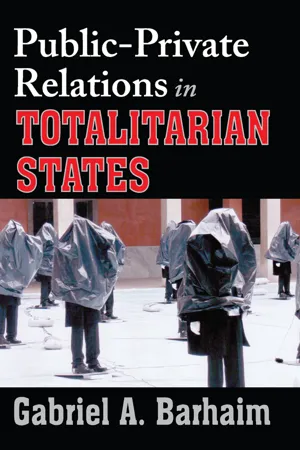
This book argues that the transition by Western society to late modernity has weakened the social order, creating a quasi-anomic state that favors those conditions that place culture in a position of prominence. The preponderance of culture over social, with its affinity for profane and its immanent nature, is posited by the author to have a major impact on the fabric of social life and its implications especially on social solidarity. Gabriel A. Barhaim employs a number of ideas and concepts to illuminate the central theme of a feeble social order. Such concepts are, among others, crisis of reference, desacralization of the social order, the predominance of individual networks as a new form of social solidarity, overpowering of the public sphere, and the reduction in authority of collective representations. The persistent crisis of the social order-strongly visible in the disappearance of major ideologies on the one hand, and in the disintegration of the state and its institutions on the other hand-has been the impetus to cultural phenomena whose prevailing themes encode the fate of individuals, both symbolically and expressively. Barhaim regards the social order as the inspiring scene of action, while culture, with its diverse modes of expressions, provides guiding commentaries. In grappling with these topics in each chapter, the analysis reveals the many facets of culture and the many symbolic forms it takes. All of this provides the necessary commentaries needed to make sense of a bewildered social life, in the context of late modernity. These commentaries should be viewed mostly as a path to understanding the pressing social arrangements, interactions, practices, of contemporary life. Three out of the eight chapters are concerned with the East-Central European experience.
Information
Part I
Contemporary Cultures
1
Popular Culture: A Conception of A Vulnerable Social Order
If any coherent image of social order can be drawn from the various themes and commentaries found in popular culture, then the image of a vulnerable social order stands out. Furthermore, it would appear that this common denominator shared by different popular cultural forms, represents a kind of implicit social denial. The social denial theme of popular culture suggests that the present social order, as a whole, is a vulnerable entity; this to be sure, is not a social or a political declaration, but an allusion to weakness, imperfection, and fallibility of certain parts or of the entire social order.
The vulnerability of the social order is an ontological image projected from the experience of those who produce, consume, or identify with the various popular forms. In other words, to propose that social order is a fallible entity suggests that one’s undeserving, deplorable existence is the product of an imperfect world. Therefore, one’s insecure existence and discontents could be justified by the unreliable and frail nature of the social order in which that individual lives, and which is represented as such in popular culture.
Furthermore, by presenting vulnerability as a palpable reality, it is implied that social life in the present is not finite, exhaustible, and closed, but just the opposite: the image of vulnerability assumes openness and therefore entails the fluidity of options and desirable changes. A finite and infallible social order would be a hopeless world, populated by trapped people and though this may be true, it is not reflected in the language and themes of popular culture. If anything, popular culture comes to “rescue” ordinary people from the despair of finitude and denigration. Bakhtin (1984, 47) says as much when he discusses the idea of the grotesque in the popular culture of the medieval Europe:
we have already shown that the medieval and Renaissance grotesque, filled with the Spirit of carnival, liberates the world from all that is dark and terrifying; it takes all fears and is therefore completely gray and bright. All that is frightening in ordinary life is turned into amusing or ludicrous monstrosities.
Through their characteristically expressive and symbolic messages, the hidden commentaries of popular forms allude to a fallible social order. Naturally, the expression of social penetrability is derived and generalized from the various forms of the individual’s private disillusions. This may be expressed as sadness over personal dreams that failed to materialize, or nostalgia for youthful times that were full of hope and enthusiasm but faded away, as in so many pop songs.
The fallibility of the social is symbolically and indirectly expressed in various genres through such metaphors as the perishable home, farewells, unfulfilled love, the desire for the unobtainable, painful departures, or the sex/violence theme as an explosive revenge of the impulses against sublimated conventions with their effect of an ostensibly stable and rigid order. The ubiquitous ironic, sarcastic, and cynical characters that appear in so many genres, movies, and popular stories consistently convey disdain for whatever or whomever is believed to be eternal, pure, and innocent; it is as if the cynical and bitter heroes know better “than us” that society is implacably corruptible. Simpson’s argument that “American popular culture contains a perception of the public realm as a moral chaos” as evident in detective stories, is pertinent here (1984).
In sum, at its basis, the world of popular culture is a profusely unhappy one, but this is a disguised world striving to appear frivolous, joyful, and lighthearted, aiming thus to make forget or to console. Octavio Paz, the Mexican philosopher in an insightful analysis of the Mexican character in his book The Labyrinth of Solitude makes a similar point when he describes the compressed feeling of joy “exploded” at times of celebrations and rites of passage (1981, 5). The moments of joy are often touched by violence and passion for vengeance cumulated during days of hardship and degradation. Simpson, who observed that in detective stories the public realm is viewed as morally chaotic, came to the conclusion that “the motives of the central character are a mixture of respect for principle and a thirst for vengeance” (1985).
The vicarious feelings of freedom, in fact a momentary outpour of catharsis, the thrill and the experience of “flow” that the audiences of a popular performance typically experience, be it at an amusement park or during the watching of soap opera, may be related to the unconscious wish for the indomitable social order to be “surprised” in its weakness; it is as though the ordinary individual has succeeded once more to “fool” his destiny, and triumphs unexpectedly over the expected and predictable.
Evidently, the kinds of themes and commentaries employed to convey vulnerability in the popular genres are different from those officially organized popular events that harbor overwrought optimism and stress redemptive societal virtues (Menon 1987). The former consists of a category of cultural resistance while the latter is often a manifestation of ideology or the ritualization of the logic of social structure.
The question of how individuals perceive social order and how consequently they react to such a perception is similar to the problem of theodicy raised by Weber. According to Weber, theodicy “consists of the very question of how it is that a power which is said to be at once omnipotent and kind could have created such an irrational world of undeserved suffering, unpunished injustice, and hopeless stupidity” (1971, 122). The possibility that this “power is not omnipotent” has been proposed by Weber as one among several possible answers to this question. This is precisely the raison dëtre of certain phenomena of popular culture, inasmuch as they are directed toward social order and not toward an omnipotent religious power.
In other words, if the divine power is substituted by the social order, as Durkheim has already suggested by observing this inherent transmutation of categories, and if Weber’s question of theodicy is reformulated with “social order” replacing the “omnipotent power,” then the idea of social omnipotence becomes a major challenge to be taken up by popular culture. Consequently, the character of popular culture is shaped by the response that social order is not only omnipotent, but also vulnerable.
In sharp contrast, however, to various intellectual responses, such as overcoming vulnerability by introducing more rationality into social order, popular culture has no solutions to propose. On the contrary, any solutions, especially those forming coherent ideological projects and policies, are likely to become the targets of popular genres, just as the religious solution is likely to become their objective (Bar-Haim 1990). The propensity of popular culture for a quasi-nihilism is inherent in the fact that its materials and the motivations for its production are supplied either by disillusionment with the social, or vexation and anxiety about its strictures. Popular phenomena are not means of salvation and therefore optimistic, but pervasively nihilistic commentaries on these means and especially on the “disenchantment of the world” (to employ another Weberian coinage used in the religious context [1971, 129–55]). The following remark by Eckhard Nixon who was a soap opera producer supports this thesis:
In contemporary society, the mind viewing the small screen knows, if it knows anything, that life is not perfect, and that man has caused the imperfections. He caused them and must “suffer the consequences” – from a family quarrel to a global war.
Nixon goes on to argue that “audiences are bound, not by the chains of her worship, but by the easily recognized bonds of human frailty and human valour” (Newcomb 1974). Simpson’s observation is also relevant when he states: “mass media dreams allow us to depict the insufficiencies of our lives” (1984).
Hence, it may well be that the inability to tackle the problematic and the absence of doubts, long seen as characteristics shared by popular cultural forms, are merely a resignation to the vicious yet weak nature of the social order. Justifiably or not, weakness and vulnerability are fundamental images of social order reflected in the ontology of the popular.
If vulnerability is perceived as the pervasive underlying theme in representations of popular culture, one is bound to identify a corollary in the relationship between social and culture, that is between “the social” that motivates the representations and the “culture” that encodes them; the former provides the inspiration, the impetus, and the materials while the latter provides the symbols, the imagery, the expressive casts; the social is the condition for the appearance of popular cultural activities, while these, once produced, take on life of their own. Hence, one can argue that before a process of cultural mystification gets underway there is need for a process of social demystification. If social demystification is germane to cultural representations then those who produce, participate in, or simply passively consume popular phenomena cannot fail to recognize the allusions concerning the vincibility, so to speak, of social order.
The cultural response to several major principles of the paradigmatic western social order, can provide the basis for a limited, nonexhaustive categorization that may help to clarify the fundamental theme that underlies forms of popular culture and to organize them. A few major categories of popular forms can be viewed as encoded commentaries on central features ingrained in the fabric of contemporary Western society. However, in the final analysis, each category of commentary grapples with the same common fundamental image of social vulnerability. For example, anecdotes and caricatures about “shrinks,” therapists, counselors, etc., among the professional middle class are an encoded cultural commentary concerning the anxiety over “colonization of mind and family,” i.e., the increasing dominance of the therapeutic ideology and its implications, by now a paradigmatic feature of Western middle classes. The semiotic key for understanding anecdotes and caricatures rests on the paradox of contrasts: the strong is the weak, the powerful is the coward, the pious is the hypocrite, etc. In other words, the premise is that there is no indomitable social role, social arrangement, or social definition. Everything pertaining to the social realm is imperfect and fallible, and as such it may also be ridiculous, absurd, and laughable. The middle class with their pretentions becomes a favored target of such anecdotes and caricatures. Historical precedents concerning the emergence of a popular forms as a result of specific ideological pressures are indeed numerous (Chambers 1986).
A categorization of popular phenomena can be especially compelling if built upon a specific symbolic commentary keyed to specific traits inherently connected with the existing Western social order.
For example, through representations of the asocial types such as spirits, the supernatural, extraterrestrial creatures, magical incarnations, and the like, the consumer of the popular attempts, in a sense, to cast doubt on the working reality of a present social order. Make-believe narratives, such as tales of the supernatural and horror stories, are good examples of how popular genres point to the weak reality of social existence, by entertaining the prospects of a different order, a surrealistic one, inhabited by the fictional heroes of the fantastic. To a large extent, many forms of popular culture emerge through attempts to challenge the “natural image” of social order. Hence, a theory concerning the relationship between the social and the cultural should proceed from here.
By its nature, the world of popular culture is anchored in the symbolic and expressive domain of the profane, therefore its messages are freer and more daring than if it were anchored in the domain of the sacred. That is, hidden or partly hidden messages of play and ludic expressions in the various forms of popular culture are free yet less committing, therefore their skepticism and assaults against the status quo are regarded as harmless (Handelman 1977).
Popular cultural commentaries are geared to symbolically free “the fixed” and “the natural” of the social. Hence, popular phenomena are cultural interpretations of the sacred, socially reified in countless ideological objects and practices. It is relevant to note Aron’s observation (1970, 192):
Interpretation is born of our contact with the object – an object which is not acknowledged passively, however, but which is simultaneously acknowledged and denied, the denial of the object being an expression of our desire for another human reality.
We have identified the conception of an imperfect and fallible social order at the root of popular forms. Yet, this analysis should properly be done in such a way as to bring to light its specific representations. Furthermore, such a specific representation also implies a certain hermeneutic that should be made explicit. Though, the fundamental conception underlying all phenomena of popular culture is basically the same, the category of commentary may vary: this conception is both symbolically and expressively presented. Based on this approach, we propose an nonexhaustive and limited categorization of phenomena of popular culture.
Three major categories of popular phenomena can be distinguished; each of these categories is a symbolic-expressive commentary aimed at challenging a central characteristic of the contemporary Western social order viewed in the popular mind as a limitation, upon which a symbolic breakthrough need be effected. I label these three categories as follows: “The Imaginary Flight: Expansion and Extension of Social Space”; “Secular Supernatural: Chance, Luck and Fate”; and: “The Triumph of Physical Gifts: Ceremonies of Regression.”
The Imaginary Flight: Expansion and Extension of Social Space
The social position of individuals implies the social options that position entails. One might argue that in modern Western society the options available lag behind social aspirations and desires, and perhaps increasingly so ever since the Western European Enlightenment established a new relationship between the individual and society and between an individual and himself. Though social mobility and rapid technological changes motivate expectations for new and more opportunities, beginning with the 1960s there began an increasing disillusionment with the supposed limitless expansion of an ever-changing society. For one, it became obvious that neither social mobility nor technological changes can eradicate inequality and injustice and none expand absolutely the range of options. It has become a widespread belief in the five decades since, that whatever progress has been made, the newly formed social structure has already activated its own proper mechanisms of limitation. But while the disillusionment from the present order of things becomes widespread and daily experiences confirm a sense of entrapment, the post-industrial Western paradigm and its welfare-state democracy, continue essentially untroubled to harbor and cultivate the belief in social mobility.
The yearning for another reality, as an attempt at symbolic liberation from the existing boundaries of the imperfect social universe, is one useful perspective for revealing the encodings of current popular forms.
True, human beings need closure and boundaries to overcome the terror of chaos and much social theorizing proceeds from these premises. However, since human consciousness has always produced social boundaries and chaos has persistently been managed, social theory at present should focus rather on how individuals react when they feel suffocated by boundaries and entrapped by their everyday routines. How do people overcome the limitations imposed upon them by inexorable social boundaries? As long as the rules (or antirules) for surpassing them have not yet materialized—the mocking of rules, or inventing make-believe rules becomes the only strategy for denying boundaries.
Many interpreters of popular narrative have identified in them a quality that symbolically transcends existing social boundaries, that is, a capacity to expand and extend social space. P. Kael (1980, 420) astutely noted the subversive quality of movies to transcend old meanings: “Movie art is the subversive gesture carried further, the moments of excitement sustained longer and extended into new meanings”… and then she went on to explain: “We want to experience that elation we feel when a movie (or even a performer in a movie) goes further than we had expected and makes the leap successfully” (421).
By “going further” than the viewers had expected, the hero, (and he is such precisely because he is going further) has thus “liberated” his audience; he has succeeded in overcoming the social limitation that all are aware of by penetrating conventional barriers. His deeds elate the audience while the excitement he generates may reach out into new meanings; “suspense” inspires a sublimative confrontation and possible a reflective breakthrough. Popular representations provide a make-believe expansion of daily experience by employing materials and strategies that encourage a momentary disregard for limits and constraints. A good example is the “Western” genre. One may argue that by definition the Westerns must convey a sense of expansion, of going beyond the conventional frontiers. That is true, yet it does not explain the persistent popularity of the genre, especially considering its anachronistic topic and culturally bound location. It might well be that the Americanization of so many local cultures as a wide global phenomena, has its roots in the appeal of a universal mythology based on fictionalizing the perennial theme of prevailing over the limitations of social life (Strinati 1995, 21–31).
Walter Benjamin who was among the first to offer a comprehensive critique of the mechanically reproduced and mass-produced art genres, understood the magic of extension created by film, though more than anybody else he disdained its artificiality. Benjamin (1969) observed that: “the film extends our comprehension of the necessities which rule our lives.” He went on to add:
our offices, and furnished r...
Table of contents
- Cover
- Half Title
- Title Page
- Copyright Page
- Dedication
- Table of Contents
- Preface and Acknowledgments
- Part I: Contemporary Cultures
- Part II: The Crises of Rituals and Rituals in Times of Crises
- Part III: The Empowered Public Sphere
- Index
Trusted by 375,005 students
Access to over 1.5 million titles for a fair monthly price.
Study more efficiently using our study tools.
Frequently asked questions
Yes, you can cancel anytime from the Subscription tab in your account settings on the Perlego website. Your subscription will stay active until the end of your current billing period. Learn how to cancel your subscription
No, books cannot be downloaded as external files, such as PDFs, for use outside of Perlego. However, you can download books within the Perlego app for offline reading on mobile or tablet. Learn how to download books offline
Perlego offers two plans: Essential and Complete
- Essential is ideal for learners and professionals who enjoy exploring a wide range of subjects. Access the Essential Library with 800,000+ trusted titles and best-sellers across business, personal growth, and the humanities. Includes unlimited reading time and Standard Read Aloud voice.
- Complete: Perfect for advanced learners and researchers needing full, unrestricted access. Unlock 1.5M+ books across hundreds of subjects, including academic and specialized titles. The Complete Plan also includes advanced features like Premium Read Aloud and Research Assistant.
We are an online textbook subscription service, where you can get access to an entire online library for less than the price of a single book per month. With over 1.5 million books across 990+ topics, we’ve got you covered! Learn about our mission
Look out for the read-aloud symbol on your next book to see if you can listen to it. The read-aloud tool reads text aloud for you, highlighting the text as it is being read. You can pause it, speed it up and slow it down. Learn more about Read Aloud
Yes! You can use the Perlego app on both iOS and Android devices to read anytime, anywhere — even offline. Perfect for commutes or when you’re on the go.
Please note we cannot support devices running on iOS 13 and Android 7 or earlier. Learn more about using the app
Please note we cannot support devices running on iOS 13 and Android 7 or earlier. Learn more about using the app
Yes, you can access Public-private Relations in Totalitarian States by Gabriel Barhaim in PDF and/or ePUB format, as well as other popular books in Politics & International Relations & Political History & Theory. We have over 1.5 million books available in our catalogue for you to explore.