- 220 pages
- English
- ePUB (mobile friendly)
- Available on iOS & Android
eBook - ePub
Racism and the Olympics
About this book
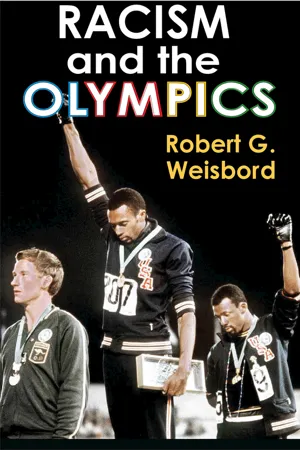
Sports are the opiate of the people, particularly in the United States, Europe, and parts of South America. Globally, billions of fans feverishly focus on the summer and winter Olympics. In theory, international fraternalism is boosted by these "friendly competitions," but often national rivalries eclipse the theoretical amity. How the Olympics have dealt with racism over the years offers a window to better understanding these dynamics. Since their revival in 1896, the modern Olympics were periodically agitated by political and moral conundrums. Racial tensions, the topic of this volume, reached their apex under the polarizing presidency of Avery Brundage. Race in sports cannot be disentangled from societal problems, nor can race or sports be fully understood separately. Racial conflict must be contextualized. Racism and the Olympics explores the racial landscape against which a number of major disputes evolved. The book covers various topics and events in history that portray discrimination within Olympic games, such as the Nazi games of 1936, the black American protest on the victory stand in Mexico City's Olympics, as well as international political forces that removed South Africa and Rhodesia from the Olympics. Robert G. Weisbord considers the role of international politics and the criteria that should be used to determine nations that are selected to take part in and serve as venues for the Olympic Games.
Information
1
A Case of Amnesia: Racism and the 1932 Los Angeles Olympics
In April 2008, with Beijing as their final destination, Olympic torchbearers in several countries in Asia, Europe, and North America found themselves besieged by demonstrators incensed over China’s human rights policies, most notably with respect to Tibet. As had happened periodically in the twentieth century, the choice of Olympic venues was being challenged on political and moral grounds. The campaign to boycott the games in Hitler’s Germany in 1936 was bitter and prolonged, but, in the end, unsuccessful. To show their displeasure with the Soviet invasion of Afghanistan, the United States and dozens of other nations stayed away from the 1980 Moscow Games, and four years later, the Soviets, playing tit for tat, boycotted the Los Angeles Olympiad. But never before had serious questions been raised about the United States as a country morally unsuitable to host the Olympiad.
Ever since the first modern Olympiad in 1896, the United States had been a significant presence at the quadrennial games, and in 1932, Los Angeles played host to the world’s athletes. It was not the first time the United States was the venue for the Olympics. In 1904, when St. Louis was staging a world’s fair, it also served as the site of the III Olympiad. President Theodore Roosevelt had favored St. Louis, which was celebrating the centennial of the Louisiana Purchase, to host the games over its chief rival, Chicago.1
On the contrary, Baron Pierre de Coubertin, the French aristocrat who founded the modern Olympics, frowned upon the choice of St. Louis and, in the end, failed to attend. For him, St. Louis lacked beauty and originality, and he feared that the Games would match the mediocrity of the city. Coubertin was further concerned that the athletic festival would simply be an adjunct to the exposition.2 Racially mixed competition was anathema to him, and two South Africans, members of the Tswana tribe, ran in the grueling marathon. For the first time, a pair of African American sportsmen, Joseph Stadler and George Poage, won medals in track and field.3 But visitors to St. Louis were strictly segregated throughout.
One 1904 St. Louis innovation was particularly embarrassing for Coubertin: the two so-called anthropological days featuring Turks, Japanese Ainus, Sioux Indians, Filipinos, and Black Africans. Many were aboriginal peoples who, according to Coubertin, had only “barely emerged from primitive barbarism.”4 The “primitives” competed in mud wrestling and in ascending a greasy pole, decidedly non-Olympic events. The euphemistically dubbed “anthropological days” were not officially part of the Olympic program. Rather, they were a circus, a carnival freak show mirroring the raw racism that was reaching its zenith in the United States in 1904.
Among the participants in the anthropological days was Ota Benga, a twenty-three-year-old Pygmy from the ruthless Belgian King Leopold’s genocidal Congo Free State, his personal plantation in the heart of Africa. Crowds mocked Ota Benga, tossed brick missiles in his direction, and poked umbrellas at him. Worse humiliation was to come. Two years later, the four foot, eleven inch Pygmy was exhibited in the monkey house of the Bronx Zoo. Tens of thousands turned up to gawk and jeer at the “wild man” from Africa.5 A sideshow barker was all that was missing. Such was the American mind-set of racism in the first years of the new country.
European cities were the venues for the Olympics after St. Louis. In 1908, it was London and four years later Stockholm. No Olympiad was held in 1916, owing to the fact World War I had broken out two years earlier. Antwerp was the site in 1920 and Paris in 1924. Los Angeles had long been eager to host the 1928 Olympiad, and William May Garland, a prosperous local businessman, made a convincing case in 1920 before the International Olympic Committee (IOC), but to no avail. Amsterdam got the nod.
Still, Garland made a favorable impression on the Lausanne-based IOC, which was predisposed to return the Olympics to the United States for 1932. When Garland made a pitch for the City of the Angels in 1923, the IOC enthusiastically acceded. Baron de Coubertin himself noted that construction for the mammoth Memorial Coliseum gave LA an advantage over its competitors. The Coliseum, which could seat 105,000 spectators, was touted as the most colossal structure of its kind on the planet.5 Given the extensive participation of the “sporting youth” of the United States in previous Olympiads across the Atlantic, the choice was something of a quid pro quo.7 Influential Angelinos rejoiced, but the East Coast athletic establishment, which regarded California as an upstart in the world of sports, was clearly displeased.
Business and political interests in LA lost no time in propelling preparations for the Games forward. A bond issue was floated by the city while the state of California appropriated funds to help defray expenses. William Garland became president of the Olympic Committee, and President Herbert Hoover, who personally had no interest in sports in general or in the Olympic Games in particular, nonetheless became honorary president of the X Olympiad.
Because Hoover was deeply involved in his reelection campaign, an eventually unsuccessful one, and because he was profoundly unpopular as the Great Depression ravaged the nation, Vice President Charles Curtis officially opened the Games as the honorary vice president of the Olympiad. Curtis is best remembered, if he is remembered at all, for his Pollyannaish prophecy, made as hunger stalked the land, that prosperity was just around the corner. Hoover remained safely ensconced in Washington, where he partook of a loaf of bread presented to him by a California congressman. It was similar to that served to the world’s athletes gathered in Los Angeles. This had been customary since the revival of the Olympics. The bread was meant to symbolize international peace.
Los Angeles’s mayor, John C. Porter, relished his moment in the sun and proudly pledged that he would keep the Olympic flag in city hall until the finish of the Games, when it would be transferred to Berlin for the XI Olympiad. The considerable financial risks notwithstanding, the Olympiad thrust Los Angeles into the national and international limelight. Thirteen hundred athletes from thirty-seven nations and in excess of a million visitors descended on sunny Southern California.
Once in Los Angeles, the American athletes were given the royal treatment. They were lionized. Motion picture stars greeted them personally and put on gigantic shows almost every night at the Olympic Village. When the athletes ventured outside the village, they were beleaguered by autograph seekers. Indeed, the Olympic Village itself was a novelty in Los Angeles at the X Olympiad. Prior to 1932, private accommodations were found, and the athletes trained secretly, sometimes individually. All that changed in 1932, at least for the males. Female competitors were accommodated at a local hotel.
In 1932, racial separation de jure and de facto was pervasive in the United States, and sports were no exception. At the same time, there was a realization that black athletes could help win coveted medals in international competition. Perhaps it was inevitable that there would be racial conflicts as the Los Angeles Olympiad approached.
In June 1932, owing to university policy, four African American athletes were barred from Olympic track-and-field qualifying meets at Johns Hopkins University in Baltimore. Both the university and the city were rigidly Jim Crowed then. A dispensation enabling blacks to circumvent the Johns Hopkins trials and compete instead in the sectional trials at Harvard University was proffered by the president of the South Atlantic Association and the chairman of the American Olympic track-and-field committee. A Johns Hopkins official lamely explained, “We often have been called on by Negro organizations for the use of the field and always have declined. Personally, I have no feelings against the boys, but the ruling has remained at the university as long as I can remember and we must be consistent.”8 Only after considerable pressure was exerted by the Baltimore branch of the National Association for the Advancement of Colored People (NAACP) and other organizations did Johns Hopkins relent and permit African Americans to try out for the Olympic berths on their campus.9
Black athletes were at a distinct disadvantage in another respect. They were more likely to be shunted aside by the American Olympic Committee, which, at that juncture, was short of money. White athletes were assisted by private clubs, but their black counterparts could not rely on the black community for training and travel expenses because it lacked adequate financial resources.10
Nonetheless, Los Angeles catapulted black sprinters on the world stage of Olympic track-and-field competition. Ralph H. Metcalfe and Thomas Edward “Eddie” Tolan captivated the throngs in attendance with their blinding speed. Short, stocky, and bespectacled—the latter ran with his glasses taped to his head—Tolan won gold medals in the 100- and 200-meter events and set two Olympic marks and one world record, but both races were disputed.
In the 100-meter competition, there was a photo finish with both Tolan and Metcalfe clocked at 10:03. It appeared they had broken the tape at precisely the same instant, but, after some deliberation, the judges declared Tolan, the “midnight express,” the winner because his torso had supposedly crossed the finish line before Metcalfe’s. Tolan thus became the first black American to earn a gold medal in Olympic sprints.11
Tolan, a University of Michigan graduate and a one-time schoolboy champion in Michigan, won a second gold medal in the 200-meter event. Again, controversy dogged the race. Metcalfe, the heavy favorite who had dominated the Olympic trials, came in a disappointing third—behind his countryman, George Simpson. It was discovered in short order that Metcalfe’s lane had been mismeasured, requiring him to run an additional two or three meters.
Metcalfe declined the offer to have the race rerun lest the American sweep be jeopardized. Was Metcalfe simply motivated by good sportsmanship? His son wondered aloud whether his father was pressured for racial reasons—Simpson, the silver medalist, was white—to not challenge the results after the 200-meter contretemps.12
In 1936, the legendary black activist and scholar W. E. B. du Bois wrote in opposition to Americans participating in the XI Olympiad in Berlin, but noted that on the “grounds of poor sportsmanship and discrimination, America, of course, cannot raise a very sincere hand, for she has given the Negro athlete copious doses of both.”13 Among others, du Bois pointed to Tolan, who had been humiliated following the 1928 Amsterdam Olympics. Tolan had been ostracized by his own teammates, who had often left him to dine alone in his hotel room. When his teammates went sightseeing Tolan, was not invited to go along. According to The Crisis magazine, the organ of the NAACP “More than once the group would pack, drive to the station, leave for the next port of call without advising Tolan either when they were leaving or where they were going.”14
Prior to an Amateur Athletic Union (AAU) meet against Great Britain in 1930, Tolan, along with a couple of black competitors, were denied accommodations by two Chicago athletic clubs where their white teammates were staying. When an angry Tolan announced his intention to leave, AAU officials reportedly informed him that such a rash move would spell finis to his athletic career.15
After the 1932 Olympics, Tolan’s fortunes took a turn for the worse. Tolan’s picture appeared on the front cover of The Crisis in September 1932, and the governor of Michigan proclaimed September 6 Eddie Tolan Day. City and county officers raised $300 to enable him to sustain himself. He had considerable difficulty eking out a living. When the mayor of Detroit presented him with a trophy and asked what else the Motor City could do for him, he replied that he needed a job. Tolan did appear briefly on the vaudeville circuit with the African American entertainer Bill “Bojangles” Robinson and taught school for some years. The fruits of his athletic prowess on the international scene were meager indeed. His plans to study medicine came to naught.16
Metcalfe’s future following Los Angeles was much brighter. The Atlanta-born athlete, whose family had moved to Chicago as part of the “Great Migration” of Blacks seeking greater economic opportunity and racial dignity, competed in the 1936 Berlin Olympiad. A graduate of Marquette University, Metcalfe earned a master’s degree at the University of Southern California. In the 1960s, he embarked on a distinguished political career that saw him elected to the United States House of Representatives from Illinois, and he served several terms. In the wake of the 1932 games, Atlanta’s white mayor James Lee Key proclaimed September 23, 1932, a day in honor of Ralph Metcalfe but conceded that if “he had remained here, he would probably have been a rose ‘born to blush unseen, its fragrance wasted on the desert air.’”
Black American Olympic performances merited front-page treatment in the Afro-Am...
Table of contents
- Cover
- Half Title
- Title
- Copyright
- Dedication
- Contents
- Acknowledgments
- Introduction
- 1 A Case of Amnesia: Racism and the 1932 Los Angeles Olympics
- 2 Jews, Blacks, and the 1936 Nazi Olympics
- 3 The 1940 Winter Olympics: The Games That Never Happened—Politics, Morality and Sports
- 4 Racism and the Olympics: Black Protest at the 1968 Mexico City Games
- 5 Apartheid and the Expulsion of South Africa from the Olympics
- 6 UDI and the Expulsion of Rhodesia from the Olympic Movement
- 7 Aftermath: Outlaw Nations as Olympic Hosts—Gays and Others as Targets of Discrimination
- Bibliography
- Index
Trusted by 375,005 students
Access to over 1.5 million titles for a fair monthly price.
Study more efficiently using our study tools.
Frequently asked questions
Yes, you can cancel anytime from the Subscription tab in your account settings on the Perlego website. Your subscription will stay active until the end of your current billing period. Learn how to cancel your subscription
No, books cannot be downloaded as external files, such as PDFs, for use outside of Perlego. However, you can download books within the Perlego app for offline reading on mobile or tablet. Learn how to download books offline
Perlego offers two plans: Essential and Complete
- Essential is ideal for learners and professionals who enjoy exploring a wide range of subjects. Access the Essential Library with 800,000+ trusted titles and best-sellers across business, personal growth, and the humanities. Includes unlimited reading time and Standard Read Aloud voice.
- Complete: Perfect for advanced learners and researchers needing full, unrestricted access. Unlock 1.5M+ books across hundreds of subjects, including academic and specialized titles. The Complete Plan also includes advanced features like Premium Read Aloud and Research Assistant.
We are an online textbook subscription service, where you can get access to an entire online library for less than the price of a single book per month. With over 1.5 million books across 990+ topics, we’ve got you covered! Learn about our mission
Look out for the read-aloud symbol on your next book to see if you can listen to it. The read-aloud tool reads text aloud for you, highlighting the text as it is being read. You can pause it, speed it up and slow it down. Learn more about Read Aloud
Yes! You can use the Perlego app on both iOS and Android devices to read anytime, anywhere — even offline. Perfect for commutes or when you’re on the go.
Please note we cannot support devices running on iOS 13 and Android 7 or earlier. Learn more about using the app
Please note we cannot support devices running on iOS 13 and Android 7 or earlier. Learn more about using the app
Yes, you can access Racism and the Olympics by Robert G. Weisbord in PDF and/or ePUB format, as well as other popular books in Social Sciences & Sociology. We have over 1.5 million books available in our catalogue for you to explore.