eBook - ePub
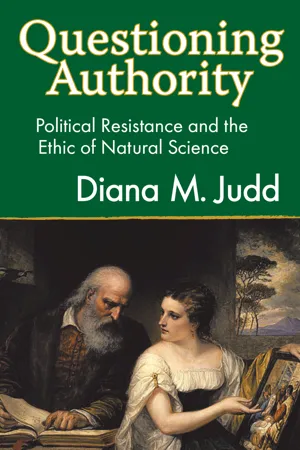
Questioning Authority
Political Resistance and the Ethic of Natural Science
- 164 pages
- English
- ePUB (mobile friendly)
- Available on iOS & Android
eBook - ePub
About this book
The West is currently witnessing the slow destruction of the classical liberal tradition. The casualties are reason, the willingness to question political or religious authority, and the validity of natural science. Replacing these are a crippling intellectual relativism, political apathy, and a grave misunderstanding of natural science and its concomitant ethic. In this work, Diana M. Judd gets to the root of the matter by directly addressing the following questions: What is modern natural science? What effect did it have on how we think about politics? What are the dangers surrounding the marginalization of natural science and the liberal intellectual and political tradition? This is a work of political theory. It seeks to engage the political by addressing the question first posed by the ancient Greeks: How ought we to live? If we have indeed entered the age of endarkenment where religious dogma, intellectual apathy, and unquestioned authority increasingly hold sway, there is a need now, more than ever, to explore the meaning and significance of the origins of the modern political and scientific traditions Americans take for granted. It is from these traditions that Americans received the ideas of legitimate political resistance, reason, individual rights, religious freedom, and natural science. The importance of modern natural science and its relationship to these tenets of classical liberalism is the central concern of this book. Claims that science is dogmatic and ideological, and that the tenets of liberalism divide individuals, have become commonplace. It is Judd's intention to show how these claims err, by exploring what natural science is and how it evolved. This ethic centers on the radical idea that authority must be questioned. We ignore this to our peril. If individuals do not question what leaders say, we abdicate the rights and responsibility of self-rule and individual freedom.
Information
Introduction
Questioning authority drove the scientific revolution of the seventeenth century. It is commonly understood that this revolution brought lasting change in humankind’s knowledge of the natural world. What is not commonly understood is that natural science from the beginning contained an ethic that directly and positively influenced the evolution of modern political thought and practice. The modern scientific method was developed in order to explore the natural world on its own terms, as opposed to those dictated by the powerful. The subsequent rise of modern political thought is inextricably linked to the birth of modern natural science. At the core of both lies the ethic—heretical from the start—that authority must be questioned.
The union of modern natural science and modern political thought led to three crucial achievements of the western Enlightenment. First is the idea that we are by nature capable of thinking for ourselves because we are capable of reason; second is that authority should be questioned; and third, that political resistance is a legitimate act. Today, we take the existence of these Enlightenment achievements so much for granted that not only have we failed to notice their dismantling, but many actually laud the process. The inherent and direct relationship between the evolution of modern natural science and the development of modern political thought and practice is both misunderstood and very much undervalued. The aim of this book is to delineate and clarify this relationship, to outline and underscore the political importance of the ethic driving modern natural science, and to make clear the implications of the destruction of this ethic that has encouraged us to question, reason, and resist for over three centuries.
The work of Francis Bacon marks the beginning of the western Enlightenment. Bacon’s achievements fed into, even mirror, those of the Enlightenment in general, but his goals were quite specific. First and foremost, Bacon called for the necessity of questioning established intellectual authority; his entire enterprise rests on the constancy and legitimacy of this act. Second, he argued for the complete separation of religious from scientific inquiry, a separation he saw as obligatory for the development of a proper “interpretation of nature” that would benefit humanity as a whole, not a particular group. Third, Bacon stipulated that the method to be used in this interpretation of nature—his natural science—would encourage future research and be self-corrective. This last is of particular importance, for it was meant to ensure that knowledge of the natural world would grow and accumulate not by the will of religious or political authority, but by the implementation of a method which was capable of calling itself into question. Bacon’s goal was that his method would bring about knowledge that would result in benefits for humankind: thus the test of his new method for exploring the natural world would be the works it produced, not the faith it might inspire. Though few today think of the debt owed by western political thought to Francis Bacon and the modern scientific method, the core notion that every individual is capable of reason is central to the basis of our own political organization. That is, it is central to democracy itself.
Francis Bacon’s plan was radical in scope. He argued that established philosophy, which in the seventeenth century was heavily grounded in Aristotelian and Scholastic precepts, had been hopelessly bogged down by constant criticism and vain verbal controversy. Discarding this orthodoxy, he advocated a new plan based on “works” that would require not only a new philosophical foundation, but also an entirely new way of thinking about the universe. The plan involved the division of knowledge into distinct spheres: metaphysics, philosophy, and what he called the “interpretation of nature.” It is important to note that this division was not meant to promote the interpretation of nature as the only “legitimate” philosophical inquiry at the expense of other forms of knowledge. In fact, in Bacon’s day the study of earth or water was considered a low and unworthy concern compared with the lofty contemplation of God and the heavens. Bacon’s purpose in separating the study of the natural world from traditional philosophies such as metaphysics and religion was not to delegitimize the latter two as subjects of inquiry. Rather, he simply stipulated that that they should remain concerned with matters other than the exploration of the physical universe.
The most complete explanation of Bacon’s schema is found in The New Organon, published in 1620. In this work he argued that the goal of the sciences should be to endow humanity with new discoveries and new powers. The method was to be codifiable, demonstrable, and most importantly, public. Knowledge of the natural world must be a collective enterprise, freely available to anyone inclined to contribute to its study. Knowledge should not belong to a secret or seemingly infallible club of alchemists or priests, but to everyone. Thus from the beginning, Bacon’s “interpretation of nature” had a collaborative tinge and a definite public, even democratic character where individual efforts would contribute to the work of all. And despite the developments the scientific method has undergone in the centuries after Bacon’s death, these foundational characteristics very much remain.
The decades following the publication of The New Organon witnessed the birth of “natural philosophy,” or modern natural science, as a discrete category of human knowledge. Early scientists such as Robert Boyle, Thomas Syndenham, Sir Kenelm Digby, John Wilkins and Samuel Hartlib were all self-professed followers of Bacon’s work and actively engaged in and promoted his method. Their work paved the way for the establishment in 1660 of the Royal Society, the western Enlightenment’s first independent scientific institution. The Bishop of Rochester—the man charged with writing the first history of the Royal Society—made clear that many members held Bacon in high esteem.
The role of the Royal Society in British intellectual life should not be underestimated. The leading scientific minds of the day were members of this group, and from the start it exhibited the kind of intellectual independence, commitment to scientific truth, and the questioning of authority Bacon’s work embodied. For example, Bernard Cohen notes the following anecdote: In the 1770s, a controversy was stirred over the question of whether lightning rods (recently invented by Benjamin Franklin) would be more effective if the ends were pointed or blunt. After studying the matter, the Royal Society concluded that the pointed version would be superior. King George III, however, in a purely political move, ordered blunt rods to be placed on top of the royal palace. Upon so doing, he tried to exert pressure on Sir John Pringle, then the president of the Royal Society, to reverse its findings to reflect the king’s decision. As Cohen writes, “Pringle’s reply noted that His Majesty might change the laws of the land but could not reverse or alter the laws of nature.”1
Both Thomas Hobbes and John Locke were closely involved with the activity of early scientists. Hobbes, who has often been noted disparagingly for his mechanistic style and materialistic outlook, was deeply influenced by both Galileo and Bacon. Not only did he serve as Bacon’s secretary before Bacon’s death in 1626, he met Galileo while traveling in Italy after the latter was tried and sentenced to house arrest. Hobbes was taken with Galileo’s “prodigious wit” and “sweetness of nature and manners,” and declared Galileo to be perhaps the greatest philosopher of any age.2 In his own works, Hobbes emulated natural philosophy and mathematics, particularly physics and geometry. For example, his analysis of politics and ethics in De Homine and De Cive involved characterizing the study of politics as the “science of the just and the unjust” and the study of ethics “the science of equity and inequity.”3
Hobbes considered René Descartes his philosophical rival, and often attacked, even ridiculed, the idea that reality is dualistic—that there exists a spirit, or soul, which operates independently from the body. This, as well as Hobbes’s placement of religious matters below the importance of the state in Leviathan earned him a reputation for heresy and atheism, a reputation that likely contributed to his rejection by the Royal Society. As Roger Coke noted of Hobbes’s De Cive in A Survey of the Politicks of Mr. Thomas White, Mr. Thomas Hobbs and Mr. Hugo Grotius, “It is not worth the examining, what he would have under the title of Religion, for men say, the man is of none himself, and complains (they say) he cannot walk the streets, but the Boys point at him saying, There goes HOBBS the Atheist!”4 Thomas Hobbes has been the subject of much study over the years. His relevance here, however, does not hinge on a philosophical dissection of his work through a twenty-first century lens. Rather, it is more interesting to focus on the real consequences of Hobbes’s thought at the time he wrote it, particularly how his blending of natural science with political theory later shaped the formation of classical liberalism. In his own age, Hobbes was seen as not merely radical, but downright scandalous. A charge of atheism in the seventeenth century was a serious one, and had very real social and political consequences. The quintessential transitional figure between absolutism and the formation of classical liberalism, Hobbes is important for the Baconian and scientific roots he planted in political thought, which enabled John Locke to go further and formulate the ideas and ideals of classical liberal thought which are now being attacked by both the political right and the academic left.
John Locke was deeply influenced by Francis Bacon and the new natural science, as well as by his fellows in the Royal Society. Locke was a member of the Society from 1668, and his personal library contained 642 medical and scientific books, as well as works by distinguished scientists and philosophers of post-Restoration England such as Boyle, Sydenham, Jonathan Goddard, Robert Hooke, Jean le Clerc, Christopher Merritt, William Molyneux, Henry Power, William Simpson, George Thomson and Thomas Willis, all of whom openly professed their Baconian influences. He was also well versed in Descartes’ works (with which he largely disagreed), and was among the collaborators in Robert Boyle’s experiments around 1664, and after a long friendship became one of Boyle’s literary executors. In addition, Locke informally pursued the study of medicine at Oxford, and later worked with Thomas Sydenham in London.5 Locke’s considerable influence stems not only from his explication of limited government in The Second Treatise of Government, but from his successful application of natural philosophy to his study of the mind in An Essay Concerning Human Understanding. Locke’s concepts of power and liberty as laid out in the Essay and The Second Treatise are analogous to Newtonian physics. Locke’s reputation for synthesizing science and philosophy later prompted Voltaire to remark that “a Sage at last arose…. Mr. Locke … every where takes the Light of Physicks for his Guide...
Table of contents
- Cover
- Half Title
- Title
- Copyright
- Dedication
- Contents
- List of Abbreviations
- Preface
- Introduction
- Conclusion
- Bibliography
- Index
Trusted by 375,005 students
Access to over 1.5 million titles for a fair monthly price.
Study more efficiently using our study tools.
Frequently asked questions
Yes, you can cancel anytime from the Subscription tab in your account settings on the Perlego website. Your subscription will stay active until the end of your current billing period. Learn how to cancel your subscription
No, books cannot be downloaded as external files, such as PDFs, for use outside of Perlego. However, you can download books within the Perlego app for offline reading on mobile or tablet. Learn how to download books offline
Perlego offers two plans: Essential and Complete
- Essential is ideal for learners and professionals who enjoy exploring a wide range of subjects. Access the Essential Library with 800,000+ trusted titles and best-sellers across business, personal growth, and the humanities. Includes unlimited reading time and Standard Read Aloud voice.
- Complete: Perfect for advanced learners and researchers needing full, unrestricted access. Unlock 1.5M+ books across hundreds of subjects, including academic and specialized titles. The Complete Plan also includes advanced features like Premium Read Aloud and Research Assistant.
We are an online textbook subscription service, where you can get access to an entire online library for less than the price of a single book per month. With over 1.5 million books across 990+ topics, we’ve got you covered! Learn about our mission
Look out for the read-aloud symbol on your next book to see if you can listen to it. The read-aloud tool reads text aloud for you, highlighting the text as it is being read. You can pause it, speed it up and slow it down. Learn more about Read Aloud
Yes! You can use the Perlego app on both iOS and Android devices to read anytime, anywhere — even offline. Perfect for commutes or when you’re on the go.
Please note we cannot support devices running on iOS 13 and Android 7 or earlier. Learn more about using the app
Please note we cannot support devices running on iOS 13 and Android 7 or earlier. Learn more about using the app
Yes, you can access Questioning Authority by Diana M. Judd in PDF and/or ePUB format, as well as other popular books in Politics & International Relations & Political History & Theory. We have over 1.5 million books available in our catalogue for you to explore.