eBook - ePub
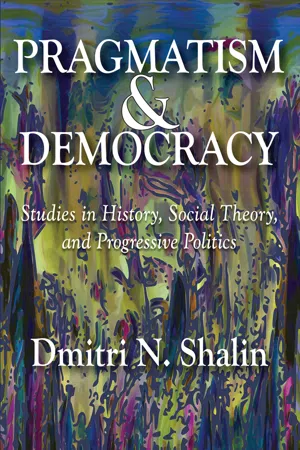
Pragmatism and Democracy
Studies in History, Social Theory, and Progressive Politics
- 412 pages
- English
- ePUB (mobile friendly)
- Available on iOS & Android
eBook - ePub
Pragmatism and Democracy
Studies in History, Social Theory, and Progressive Politics
About this book
This volume examines the roots of pragmatist imagination and traces the influence of American pragmatism in diverse areas of politics, law, sociology, political science, and transitional studies. The work explores the interfaces between the Progressive movement in politics and American pragmatism. Shalin shows how early 20th century progressivism influenced pragmatism's philosophical agenda and how pragmatists helped articulate a theory of progressive reform. The work addresses pragmatism and interactionist sociology and illuminates the cross-fertilization between these two fields of studies. Special emphasis is placed on the interactionists' search for a logic of inquiry sensitive to the objective indeterminacy of the situation. The challenge that contemporary interactionist studies face is to illuminate the issues of power and inequality central to the political commitments of pragmatist philosophers. Shalin explores the vital link between democracy, civility, and affect. His central thesis is that democracy is an embodied process that binds affectively as well as rhetorically and that flourishes in places where civic discourse is an end in itself, a source of vitality and social creativity sustaining a democratic community. The author shows why civic discourse is hobbled by the civic body that has been misshapen by past abuses. Drawing on the studies of the civilizing process, Shalin speculates about the emotion, demeanor, and body language of democracy and explores from this angle the prospects for democratic transformation in countries struggling to shake their totalitarian past. View Table of Contents
Information
1
Empowering the Self: Romanticism, the French Revolution, and the Rise of Sociological Hermeneutics
Although biblical exegesis and rhetoric, from which modem hermeneutics derived its first principles, are ancient arts, an effort to establish hermeneutics as a universal science, and especially to extend its principles to the science of society, is of decidedly recent origin. “There is little doubt,” states Gouldner, “that hermeneutics’ roots in the modern era are traceable to Romanticism.”1 Why is this so, what makes romanticism fertile ground for hermeneutical speculations? Hans-Georg Gadamer, a leading authority on hermeneutics, makes this intriguing suggestion about its origins:
The hermeneutical problem only emerges clearly when there is no powerful tradition present to absorb one’s own attitude into itself and when one is aware of confronting an alien tradition to which he has never belonged or one he no longer unquestioningly accepts.... Historically it is worth of note that while rhetoric belongs to the earliest Greek philosophy, hermeneutics came to flower in the Romantic era as a consequence of the modern dissolution of firm bonds with tradition.2
Gadamer does not pursue the argument much further, yet his remark offers a clue for a potentially fruitful line of inquiry.
Indeed, the onset of romanticism was marked by the breakdown of a century-old tradition. Precipitated by the French Revolution of 1789, a major upheaval swept over Europe, leaving its indelible mark on virtually every form of practical and spiritual life. The romantic movement was in great measure an attempt, inconclusive and contradictory as it might seem, to come to grips with the legacy of the French Revolution. The revolution compelled the reappraisal of the past and made imperative a conscious stance with regard to the present. It underscored the historicity and fragility of the tradition. Most frighteningly, the revolution revealed the constitutive role of reason, its uncanny ability to revamp the natural order of things that establishes man as a participant observer in the drama of history. The realization that man is a producer as much as the product of society—this major insight of sociological hermeneutics—was first formulated by the romantic thinkers in response to the promise and the threat of the French Revolution.
A few preliminary remarks on the meaning of “romanticism” as employed in this paper are in order. The term has been the subject of an ongoing controversy since the beginning of this century.3 Some critics see little use in it because “it has come to mean so many things that, by itself, it means nothing”4 —too many different authors are lumped together under the heading “romanticism,” too antithetical are the ideas stamped “romantic,” too uncertain is the time span encompassing the “romantic movement.” What useful purpose, indeed, may serve bringing under one head such unlikely bedfellows as Goethe, Tieck, E. T. A. Hoffman, Fichte, F. Schlegel, Novalis, Hegel, Schopenhauer, Kierkegaard, A. Muller, and Marx? Lovejoy’s unhappiness with the term and his preference for the plural form “romanticisms”5 are understandable. Still, his argument overestimates the uniqueness of the case. What is peculiar about them, as Gouldner rightly noted, is that “ever since Hegel, romantics have expressed their distance from others by condemning them as ‘romantics.’”6 It may be prudent to distinguish those consciously advancing the romantic cause (we can call them “romantics”) from those partaking in it without openly subscribing to its tenets or accepting some of its forms (they may be called “romanticists”), but to deny Goethe, Hegel, or Marx a place in the history of romanticism on account of their ambivalence about it is to engage in the “petty politics of cultural history.”7 Barzun hardly overstates the case when he calls Faust “a bible of Romanticism” in spite of Goethe’s deliberate attempts to put distance between himself and the romantics.8 Hegel’s contempt for everything romantic notwithstanding, his Phenomenology of Mind is an outstanding piece of romantic philosophy, deservedly included by Peckham among the required readings on romanticism.9 Gouldner’s interest in “Marx’s Romanticism”10 does no violence to the historical realities, even though it flies in the face of Marx’s well-known antiromantic sentiments. And certainly a long list of romantic writers compiled by Isaiah Berlin,11 which features among others Chateaubriand, Kierkegaard, Stirner, and Nietzsche, is no sign of his indifference to the diversity of their respective views. The greater the stature of a thinker, the more likely he is to be in a class by himself; classing him together with other romanticists is not meant to suggest that he is nothing but romantic, only that he took part in the romantic discourse, shared in the romantic problematics, and wittingly or unwittingly contributed to the vast field of idioms and meanings which sprang to life in the aftermath of the French Revolution and signified a break with the Age of Reason.
All this is not to belittle the formidable task facing the student of romanticism seeking to unravel the unity of the romantic movement. This task is exacerbated by the violently contradictory statements emanating from alleged romanticists. In the same breath we find them asserting the autonomy of the individual and the primacy of the whole, the right to self-determination and the duty to the state, personal responsibility for the future and the inviolability of tradition. These contradictions cannot be simply charged to the factional divisions within the romantic movement, for they are endemic to every genuinely romantic thinker; rather, they should be seen as a manifestation of the “contradictoriness, dissonance and inner conflict of the Romantic mind.”12 It is to the credit of such students of romanticism as Kluckhohn and Barzun, Peckham and Abrams, Wasserman and Schenk that they endeavored to grasp the unity underlying the romantic movement without glossing over the artistic, intellectual, and ideological diversity of its protagonists.
The following account focuses on the tension inherent in the premises of romantic thought. Several of these premises are central to the present study. The first one concerns the romanticists’ political commitment and is predicated on the idea that “Romanticism as well as Revolution ... were united in their impassioned striving for freedom.”13 Deploring revolutionary violence, the romanticists remained committed to the Revolution’s emancipatory goals. The novel element in their political reasoning was the contention that individual freedom is not antithetical to social order, that the former is grounded in the latter and can be fully realized only in and through society. The second premise has to do with the philosophical assumptions of romanticism and is based on the precept that “the romantic reaction was a protest on behalf of value.”14 Whereas rationalist philosophy sought to minimize the value component in human understanding, the romantic thinkers proclaimed it to be the very condition of objective knowledge. The notion that knowledge devoid of interest and a priori assumptions is a contradiction in terms is quintessentially romantic. The third idea contained in romanticism is that of organic unity. “The paradigm of ‘organic’ unity,” according to Higonnet, is central to “romantic hermeneutics.”15 I will also argue that it is central to the entire romantic tradition in sociology, insofar as it entails a new image of society as Gemeinschaft or free discourse. The above precepts do not exhaust the list of romantic premises; arguably, they form the core of the romantic teaching and are signally important for the understanding of romantic sociology and the hermeneutical perspective endemic to its premises. The principle task of this chapter is to place these in a proper historical, social, and political context. I begin with the examination of the romanticists’ attitude toward the French Revolution. After reconstructing the premises of romantic hermeneutics, I discuss the circular nature of reasoning in romantic social thought. Next, I analyze the notion of Gemeinschaft as an epitome of the romantic ideal of the future community. And finally, I zero in on the continuity between romantic theory and twentieth-century interpretative sociology.
Political Underpinnings of the Romantic Movement
The history of the romantic movement is inexorably tied to the Revolution of 1789, which continued to evoke passionate response throughout the nineteenth century. The first generation of romanticists greeted the news about the fall of the Bastille with cheers and applause. To commemorate the happy events of July 14, young students in Gottingen—Hegel, Schlegel and Hölderlin — planted a liberty tree. Friedrich Schlegel ranked the French Revolution with “the greatest tendencies of the age,” along with Fichte’s philosophy and Goethe’s Meister.16 Fichte praised the valeur of the French and claimed to have laid the philosophical foundation for what they selflessly fought for in practice.17 Wordsworth, deploring “the baleful influence of aristocracy and nobility upon human happiness and virtue,” declared himself a supporter of the republic.18 The feeling of euphoria, however, did not survive the third year of the Revolution. The terror struck, and almost overnight the mood of the romanticists changed: enthusiasm gave way to depression, hope to despair, acclamation to denunciation. The awakening was particularly rude for the German romanticists, who saw in the French Revolution the best hope for the liberty in their country, still deeply ensconced in the feudal tradition. Even in England, where a good many liberties espoused by the French revolutionaries were in place for more than a century, the judgment of the three years of revolutionary violence was strongly negative. “I abandoned France and her rulers,” explained Wordsworth, “when they abandoned the struggle for liberty, gave themselves up to tyranny, and endeavored to enslave the world.”19 By the end of the century this sentiment prevailed among the romantic thinkers. The first decade of the nineteenth century witnessed the romanticists’ turning away from cosmopolitanism to patriotism, from republicanism to monarchism, from scientific rationality to Christianity and revelation.
It is this metamorphosis that accounts for a still predominant view of romanticism as a soundly conservative movement. Thus in his study of Goethe and his age, Lukacs rarely refers to romanticism without a qualifier “reactionary”; Cobban uses the terms “romantic” and “conservative” as virtually synonymous; Zeitlin speaks about “the Romantic-Conservative reaction” to the French Revolution; Ruggiero scolds romanticism for “promoting a reactionary type of thought inspired by the pure Junkerism”; and Briefs deplores romantic idealism as “the philosophy of counter-revolution.”20 Mannheim makes perhaps the most elaborate case for romanticism as a paragon of conservative thinking. In his important inquiry into the styles of social thought, Mannheim identifies conservatism with the distrust of reason and formal logic, preference for qualitative thinking and dialectics, penchant for irrationalism and mysticism, and above all, with the idealization of the past: “Acting along conservative lines ... means that the individual is consciously or unconsciously guided by a way of thinking and acting which has its own history behind it, before it comes into contact with the individual.”21 Romanticism, or “feudalistic romanticism” as Mannheim sometimes refers to it, with its preoccupation with medieval institutions, abhorrence of radical change, and the support of reactionary governments, does then appear to be the purest species of conservatism.
Whatever the merit of the above interpretation—and it certainly succeeds in bringing into focus romantic stylistics—it cannot be accepted in its original form. Mannheim’s scheme fails to account for other facets of romantic thought that cannot be forced under the heading “conservatism.” Too perceptive a thinker to simply ignore the inconsistencies, Mannheim acknowledges “the infiltration of liberal ideas into the conservative system of thought” and admits that “liberalism allowed itself to be penetrated by conservative elements.”22 By and large, however, he chooses to explain away anomalous manifestations rather than to admit the deficiency of his schema. Yet the whole scheme needs to be overhauled if we are to understand the unique position of romanticism in postrevolutionary Europe. The uniqueness of romanticism is not to be seen in its furnishing a rallying point for the forces of the past, but in the romanticists’ ingenuous effort to enlist tradition in service of the revolutionary objectives of the present. An interpretation that paints romanticism as “a one-dimensional negation of liberalism and bourgeois society,”23 an interpretation first fully articulated in Mannheim’s Habilitation thesis and still enjoying wide currency, fails to grasp the peculiar status of the past in romantic literature. A simple return to the past was not seriously contemplated by the romantic thinkers, certainly not as a practical option for the future. An ideal past—an organic state of feudal Europe, an amiable polis of Greek antiquity, or a harmonious community of prehistoric past—was to be regained on a higher level, through the negation of the present. The past of the romantics is clearly an extension of the present, a resource skillfully manipulated to advance contemporary cause. As Mead observed in his vastly underestimated study of romantic thought, the romanticists “created a different past from that which had been there before, a past ... into which a value has been put which did not belong there before.”24 The values the romanticists found in medieval Europe were their own, conspicuously modern values of autonomy, freedom, and dignity of man. Combined with the ancient virtues of courage, honesty, and duty, these values were thought to produce the noble, harmonious order. Never mind that the idyllic picture of the past was chiefly the phantom of the romantic imagination; its function was to furnish a convenient vantage point for an attack on t...
Table of contents
- Cover
- Title Page
- Copyright Page
- Dedication Page
- Contents
- Introduction
- 1. Empowering the Self: Romanticism, the French Revolution, and the Rise of Sociological Hermeneutics
- 2. Reforming American Democracy: Socialism, Progressivism, and Pragmatic Reconstruction
- 3. Envisioning Pragmatist Sociology: Philosophical Sources, Methodological Principles, and Political Underpinnings of Social Interactionism
- 4. Challenging Critical Theory: The Frankfurt School, Communicative Action, and the Pragmatist Revival
- 5. Reading Text Pragmatically: Modernity, Postmodernism, and Pragmatist Inquiry
- 6. Signing in the Flesh: Pragmatist Hermeneutics, Embodied Sociology, and Biocritique
- 7. Reframing the Law: Legal Pragmatism, Juridical Moralism, and the Embodied Democratic Process
- 8. Cultivating Democratic Demeanor: Liberalism, Affect Control, and Emotionally Intelligent Democracy
- 9. Becoming a Public Intellectual: Advocacy, National Sociology, and Paradigm Pluralism
- Name Index
- Subject Index
Trusted by 375,005 students
Access to over 1.5 million titles for a fair monthly price.
Study more efficiently using our study tools.
Frequently asked questions
Yes, you can cancel anytime from the Subscription tab in your account settings on the Perlego website. Your subscription will stay active until the end of your current billing period. Learn how to cancel your subscription
No, books cannot be downloaded as external files, such as PDFs, for use outside of Perlego. However, you can download books within the Perlego app for offline reading on mobile or tablet. Learn how to download books offline
Perlego offers two plans: Essential and Complete
- Essential is ideal for learners and professionals who enjoy exploring a wide range of subjects. Access the Essential Library with 800,000+ trusted titles and best-sellers across business, personal growth, and the humanities. Includes unlimited reading time and Standard Read Aloud voice.
- Complete: Perfect for advanced learners and researchers needing full, unrestricted access. Unlock 1.5M+ books across hundreds of subjects, including academic and specialized titles. The Complete Plan also includes advanced features like Premium Read Aloud and Research Assistant.
We are an online textbook subscription service, where you can get access to an entire online library for less than the price of a single book per month. With over 1.5 million books across 990+ topics, we’ve got you covered! Learn about our mission
Look out for the read-aloud symbol on your next book to see if you can listen to it. The read-aloud tool reads text aloud for you, highlighting the text as it is being read. You can pause it, speed it up and slow it down. Learn more about Read Aloud
Yes! You can use the Perlego app on both iOS and Android devices to read anytime, anywhere — even offline. Perfect for commutes or when you’re on the go.
Please note we cannot support devices running on iOS 13 and Android 7 or earlier. Learn more about using the app
Please note we cannot support devices running on iOS 13 and Android 7 or earlier. Learn more about using the app
Yes, you can access Pragmatism and Democracy by Dmitri N. Shalin in PDF and/or ePUB format, as well as other popular books in Social Sciences & Sociology. We have over 1.5 million books available in our catalogue for you to explore.