- 286 pages
- English
- ePUB (mobile friendly)
- Available on iOS & Android
eBook - ePub
About this book
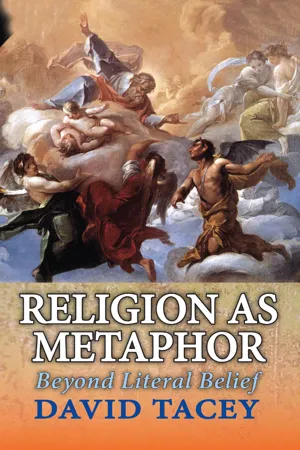
Biblical stories are metaphorical. They may have been accepted as factual hundreds of years ago, but today they cannot be taken literally. Some students in religious schools even recoil from the "fairy tales" of religion, believing them to be mockeries of their intelligence. David Tacey argues that biblical language should not be read as history, and it was never intended as literal description. At best it is metaphorical, but he does not deny these stories have spiritual meaning. Religion as Metaphor argues that despite what tradition tells us, if we "believe" religious language, we miss religion's spiritual meaning. Tacey argues that religious language was not designed to be historical reporting, but rather to resonate in the soul and direct us toward transcendent realities. Its impact was intended to be closer to poetry than theology. The book uses specific examples to make its case: Jesus, the Virgin Birth, the Kingdom of God, the Apocalypse, Satan, and the Resurrection. Tacey shows that, with the aid of contemporary thought and depth psychology, we can re-read religious stories as metaphors of the spirit and the interior life. Moving beyond literal thinking will save religion from itself.
Information
1
Miracles as Imagination
The symbolic language of myth will always be degraded
into a language of the tangible. Every epoch has the
critical task of correcting such perversions.
— Karl Jaspers1
into a language of the tangible. Every epoch has the
critical task of correcting such perversions.
— Karl Jaspers1
Mythos and History
There are elements of history in scripture, but the miraculous moments with gods, angels, devils, and other visitations are metaphors pointing to the presence of spirit in human experience. Such moments of presence are personified as supernatural “beings” according to the conventions of myth, which we today do not understand, and tend to either dismiss as nonsense or believe literally. Many secular people assume scripture writers were deluding themselves by seeing things that did not exist. Many religious people assume scripture writers were taking eyewitness accounts of supernatural happenings. Neither is true. Scripture writers were engaged in literary conventions and tropes that today’s believers and unbelievers fail to appreciate. Religion is literature and art that has been distorted by literal readings.
If modern poets, visionaries, or novelists write about their experience, and use myth or legend to amplify their thoughts and feelings, we do not assume they are talking about literal gods if they draw on Greek, Roman, or Hebrew mythology. On the contrary, we assume they are using mythic figures symbolically to amplify themes or visions. Then why do we read “the good book” in such a narrowly dogmatic way? Imagination has to be brought to bear on holy scriptures, so we can read them correctly.
Religious stories are to civilizations what dreams are to individuals. They are symbolically encoded messages from the depths of the human soul. Just as it would be inadvisable to interpret our dreams literally, in which case we would get into all sorts of trouble with the real world and human relationships, so we miss the inner meaning of scriptures by unimaginative readings. They are only loosely related to “reality” as we understand it. They demand reflection, contemplation, and an understanding of symbolic language. If we bring imagination and knowledge to bear on religious stories they can come to life in unexpected ways. At the same time, this metaphorical turn brings with it the advantage that religion loses its arrogant and absolutist sting, allowing us to combat the violence and discord to which literalism gives rise.
The metaphors of religion do not appear in a cultural vacuum. History and myth work together: there are historical occurrences that trigger metaphors to describe their inward meaning. Unless history has been turned into myth, the significance of historical events is not realized. As T. S. Eliot said: “history is a pattern of timeless moments.”2 Events by themselves do not establish truth. These events “mean” something, “want to say” something, and their timeless truths can be communicated only in metaphor. In the case of the gospels, the fact of Jesus’ existence (which I do not doubt) triggered the myth of the Christ who is eternal. The fact of his ministry, its emphasis on love and compassion, triggered the myth that he was God’s only begotten son. The fact that his disciples felt that his spirit still dwelt among them after the crucifixion triggered the myth of the resurrection, and so on. Metaphor and history work together to weave sacred history. Metaphor draws out the spiritual significance, while history acknowledges that certain events took place in time and space. But for too long, we have treated the significance as fact; a simple but fatal error.
The churches have failed to understand that the scriptures are a mixture of mythos and history, not pure history. I use the Greek term “mythos” advisedly. This term means sacred story, whereas the modern term “myth” has been debased and refers to falsity. We can revert to the English word “myth,” but only after we have familiarized ourselves with the proper meaning of the term and its Greek origins. It is impossible to call for a recovery of myth, or more respect for myth, if the word itself subverts all attempts to restore value. The debasement of the term is part of the crisis we face in trying to recover the meaning of religion. Western intellectual history has virtually undermined the platform upon which religion stands.
In recent times, partly as a defense against critical thinking, some churches have pretended that the Bible is primarily historical. The Bible is aware of history, to be sure, but “being aware of history and being historical are different things.”3 Northrop Frye admits that “the degree to which the Bible does record actual events can perhaps never be exactly ascertained:” The Bible looks at first like a historical narrative, but this impression is misleading, as Frye makes clear:
The historical narrative in the Bible is not really a history but a mythos or narrative principle on which historical incidents are strung. The narrative of the Bible is much closer to poetry than it is to actual history, and should be read as such.4
This is scandalous to naive believers who imagine every word is historical. Frye is adamant that the Bible is least historical when it comes to the miracles and wonders, which have to be read as sensational symbols of the life of the spirit, its quest to “overcome” our finite nature and material conditions. To take the miracles literally is to misread the Bible and end with a belief based on falsity. Such belief has almost nothing to do with faith, and does not give faith a chance to mature, confining it to childhood ideation.
Some scholars within the church attempt to preserve the cherished sense of history, as well as admit to the presence of myth. A case in point is George Caird, who was professor of exegesis of holy scripture at the University of Oxford. In The Language and Imagery of the Bible he said the metaphorical element does not invalidate the church’s claim that scripture is a narrative of historical events.5 Caird claims that “the New Testament lays great emphasis on the actuality of the events it records.”6 He then contradicts this by saying “at certain points the gospel tradition has been embellished with new detail and even new events.”7 But at what points are the tradition embellished? He does not say. He admits that “bare facts are never significant in themselves, but only when brought into relation with a tradition and seen in a framework of interpretation.”8 He places us in a whirlpool of competing claims. Frye is correct when he says fact is subordinate to myth in the Bible, and I suspect Caird agrees but is afraid to say so. As a conservative, Caird hedges around this fact, as he wants to toe the line and not create ecclesiastical disturbance. It is all very well for him to say that real events are “elevated” above the ordinary by literary devices, but only if the reader/believer is made aware that the Bible’s miraculous moments are to be read in the light of history-told-as-myth.
If we say scripture represents sacred history, emphasis has to be placed on “sacred” rather than “history” Caird is regarded as a pioneer of the metaphorical approach, but his conservatism destroys his courage and necessitates the rise of strong voices like Armstrong, Crossan, Frye, and Spong after him. His findings are muffled in a highly scholastic style, almost as if he did not want to be understood by the average reader or by those sitting in the pews. His exegesis of scripture made it apparent that the conventional readings of biblical language have been naive in the extreme, but he has an uncanny ability to fudge this point and end up saying little that is memorable. He was sitting on dynamite but did not want to bear witness to any explosions. He wanted to come back to church next Sunday and not change a word of any of the claims made by creeds, dogmas, and liturgies.
The history of Christianity is a history of errors. It has mistaken belief for faith, mythology for theology, and poetry for doctrine. The result is that a good religion has been ruined by its advocates, who got so caught up in literalism that its essence was lost. Its essence is more humble, yet more profound, than most believers have been able to realize. If we strip away the literalism, a real religion is left for us to appreciate—perhaps for the first time. But as this religion has presented itself to the world, it has adopted a fake appearance that most educated people have been unable to accept. When we reject this facade, we think we have rejected religion per se, but not so. We have only rejected the packaging of unimaginative churchmen. Baptist minister Harvey Cox tells of his crisis when he saw through the charade of his tradition. He almost lost everything, until it dawned on him that to confuse “belief with faith is simply a mistake”: “We have been misled for many centuries by the theologians who taught that ‘faith’ consisted in dutifully believing the articles listed in one of the countless creeds they have spun out.”9 His healthy skepticism is what saved his faith.
When religion adopted a literalist frame it set itself against reason and allowed itself to be taken down by scholars. As Eugen Drewermann writes:
We won’t give religion a solid foundation by seeking the truth of mythical texts in a place where it can’t be found: in the external world. Anyone who insists on this sort of logical confusion as an article of faith will involuntarily play into the hands of atheism and irreligion, instead of getting closer to the real point of the mythical traditions.10
A new tradition of celebrity atheists responds to the mysteries of the Bible with contempt, dismissing them as lies. Most atheists consider themselves more intelligent than believers because they have seen through the deception. This comes across in the interview style of Richard Dawkins and others, who talk to religious people as if they are morons. But the celebrity atheists rarely stop to wonder if what they are rejecting is the essence of religion. Indeed, one could say that what atheists are rejecting—literalism and idolatry—must be rejected by intelligent persons. Atheism has an important role to play, not only in society but in the formation of faith. I commend atheism insofar as it strips back religion and rejects the ways in which it has been misrepresented in the past.
The crisis of atheism is that it not only strips back the false overlay, but it goes further and denies there is anything of value in religion. We need to question the dogmatic claims, but not destroy the interior life of religion, which contains the best of what it means to be human. There is too much unraveling, an orgy of destruction, without attention to preserving what is worthwhile. In this regard, we have only just begun the great adventure of our time: sifting the chaff from the wheat, and preserving what is life giving and precious. Insensitive deconstruction can be seen as an early stage of faith, the stage in which faith tries to shrug off the burden of literalism.
We are faced with a conundrum in which those who believe in the Bible, and those who attack it, are caught by the notion that it is a historical document. Believers read scripture as good history, a depiction of things that happened, while unbelievers see it as bad history, a cooked-up version of events. Both are making errors and failing to ask the right questions. The Bible is an amalgam of myth and history. Some of what we read has historical credibility but the wonders and miracles are mythical images.
The Miracles of Jesus
The miracles of Jesus can be read as metaphors of the significance astir in the events of his ministry. I don’t believe there were any supernatural miracles performed by ...
Table of contents
- Cover
- Half Title
- Title Page
- Copyright Page
- Dedication
- Table of Contents
- Preface
- Acknowledgments
- Personal Introduction
- 1 Miracles as Imagination
- 2 Religion as Metaphor
- 3 The Soul’s Symbolic Code
- 4 Jesus the Metaphor
- 5 The Myth of the Virgin Birth
- 6 Waking Up
- 7 Apocalypse
- 8 Satan and Literalism
- 9 Resurrection: Ascending to Where?
- 10 Psyche and Symbol
- 11 After Belief
- Conclusion: Unveiling the Soul
- Index
Trusted by 375,005 students
Access to over 1.5 million titles for a fair monthly price.
Study more efficiently using our study tools.
Frequently asked questions
Yes, you can cancel anytime from the Subscription tab in your account settings on the Perlego website. Your subscription will stay active until the end of your current billing period. Learn how to cancel your subscription
No, books cannot be downloaded as external files, such as PDFs, for use outside of Perlego. However, you can download books within the Perlego app for offline reading on mobile or tablet. Learn how to download books offline
Perlego offers two plans: Essential and Complete
- Essential is ideal for learners and professionals who enjoy exploring a wide range of subjects. Access the Essential Library with 800,000+ trusted titles and best-sellers across business, personal growth, and the humanities. Includes unlimited reading time and Standard Read Aloud voice.
- Complete: Perfect for advanced learners and researchers needing full, unrestricted access. Unlock 1.5M+ books across hundreds of subjects, including academic and specialized titles. The Complete Plan also includes advanced features like Premium Read Aloud and Research Assistant.
We are an online textbook subscription service, where you can get access to an entire online library for less than the price of a single book per month. With over 1.5 million books across 990+ topics, we’ve got you covered! Learn about our mission
Look out for the read-aloud symbol on your next book to see if you can listen to it. The read-aloud tool reads text aloud for you, highlighting the text as it is being read. You can pause it, speed it up and slow it down. Learn more about Read Aloud
Yes! You can use the Perlego app on both iOS and Android devices to read anytime, anywhere — even offline. Perfect for commutes or when you’re on the go.
Please note we cannot support devices running on iOS 13 and Android 7 or earlier. Learn more about using the app
Please note we cannot support devices running on iOS 13 and Android 7 or earlier. Learn more about using the app
Yes, you can access Religion as Metaphor by David Tacey in PDF and/or ePUB format, as well as other popular books in Philosophy & Philosophy History & Theory. We have over 1.5 million books available in our catalogue for you to explore.