- 263 pages
- English
- ePUB (mobile friendly)
- Available on iOS & Android
eBook - ePub
About this book
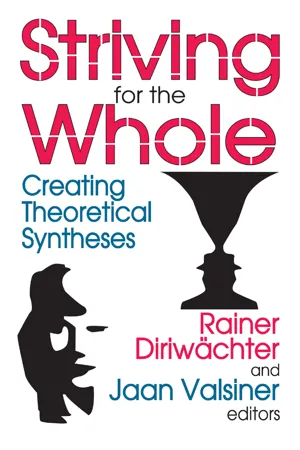
This unusual collection explores the development of ideas in psychology's past, and shapes them into a valuable resource for ideas in the discipline's future, with particular emphasis on holistic traditions in psychology. Diriwochter and Valsiner focus on developmental holistic psychology as advocated by the second school of Leipzig in Germany. Although largely neglected, this school of thought has provided some of the fundamental ideas necessary for a truly holistic approach in psychology. This volume includes Leibniz's dynamic holism and Ehrenfels' discussion about Gestalt qualities, which has generally been acknowledged as a major milestone in the formation of Gestalt psychology. Each chapter looks at the possible future of holistic psychology. Striving for the Whole contains several well-though out discussions on possible elaborations of holistic psychology by contrasting it with Ernst Boesch's cultural psychology, Pierre Janet's theory on emotions, and Jan Smuts holistic approach to personality theory. Discussions of holistic approaches in biology and evolutionary psychology, as well as a renewed look at Lloyd Morgan's comparative methodology, complete the volume. Striving for the Whole has been written by an international group of authors and will be of interest to students of the social sciences and intellectual history, and anyone who wants to dive deeper into holistic approaches that maintain their ties with empirical methodology. It is ideal for graduate and upper-level undergraduate courses in psychology.
Information
1
Leibniz’s Dynamic Holism*
Dortmund University
Leibniz’s philosophy is perhaps best known for its principles (of sufficient reason, continuity, differentiation, least effort, and pre-established harmony; see Ortega y Gasset, 1958) and for the idea that the rules of reasoning can be represented within a formal symbolic system to allow for computational or artificial intelligence (Davis, 2000). Yet, the emphasis placed on Leibniz’s rationalism has to some extent obscured the robust role that Leibniz saw for sensory experience, observation, and experiments in establishing factual or contingent truths to complement necessary or axiomatic truths.
With respect to life sciences, Leibniz provided a remarkable framework for investigating complex, organic, and particularly mental phenomena by conceiving the surface organization of phenomena as dependent on a deeper order of underlying micro-processes so as to account for the emerging organization (Duchesneau, 2003). In particular, Leibniz postulated genuine units (monads) as autonomous and predisposed tendencies of living activity resulting in a multitude of original worldviews. Unity and activity were the concepts on which Leibniz’s metatheory of being, his dynamic holism, essentially relied. Before going into this further, let us briefly turn to Leibniz’s remarkable life and career with outstanding achievements apart from philosophy.
Biographical Sketch
Gottfried Wilhelm Leibniz (1646–1716) was born into a pious Lutheran family in the Saxon city of Leipzig, Germany, near the end of the Thirty Years’ War. His father, Friedrich (1597–1652), was a professor of moral philosophy at Leipzig’s renowned university, at which his son enrolled as a student already in 1661. In his bachelor’s thesis “On the Principle of the Individual” (1663) Leibniz emphasized the value of the individual as a whole essence (entitate tota), not sufficiently described by matter or form alone. In 1666 he became qualified to lecture philosophy with a thesis “On the Art of Combination,” which anticipates some basic principles of modern computation, emphasizing that all reasoning may be generated by an ordered combination of elements, be it verbal (words, numbers) or nonverbal (colors, tones). His application for the degree of a doctor of law was, however, refused because of his (too young) age. As a consequence he went to the University of Nuremberg, located at Altdorf, where his dissertation “On Perplexing Cases” procured him the doctor’s degree of law at once followed by an offer of a professor’s chair in 1667.
Leibniz, however, declined the offer for an academic career and instead entered the service of the nobility. It was the Baron of Boineburg, a minister of the Elector of Mainz, who first employed him as a lawyer and diplomat. His duties took him to Paris, where he stayed from 1672 to 1676. Soon after his arrival at Paris, he lost his protector by death and thus was free to pursue his scientific interests. In search of financial support, he constructed a calculating machine which he presented to the Royal Society during a short visit to London in 1673. His intense studies of mathematics culminated in his invention of the infinitesimal calculus late in 1675. Leibniz sought a permanent position in Paris, but his efforts were in vain.
In 1676 he entered the service of the Duke of Hanover and remained there for forty years until his death in 1716. Serving this major German noble house (that became the British royal family by the end of his service), Leibniz played a major role in the European politics and diplomacy of his time. Remarkably, he managed to combine his work as a courtier with intellectual interests and activities of the most varied kinds. He served as a librarian and was instrumental in founding the Academy of Sciences in Berlin, Vienna, and St. Petersburg. His intellectual merits excel in mathematics and philosophy. He invented the differential and integral calculus independently of Newton (1643–1727) and his notation is the one in general use since. He introduced the binary system on which modern computer architectures rely. With Descartes (1596–1650) and Spinoza (1632–1677), he is regarded to belong to the three great seventeenth-century rationalists, but only recently historians of philosophy took notice that his approach was markedly less rationalist than Kant (1724–1804) had suggested. Rather, Leibniz stood “on the interface between the holistic and vitalist world-view of the Renaissance, and the atomistic and mechanistic materialism that was to dominate the eighteenth and nineteenth centuries” (Ross, 1984:1). Besides, we owe Leibniz seminal contributions to a multitude of rather specialized topics in which he anticipated notions that surfaced much later in biology, cybernetics, geology, medicine, physics, psychophysics, and neuroscience; he also wrote on economy, ethics, ethnology, history, law, linguistics, and theology (see Aiton, 1985; Jolley, 2005). Many of his ideas were far ahead of his time to be taken up with great delay—sometimes not until today.
The access to Leibniz’s work is difficult, since his contributions are scattered in journals, in tens of thousands of letters, and various unpublished manuscripts. Only two books, Combinatorial Art (1666) and Theodicy (1710) were published during his lifetime; two more books appeared posthumously—his Monadology (composed 1714) in 1720 and, in 1765 with huge delay, his New Essays on Human Understanding (completed 1705). To date, there is no complete edition of Leibniz’s writings, hence a full account of his work is not yet possible. Much of what is published has been so only in recent decades. Leibniz wrote in three languages: French, Latin, and (least often) German; only a small proportion of his writings is available in English (see Gregory Brown’s on-line bibliography: http://www.gwleibniz.com/).
A Universal Genius to be Recognized as Pioneer in Holistic Psychology
Leibniz’s life was so rich of various activities with achievements in so many and distinct areas that he may be best characterized as Universalgenie, a “universal genius” (Ross, 1984). In taking every of his single achievements in the context of everything else he did, single contributions are indeed prone to rival with and to obscure each other. The eminent mathematician, logician, engineer, philosopher, and physicists he was, he is hardly identified as a psychologist. Thus, it may come as a surprise even to experts to recognize Leibniz as a still underappreciated “pioneer of psychology” (Fancher & Schmidt, 2003), who particularly anticipated key issues of Gestalt psychology and Ganzheitspsychologie (Ehrenstein, 1983).
In fact, Leibniz is rarely mentioned in current textbooks of psychology, although one of the founding fathers of modern psychology, Wilhelm Wundt (1832–1920), had devoted him a whole monograph (Wundt, 1917). While Wundt was able to appreciate Leibniz as a philosopher of mind, as the one who conceptualized minute sensations that led Fechner (1801–1887) to develop his psychophysics, and as a pioneer in cross-cultural psychology (e.g., his detailed linguistic and ethnographic studies of China and other cultures) he could not yet foresee Leibniz’s role in a most recent field of psychology, that of artificial intelligence and virtual reality. “With his general conception that reasoning processes are reducible to mathematical-like computations, which in turn could be performed by machines, and with his anticipation of the binary notation that underlies the workings of modern digital computers, Leibniz deserves at least the title of intellectual grandfather to the modern movement of artificial intelligence” (Fancher & Schmidt, 2003: 12).
Even more astonishing is the neglect of Leibniz in the field of holistic approaches to psychology. We look for his name in vain in the representative texts such as of Ehrenfels, Koffka, Köhler, Krueger, Metzger, Uexküll, Volkelt, or Wertheimer (though see for some exceptions: Allport, 1955; Anschütz, 1953; Ehrenstein, 1947, 1965; Graumann, 1960; Huber, 1951). It is as if one had failed to see the forest for the trees. As we will see, the idea of Gestalt-like, supra-additive wholes is so central to Leibniz’s thinking that one is easily led astray, if one, in the tradition of Kant, tends to disregard its key significance.
Leibniz’s Search for Principles of True Unity
Initially, Leibniz was much impressed by the simplicity of the new atomic theory as set forth by the French philosopher Pierre Gassendi (1592–1655). His search for real unities, however, left him soon dissatisfied with its rather collective or accumulative assumptions of coherence. In his New System of the Nature (1695), he reports on his intellectual development that led him to adopt and conceptualize a holistic alternative.
At first, when I had freed myself from the yoke of Aristotle, I had believed in the void and atoms, for it is this which best satisfies the imagination. But returning to this view after much mediation, I noticed that it is impossible to find the principles of a true unity in matter alone, or in what is merely passive, since everything in it is but a collection or accumulation of parts ad infinitum. Now a multiplicity can be real only if it is made up of true unities which come from elsewhere and are altogether different from mathematical points, which are nothing but extremities of the extended and modifications out of which it is certain that nothing continuous could be compounded. Therefore, to find these real unities, I was constrained to have recourse to what might be called a real and animated point or to an atom of substance which must embrace some element of form or of activity in order to make a complete being. It was thus necessary to recall and in a manner to rehabilitate substantial forms which are so much decried today, but in a way which makes them intelligible and separates the use which must be made of them from their previous abuse. I found then that their nature consists of force and that from this there follows something analogous to feeling and to appetite; and that therefore it was necessary to form a conception of them resembling our ordinary notion of souls. But just as the soul must not be used to explain the detail of the economy of the animal’s body, so I judged in the same way that these forms ought not to be used to explain the particular problems of nature, although they are necessary to establish true general principles. Aristotle calls them first entelchies; I call them, more intelligibly perhaps, primitive forces, which contain not only the act, or the fulfillment of possibility, but also an original activity. (Leibniz, 1995: 116–117, emphasis in the original)
From his mathematical studies, in particular his method of the infinitesimal calculus, Leibniz knew how to analyze a complex variation (differential) and, conversely, how to gain a whole from a given value (integral). The idea of infinitesimal units that afforded such mathematical flexibility served to develop an alternative to the materialistic and mechanistic models. Leibniz asked for indecomposable units instead arguing that any material particle, no matter how small, can still to be subdivided further—hence, an ultimate material particle as a building block of the universe could be hardly obtained.
Furthermore, Leibniz’s access to the then newly constructed microscope, by courtesy of Anton van Leeuwenhoek (1632–1723), afforded him to observe at first hand the amazing spectacle of microorganisms within a drop of ordinary pond water. This gave rise to a vision of a universe filled with hierarchies of organisms, to the conception that “each portion of matter may be conceived as like a garden full of plants, like a pond full of fishes”; it led Leibniz to adopt active or vital properties, force or energy, as primal entities.
Active Units and Interactive Dynamics
Leibniz faced two major contemporary cosmological accounts. Atomists such as Gassendi postulated discrete atoms, but had problems to explain their composition into continuous wholes. Conversely, Cartesians took spatial continuity as their point of departure, but failed to account for discrete objects out of it. In order to resolve this dilemma, Leibniz assigned elementary physical units to points in geometric space and interpreted these units as centers of force. Mathematically, the infinitesimal calculus allows for such an operation in that differential geometric points on space curves are assigned acceleration vectors which correspond to physical forces, if the curves are conceived of as motion trajectories. Thus, energy constituted the essence of matter and the world consisted of an infinity of centers of force, permanently expressed in motion. Leibniz’s explanation of matter and space tried to avoid circularity in that his energy particles were themselves neither material nor, strictly speaking, even spatial.
Moreover, Leibniz challenged the conventional view of mechanical interaction. Although we tend to picture force as a thing which is transferred from one body to another, it is not a thing at all, but only a quality or state of things. Consequently, a force cannot literally be transferred from one body to another, any more than, say, a headache or color. Even in the case of balls ricocheting off each other on a billiard table their motions are permanently dependent on various other conditions, such as gravitational forces acting on them, properties of the table and its felting, air currents, and so on.
In fact, the resultant motion of a particular ball is more like the expression of the solution to an infinitely complex equation, than like receiving the baton in a relay race. Leibniz was quite right to interpret the laws of mechanics, not as laws governing the amount of force transferred from one colliding body to another, but as elegant mathematical formulae governing the evolution of whole complex systems fr...
Table of contents
- Cover
- Half Title
- Title Page
- Copyright Page
- Table of Contents
- Preface The Past and Future of the Whole
- Chapter 1 Leibniz’s Dynamic Holism
- Chapter 2 Christian von Ehrenfels
- Chapter 3 Genetic Ganzheitspsychologie
- Chapter 4 Felix Krueger and Ganzheitspsychologie: History of Psychology in Japan before and during World War II
- Chapter 5 Ganzheitspsychologie in Heidelberg
- Chapter 6 Jan Smuts and Personality Theory: The Problem of Holism in Psychology
- Chapter 7 Janet’s Emotions in the Whole of Human Conduct
- Chapter 8 Ernst E. Boesch’s Holistic Cultural Psychology
- Chapter 9 Comparative Methodology as the Human Condition: Conwy Lloyd Morgan and the Use of Animal Models in Science
- Chapter 10 Other Minds than Ours1
- Chapter 11 A Holistic Perspective in Natural Sciences
- Chapter 12 Dynamic Adaptive Psychology: Viewing the Individual through the Lens of Evolution and Development
- Conclusion Returning to the Whole—A New Theoretical Synthesis in the Social Sciences
- About the Contributors
- Index
Trusted by 375,005 students
Access to over 1.5 million titles for a fair monthly price.
Study more efficiently using our study tools.
Frequently asked questions
Yes, you can cancel anytime from the Subscription tab in your account settings on the Perlego website. Your subscription will stay active until the end of your current billing period. Learn how to cancel your subscription
No, books cannot be downloaded as external files, such as PDFs, for use outside of Perlego. However, you can download books within the Perlego app for offline reading on mobile or tablet. Learn how to download books offline
Perlego offers two plans: Essential and Complete
- Essential is ideal for learners and professionals who enjoy exploring a wide range of subjects. Access the Essential Library with 800,000+ trusted titles and best-sellers across business, personal growth, and the humanities. Includes unlimited reading time and Standard Read Aloud voice.
- Complete: Perfect for advanced learners and researchers needing full, unrestricted access. Unlock 1.5M+ books across hundreds of subjects, including academic and specialized titles. The Complete Plan also includes advanced features like Premium Read Aloud and Research Assistant.
We are an online textbook subscription service, where you can get access to an entire online library for less than the price of a single book per month. With over 1.5 million books across 990+ topics, we’ve got you covered! Learn about our mission
Look out for the read-aloud symbol on your next book to see if you can listen to it. The read-aloud tool reads text aloud for you, highlighting the text as it is being read. You can pause it, speed it up and slow it down. Learn more about Read Aloud
Yes! You can use the Perlego app on both iOS and Android devices to read anytime, anywhere — even offline. Perfect for commutes or when you’re on the go.
Please note we cannot support devices running on iOS 13 and Android 7 or earlier. Learn more about using the app
Please note we cannot support devices running on iOS 13 and Android 7 or earlier. Learn more about using the app
Yes, you can access Striving for the Whole by Jaan Valsiner in PDF and/or ePUB format, as well as other popular books in Psychology & History & Theory in Psychology. We have over 1.5 million books available in our catalogue for you to explore.