- 264 pages
- English
- ePUB (mobile friendly)
- Available on iOS & Android
eBook - ePub
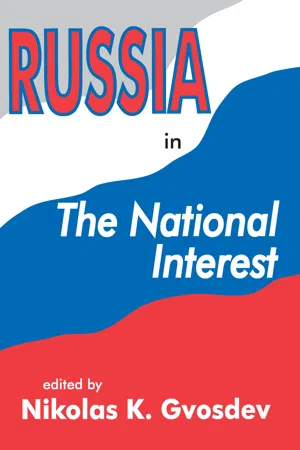
Russia in the National Interest
About this book
Since its inception, The National Interest, the leading realist journal of international affairs, has devoted a good deal of attention to the relationship between Moscow and Washington, from the dying days of the Cold War to the prospect of true Russian-American partnership following 9/11. This work brings together the reflections and ruminations of statesmen, policymakers, and academics on developments and forecasts about one of the world's leading geo political actors. This edited volume is the third in a series of readers co-produced by The National Interest and Transaction Publishers. Each brings together in one place prescient analysis and provocative assessments, this case, about Russia, published in the last decade. For some of the contributors, Russia is to be viewed with suspicion, a state whose current weakness has only retarded, not extinguished, its hegemonic ambitions to dominate Eurasia. For others, Russia is a strategic partner and prospective ally. This volume tackles the hard questions. Readers have the opportunity to listen in on a number of the great debates surrounding Russia policy. Is Russia finished as a great power, or will its influence grow in the coming years? Can a true partnership be forged between Washington and Moscow based on common interests and values? To what extent can Russia be integrated into the institutions of the Euro-Atlantic community? Has American policy aided or harmed the course of market reforms and democratization over the past decade? Is the -war on terrorism- a sufficient foundation for a new U.S.-Russia relationship? How can conflicting interests, whether in Iran, Iraq, or North Korea, be dealt with? This book presents a fascinating and multifaceted look at a country that is likely to remain a major factor in U.S. foreign policy in the twenty-first century. The list of distinguished contributors to this volume includes Zbigniew Brzezinski, William Odom, Stephen Sestanovich, Robert Legvold, Martin Malia, Alexey Pushkov, and Dimitri K. Simes.
Information
Part 1
Post-Soviet Expectations
1
Comrades in Arms: The Case for a Russian-American Defense Community
Fred Charles Iklé*
The strategic relationship now emerging between the United States and Russia opens a new chapter in world history. During most of this century, these two great nations could change their relationship only incrementally, if at all. But since last August, their relations have entered a period of unique malleability, one that offers an epochal opportunity for creative statesmanship.1
By far the most promising initiative now would be to inaugurate an American-Russian Defense Community, designed as an evolving program of cooperation that would build progressively closer links between the military establishments of the two sides. Such a relationship with the main heir to Soviet military power would greatly enhance America’s security in the coming era, when weapons of mass destruction will spread throughout the world.
As America’s foreign policy experts look to the future, they understandably draw on the ideas that served us so well in the recent past. The broad consensus that has emerged on the key goals for the post-Cold War world is constructed entirely out of Cold War concepts. These goals are: to preserve NATO and the alliance with Japan, to continue the policy of peace through nuclear strength, to maintain the “stability” of mutual deterrence, and to redouble our efforts against weapons proliferation. Some want to add a bit of fresh garnish to this platter of old leftovers by postulating an expanded role for the UN Security Council (henceforth supposed to be untrammeled by vetoes). Others draw comfort from the notion that if something like a Stalinist Soviet Union should re-emerge, we could always reconstitute our forces and man the old ramparts again.
Justifiably, warnings of what might go wrong are plenty. From Minsk to Vladivostok, democratic reform is incomplete, the new political structures are fragile, the economy is deteriorating from bad to worse. Attempts might be launched sooner or later to revert to the evil ways of the past. The widespread anxiety about such hazards is now focused on the near term— getting through the Russian winter, avoiding total economic collapse, preventing civil wars among former Soviet republics, and precluding any kind of misuse or accident among the thousands of nuclear weapons. To be sure, traversing the near term is a necessary condition for reaching a better future. But it is not sufficient.
President Bush has moved quickly and prudently to cope with the enormous upheaval in the former Soviet Union, to contain its risks, and to pursue new opportunities. His nuclear initiative in September, in particular, not only reduces present dangers, but opens highly promising avenues for fundamental long-term improvement. The basic transformation of the American-Russian relationship that is so essential for our security, however, cannot be completed within a year or two. Seventy years of Bolshevism and forty years of Cold War have left a hazardous legacy in both East and West—a spiritual, intellectual, and material pollution that will require a purposeful effort over many years to be rendered harmless. The old poisons could become virulent again, like an infectious disease that has lain dormant for a long time.
Danger Signs
Like no other dimension of the emerging American-Russian relationship, the military interaction will remain heavily burdened by the Cold War legacy. On both sides, old habits of the mind, reinforced by old bureaucratic practices, will subtly influence new strategic concepts and new war plans. Throughout the Northern Hemisphere, thousands of military artifacts will remain—armaments, electronic installations, air bases, naval ports, laboratories—that will invest the Cold War apparitions with tangible reality made of hard metal and reinforced cement. Amidst the detritus of the Soviet Union, the Russian Republic is inheriting vast arsenals, huge military forces, and an enormous (although presently crippled) military-industrial complex.
Given this context, we should seek to anticipate how things might go wrong in the evolving military relationship between America and Russia. At first brush, we may find it reassuring to see how military officers from both sides get along with each other. The military harbors less animosity toward its former Cold War adversary than other population groups do. American military leaders are eager to develop cordial and cooperative relations with their Soviet counterparts; to speak to them “as a friend—no longer as an enemy,” as General Colin Powell recently told a group of visiting Soviet officers. And the Soviet military has shown that they reciprocate this sentiment.
Underneath this new comity, however, a dangerous dynamic threatens to push America and Russia into a new military confrontation. One way in which this dynamic works is through the growing military strength of other nations that are seen as potential adversaries by Washington or Moscow, and hence as compelling the United States, or Russia, to acquire compensating military strength. For example, many Americans are cautioning against further reductions in the U. S. defense budget, for fear that American forces might not be strong enough later this decade to defeat “another Iraq.” Similarly, Russia’s new military leaders anticipate that their nation will have to be armed against ever more sophisticated weaponry among (unnamed) nations to the south, and perhaps even against independent armies that are being established by some of the other former Soviet republics. Strategic planners both in America and Russia will surely want to see their own nation’s military technology stay well ahead of these potentially threatening new powers.
Alas, with such efforts to arm against emerging “Third World” military threats, America and Russia will stumble into new kinds of arms competition between each other, covering a wide range of weapons developments. And the international arms trade will add fuel to this fire. Because of sharply declining defense budgets at home, arms manufacturers in the United States, Western Europe, and the former Soviet Union are all anxious now to find new markets. The few importers in this buyers’ market who are still solvent can demand some of the best and latest technologies. It will not take long for nations acquiring such advanced armaments to be seen—either by Washington or Moscow—as new military threats.
The dynamic that levers America and Russia toward a new military confrontation also includes tensions created by secret and possibly illicit weapons developments. In spite of glasnost, the political transformation in Moscow, and the verification arrangements of recent arms accords, the battle between openness and secrecy is far from over—not only in the Soviet military establishment that is being inherited by Russia and other republics, but in the U.S. military as well.
When the detailed verification provisions of START were finally being settled, it was the American negotiators more often than the Soviet ones who insisted on limiting access for the other side’s inspectors. Indeed, protecting the secrecy of certain military technologies had a higher priority for the United States than enlarging the agreed scope for verification. For example, the United States sought to protect technological secrets of its radar-evading “stealth” aircraft.
For the Soviet military, shielding its latest technology from American “espionage” may be less important than keeping other kinds of secrets. Quite likely, the Soviet military establishment still keeps some ugly skeletons in its closet. When former Soviet Foreign Minister Eduard Shevardnadze admitted that the Krasnoyarsk radar station in Siberia violated the ABM Treaty, Soviet military officers still sought to deny culpability. And the story has yet to come out, it seems, on violations of the treaty banning biological weapons.
The old penchant of the Soviet military for pushing to the very edge of what arms agreements allow—and sometimes well beyond—may not have been entirely eradicated by the democratic revolution. Besides, the complexities and ambiguities of recent arms agreements will provide ample opportunity for hard to-prove cheating. In this environment, the cloak of secrecy will do double duty for the self-styled “patriots” in Moscow. It will shield them from American arms control monitors as well as from budget-conscious economists in their own government. Indeed, in the coming years, some Soviet officers and managers of arms industries may seek to perpetuate old practices of secrecy, not as protection from potential foreign enemies, but to keep their parliament and public in the dark about the burden that their military continues to impose on the nation’s economy.
Tensions caused by military secrecy could mar American-Russian relations in many ways. On both sides, it is safe to predict, bureaucracies will show great zest and ingenuity in creating confrontational issues about “espionage” and “cheating.” Secrecy is a customary companion of military research projects. And it is to be expected that both the American and Russian military establishments will continue to conduct certain research projects whose purpose, at least in part, will be to stay ahead of the former Cold War adversary.
Nuclear Gridlock
Among Americans associated with nuclear weapons research, there is nearly unanimous conviction that the United States must continue to test nuclear weapons, regardless of what happens to nuclear testing in the former Soviet Union. Since the 1950s, Moscow has favored a ban on all nuclear testing, while Washington’s position has shifted back and forth between reluctantly considering such a ban and opposing it outright. In prior decades, the American reluctance was due, in part, to the fear that the Soviet Union could easily cheat in ways that would not yield sufficiently unambiguous evidence. Today, the Soviet nuclear weapons establishment is under political pressure not to resume testing for environmental reasons. Should current differences on nuclear testing between Washington and Moscow persist for several years, those in Moscow who want arms spending again to increase will argue that one-sided nuclear testing by the United States is beginning to undermine the Soviet nuclear deterrent.
The hoary dispute about nuclear testing is merely a skirmish in a larger battle—the emancipation of nuclear strategy from Cold War thinking. The warp and woof of nearly all strategic thought—not only in the United States and the former Soviet Union, but also in France and Great Britain—remains the East-West enmity of the last forty years. And this strategic thought remains locked into place in each of these countries by their equally dated nuclear arsenals.
To be sure, we have heard some good news lately. President Bush decided in September to withdraw most of America’s so-called “theater” nuclear weapons, and President Gorbachev agreed to reciprocate. In one fell swoop, a large artifact in the Cold War museum of nuclear horrors is thus to be dismantled.
What was the purpose of this artifact? The story reaches back to the early 1950s, when the United States began to deploy theater nuclear weapons for two reasons: as a means of nuclear retaliation less massive than the strategic bomber force, and to give the U.S. Army—which was jealous of the Navy’s and the Air Force’s nuclear missions—its own nuclear arms. To keep a long story short, since the late 1950s, the various rationales for these weapons have disappeared one by one. In particular, the principal target for American theater nuclear weapons—the Red Army—has gone home.
As these changes occurred, those who believed strongly in the merits of theater nuclear weapons reached for a metaphysical rationale: that nuclear weapons based forward on the territory that might be attacked would provide a more credible deterrent than weapons based in the rear. Here is a reminder that military doctrine based on disconfirmed beliefs can survive for decades.
This brings us to the bad news about the role of nuclear strategy in the emerging American-Russian relationship. Even though theater nuclear weapons will cease to burden this relationship, a Cold War gridlock still persists for “strategic” nuclear weapons—the thousands of nuclear arms on missiles and bombers of intercontinental reach.
During the last four decades each superpower built an enormously elaborate apparatus capable of totally destroying the other and designed so that this cataclysm could be irrevocably unleashed within minutes—on purpose, or (perhaps) by accident. The risk that this supposedly stable system might end in the superpowers’ mutual suicide has not yet been eliminated. While the combination locks on nuclear weapons that many people now confidently promote might ameliorate this risk, they cannot eliminate it. A safeguard system relying on codes that would instantly have to be passed to thousands of command posts needs to be renewed and tested from time to time. (The Chemobyl reactor did have safeguards; it exploded because of a mismanaged test of its safeguard system!)
The dangers inherent in this nuclear legacy will continue to create new tensions in the American-Russian relationship. Whenever one side modernizes elements of its strategic forces, the other side will find reason to worry. Military staffs on each side will continue to perform calculations to estimate whether the Other Side (who used to be the Enemy) could somehow launch a first strike without having to fear massive and certain retaliation. On each side, estimates will also be prepared on the number of minutes within which the retaliatory strike would have to be launched before the codes to unlock nuclear weapons could no longer be transmitted to the missile and bomber crews. Such Cold War imagery is likely to persist, like a genetic defect, long after the conflict itself has ended.
Woe and Wickedness
Threats from third nations, competition in military research, and contradictions in nuclear strategy all have the potential to ratchet the United States and Russia toward a new enmity. To make matters worse, as these pressures and tensions do their work, they will be exacerbated on occasion by accidents, mistakes, or mischief—the woeful triplets that always intrude into human affairs.
A future dispute between Washington and Moscow about some secret military research project, for example, might suddenly become inflamed because of an accident that, to Americans, looked like a hostile act planned in Moscow at the highest level—the Soviet shooting down of a Korean airliner in 1983 comes to mind. Disagreements about a new arms program (ostensibly directed against third country threats) might be aggravated by incidents involving “spies” and denial of legitimate access for arms control inspectors. Such incidents, perhaps started by junior officers, could well be magnified by mistakes higher up in the decision chain.
To make matters worse, scattered amidst all these combustible tensions between Moscow and Washington will be plenty of mischief-makers. Like smoldering embers, Bolshevik hatred of the West will linger on in the minds of many senior officials in Russia. In all the former Soviet republics, the older generation had to spend its formative years in a din of anti-Western locutions, distortions, and lies. One recalls that several years after glasnost had swept such old-think aside, then KGB Chief Kryuchkov and Prime Minister Pavlov still gave speeches bristling with hostility toward the West. Although these two men are facing trial as leaders of the August coup, years from now like-minded Bolsheviks might again—or still—occupy positions of influence in the lands that Stalin ruled.
In 1920, Lenin asserted that “the real basis of contemporary international politics is the coalition of all powerful capitalist countries of the world against Soviet Russia”; and Stalin in 1925 foreshadowed the Cold War era by declaring that “the world is now divided into two camps.” Two camps—“us” and “them”—who will destroy whom? Paint these old fighting words with lush new colors of Russian nationalism, omit that tedious Marxist theorizing, and you have the core of a new ideology for Russia’s unreconstructed Bolsheviks to rally throngs of discontented youths—that essential ingredient for a political mass movement.
If, sometime during this decade, such a political movement were to become influential in Russia or to gain controlling power, much of the enormous Soviet military establishment would still exist. It will take many years and strong political leadership (both in short supply) to transform a major part of the gigantic Soviet arms industries into genuine civilian enterprises, to deactivate substantial military forces, and to dismantle excess armaments, bases, and military infrastructure.
The American-Russian military relationship would therefore have a decisive influence—for better or for worse—if a reactionary political movement in Russia sought to stir up tensions with the United States. Unless most of the Cold War legacy had been cleared away in the meantime, a new Bolshevik-nationalist-fascist movement could readily gain ardent support throughout the Russian military establishment. A long list of growing American “threats” could easily be compiled: continued U.S. nuclear tests, undiminished U.S. naval superiority, expanded deployment of the “stealth” and precision technologies that won the Gulf War, and the survival of NATO and of most U.S. bases that are “encircling” Russia even though the Warsaw Pact has been abolished.
A Gathering Storm
One recalls that after the First World War, Germany became a democratic nation free of its imperial burdens. During its first four years, to be sure, the new Weimar Republic had a troubled time. It suffered a string of disasters—a Communist putsch, a Nazi putsch, hyperinflation, food riots—the kind of tribulations that people in Moscow are now worried about. During the following five years, however, Germany enjoyed stable democratic government, vigorous economic growth, minimal unemployment, friendly relations with all its neighbors, and a burst of extraordinary cultural creativity. Europe and the world seemed at peace. Suddenly, the Great Depression and its wave of massive unemployment tilted the political forces in Germany (and in Japan as well) in favor of an ideology of violence and expansion.
Yet Adolf Hitler could not have consolidated his power, much less launched his sweeping territorial conquests a mere seven years later, had the German military establishment not been so willing and so well prepared to revert to a policy of imperial expansion. Throughout the seemingly peaceful Weimar years, the German military, stuck in their 1914 mentality, saw the world as divided into two camps—and readied themselves accordingly.
History, of course, will not repeat itself—not exactly. And every lesson from history can be contradicted with another one. Should we heed today the lessons from the 1920s, or the lessons from the 1930s? Were France and Great Britain too slow in the 1920s in weaving closer ties with Weimar Germany, especially with its military? Or were they too slow in rearming themselves in the 1930s? If again “the Russians are coming,” how should the United States respond?
The Pentagon’s answer today is “reconstitution,” by which is meant the rebuilding and refurbishing of America’s armed forces. Defense Secretary Dick Cheney has rightly emphasized that such a rearmament effort would entail building “wholly new forces” whose equipment and weaponry would have to be developed long in advance. Much of the equipment that played a crucial role in the American victory over Iraq, Cheney pointed out, “was developed 20 or 30 years ago.” Unless the Pentagon keeps funding a wide range of research and development projects, the United States will be ill prepared to rebuild its military strength if it had to meet a global crisis in the future.
In this age of turmoil throughout vast reaches of Eurasia, to maintain a ca...
Table of contents
- Cover Page
- Title Page
- Copyright Page
- Contents
- Introduction: The Russian Dichotomy
- Part 1 Post-Soviet Expectations
- Part 2 Russia: Ally or Adversary?
- Part 3 Culture and Society
- Part 4 Russia Under Putin
- Afterword
Trusted by 375,005 students
Access to over 1.5 million titles for a fair monthly price.
Study more efficiently using our study tools.
Frequently asked questions
Yes, you can cancel anytime from the Subscription tab in your account settings on the Perlego website. Your subscription will stay active until the end of your current billing period. Learn how to cancel your subscription
No, books cannot be downloaded as external files, such as PDFs, for use outside of Perlego. However, you can download books within the Perlego app for offline reading on mobile or tablet. Learn how to download books offline
Perlego offers two plans: Essential and Complete
- Essential is ideal for learners and professionals who enjoy exploring a wide range of subjects. Access the Essential Library with 800,000+ trusted titles and best-sellers across business, personal growth, and the humanities. Includes unlimited reading time and Standard Read Aloud voice.
- Complete: Perfect for advanced learners and researchers needing full, unrestricted access. Unlock 1.5M+ books across hundreds of subjects, including academic and specialized titles. The Complete Plan also includes advanced features like Premium Read Aloud and Research Assistant.
We are an online textbook subscription service, where you can get access to an entire online library for less than the price of a single book per month. With over 1.5 million books across 990+ topics, we’ve got you covered! Learn about our mission
Look out for the read-aloud symbol on your next book to see if you can listen to it. The read-aloud tool reads text aloud for you, highlighting the text as it is being read. You can pause it, speed it up and slow it down. Learn more about Read Aloud
Yes! You can use the Perlego app on both iOS and Android devices to read anytime, anywhere — even offline. Perfect for commutes or when you’re on the go.
Please note we cannot support devices running on iOS 13 and Android 7 or earlier. Learn more about using the app
Please note we cannot support devices running on iOS 13 and Android 7 or earlier. Learn more about using the app
Yes, you can access Russia in the National Interest by Nikolas K. Gvosdev in PDF and/or ePUB format, as well as other popular books in Politics & International Relations & International Relations. We have over 1.5 million books available in our catalogue for you to explore.