- 216 pages
- English
- ePUB (mobile friendly)
- Available on iOS & Android
eBook - ePub
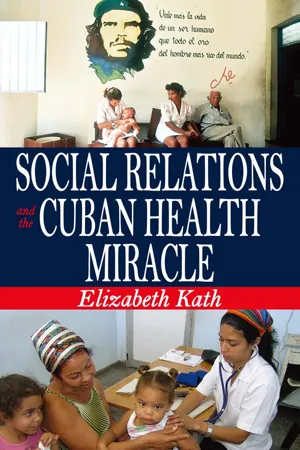
Social Relations and the Cuban Health Miracle
About this book
For Cuba's supporters, health is the most commonly cited evidence of the socialist system's success. Even critics often concede that this is the country's saving grace. Cuba's health statistics are indeed extraordinary. This small island outperforms virtually all of its neighboring countries and all countries of the same level of economic development. Some of its health statistics rival wealthy industrialized countries. Moreover, these health outcomes have resulted against all odds. Setting out to unravel this puzzle, the author finds that Cuba possesses an unusually high level of popular participation and cooperation in the implementation of health policy. This has been achieved with the help of a longstanding government that prioritizes public health, and has enough political influence to compel the rest of the community to do the same. On the other hand, popular participation in decision-making regarding health policy is minimal, which contrasts with the image of popular participation often promoted. Political elites design and impose health policy, allowing little room for other health sector groups to meaningfully contribute to or protest official decisions. This is a problem because aspects of health care that are important to those who use the system or work within it can be neglected if they do not fit within official priorities. The author remains, overall, supportive of health achievement in Cuba. The country's preventive arrangements, its collective prioritization of key health areas, the improvements in public access to health services through the expansion of health facilities and the provision of free universal care are among the accomplishments that set it apart. The sustainability and progress of these achievements, however, must involve open recognition and public discussion of weaker aspects of the health system.
Information
1
Introduction and Background
Introduction
Cuba, one of the world’s most globally-isolated countries with a generally poor record of economic development, has achieved exceptionally positive health indicators that are comparable with those of wealthy industrialized countries. Moreover, these outcomes have been sustained, and some improved, despite the severe external crises the country has faced including the collapse of the Soviet Union in the early 1990s and an ongoing U.S. embargo. The apparent miracle of the country’s continued health improvements despite its troubled economic situation has sometimes been described as the “Cuban Paradox” (Spiegel and Yassi 2004; Dotres Martinez 2001; Birch and Norlander 2007; Field 2007). Cuba’s post-1959 health achievements have won almost unanimous international praise. Glowing accounts of the country’s health record have regularly appeared in academic literature from a range of disciplines, in reports from international agencies and in the Cuban and world media (Waitzkin et al. 1997; Lunday 2001; Coughlin 2005; Spiegel and Yassi 2004; Santana 1988; Feinsilver 1993; Nayeri 1995; Danielson 1981; Rodriguez et al 2008; Whiteford et al 2008). In addition, it has been frequently suggested that other countries could learn from Cuba’s example (De Vos 2005; Dresang et al. 2005; Moore 2007; Yudkin et al 2008; Keon 2009; Grattan 2010). Even World Bank officials, despite a record of promoting market-led economic growth and supporting policies as the most reliable route from the problems of underdevelopment, have acknowledged some of the country’s accomplishments. In 2001, World Bank President James Wolfensohn publicly congratulated the island on having done “a great job” in health and education (Climan 2001). The Bank’s Vice President Jo Ritzen commended the country’s infant mortality and under-five mortality rates, encouraging other poor countries to study its social welfare policies. More recently, the United Nations Development Program (UNDP) praised Cuba’s position in the Human Development Index (HDI)1; it ranked fiftieth (in 2006) amongst 177 countries around the world (Escambray Digital 2007).
Cuba achieved its health outcomes via an unconventional path that explicitly rejects the prevailing liberal development model favored by international development institutions including the International Monetary Fund (IMF) and World Bank. The liberal model has tended to view increased spending on health (seen as a natural progression from increased private investment and the GDP growth thereby expected) as the most effective means for countries to improve outcomes in social spheres generally. In Cuba, health and education and other social programs have been politically prioritized despite the country’s poverty-ridden status, and even through the extreme economic crises the country has faced. Statistical outcomes indicate the country has been highly effective in implementing these political decisions, despite resource shortages.
However, since material resources alone cannot explain the country’s achievements in health, there is reason to suppose more intangible elements have been involved. Although Cuba’s unusual health outcomes are widely recognized and applauded, the academic literature on the subject is still somewhat limited. Most of the studies of Cuba’s health system link the country’s success to various health policies (including free health care, the emphasis on primary care, the expansion of health facilities and others). However, in order to fully understand these health policies, I contend that we need to know how they are designed and implemented. The arrangements for collective decision-making in the Cuban health sector are still relatively under-researched but warrant more attention given the country’s apparent effectiveness in this area.
This book adopts a new approach to the puzzle of Cuba’s health outcomes by drawing on findings emerging from two bodies of recent theoretical literature; those dealing with “social capital” and “state capacity.” Each presents challenges to liberal conceptions of development and societal progress. The concept of social capital, which has generated widespread enthusiasm in recent decades, is fundamentally an attempt to augment the traditional conception of capital as a purely material phenomenon by drawing attention to capital’s non-economic dimensions. This follows from earlier discussions of human capital and cultural capital. The essence of social capital is the recognition that societies’ developmental capacities are inseparable from social relations and social structures. During the same period there has been a revival of interest in state capacity; this literature has argued that liberals and Marxists alike have underestimated the capacity for the political realm to achieve what constituents want it to do. This book employs some of these theoretical developments as a new way to understand the unusual case of Cuba’s success in achieving its health goals. Drawing on elements of these literatures, it is hypothesized that Cuba’s ability to improve its public health outcomes might be the result of effective public institution-building, particularly the development of formal structures permitting public participation in the processes of health policy design and implementation.
For the purposes of this project, a specific health program (the Maternal-Infant Program or PAMI) was chosen as a focal point to gain insights into the overall system. The PAMI was selected partly because it is recognized as Cuba’s most prioritized program and has produced some of the country’s more impressive statistical outcomes (especially maternal and infant mortality indicators). The focus on a discrete and delimited segment of the health system was also a way to permit a thorough study that nevertheless fitted within the project’s scope. The empirical research for this project included a total of nine months of fieldwork in Havana. Key components of this work were qualitative interviews with 24 experts representing significant groups or institutions associated with the PAMI. These included representatives from the Ministry of Public Health, family doctors, medical specialists based at policlinics and maternity hospitals, representatives from the Federation of Cuban Women (the mass organization most directly involved with issues of maternal and infant health), social workers, teachers and researchers in the area of maternal-infant health, and employees from various other institutions linked to the program (see “List of Interviews Conducted in Cuba,” pages vii–viii). The fieldwork in Havana also allowed considerable immersion, including ongoing informal conversations and personal observations, which informed the research. In addition to interview material, selected excerpts from my field notes have also been included in the book. The research also draws significantly on secondary literature related to Cuba and its health system, mostly from international sources, but also data and literature collected in Cuba. Some data has also been included from interviews conducted in Australia with Cuban expatriates in the period after my return from Cuba.
The findings of this research were unexpected in the sense that they present a significant challenge to the image of the country’s health system as it is usually portrayed in both the Cuban and international literature. The qualitative research methods and specific attention to the social dimensions of the health system have led to some new explanations for the system’s successful outcomes. However, they also uncovered a number of the system’s weaknesses that are usually overlooked due to a common fixation on quantitative assays of population health as sole measures of the health system’s quality.
Within Cuba’s health sector, considerable institutional capacity has been built up through the formalization of cooperative relationships between various actors (for example, between health workers and patients, between different institutions and sectors). This, I have argued, is an aspect of social capital that is quite well-developed. The concerted and coordinated effort of these diverse participants towards common objectives has considerably added to the country’s capacity to achieve national health goals. In line with this, the research found that the “state” in Cuba is in some senses fairly “embedded,” particularly in its capacity to mobilize popular action to achieve health initiatives. Unfortunately, while there is a great deal of popular cooperation and participation in the implementation of health policy in Cuba, the contribution, either direct or indirect, of different social groups to policy design is quite underdeveloped. This lack of negotiation with social groups has indirectly produced a number of adverse consequences that detract from the quality of health care and threaten the sustainability of the country’s health achievements. A summary of how each chapter develops these arguments follows.
Summary of Chapters
Chapter 2: Social Capital and State Capacity
The purpose of this chapter is to identify and explain the aspects of social capital and state capacity that will be employed in this book. Existing literatures will be examined in an attempt to find conceptual tools for approaching and understanding the Cuban case. Since social capital is still an unsettled and disputed concept, a significant part of the chapter is devoted to clarifying what is meant by social capital for the purposes of this project. This involves a critique of the prevailing treatment of social capital as “social connectedness,” and a recasting of the concept more in line with the structurally-located work of Coleman and Bourdieu and in the light of earlier debates regarding the social dimensions of capital. This discussion leads into a summary of a recent revival of interest in positive theories of “the state,” often rendered as the developmental capacities of the state. In view of previous academic investigations of Cuba’s health system, the relevance and potential contribution of social capital and state capacity are explained. Drawing on this theoretical discussion of social capital and state capacity, the project’s preliminary hypothesis and research questions and details of the research conducted in Cuba are outlined.
Chapter 3: Political Will and Cooperative Institutional Arrangements
The main aims of this chapter are to illustrate the political prioritization given to maternal-infant health in Cuba and to highlight a number of institutional characteristics of the Cuban health system that have directly improved the country’s capacity to achieve its health goals. The first section provides a background explanation of the various reasons why Fidel Castro and his government maintained a prolonged commitment to population health improvements (particularly in maternal-infant health), including its humanitarian, political, and symbolic motives. The following section details the nature of interaction between health workers and the Cuban population, particularly with regard to the PAMI. The design of health provision that prescribes regular contact between health workers (especially family doctors) and every citizen in their designated catchment area is quite unique to Cuba. This interaction is sustained through routine procedures for proactive, preventive monitoring of the population to avert factors leading to maternal-infant morbidity and mortality, as well as other health problems. That family doctors are required to serve long periods living in a defined community also allows long-term doctor-patient relationships, which improve doctors’ knowledge of individual cases and assists with early diagnosis of health risks. A third section details a well-developed system of inter-institutional and inter-sectoral cooperation and the various ways in which this has facilitated Cuba’s effectiveness in health policy implementation. Collaboration between different health institutions allows resource sharing and thereby increased public access to limited medical equipment and supplies. That family doctors, social workers and specialists work collaboratively on each pregnancy case (including regular communication and routine information sharing) improves the detection of risk factors and the general comprehensiveness of attention to each pregnancy case from its early stages. Furthermore, the contributions of sectors outside health reduce environmental, social and other factors that can detrimentally affect health outcomes. Considering that other countries have had limited success with inter-sectoral collaboration, the high level of public and systemic compliance with state health goals in Cuba is unusual. The final section of the chapter argues that this institutional cohesion—as well as popular mobilization and compliance with often interventionist measures to improve maternal-infant health outcomes—is the result of an organizational hierarchy controlled by a politically dominant and long-standing government that exerts pressure on all other levels of the system to ensure that its health goals are met.
Chapter 4: The Limits of State Capacity and Social Capital in a Top-Down System: Exclusion and Non-Participation
As Chapter 4 explains, the various institutions of the Cuban health system operate with unusual cohesion and unity in the pursuit of clear health goals, and this has been a significant contribution to state capacity. That this cohesion is maintained is largely attributable to the Cuban government. Its political dominance in the health sector has ensured health improvements remain a priority and that health goals are clearly defined. This is one aspect of state embeddedness that seems to be well-developed in Cuba’s health sector; that is, the ability of state elites to marshal widespread cooperation and participation in the implementation of health plans. It was initially hypothesized that popular participation in the health policy-making process might have been part of the explanation for this effectiveness in implementation. As is outlined in this chapter, however, the research found very little evidence of negotiation between state elites and other social groups involved (patients who use the system and professionals with technical knowledge) in the process of health policy design. Rather, central state authorities were found to retain a monopoly over decisions regarding public health goals and policies; compliance is, for the most part, imposed rather than negotiated. These paternalistic arrangements contribute to a number of adverse consequences which are outlined in this chapter. Moreover, many of these consequences counteract the government’s proclaimed health goals by undermining the quality of health care and threatening the system’s chances of long-term sustainability. Lack of negotiation in the policymaking process can therefore be construed as a state weakness. I argue therefore that state capacity has not been satisfactorily consolidated in Cuba. From the analysis it can be inferred that for political principles and public policy competencies to be entrusted or embedded, collective decisions need to be whole-heartedly endorsed by the populace, not merely imposed.
Chapter 5: Underground Health Care Arrangements as Temporary Solutions and Long Term Challenges to the Formal System
The Cuban health system may the...
Table of contents
- Cover
- Half Title
- Title Page
- Copyright Page
- Table of Contents
- Acknowledgments
- List of Interviews Conducted in Cuba
- List of Abbreviations
- Preface
- 1. Introduction and Background
- 2. Social Capital and State Capacity
- 3. Political Will and Cooperative Institutional Arrangements
- 4. The Limits of State Capacity and Social Capital in a Top-Down System: Exclusion and Non-Participation
- 5. Underground Health Care Arrangements as Temporary Solutions and Long Term Challenges to the Formal System
- 6. Conclusion
- References
- Index
Trusted by 375,005 students
Access to over 1.5 million titles for a fair monthly price.
Study more efficiently using our study tools.
Frequently asked questions
Yes, you can cancel anytime from the Subscription tab in your account settings on the Perlego website. Your subscription will stay active until the end of your current billing period. Learn how to cancel your subscription
No, books cannot be downloaded as external files, such as PDFs, for use outside of Perlego. However, you can download books within the Perlego app for offline reading on mobile or tablet. Learn how to download books offline
Perlego offers two plans: Essential and Complete
- Essential is ideal for learners and professionals who enjoy exploring a wide range of subjects. Access the Essential Library with 800,000+ trusted titles and best-sellers across business, personal growth, and the humanities. Includes unlimited reading time and Standard Read Aloud voice.
- Complete: Perfect for advanced learners and researchers needing full, unrestricted access. Unlock 1.5M+ books across hundreds of subjects, including academic and specialized titles. The Complete Plan also includes advanced features like Premium Read Aloud and Research Assistant.
We are an online textbook subscription service, where you can get access to an entire online library for less than the price of a single book per month. With over 1.5 million books across 990+ topics, we’ve got you covered! Learn about our mission
Look out for the read-aloud symbol on your next book to see if you can listen to it. The read-aloud tool reads text aloud for you, highlighting the text as it is being read. You can pause it, speed it up and slow it down. Learn more about Read Aloud
Yes! You can use the Perlego app on both iOS and Android devices to read anytime, anywhere — even offline. Perfect for commutes or when you’re on the go.
Please note we cannot support devices running on iOS 13 and Android 7 or earlier. Learn more about using the app
Please note we cannot support devices running on iOS 13 and Android 7 or earlier. Learn more about using the app
Yes, you can access Social Relations and the Cuban Health Miracle by Elizabeth Kath in PDF and/or ePUB format, as well as other popular books in Politics & International Relations & Social Policy. We have over 1.5 million books available in our catalogue for you to explore.