- 281 pages
- English
- ePUB (mobile friendly)
- Available on iOS & Android
eBook - ePub
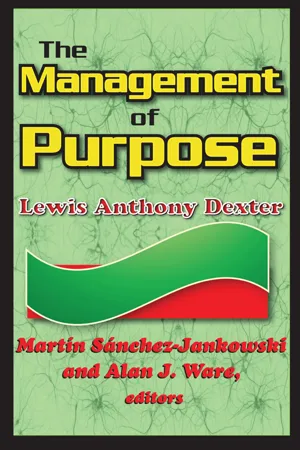
The Management of Purpose
About this book
Lewis Anthony Dexter may well have been one of the better known and least appreciated political scientists of the last century. This outstanding collection of Dexter's writings, demonstrates why Dexter remains important. The volume off ers solid reasons for researching the topics Dexter pioneered, and is a masterful guide to his thought and analyses. Dexter's writings derive from a multifaceted career. The Management of Purpose is organized into three broad subject areas: sociology, political science, and practicing social science. Dexter's notions of what constituted sociology and anthropology and his understandings of these areas and how to use them to illumine political matters are unusual. His use of multiple types of evidence, including history and logic, enables him to make significant contributions to the study of society's response to social problems. His work on labeling theory shows that social labels have a power that both transcends and distorts reality. Dexter was also a pioneer in the interactionist perspective, linking the labeled and those doing the labeling, and in demonstrating how organizations tend to compartmentalize and specialize. Dexter's work provides the analytic tools to enable readers to better understand many of the issues that remain a part of the American political landscape.
Information
Part I
Sociology
1
“Be Not the First”
What price unorthodoxy? “There is nothing more bothersome … than to alter entrenched habits. That is what the innovator wants done when he advocates a new ritual in the church, a new technique in the file department, a new labor saving device in the factory.”1
Spoonfuls of salt should always be poured on one of the favorite beliefs of the folklorists of self-help. It is simply not true that ingenuity, inventiveness, and a perception of new needs and new devices smooth the way to promotion and pay. In fact, a readiness to recommend reforms is one of the greatest handicaps under which an ambitious apprentice can labor.
The sophist might maintain that the belief, though false, is socially beneficial. Taking the thesis that “the blood of the martyrs is the seed of the church” as his text, he could point out that, although those who first introduce innovations usually succumb to the slings and arrows of outraged public opinion, sooner or later the more desirable new departures are adopted, precisely as a consequence of the sufferings of their early advocates; and, since no modern man deliberately chooses to be a martyr, it is fortunate indeed that the superstition about the rewards of originality exists, for it causes men to become martyrs in spite of themselves.
However, in fact, the most that one can say with accuracy is that the blood of some martyrs may have been the seed from which some churches have sprung. By the world’s standards, at least, such martyrs as the Albigenses of Languedoc, who fell before the orthodox and covetous crusaders of Northern France, during the era of St. Louis, died in vain; and it is open to grave doubt whether the ultimate success of Quakerism is attributable to the willingness of early Quakers to suffer the stake. As Max Weber has suggested in his work on the Protestant Ethic and the Spirit of Capitalism, perhaps Quakerism really grew in esteem because of the congruence of its doctrines with business-mindedness.
Pure logic, on the other hand, will demonstrate the fallacy, as a general counsel for everybody all of the time, of the old rhyme:
Be not the first by whom the new is tried,Nor yet the last by whom the old is laid aside.
But, under what circumstances is it wise to try the new first? As things go, it is often the most intelligent young people who see something that needs to be done and try to do it. They find themselves thrown against stone walls; and, according to temperament and experience, become cynical or embittered.
Perhaps some instruction in the sociology of reform might lessen their sufferings and benefit society through making possible more ready acceptance of new contributions. On the principle, “Forewarned Is Forearmed,” potential reformers would study the history of inventors and innovators. They would be told of Semmelweiss who valiantly tried to explain to fellow-physicians how elementary hygiene would reduce deaths at childbirth; and they would be shown how as a consequence, he was ostracized to the point where he sacrificed career, sanity, and life itself. They would study the case of Jonas Hanway, who first introduced the umbrella into England, and have it explained to them why he was mobbed. They would hear of eminent scientists who joined with the lay public in deriding the pioneers of aviation. They would see Servetus, the forerunner of Unitarianism, burned at the stake, and Priestley, scientist and religious thinker, in effect exiled two centuries later by public opposition. They would learn to understand why Roger Williams’ “inconvenient questioning of land titles and his views on the Massachusetts charter” led to his banishment into the wilderness where he was “sorely tossed … in a bitter winter season, not knowing what bread or bed did mean.”
Cost of Unorthodoxy
And, lest they gather the impression that these are matters of far away and long ago, there would be those to instruct them in the cost of unorthodoxy today. It would be explained that although in the western democracies resort to physical violence is infrequent, the pressures to conformity are intense. Case studies to document this generalization would be made, case studies, not chiefly from the lives of those now considered heroes, but from the experience of men who, whether rightly or wrongly, are trying to advance the cause of human decency and efficiency today. These case studies would permit them to answer such questions as: What happens to the Negro dentist in some backward areas who tries to dissuade his patients from getting gold teeth if they do not need them? What is the fate of the worker who complains that his trade union’s leadership is autocratic? What happens to the little street vendor who sells a magazine, which influences, close to the Commissioner of Licenses, distrust? What are the chances of promotion for a private who was formerly a publicist and lets ex-colleagues know of some scandalous situation which has developed in his camp?
Instruction could be carried well beyond the bounds of what we ordinarily think of as civil liberties. Tables might be prepared of the average number of articles accepted by the more reputable academic journals from persons using orthodox scientific methods and terminologies and of the average number accepted from those who utilize a new (and afterwards accepted) method or style; similar tables might be made of the salaries of the former group, as compared with the latter, at the same ages. Studies might be made of certain organizations to see who is promoted when and why; and these will demonstrate that those who accept the accustomed methods of doing business on the whole rise to the top. The careers of physicians who adopt new and soundly-based treatments might be examined to see whether they lag behind less progressive men in income; it will be shown that poets who write in a new idiom are retarded in winning recognition.
If these facts are accepted simply as facts, the curriculum just outlined might serve only to discourage potential innovators. But, wisely handled, the insistent question will be: Why did these new ideas meet with so much opposition? How could that opposition have been avoided?
In each case, presumably, the answer will be somewhat different; but certain general conclusions will probably emerge from a study, directed towards answering such questions.2
Innovators Are Nuisances
First, students will come to see that most innovators lack completely the ability to see themselves as others see them—which is to say as nuisances. There is nothing more bothersome in the entire world than to alter entrenched habits. That is what the innovator wants done when he advocates a new ritual in the church, a new technique in the file department, or a new labor saving device in the factory. There is nothing more insulting than to imply that the man who does the job does not do it as well as it could be done. This is what the bright employee does when he suggests that the manager employ a new technique of administrative analysis or that statisticians scrap conventional methods of analyzing costs. There is nothing more dreadful than to run the risk of losing prestige. And any significant change in any organization means that some people are likely to be less influential and prominent than they were.3 When two churches are merged, then there will be only one chairman of a standing committee instead of two; when the United States joins a League of Nations, perhaps individual United States Senators (and especially the Chairman of the Committee on Foreign Relations) will feel less important.
The typical inventor appreciates none of these things. He is obsessed with the particular kind of improvement which he can offer; and he regards those who stand in his way as reactionaries or dunderheads.4 For the most part, to be sure, his opponents disguise their opposition behind well-sounding arguments about the merits of the new proposal. Its sponsors will then waste time in attempting to destroy the rationalizations put forward instead of striking at the real issues. For instance, not one man in ten thousand who cites George Washington’s words about “no entangling alliances,” is in any sense convinced by them or cares what Washington really means. Some deeper motive of habitual patriotism, or dislike of foreigners, or suspicion of the British, or desire to see the Senate continue free to reject treaties, is almost surely at work when that immortal cliché is trotted forth. Nor will argument convince the real Jewbaiter that the Protocol of the Elders of Zion is a forgery. He believes in it because deep within him is a need to hate something, and the Jew is a convenient target for the hostilities of which he is especially aware.
Mere awareness of the factors creating opposition to a plan may at least make reformers more charitable towards their opponents, more able to meet them on grounds of genuine tolerance, more perceptive to answer what they mean, and less quick to ridicule what they say. And, in some cases, forethought may enable inventors to see who will lose what in the way of prestige, profit, and entrenched habit, if the proposed plan be adopted; and consequently to have ready some method of allaying fears and soothing injured feelings. A chairman of a standing committee who fears for the loss of his position may be assured that the two churches which merge will back him for a post in the state conference; suggestions for the introduction of labor saving devices, or the elimination of conductors on buses, may be accompanied by schemes for retaining ousted men.
There is another motive, frequently present in resistance to change, of which the typical innovator is unaware. Schiller has expressed it thus:
For, of the wholly common is man madeAnd custom is his nurse. Woe then to themThat lay irreverent hands upon his oldHouse furniture, the dear inheritanceFrom his forefathers, for time consecratesAnd what is gray with age becomes the sacred.
The typical innovator has no sympathy with such sentiments. Accordingly, to those who have grown up in some old fashioned way of doing business, reform seems to be (and in fact sometimes is so handled that it really is) nothing but an excuse for more or less refined sadism. Anthony Trollope in The Warden presents an extremely touching picture of the sufferings, which a reform may impose upon those who have grown into the old order of things.
Few innovators see, either, that frequently they suffer not so much because of their good ideas as because of their total personalities. That is to say, the kind of man who develops something new is apt to be relatively insensitive to customary courtesies in many respects. For personalities tend to be more or less integrated; and unorthdoxy in one field is apt to be accompanied by unorthodoxies in others. It is characteristic that several potential donors to a project for reducing the chances of war were unwilling to give anything when they observed that the leading advocate to the idea had dirty fingernails. He himself was not aware of this; he does not care about appearance. But they could not judge his ideas; they could judge his cleanliness. And so they refused to support his plan. So, in larger matters too, the man with a new vision is apt to be unconventional. Priestley was born an original scientist and a deviant religious thinker; had he confined himself to one occupation or the other he might have been safer than in fact he was. Veblen was not only a scoffer at classical economics; he was personally sarcastic.
Innovations and Military Planning
It is imperative that embryo innovators realize that the chances are they are wrong in any original suggestion which they advance. This does not mean that original suggestions should not be advanced. It does mean, however, that men should make sure they know why things are done the way they are done before they propose different procedures.5 Amateur strategists who ignore problems of supply and transport can always evolve paper-brilliant plans because they do not recognize that effective planning must be organismic. That is to say, a new proposal or innovation must fit both into the limitations imposed by the attitudes and values of those who have to adopt it. Military critics, like Winston Churchill and Liddell Hart, have justly pointed out that the Allied commanders in the last war made a great mistake in not using the tank intelligently; but there had to be a change in the cautious, infantry-minded thinking of the high command, before they could use the tank properly. It is, in fact, almost axiomatic that no genuinely new weapon will be used effectively because it takes time for generals to readjust their conceptions of military propriety to its possibilities.
Similarly, it might be desirable in the United States to adopt many features of Russian or German military organization; but, in fact, such adoption would presuppose a change in the attitudes and values of American officers and men. Or, in every congregation, and in every university, one may notice many, many needed changes; but always, always, the man who first tries to introduce such changes “...
Table of contents
- Cover
- Half Title
- Title Page
- Copyright Page
- Table of Contents
- Preface
- Introduction
- Part I: Sociology
- Part II: Political Science
- Part III: Practicing Social Sciences
- Selected Bibliography: Lewis Anthony Dexter (1915–1995)
- Index
Trusted by 375,005 students
Access to over 1.5 million titles for a fair monthly price.
Study more efficiently using our study tools.
Frequently asked questions
Yes, you can cancel anytime from the Subscription tab in your account settings on the Perlego website. Your subscription will stay active until the end of your current billing period. Learn how to cancel your subscription
No, books cannot be downloaded as external files, such as PDFs, for use outside of Perlego. However, you can download books within the Perlego app for offline reading on mobile or tablet. Learn how to download books offline
Perlego offers two plans: Essential and Complete
- Essential is ideal for learners and professionals who enjoy exploring a wide range of subjects. Access the Essential Library with 800,000+ trusted titles and best-sellers across business, personal growth, and the humanities. Includes unlimited reading time and Standard Read Aloud voice.
- Complete: Perfect for advanced learners and researchers needing full, unrestricted access. Unlock 1.5M+ books across hundreds of subjects, including academic and specialized titles. The Complete Plan also includes advanced features like Premium Read Aloud and Research Assistant.
We are an online textbook subscription service, where you can get access to an entire online library for less than the price of a single book per month. With over 1.5 million books across 990+ topics, we’ve got you covered! Learn about our mission
Look out for the read-aloud symbol on your next book to see if you can listen to it. The read-aloud tool reads text aloud for you, highlighting the text as it is being read. You can pause it, speed it up and slow it down. Learn more about Read Aloud
Yes! You can use the Perlego app on both iOS and Android devices to read anytime, anywhere — even offline. Perfect for commutes or when you’re on the go.
Please note we cannot support devices running on iOS 13 and Android 7 or earlier. Learn more about using the app
Please note we cannot support devices running on iOS 13 and Android 7 or earlier. Learn more about using the app
Yes, you can access The Management of Purpose by Lewis Anthony Dexter in PDF and/or ePUB format, as well as other popular books in Politics & International Relations & Political History & Theory. We have over 1.5 million books available in our catalogue for you to explore.