- 154 pages
- English
- ePUB (mobile friendly)
- Available on iOS & Android
eBook - ePub
About this book
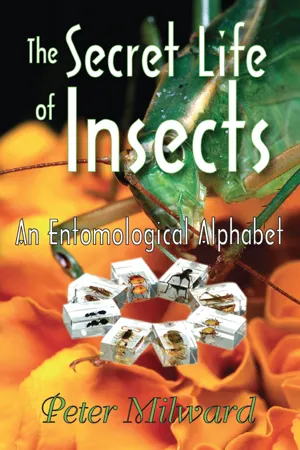
Every science, including the study of insects, may have circumscribed limits, but its deeper principles open up new worlds of possibility. Milward uncovers these hidden principles by examining the daily lives and habits of insects. His studies lead him to fascinating speculations, taking the reader into the realms not only of literature, as suggested by the subtitle, but also of philosophy and theology. When Milward discusses what everybody knows about insects and what he has personally observed, he relates insects to human life in general. His insights help us feel a certain fellowship with the insects, or at least with some of the more familiar insects. He does not let us forget that there is an important difference between human beings and insects. Human beings think. It is our ability to think that makes us what we are, but it is thinking that enables us to discover our affinity with insects. "The Secret Life of Insects" does not probe into the hidden lives of insects or treat them as individuals. His main interest is the light insects may throw on our human experience, and the assistance they may lend us as we seek to transcend our human experience. Milward aims at the level of common knowledge. In contrast to entomological scientists, Milward finds shadowy glimpses of hidden meaning in the insect world. These intimations or shadowy glimpses reveal thoughts and possibilities that will extend the human imagination. As a consequence, this work will inspire philosophers, as well as general readers interested in reflecting on the profundity of ordinary life.
Information
1
Ants in Antarctica
The Ant is a little creature for whom I feel a special, if somewhat irrational, fondness. I will not call him “which,” for “which” is a neuter pronoun used of things, and I can’t help thinking of the Ant in a personal manner that obliges me to use the personal pronoun “whom” of him. This is because, in my fondness for him, I regard him not only as a person but also as a projection of myself. In other words, I can’t help identifying myself with him, so that in thinking of him I am, for the time being, one with him.
For one thing, he makes me conscious of my towering size, as I look down on him scurrying about amid the forests of grass below me. How tiny he is! By comparison, how gigantic I am! Yet he isn’t in the least afraid of me. However immense I may seem in his eyes, if he sees me at all, he doesn’t mind. He carries on with whatever he is doing, without caring about me. He is even quite unconcerned about my existence.
It is, in fact, by paying no attention to me that the Ant makes it easy for me to identify myself with him. Because he never looks up at me, I can look down at him without any feeling of self-consciousness or embarrassment. I can contemplate him as he goes about his unending business, and while at first I may feel aware of my gigantic in contrast to his diminutive size, I easily forget not only my gianthood but even my separate existence, as I become immersed in his tiny busy existence.
In my fondness for the little Ant, he and his kind become, in the Biblical expression, the pupils of my eyes. At the same time, to use another Biblical expression, I descend to the status of being his pupil. There is so much, I find, I can learn from him, and he is so patient with me as my teacher. He goes on and on repeating the same lesson, as though allowing for the endless stupidity of his pupil.
How those words of the Book of Proverbs echo in my ears, “Go to school with the Ant, thou sluggard!” They are words seemingly addressed to one kind of men, those whom we call “sluggards.” But when we reflect on the truth of the matter, and on ourselves, we find, I am sure, that they comprise the vast majority of mankind. As a teacher, I find this quality in the vast majority of my pupils, and as an occasional pupil, I have to admit its presence also in myself.
What the Ant teaches us is, one might think, to be busy, to make good use of the present, or—in proverbial phrase—to gather the rosebuds while we may, and to make hay while the sun shines. There are surely few creatures on the earth who are so busy as the Ant, scurrying as he does to and fro on his little legs, incessantly twitching his tiny antennae this way and that. He hardly knows how to stay still. Block his way in one direction, and at once off he scurries in another. There is no way of stopping him.
This lesson is perhaps hardly needed in today’s business world, where human beings are kept so busy from morning till night, earning not just their daily bread but much else besides. If anything, the contrary lesson seems to be needed, the lesson not of business but of stillness—the lesson not of the Ant but of the Slug. There he stays, the Slug, on his favorite leaf for hours and hours, patiently devouring the ground on which he stands and softly masticating it. There he provides us with a perfect model of the contemplative life, or Buddhahood.
That is indeed true. But what we have to learn from the Ant, according to the Book of Proverbs, is not just business but well directed business. It isn’t business for business’ sake, or even business for leisure’s sake, but business for the sake of something that makes human life worth while. This is the lesson we have to learn in the busy world of today, when so many men and women are swept off their feet in search of—they know not what! They go on and on earning money, but then they don’t know what to do with it, or with the things they buy with it.
The Ant is ceaselessly busy, but there is meaning and purpose in his business, if only vaguely understood by himself. In his antic disposition he may not perhaps, in Shakespeare’s phrase, be looking after, into the past, but he is surely looking before, into the future, and preparing for the lean season of winter. Here is the meaning of the old fable of the Ant and the Grasshopper. The latter spends his brief time in the grass singing to his heart’s content, forgetting that summer isn’t always present. But the former is always looking forward to the future, remembering that winter is coming and laying in a store of provisions against that lean season.
In this fable and the lesson it teaches is comprehended the whole of philosophy, or at least of that wise philosophy which Socrates defined as a meditation on, or preparation for, death. This is no less true of religion, in which that wise philosophy has its appropriate setting and interpretation. “The readiness is all,” says Hamlet, echoing the words of Jesus on the coming of the Son of Man. He is, moreover, echoed by Edgar in King Lear, who says, “Ripeness is all”—with reference to the eschatological harvest. To this moment, the time of death, all the business of life must be directed, if it is to have any meaning. In this moment, all the business of life is to be consummated, when the ripe fruit is to be cut and stored in the everlasting barn.
There are yet other characteristics of the Ant which make this lesson easier and more delightful for us pupils to learn. In the first place, as I have said, the Ant is so tiny and unconscious of himself, he makes an admirable teacher. He isn’t even conscious of teaching us. He teaches not by what he says, but by what he does and is. In the Ant there isn’t any hypocrisy, or any shadow of self-interest falling in between the first motion and the acting of what he does. For the Ant, to be is to do, and to do is to be. Once he stops moving, he all but stops being, and vice versa.
Secondly, the Ant is so tiny, and so exquisitely photogenic in his every movement, one can’t feel any prejudice against his precepts, or any reluctance to learn his lessons. In fact, one takes in his precepts and lessons almost as unconsciously as he gives them out. It is indeed a case of heart speaking to heart—as in Newman’s motto of “Cor ad cor loquitur.” The Ant can’t help speaking to us, not on the level of mind and understanding, but on the level of heart and affection. He is the best of teachers.
Tiny and delicate the Ant may be, and yet Nature presents us with millions and millions of them in unfailing abundance. I have never been anywhere without meeting these little friends of mine. Individually, they may be infinitesimal in size, but collectively, they are universal in extent. They are indeed everywhere in the world, from the rising of the sun to the going down thereof. They are the most catholic of creatures.
But now I come to a serious objection, What of the Poles? What of the North Pole and the regions North of the Arctic Circle, the South Pole and the regions South of the Antarctic Circle? To be there, or not to be there, that—for the Ant—is the question. Or to put it more succinctly, in the striking phrase I have hit upon for the title of this chapter, are there any “Ants in Antarctica”?
Literally speaking, there are, I suppose, no ants (in the generic plural) in Antarctica. There is only one Ant (in the personal singular). But that is merely playing with words. Now I am speaking in a serious, geographical sense. Are there any ants, I ask, in that icy region of the globe known as Antarctica?
On this important question I have to confess, I have played the part of a sluggard. I haven’t even looked up the Encyclopedia Britannica, under the entry for “Ants” and under the particular heading of “World Distribution,” or perhaps “Ecology.” So I don’t know if there are any ants in Antarctica. Nor, for some strange reason—which I suspect I share with most of my readers—have I any desire to know. Perhaps if I have any occasion to visit Antarctica, I may feel prompted to ascertain the answer to this question. But till then, I am content to bask in blissful ignorance.
Why then, I may be asked, do I venture to speak of “Ants in Antarctica”? Merely, I must confess, for the sake of the title. I find its alliteration so attractive. It also serves to illustrate, in an extreme case, what I have said about the universality of ants. They are to be found everywhere in the world, even, as I suppose—without having taken the trouble to verify my hypothesis—in Antarctica. In other words, wherever I go in the wide world, I am made to feel at home by these little creatures who know how to make themselves everywhere at home.
Then, too, I find a charming contrast between the tiny size and delicate structure of the Ant and the vast, undifferentiated expanse of the Antarctic region. What is there more cozy or homely than the way this little creature goes about his work, crawling up and down over the mountainous surface of the seemingly flattest soil, and finding infinite variety in all its bumps, cracks and crevices? On the other hand, what is there bleaker or more remote from home than the desolate view of the Antarctic landscape? Indeed, it is an earthly image of those vast interstellar spaces whose eternal silence so terrified the soul of Pascal.
Putting these two and two together, Ants and Antarctica, I find more than just a pleasing alliteration of sound and a striking contrast of sense. Somehow the two seem to converge, even as one word loses itself in the other—the little insect on the one hand and the great universe on the other, microcosm and macrocosm in one. In this strange union size suddenly seems to lose its meaning and relevance. All that remains is a mysterious conjunction of majesty and lowliness, infinitesimal complexity and infinite simplicity.
On the one hand, here is the lowly stature of the Ant, within whose lowliness is concealed an inconceivable complexity of limbs and joints. On the other hand, there is the immense majesty and severe simplicity of Antarctica, reaching away in mountain upon mountain, in plain upon plain of ice and snow, as far as the horizon. Finally, what of the South Pole itself, at the very heart of Antarctica? There in my imagination stands a sentinel, a single little Ant, the only ant of his unnumbered race, standing still on one eternally revolving point, the only Ant of its kind in proud possession of a name. For this is Ant, the king of ants, whose name he has given to his kingdom of Antarctica. But this is a mere dream of mine, the dream of a sluggard!
2
Bees in the Bonnet
If there is any insect who bids fair to rival, or even outrival, the Ant in public esteem, it is surely the Bee, who comes next in my alphabet of insects. Consider the many claims the Bee has on our affection, and the Ant must needs confess himself vanquished and the Bee the victor. So may the first in the alphabet of insects be the last in our affection—at least, in comparing the respective claims of these two little champions.
First, what insect or what animal is there more industrious than the Bee? Business is the peculiar attribute not so much of the Ant as of the Bee. We don’t speak of “the busy Ant” but “the busy Bee”—though chiefly, I admit, because of the alliteration in the Bee’s favor. On the other hand, it may be added, the epithet “industrious” may go better, alliteratively, with the Ant. Only, it is a heavy word, unsuited to the light activity of the Ant.
Strangely enough, it is the Ant whom the Book of Proverbs singles out as a model of wise industry to the sluggard—that is, to you and me. The poor Bee receives not so much as a mention. He is altogether overlooked. Yet this can’t be because the Bee is foolish in his industry, like the proverbial Bee caught in a lady’s bonnet. So long as he prudently stays out of such a bonnet, the Bee is no less wise and providential for the future than the Ant.
I can’t help feeling that the author of Proverbs was either ignorant of the true worth of the Bee, or unduly prejudiced against him for some personal reason. (For example, he may have been stung by an angry bee.) It is even possible that his preference for the Ant was merely linguistic. After all, which of the two is easier to say, “Go to school with the Ant!” or “Go to school with the Bee!” In English, I wouldn’t hesitate to choose the former, but I can’t speak for the original Hebrew.
Certainly, if the Bee may be said to rival the Ant in respect of industry, he may be said to outrival his rival in almost every other respect. Who hasn’t watched processions of ants moving across the earth like armies on the march? There is something too precise and militaristic about them for us to feel over-fond of them or to identify ourselves with them. They aren’t after all quite human. They are always acting as though under orders from above. They never seem to be doing anything for themselves, and that is inhuman.
Then, contrast this behavior of the Ant with that of the Bee. Who has ever seen bees marching from their hive in military fashion? Or rather, seeing they can hardly be said to march, who has ever seen them flying through the air in precise squadron formation? They are much too individualistic for that. Yet they contribute each in his own way to the common good of the hive. Such behavior is much more human than that of the ants.
Then, look at the way the Bee sucks the nectar from different flowers, one after another. He has no air of obeying impersonal orders from above. He takes an intensely personal delight in his task. See the way he wags his little tail up and down while he has his nose poked inside the flower. Isn’t he just like a little puppy discovering his first rabbit down a rabbit-hole? Who ever saw an ant wagging his tail in this way?
As for the outcome of their activity, there is no comparison between ants and bees. The latter win hands down. Who has ever eaten ants’ honey? Not even the most ascetic hermit in the desert, I suppose. I even doubt if ants do make honey, for all their frenzied activity. So far as I know, honey is the exclusive product of bees. And well may they be proud of this product! For one thing, it has given rise to the adjective “mellifluous,” or flowing with honey, which is variously applied to the sermons of Bernard of Clairvaux and the plays of Shakespeare.
There is indeed all the difference in the world between the wisdom of the Ant and the wisdom of the Bee. What the former stores up for the winter, he stores up, so far as I know, only for himself. But what the latter stores up, he stores up not only for himself but also, if unintentionally, for others—such as bears and human beings. In other words, it is all the difference between selfish and altruistic love.
In praising the Bee, however, I fear I may have somewhat denigrated the poor little Ant, of whom I professed to be so fond in my last chapter. No, I wouldn’t have it be thought that I am turning against him, now that I am turning to the Bee in this chapter. If the good points of the Bee reflect unfavorably on the Ant, it may also be said that the good points of the Ant reflect unfavorably on the Bee. So now in all fairness I must proceed to enumerate the weak points or demerits of the Bee, if only to leave the Ant unchallenged in his Biblical function as teacher to the sluggard.
First, the Ant is so much smaller than the Bee—though it may well be that the largest Ant is larger than the smallest Bee. Then, the smaller he is, the easier it is for him to win over our hearts—even if he lives and moves in a rigidly ordered group rather than as an individual. For love is won rather by the smaller than the taller, by the Benjamin than the Ruben of the family. In contrast, there is something ungainly and awkward about the hairy bodies of even the smallest Bee. So if we feel fond of him, as of course we do, it isn’t so much for his tiny delicacy as for his heavy clumsiness, as when we feel fond of the Giant Panda and the Koala Bear at the zoo.
Secondly, the Ant is to be found everywhere on the face of the earth, from corner to corner, even perhaps in Antarctica. And everywhere he makes the stranger feel strangely at home. But the Bee is to be found, excusably enough, only where there are flowers, and flowers aren’t to be found everywhere, least of all in the vast icy wastes of Antarctica. Who ever heard of bees sucking nectar from flowers of snow, however much poets may contrive to do so with their addiction to metaphor?
Moreover, the Bee isn’t content to let well alone, and to carry on his honey-making pursuits without concern for the eyes of human watchers. Unlike the Ants, he is among the most intensely self-conscious of insects, and endowed with a bad temper into the bargain. So he has a lamentable tendency to communicate this self-consciousness of his to any human watcher, not just in a theoretical but in a painfully practical manner. If he suspects the watcher of possible interference, he will make a bee-line for him and heighten his self-consciousness with the injection of a sting.
Among the tribe of ants, too, it has to be admitted there are stinging varieties. Still, though I have watched thousands of them, and even allowed privileged ones to crawl over my arms and legs, I haven’t ever been stung. Or if I have, I don’t remember it. But I wonder if it is possible to be stung by the Bee and forget it—even if one forgives the Bee. I have once been stung by a bee, and to this day it remains a vivid memory. There is no withstanding his fierce attack. He comes straight at you like a kamikaze pilot. Nor does he mind if he dies in the attack, as he is sure to do, since with one sting he empties his entrails. One can’t help admiring the pluck of the Bee, even while agonizing over the pain of his sting.
Finally, to come to the title of this chapter—or rather, to turn to the second half of the title—there is this unfortunate association of bees with bonnets, as of bats with belfries. It may be blamed on the obvious alliteration, which has quite ruined the reputation of the unoffending Bee.
There is no doubt that the Bee is an impulsive creature, with a one-track mind, like Shakespeare’s Romeo. So when, like Romeo in love with Juliet, he gets caught inside a lady’s bonnet, he becomes fighting mad. He buzzes round and round in frantic attempts to escape, which only makes things worse for him. So he has passed into a proverb for madness, or for a man out of his wits—which is a most humiliating fate for any animal or insect.
It is, therefore, my modest ambition to help the poor Bee, as best I can, to retrieve his lost reputation. For in wisdom I really think, with all respect to the author...
Table of contents
- Cover
- Half Title
- Title Page
- Copyright Page
- Table of Contents
- Prologue: The Anonymity of Insects
- 1. Ants in Antarctica
- 2. Bees in the Bonnet
- 3. A Song for Sentimental Centipedes
- 4. Such Darling Daddy-Long-Legs
- 5. Evenings with Earwigs
- 6. Freedom for Flies!
- 7. The Grasshopper in Grub Street
- 8. Little Jack Hornet
- 9. Jumpers and Junipers
- 10. The Kat and the Katerpillar
- 11. My Fair Ladybird
- 12. Mesmerizing the Mosquito
- 13. The Gnat is a Nitwit!
- 14. O for an Oil-Fly!
- 15. The Problem of the Praying Mantis
- 16. Queen Bees in Question
- 17. The Readiness of the Red Admiral
- 18. I, Spider
- 19. This Tremendous Termite
- 20. Uses of the Unicorn
- 21. Very Venerable Vermin
- 22. Wee Willie Waspie
- 23. Sex and Insex
- 24. ZZZZZZZ
- Epilogue: Yintimations of Yantomology
Trusted by 375,005 students
Access to over 1.5 million titles for a fair monthly price.
Study more efficiently using our study tools.
Frequently asked questions
Yes, you can cancel anytime from the Subscription tab in your account settings on the Perlego website. Your subscription will stay active until the end of your current billing period. Learn how to cancel your subscription
No, books cannot be downloaded as external files, such as PDFs, for use outside of Perlego. However, you can download books within the Perlego app for offline reading on mobile or tablet. Learn how to download books offline
Perlego offers two plans: Essential and Complete
- Essential is ideal for learners and professionals who enjoy exploring a wide range of subjects. Access the Essential Library with 800,000+ trusted titles and best-sellers across business, personal growth, and the humanities. Includes unlimited reading time and Standard Read Aloud voice.
- Complete: Perfect for advanced learners and researchers needing full, unrestricted access. Unlock 1.5M+ books across hundreds of subjects, including academic and specialized titles. The Complete Plan also includes advanced features like Premium Read Aloud and Research Assistant.
We are an online textbook subscription service, where you can get access to an entire online library for less than the price of a single book per month. With over 1.5 million books across 990+ topics, we’ve got you covered! Learn about our mission
Look out for the read-aloud symbol on your next book to see if you can listen to it. The read-aloud tool reads text aloud for you, highlighting the text as it is being read. You can pause it, speed it up and slow it down. Learn more about Read Aloud
Yes! You can use the Perlego app on both iOS and Android devices to read anytime, anywhere — even offline. Perfect for commutes or when you’re on the go.
Please note we cannot support devices running on iOS 13 and Android 7 or earlier. Learn more about using the app
Please note we cannot support devices running on iOS 13 and Android 7 or earlier. Learn more about using the app
Yes, you can access The Secret Life of Insects by Peter Milward in PDF and/or ePUB format, as well as other popular books in Philosophy & Mind & Body in Philosophy. We have over 1.5 million books available in our catalogue for you to explore.