eBook - ePub
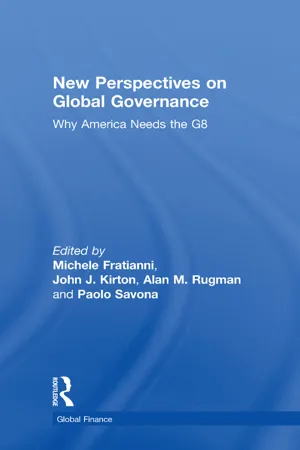
New Perspectives on Global Governance
Why America Needs the G8
- 344 pages
- English
- ePUB (mobile friendly)
- Available on iOS & Android
eBook - ePub
New Perspectives on Global Governance
Why America Needs the G8
About this book
On its 30th anniversary in 2004 responsibility for hosting the G8 Summit fell into the hands of an allegedly unilateralist America. An America still reeling from the shock of the September 11th terrorist attacks, the resulting economic recession, bitter divisions with its NATO allies and disappointment with the United Nations Institutions over the 2003 Iraq war. So why does America still need the G8? New Perspectives on Global Governance offers new insight into the role of the Group of Eight's major market democracies and challenges the assumption that the G8 is simply a forum for binding a unilateralist hegemonic America. In contrast to seeing the G8 as a means of imposing an American world order this unique collection of new writings suggests that a now vulnerable America must rely on the G8 as a central instrument of foreign policy. America needs the G8 to achieve its security, economic and political interests in the world and to shape the twenty-first central global order it so desperately wants.
Information
PART I:
THE G8 IN THE PAST AND IN THE FUTURE
Chapter 2
Do We Need the G8 Summit? Lessons from the Past, Looking Ahead to the Future
The underlying aim of this chapter is to examine whether the G8 summit serves a useful purpose in the 21st century and whether the world would miss the summit if it were not there. The chapter approaches this enquiry from two directions. First, it will draw lessons from the history of the summits and apply them to the 2004 Sea Island Summit. These lessons will sometimes be taken from the full 30-year perspective since the summits began. But the main focus will be on the sequence of summits since Tony Blair inaugurated the current ‘heads-only’ model at Birmingham in 1998, which also marked the change from G7 to G8 (see Table 2-1). Second, it will look forward into the future. Sea Island in 2004 concluded the first G8 sequence of seven summits, each hosted by a different country.1 Blair now gets the chance to host a second summit, the first British prime minister to do so, and to start a new sequence. The chapter will assess the outlook for the 2005 Gleneagles Summit, for Russia’s first summit in 2006, and beyond.
The lessons from the past try to capture the recent evolution of the G8 summit in three respects: how well the heads-only format is working, the integration of politics and economics in the summit’s themes, and the operation of collective management of the international system by North America, Europe, and Japan (see Bayne 2004). The following conclusions can be drawn from this analysis:
•the new format has worked well, especially up to the Kananaskis Summit of 2002, although important elements are now being eroded;
•the new format has also encouraged outreach to non-G8 countries and to non-state actors such as civil society;
•the G8 summits have developed a new capacity to introduce combined economic and political initiatives;
•contrary to the conventional wisdom, G8 collective management has survived under U.S. president George Bush and gained some ground in 2004.
The forecast for the future considers whether the summit will continue much as now, whether it will shift toward more economics or more politics, and whether outreach to non-G8 countries will change the summit itself. The conclusions from this analysis are as follows:
•the present focus on combining economics and politics could persist through 2005 and 2006, but will eventually run out of material;
•the United Kingdom is seeking to revive the G8 economic agenda, while Russia may prefer more politics;
•converting the G8 to the G20 (or the ‘Leaders 20’ or ‘L20’ of heads of state and government) would change the summit’s nature and the current G8 heads are not attracted by the idea;
•there are strong grounds for a G9, embracing China, but it is not clear how to get there at summit level (as opposed to at lower ministerial levels).
Both the past record and the future prospects confirm the utility of the G8 summit. Thanks to the new format, the summit has been able to achieve results that would not have been possible in other forums: by innovating, by striking deals not available at lower levels, by mending deep divisions among the heads, and by developing new capacities to integrate politics and economics. Although it now works with non-G8 countries and wider institutions in a more co-operative manner than before, the summit provides a source of collective management that cannot be replicated elsewhere. For the future, the G8 is well positioned not only to maintain these capacities, but also to revive its economic vocation, which had gone a bit into abeyance, and to develop the outreach that is essential in a globalising world. The G8 summit could dissolve itself with very little trouble and is subject to various pressures to do so, both external and internal. But a world without the G8 would be a more fractious and dangerous place.
Table 2-1 The Summits of the First G8 Sequence
| Year | Site | Host and Country |
| Sixth Summit Series: Globalisation and Development | ||
| 1998 | Birmingham | Tony Blair, United Kingdom |
| 1999 | Cologne | Gerhard Schroeder, Germany |
| 2000 | Okinawa | Yoshiro Mori, Japan |
| 2001 | Genoa | Silvio Berlusconi, Italy |
| Seventh Summit Series: Fighting Terrorism and Its Causes | ||
| 2002 | Kananaskis | Jean Chrétien, Canada |
| 2003 | Evian | Jacques Chirac, France |
| 2004 | Sea Island | George Bush, United States |
| Start of Sequence G8 Sequence | ||
| 2005 | Gleneagles | Tony Blair, United Kingdom |
| 2006 | Site not known | Vladimir Putin, Russia |
Note: TA summit ‘sequence’ denotes a run of seven summits, each chaired by a different country. Thus the sequence that began at Birmingham in 1998 concluded at Sea Island in 2004. A summit ‘series’ is a group of summits focussed on a particular set of issues. The sixth series began with reforms to the format and concentrated on the G8 response to globalisation. The seventh series took over in 2002, when the summit began paying more attention to terrorism and related political issues after 11 September 2001.
Lessons from the Past
The Heads-Only Format
The Birmingham reforms to the summit format were intended to limit the numbers, the agenda, and the documentation.2 The first of these reforms has worked well throughout the sequence. The regime whereby only the heads of government come to the G8 summit, without supporting ministers or large delegations, is often presented as a return to the original vision of the summit as an informal, personal encounter. In fact, that early vision was never achieved, even at the very first summit at Rambouillet in 1975.3 Today’s summits are indeed more intimate than those of the 1970s. There are fewer people at the summit table, even as G8. Delegations are kept small and all housed close together at the summit site. Everything is done to encourage a personal rapport between the leaders during the time that the summit lasts.
The latter objectives — shorter agenda and documents — were also well maintained from Birmingham 1998 to Kananaskis 2002 (with a slight lapse at Okinawa 2000). The summit hosts chose a short agenda of precise topics well in advance and stuck to it, and the documentation from those summits was kept within limits. All these summits produced innovative initiatives or struck deals only available at the level of head of government. These embraced, for example, new financial architecture, debt relief, settling Kosovo, the digital divide, fighting infectious diseases, help for Africa, and the nonproliferation of weapons of mass destruction (WMD).
For Evian 2003, however, France preferred an agenda of broad themes that could accommodate almost anything. The consequence was that, by the time the summit arrived, the agenda had become something of a Christmas tree. This in turn inflated the documentation, so that the Evian Summit produced a record number of action plans.4 The G8 recognised that Evian was over-ambitious and in 2004 the Americans promised a much more austere summit. But they too preferred broad themes freedom, security, and prosperity — that set no limits to the agenda. In consequence, by the time of Sea Island, more and more items had crowded on to the agenda and the copious and confusing summit documentation sacrificed quality to quantity. Despite these lapses, Evian and Sea Island were vital in restoring agreement among the G8 heads over the approach to Iraq and made advances on Africa, nonproliferation, and the Middle East.
Because the new format limits the official participation at the summit, it has allowed the G8 to reach out to other circles, such as non-G8 countries and non-state actors including business and civil society. The real breakthrough here came in 2000. The Japanese hosts consulted civil society worldwide and provided facilities for them at Okinawa.5 They invited selected non-G8 leaders to join the G8 over dinner before the summit. Both practices have developed further at subsequent summits. For example, a strong representative gathering with non-G8 leaders (including China) took place at Evian in 2003. In 2004, however, the American hosts resisted both trends, at least at first. There was no engagement with civil society. There was originally no intention to invite non-G8 leaders. But as the summit approached, Middle Eastern countries were involved in the preparatory meetings of finance and foreign ministers and leaders from the ‘broader Middle East’ region were invited to the summit itself. Since it was unclear whether enough of them would come, the African leaders who had been at previous summits were also invited to Sea Island. Outreach from the summit is thus well established, although no permanent pattern has emerged.
Many civil society bodies are equally ready to sit down and make suggestions to G8 governments on summit issues and then to mobilise massive demonstrations against the summit when it is held. The riots associated with these demonstrations at Genoa in 2001 caused the Canadians to decide to hold the next summit in a remote Rocky Mountain resort, well away from the public eye. Fears of terrorist attacks after 11 September 2001 reinforced this isolation, which also determined the choice of summit sites by France in 2003 and the U.S. in 2004. Yet isolation has its drawbacks: the G8 leaders are closer to each other, but cut off from the outside world, including the media, who are increasingly sceptical of the value of the summits.
Economics and Politics
The early summits were meant to be exclusively economic, with politics excluded. But politics began to encroach on the agenda very early on and gathered strength during the long U.S. presidency of Ronald Reagan. The end of the Cold War revived the economic agenda, with help first for Central Europe and then for Russia, while new issues arrived such as the environment and money laundering. But the political component was always present, and Russia’s growing involvement made it stronger.
Blair’s Birmingham reforms were intended to focus the summit on a concise economic agenda, with politics only on the side. The next three summits kept to that pattern, except for Cologne 1999, where the Kosovo crisis required a combined political and economic response and generated a new interest in conflict prevention (Kirton and Stefanova 2004). But after the terrorist attacks of 11 September, it was inevitable that political issues, such as terrorism and nonproliferation, would move up the G8 agenda, driven especially by the United States. Since the Kananaskis Summit of 2002, political issues have had at least equal weight in the summit agenda with economic ones. The 2004 Sea Island Summit, with George Bush as host, had two political themes to one economic.
Heads of government can deal equally well with economic issues and political issues; they can also integrate the two. In earlier years the summits dealt with economics and politics separately. Since Birmingham, however, they have learned how to combine political and economic components, starting with their treatment of Kosovo at Cologne in 1999. The most enduring example of this practice is the summit’s involvement in Africa, where the G8 Africa Action Plan combines provisions on security, governance, and economic growth, matching the content of the New Partnership for Africa’s Development (NEPAD) in this respect. But the Global Partnership against the Spread of Weapons and Materials of Mass Destruction to clean up chemical weapons and nuclear installations also integrates politics and economics, as does transport security; both issues, first treated at Kananaskis, returned to the agenda in 2004. These combined political and economic initiatives are new to the G8 summit but also play to its strengths, because only heads of government can integrate all the aspects involved.
The principal topic chosen by the Americans for the 2004 Summit — the Broader Middle East and North Africa (BMENA) Initiative — fitted these criteria precisely. The region it would cover, from Morocco to Afghanistan, was marked by both political unrest and economic sluggishness, with each feeding on the other. A programme of linked political and economic reform, to enhance democracy and stimulate market economies, would be a very suitable subject for the G8 leaders. The American proposals were new, but they had the same objective as the Barcelona process launched by the European Union in 1995 to enhance political and economic development around the Mediterranean. That programme survived, although it had made only very slow progress. There was therefore the basis for a common G8 agreement, comparable with what has been done over Africa.
The great difference, however, was that in Africa the G8 were responding to an initiative that came from the African leaders themselves. The Africans had clear ownership of NEPAD and the G8 took care to preserve this. In the Middle East, however, as word of American intentions leaked out early in 2004, leading regional powers, such as Egypt and Saudi Arabia, reacted strongly against them. These countries insisted that they must be in control of their own reforms — they could not accept dictation from outside. The Arab League tried to launch its own reform process, but had great difficulty in agreeing what that should be.
The difficulties facing this topic at Sea Island were therefore formidable. But thanks to intensive preparatory work, the Summit was able to agree on a programme to encourage political and economic reform in the Middle East. This was based on universal values of freedom, democracy, and human rights. It embodied specific principles: reform could not be imposed from outside; each country was unique; governments, business, and civil society would be involved as full partners; and reform was a long-term effort, which required ‘a generational commitment’. On that basis, the programme proved acceptable to the regional powers that attended the Summit and was not disowned by any of the absentees, such as Egypt and Saudi Arabia. A full turnout of regional states (except Iran and Syria) later attended joint meetings with G8 foreign and finance ministers to prepare for the first meeting of the Forum for the Future in Morocco in December 2004.
Collective Management
One original aim of the G7/8 summit, right from 1975, was to bring about a transition from American hegemony to a regime of collective management of the international system, with responsibility shared between Europe, North America, and Japan. But U.S. hegemony continued to cast a long shadow. For the first 15 years or so, the G7 process depended heavily on U.S. initiative. If the Americans took the lead, with one or more G7 partners, there were good results. If the Americans tried to lead alone, the outcome was disappointing. If the Americans did not lead, nothing much happened (Putnam and Bayne 1987, 272–273).
During the 1990s, as the summit revived after the end of the Cold War, this pattern changed and became much closer to real collective management. While the Americans usually led on monetary and financial issues, the Europeans began to take the lead in other areas: the environment, debt relief for poor countries, and even, by ...
Table of contents
- Cover
- Half Title
- Title Page
- Copyright Page
- Table of Contents
- List of Tables
- List of Figures
- List of Contributors
- Preface and Acknowledgements
- List of Abbreviations
- Introduction
- Part I: The G8 in the Past and in the Future
- Part II: Prosperity and Security
- Part III: Finance and Security
- Part IV: The G8 and International Trade Policy
- Conclusion
- Documentary Appendices
- Bibliography
- Index
Trusted by 375,005 students
Access to over 1.5 million titles for a fair monthly price.
Study more efficiently using our study tools.
Frequently asked questions
Yes, you can cancel anytime from the Subscription tab in your account settings on the Perlego website. Your subscription will stay active until the end of your current billing period. Learn how to cancel your subscription
No, books cannot be downloaded as external files, such as PDFs, for use outside of Perlego. However, you can download books within the Perlego app for offline reading on mobile or tablet. Learn how to download books offline
Perlego offers two plans: Essential and Complete
- Essential is ideal for learners and professionals who enjoy exploring a wide range of subjects. Access the Essential Library with 800,000+ trusted titles and best-sellers across business, personal growth, and the humanities. Includes unlimited reading time and Standard Read Aloud voice.
- Complete: Perfect for advanced learners and researchers needing full, unrestricted access. Unlock 1.5M+ books across hundreds of subjects, including academic and specialized titles. The Complete Plan also includes advanced features like Premium Read Aloud and Research Assistant.
We are an online textbook subscription service, where you can get access to an entire online library for less than the price of a single book per month. With over 1.5 million books across 990+ topics, we’ve got you covered! Learn about our mission
Look out for the read-aloud symbol on your next book to see if you can listen to it. The read-aloud tool reads text aloud for you, highlighting the text as it is being read. You can pause it, speed it up and slow it down. Learn more about Read Aloud
Yes! You can use the Perlego app on both iOS and Android devices to read anytime, anywhere — even offline. Perfect for commutes or when you’re on the go.
Please note we cannot support devices running on iOS 13 and Android 7 or earlier. Learn more about using the app
Please note we cannot support devices running on iOS 13 and Android 7 or earlier. Learn more about using the app
Yes, you can access New Perspectives on Global Governance by Michele Fratianni,Paolo Savona, John J. Kirton in PDF and/or ePUB format, as well as other popular books in Politics & International Relations & International Relations. We have over 1.5 million books available in our catalogue for you to explore.