In the 1730s two expeditions set out from Paris on extraordinary journeys; the first was destined for the equatorial region of Peru, the second headed north towards the Arctic Circle. Although the eighteenth century witnessed numerous such adventures, these expeditions were different. Rather than seeking new lands to conquer or mineral wealth to exploit, their primary objectives were scientific: to determine the Earth's precise shape by measuring the variation of a degree of latitude at points separated as nearly as possible by a whole quadrant of the globe between Equator and North Pole. Although such information had consequences for navigation and cartography, the motivation was not simply utilitarian. Rather it was one theme among many in an intellectual revolution in which advances in mathematics paralleled philosophical strife, and reputations of the living and the dead stood to be elevated or destroyed. In particular the two expeditions hoped to prove the correctness of Isaac Newton's prediction that the Earth is not a perfect sphere, but flattened at the poles. In this study, the 'Figure of the Earth' controversy is for the first time comprehensively explored in all its several dimensions. It shows how a largely neglected episode of European science, that produced no spectacular process or artefact - beyond a relatively minor improvement in maps - nevertheless represents an almost unique combination of theoretical prediction and empirical method. It also details the suffering of the two teams of scientists in very different extremes of climate, whose sacrifices for the sake of knowledge rather than colonial gain, caught the imagination of the literary world of the time.
In the 1730s two expeditions set out from Paris for what might well be termed the ends of the Earth. The first, under Louis Godin was destined for the equatorial region of Peru; the second, led by Pierre-Louis Moreau de Maupertuis headed north to the Arctic Circle. Several factors set these adventures apart from better-known tales of exploration and conquest. Though under royal patronage, they were initiated by the Académie Royale des Sciences, with a common purpose; moreover their members were neither ruffians in search of adventure, nor prospectors after mineral wealth, but rather, for the most part, distinguished scientists, sensitive men, already famous in their fields and with further distinction ahead of them. Both parties suffered great hardships in opposite extremes of climate and were lucky to escape with their lives, the Arctic team nearly shipwrecked, the equatorial party risking fever and assassination. Both, when they struggled back to Paris, found themselves in a sea of back-biting and controversy, such as only the high Enlightenment could provide.
The purpose of the twin expeditions was to determine the Earth’s precise shape by measuring the variation of a degree of latitude at points separated as nearly as possible by a whole quadrant of the globe between equator and North Pole. Though some would urge its importance for navigation and cartography, the need for such measurement was not primarily utilitarian; rather it was one theme among many in an intellectual revolution in which advances in mathematics paralleled philosophical strife, and reputations of both the living and the dead stood to rise and fall in the general ferment. Central to this was the newly deceased figure of Isaac Newton, the mathematical giant who, among others, had made a crucial calculation of the shape conformed to by a revolving planet, a prediction which, significantly, had excited far more attention in the volatile intellectual climate of France than in the more staid, to a degree complacent, Royal Society of London. Thus the reputation of the English genius of the previous century was tied to a tangible measurement, a matter of finding out, and moreover in a manner ironically ‘down to Earth’, in contrast to the celestial mechanics on which his reputation, and the theory of universal gravitation, had largely turned.
When the results of the two surveys were collated, and Newton’s prediction confirmed, French literary circles were as much impressed as the world of Science. Voltaire, a partisan of Newton since his brief exile in England, went into raptures at the return of the northern expedition, declaring with characteristic hyperbole: ‘If your undertakings are those of Archimedes and your courage that of Christopher Columbus, your description of the snows of Tornea is that of Michaelangelo, and those of the aurora borealis are those of Alban…’, while more soberly averring that: ‘Never have experiment and reason come together in such agreement to prove a truth.’1 When, in later life, La Condamine, a mainstay of the southern expedition, became one of the few scientists to be admitted to the Academie Française, his contemporary Georges Buffon eulogized him for having done: ‘…par le seul motif de la gloire des Lettres, ce que l’on ne fit jamais pour la soif de l’or: voilà ce qu connaît de vous l’Europe, et ce que dira la posterite…’2 [‘…from the simple motive of the glory of Letters, that which were never done for the glory of gold: this is what Europe knows of you, and what posterity will come to relate’].
Not all were so impressed with Newton’s laurels, however, and the controversy over the true shape of the Earth that had bridged the seventeenth and eighteenth centuries would rumble on well into the nineteenth. At its height passions were raised almost to the point of duels being fought, and more than once the dignity of the French nation was held to be at stake. Yet, however interpreted, the achievement of the two expeditions entered deeply into the Enlightenment consciousness; in the great Encyclopédie of d’Alembert and Diderot, published in 1751, the entry FIGURE DE LA TERRE ran to no less than twenty-five quarto columns with myriad cross-references, one of the longest articles in that monumental work. The quantitative precision that had hitherto been the preserve of astronomy was given a terrestrial dimension; the previously humdrum profession of the surveyor acquired global significance; and as the new science of geodesy emerged the perfection of measuring instruments was fruitfully paralleled by new mathematical methods far extending Newton’s primitive version of the infinitesimal calculus.
In this volume I shall describe the Figure of the Earth controversy in its several dimensions, not neglecting the human actors and its impact on the development of the Enlightenment world-view. I hope to show that this relatively little-known episode in European science, while producing no spectacular process or artefact, beyond a relatively minor improvement in maps and safety at sea, represented an almost unique combination, for its time, of theoretical prediction and empirical method, the latter of a painstaking character worthy of celebration in itself. That it was, as Buffon said, ‘for the glory of Letters rather than that of gold’ is, moreover, a marker of poignant contact in the sometimes troubled relationship of Science and Literature, no less important for its remoteness from our present-day perceptions.
The history of concern for the geometry of the Earth presents us with a number of stages. Leaving aside the fantastic models of the Ancients — the cylinder of Leucippus, Democritus’ hollow disc, the column of Anaxiamander, not to mention Hercules and the supporting elephants of Hindu tradition — we can discern a progressive refinement of interest paralleled by mathematical sophistication. First, there is the topological conception of the Earth as a three-dimensional ball, assumedly spherical, as reason and aesthetic alike seemed to demand; secondly, the quantitative concern with its dimensions, the measure of the circumference, or equivalently the length of the degree, a matter of more than just maritime interest; thirdly, the raising of doubts as to whether the perfection of the sphere might be perturbed into other forms with rotational symmetry; finally, the onset of doubts as to whether even this element of symmetry might be flawed by the existence of long-range irregularities, beyond those of its superficial mountains and valleys.
The focus of this book is on the third of these stages, and its emergence from the second. The scene is set at the turn of the eighteenth century, in the politically fraught atmosphere that attended the early years of the Academie Royale des Sciences, the prized creation of Louis XIV and his equivocal concession to modernity. But if the focus of events is to be found in France, their range of influence was considerably wider and touched on many orders of national sensibility across Europe, where frequently pride and philosophical tradition conflicted with the unyielding regime of the mechanical world-view, with its respect for reason and measurement over speculation, and its healthy disregard for national boundaries.
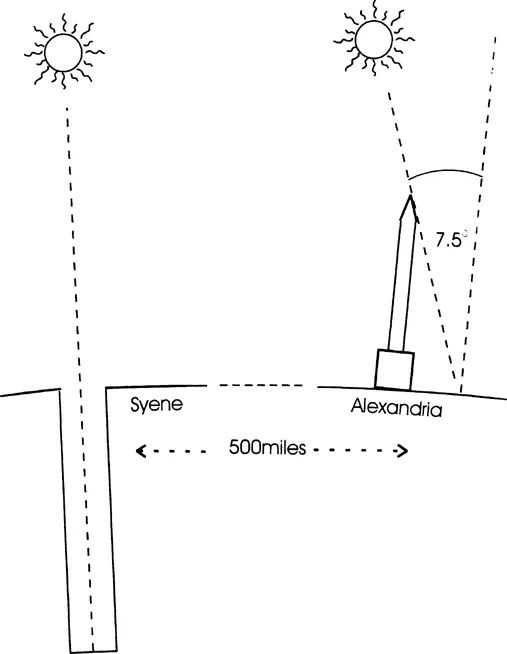
To approach the subject from its origins it is necessary to go back over two thousand years. The idea that the spherical Earth was a discovery of the first circumnavigators is, of course, a literary conceit which ignores the whole classical tradition of investigation. Leaving the purely fantastic aside, the first serious moves towards a realistic depiction of the Earth belong to ancient Greece and it was the Greek spirit of geometry that led to an ingenious measurement, in effect the prototype for the modern survey methods almost two millennia later. In the third century BC it was common knowledge in the Egyptian city of Syene that the midday Sun at the summer solstice stood precisely at the zenith, and would directly illuminate even the bottom of a deep well. The philosopher Eratosthenes noted that in Alexandria, some distance to the north, this was not the case, and that simultaneously the Sun stood at an angle of some 1/5th of a revolution towards the south. Assuming the rays of sunlight to be parallel, and the two cities to lie on the same meridian, this angle must equal that subtended by the arc between them, just over 7°. (See Figure 1.) If the distance between the cities were known, then the length for one degree could be found, and from this the radius, R, of the Earth.3 Eratosthenes estimated the distance between Alexandria and Syene to be 5,000 ‘stadia’ and this led him to a circumference of 50 × 5,000 stadia for the Earth. Unfortunately we have no precise knowledge of the length of the ‘stadium’. Some inspired guesses, perhaps with a suspicion of working backwards from modern units, put the value at about 185 metres.4 If so, this would make Eratosthenes’ estimate some 15 per cent high.
Figure 1 Eratosthenes’ method for determining the radius of the Earth
In the first century BC another Greek, Poseidonius, performed similar observations at a greater distance, between Alexandria and the island of Rhodes. He observed that, while the star Canopus lay on the horizon at Rhodes, its elevation at Alexandria was 1/48 of a circle (7°30’). His estimate of the distance, based on the sailing time between the two can hardly have been reliable, and his result, some 11 per cent too high, depending on the stadium, can only be a historical curiosity. Other observations were made in the Chinese and Arab worlds. In the year 724 in the Tang dynasty, the Buddhist astronomer Yixing (
) measured the shadows of a standard gnomon along a meridian of some 11,400 Chinese li (approximately 5000 km). (Although it is possible to derive an Earth radius from these results,5 these results,5 Yixing most certainly did not do so, since the idea of a spherical Earth was inconceivable to the Chinese until suggested nearly eight centuries later by the Jesuit missionaries).6 A little later, in the year 883, in the time of the caliphs Al-mansur and Al-ma’mum, the Arab astronomer Al-Hâçan ben Schaker measured a meridian of over two degrees, though again the translation into modern units remains doubtful.7 There matters would appear to have rested, until the first tentative surveys of the sixteenth century. Not surprisingly, interest in the geometry of the Earth was not confined to land surveys, for in practical terms maritime concerns were probably the greater. One of the most succinct reviews of the reasons for believing in the spherical Earth is to be found in Richard Norwood’s Seaman’s practice of 1659. Though the conclusions may be obvious, the simplicity of the arguments can hardly be bettered, and they touch usefully on the astronomy and history involved. This little-known and charming work deserves quotation in extenso. Norwood’s argument in his original words runs as follows:
First, the Eclipses, especially of the Moon, which are caused by the shadow of the Body of the Earth being interposed between the Sun and the Moon, and as much as this shadow doth fall upon the Moon, alwayes and on every side circular, and so appears to us, it is manifest by the Optiks, that the Earth from whence it proceeds is a Spherical body.
Secondly, likewise the Eclipses of the Sun, which are caused by the interposition of the Moon beteen the Sunne and those places where it appears Eclipsed; I say it could not be determined when and in what place such an Eclipse should appear, and where not, if the form of the Earth were not known; but seeing the places where such Eclipses happen, and where not, may be and are usually determined, and that upon this ground; that the surface of the Earth is spherical, it is thence also ratified to be a truth.
Thirdly, the Sunne, Moon, and Starres do rise and set, and are upon the Meridian sooner to those that are resident in the Eastern parts, then to others more Westerly, and that in a proportion answerable to the roundnesse of the Earth, as the Planets and stars are up upon our Meridian at London sooner by almost four houres, then they are to those that inhabit Summer Islands, and the confines of Virginia and New England; And so in East-India, and other Eastern Regions, the Sunne and Starres are sooner upon their Meridian then upon ours, which is manifest to be so, as by other reasons, so especially by the Eclipses of the Moon: for an Eclipse of the Moon hath not in it self any diversity of time, being at one and the same instant without respect of places, yet because in the Eastern parts the day is begun, and it may be far spent before it begin in places farre Westerly, therefore such an Eclipse may appear to the Eastern Inhabitants towards the end of their night, which to the Western appears in the beginning or middle of the same night with them, and so the difference will be more or lesse, according to the different distance of those places in Longitude.
Fourthly, furthermore we see, that going or sayling to the Northwards, we have the Artick Pole and the Southern Stars more elevated, and the Antartick Pole and Northern Starres more depressed, the Elevation Northerly increasing equally, with the depression Southerly, and either of them proportional to the distances we goe: the like happeneth in going to the Southwards. Besides the Oblique Ascensions, Descensions, Occultations, Emersions, and Amplitudes of Rising, and Setting of the Sunne and Starres, in every several Latitude, agreeing with the Hypothesis of the Earths Sphericity.
Fifthly, so if we stand upon the Sea-shore, and see a Ship farre off under sail making towards the Land, at first we see only the Top-sails or highest parts, and withall doe manifestly behold the convex Superficies of the Sea, as it were raised and interposing itself between our sight and the Hull or the lower parts of the Ship, till she approacheth neerer, and this uniformely, every wayes alike, and proportionately to the several distances which evidently demonstrate the Spherical roundnesse thereof.
Sixthly, And lastly, (to adde no more) the Navigations of these later times make it apparent, those especially that have been made around the World, as those two voyages by our famous Countrey-men Sir Francis Drake, and Mr. Thomas Candish, both which severally sayling from our Coasts to the West Indies, and passing the straights of Magellans, continued their course Westerly till they came into those parts, which are from us to the Eastwards, namely the East Indies, and so sailed still Westerly till they came to Cap bon Esperance, and thence returned into England, having sailed about the whole Terrestrial Globe, they found nothing by their Observations or reckonings dissonant from the uniforme Sphericity thereof in all its parts. That they came short in the number of dayes, one, and reckoned the time of their absence lesse by one day and a night then they which remained at home, this further confirms the thing in hand.8
To this we need only add, seventhly, that the Earth when seen from a distant spacecraft is most certainly spherical in appearance, and can be seen to rotate, while finally the rotation of the Earth can now be detected not only by the classic Foucault’s pendulum experiment, but even on the...
Table of contents
Cover
Half Title
Dedication
Title Page
Copyright Page
Table of Contents
List of Figures and Tables
Author’s Preface
Chapter 1 A Dispute in the Making
Chapter 2 Prelude to an Odyssey
Chapter 3 Some Technicalities
Chapter 4 The Lapland Expedition
Chapter 5 The Peru Expedition
Chapter 6 Meanwhile in Paris
Chapter 7 Death and Deliverance
Chapter 8 A Grievous Aftermath
Chapter 9 Once More unto the Meridian
Chapter 10 A Modern Postscript
Appendix 1 Mathematical formulae
Appendix 2 Modem values of geodetic units
Select reading list
Index
Trusted by 375,005 students
Access to over 1.5 million titles for a fair monthly price.
Study more efficiently using our study tools.
Frequently asked questions
Yes, you can cancel anytime from the Subscription tab in your account settings on the Perlego website. Your subscription will stay active until the end of your current billing period. Learn how to cancel your subscription
No, books cannot be downloaded as external files, such as PDFs, for use outside of Perlego. However, you can download books within the Perlego app for offline reading on mobile or tablet. Learn how to download books offline
Perlego offers two plans: Essential and Complete
Essential is ideal for learners and professionals who enjoy exploring a wide range of subjects. Access the Essential Library with 800,000+ trusted titles and best-sellers across business, personal growth, and the humanities. Includes unlimited reading time and Standard Read Aloud voice.
Complete: Perfect for advanced learners and researchers needing full, unrestricted access. Unlock 1.5M+ books across hundreds of subjects, including academic and specialized titles. The Complete Plan also includes advanced features like Premium Read Aloud and Research Assistant.
Both plans are available with monthly, semester, or annual billing cycles.
We are an online textbook subscription service, where you can get access to an entire online library for less than the price of a single book per month. With over 1.5 million books across 990+ topics, we’ve got you covered! Learn about our mission
Look out for the read-aloud symbol on your next book to see if you can listen to it. The read-aloud tool reads text aloud for you, highlighting the text as it is being read. You can pause it, speed it up and slow it down. Learn more about Read Aloud
Yes! You can use the Perlego app on both iOS and Android devices to read anytime, anywhere — even offline. Perfect for commutes or when you’re on the go. Please note we cannot support devices running on iOS 13 and Android 7 or earlier. Learn more about using the app
Yes, you can access The Quest for the True Figure of the Earth by Michael Rand Hoare in PDF and/or ePUB format, as well as other popular books in History & World History. We have over 1.5 million books available in our catalogue for you to explore.