eBook - ePub
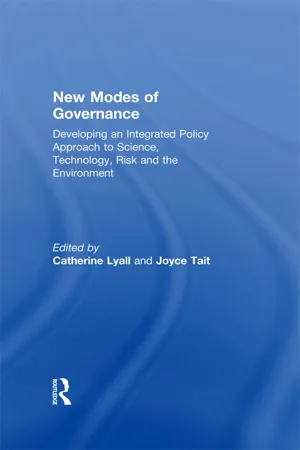
New Modes of Governance
Developing an Integrated Policy Approach to Science, Technology, Risk and the Environment
- 208 pages
- English
- ePUB (mobile friendly)
- Available on iOS & Android
eBook - ePub
New Modes of Governance
Developing an Integrated Policy Approach to Science, Technology, Risk and the Environment
About this book
In modern global economies, how can we govern science, technology, risk and the environment more effectively? As the pace of innovation has increased, the governance agenda has, itself, been changing; policy-making is in a state of flux and governments are stressing the need for more integrated or "joined up" policies to deal with new orders of complexity. This timely book describes the new approaches to policy for science, technology, risk and the environment in the context of this modern governance agenda. The authors examine the extent to which governance is integrated, where gaps exist and where further integration might be helpful for a range of policy areas. The interdisciplinary approach bridges scientific, technical and socio-economic research at global, European, UK and regional levels. New Modes of Governance will be a valuable resource for academics, policy-makers, regulators, and science and industry communities involved in innovation.
Information
PART I
NEW APPROACHES TO GOVERNANCE
Chapter 1
Shifting Policy Debates and the Implications for Governance
Policy-making is in a state of flux and governments are stressing the need for more integrated or “joined up” policies to deal with the complex issues now facing society. There is an ongoing policy revolution taking place at global, European, UK and regional levels but the buzz-words that are often used to describe this revolution – “Third Way”, “joined-up policies”, “what works” – are sometimes regarded with scepticism.
The Modernising Government initiative (HM Government, 1999) in the UK had as one of its primary themes the need for forward looking, more integrated policy-making. The policy environment for science, technology and innovation (STI) is one of the areas most in need of an integrated policy approach. Getting this right is vital to nations’ economic prosperity and hence their ability to deliver on other social and environmental policies. However, there is arguably less integration in this area than in many others and, so far, there has been little guidance on what integrated policies would consist of and how they might be delivered.
The Governance Perspective
Theories of governance draw on a range of disciplinary perspectives and operate at multiple levels (local, regional, national and supra-national). In the most common current usage of the term, “Governance” is seen as implying a move away from the previous government approach (a top-down legislative approach which attempts to regulate the behaviour of people and institutions in quite detailed and compartmentalised ways) to governance (which attempts to set the parameters of the system within which people and institutions behave so that self-regulation achieves the desired outcomes), or put more simply, the replacement of traditional “powers over” with contextual “powers to” (Pierre and Peters, 2000). In such a governance system, permeable and flexible system boundaries will facilitate communication and will support the achievement of higher level goals. These assumptions underline the switch from government to governance in debates about the modernisation of policy systems implying a switch from constraining to enabling types of policy or regulation (i.e. from “sticks” to “carrots”). The UK literature tends to discuss the emergence of “new” modes of governance, and in particular “joined-up government”, in terms of a response to Thatcherite reforms, specifically as a way of coping with the fragmentation effects of New Public Management (NPM) (Newman, 2001; Bevir and Rhodes, 2003) although its antecedents arguably go back much further. The reconnection in the 1990s of the work on networks in policy-making with studies in organisational sociology of networks of service provision provided a spur to the rethinking of governance in network terms which in many ways has provided a critical link to the joined-up government debate (Perri 6, 2004).
The governance debate has its origins in various disciplines spanning institutional economics, international relations, organisational studies, development studies, political science, and public administration (Stoker, 1998). As others have noted, the term “governance” is currently applied to “everything from corporations to rural society” (Sloat, 2002) and the academic literature on the subject of governance has been described as “eclectic and relatively disjointed” (Stoker, 1998). Its meaning is contested and often lacks definitional clarity (Bache, 2003) although most commentators accept that “governance” is no longer a synonym for “government”. However, Stoker (1998) argues that, as governance is ultimately concerned with creating the conditions for ordered rule and collective action, its outputs are no different from those of government. What is significant is the difference in processes.
Most would accept that governance refers essentially to the increased role of non-government actors in policy-making (Bache, 2003) and it is generally regarded as implying an increasingly complex set of state-society relationships in which networks rather than hierarchies dominate the policy-making process (Bache, 2003). The current work adopts the view that “governance” refers to the development of governing styles in which boundaries between and within public and private sectors have become blurred; in this approach the role of the state changes from being the main provider of policy to one of facilitating interaction among various interests (Sloat, 2002). In this context, government’s role is increasingly one of co-ordination and steering (Bache, 2003).
From a governance perspective, the process of governing is an interactive one because no single actor has the knowledge and resource capacity to tackle problems unilaterally (Kooiman, 1993) and the powers of government tiers are no longer clearly distributed, as co-operation replaces hierarchy and legislative competences are shared among several levels (Sloat, 2002). In summary, this perspective focuses on the co-ordination of multiple actors and institutions to debate, define and achieve policy goals in complex political arenas such that the state no longer dominates the policy-making process and decisions are made by “problem solving rather than bargaining” (Sloat, 2002).
“Governance” is therefore a term that takes different meanings in the hands of different authors and Newman (2001) suggests that, in fact, it comprises multiple and conflicting strands and is constituted by disparate forms of power. Some authors take a “state centric image of governance” (Pierre and Peters, 2000) in contrast to Rhodes’ approach (Rhodes, 1997), which downplays the role of central government. Others focus on the complexity, dynamics and diversity of interactive social-political governance where the state still has a role in steering society (Kooiman, 1993). In this scenario there has been a shift from formal powers to political capabilities so that there is now less reliance on coercive policy instruments and a greater reliance on more subtle techniques. This has led to a restructuring of state institutions, creating agencies, quangos and other institutional forms that operate at considerable distance from control by the political elite (Pierre and Peters, 2000). Nevertheless, these authors contend that states as centres of governance still play a defining role in the economy, in international relations, and in many areas of domestic politics and policy. This perspective highlights concerted public-private efforts and co-operative rather than adversarial policy strategies. Pursuing this collective interest through different forms of governance on and between different institutional levels requires closer, more continuous and more informal contacts between political institutions and their environment (Pierre and Peters, 2000 p. 196).
From an academic standpoint, the governance perspective might just be “a simplifying lens to a complex reality” (Stoker, 1998) but its practical value rests in its capacity to provide a framework for understanding changing processes of governing, characterised by processes of adaptation, learning and experiment (Stoker, 1998). This approach necessitates a new policy design where the state acts as a moderator and enabler within a network-oriented polity rather than a hierarchical interventionist approach. This requires a “new mode of governance” with, on the one hand, more elaborate forms of institutionalised co-ordination between the European level and national and regional levels, and on the other hand, a continuous reflection on appropriate principles of governance with respect to both strong leadership and participatory approaches which in turn requires a reorganisation of policy administrations in a way that enables flexible, horizontal coordination and exchange (Edler et al., 2002).
Policy Integration
In general, public policy is not used to tackling problems in an integrated manner and, in particular, policy approaches for areas such as innovation are usually compartmentalised in different departments and agencies that compete for power rather than co-operate to tackle policy issues (Cooke et al., 2000 p. 142). Despite current and emerging socio-economic and political developments where policymakers in most industrialised countries are trying to reform traditional policy approaches, intradepartmental rather than overall co-ordination would still seem to be the preferred policy mechanism in the UK at least where individual agencies are allowed self-determination while trying to avoid undue duplication of effort or pursuit of conflicting goals in different parts of government (Ronayne, 1984 p. 141). In practice, it is still true that co-ordination in Britain tends to mean cross-membership of committees: an “insider’s world” where a relatively small group of senior civil servants, elite scientists, and influential industrialists move from committee to committee (Ince, 1986) and co-ordination between policy domains remains the exception rather than the rule.
Over the past thirty years there has been a steady shift in the emphasis of research policies at national and European levels, to obtain better value for money from public investment in research by ensuring that both curiosity-driven, fundamental research and applied research contribute as much as possible to improving competitiveness at national, European and international levels. New approaches to governance are being developed under a variety of labels at different institutional levels in many European countries. In the UK, what some see as an on-going policy revolution and others regard as a more managerial response to the often unintended consequences of NPM (Bevir and Rhodes, 2003), has been referred to as the “Third Way”, which promotes a network-based polity as an alternative to bureaucracies and markets (Bevir and Rhodes, 2003; Giddens, 1998)1, with a strong commitment to more integrated or “joined-up” approaches to policy. Others have advocated “holistic governance” (6 et al., 2002) which goes beyond simply stitching together the plethora of government committees and policy documents and instead takes a more grassroots approach which moves away from a model of government that is structured around functions and services and instead focuses on solving “wicked” problems (6, 1997).
Some parameters of the new governance-based policy-making systems are relevant to STI policy, such as initiatives on policy integration, evidence-based policy, the use of standards and guidelines linked to policy evaluation, encouragement of openness, stakeholder involvement and consultation, and avoidance of unnecessary regulatory burdens. However, despite frequent references to the need for more integrated approaches to policy development, new governance initiatives in the UK are largely socially-oriented and ignore STI-related issues (Lyall and Tait, 2004).
The development of new governance structures, for example in the UK under the Modernising Government agenda (HM Government, 1999) focuses on modernising the processes of government, including a framework for excellence in policy-making and a strong emphasis on learning lessons from policy experience in other countries. The over-arching ethos is “what matters is what works” (Davies et al., 2000) with, at least in theory, a much freer flow of ideas across governments and government departments and from one level of government to another, focusing on ideas that can contribute to an effective system of governance, rather than on the ideology that generated the ideas.
The cri de coeur of the current Labour Government for “joined-up” policy is reflected in the goal of the Modernising Government initiative to develop a more integrated approach to policy-making, and a series of Cabinet Office publications (for example, Cabinet Office Performance Innovation Unit, 2000; Cabinet Office Strategic Policy Making Team, 1999) aims to improve policy formulation and implementation in areas that cut across the policy boundaries of traditional government departments.
Effective policy integration would imply that science-related policies ought to be crucial components of new governance initiatives but we find little evidence of their inclusion. The Modernising Government agenda concentrates almost entirely on the social policy arena covering social welfare, crime, health and education, these being the areas which focus groups tell government ministers are of most concern to voters. Science, technology, and innovation are apparently of lesser concern to voters as they are not linked in the public mind (and hence less likely to be linked by governments) to national competitiveness which generates the wealth to support the other functions, although others would argue (6, 2004) that there have been attempts with, for example, the publication of the Competitiveness White Paper (DTI, 1998) which aspired to provide an integrated framework of tax, subsidy, regulation, trade, patent and regional policy for the development of science-based industries in the UK, particularly in respect of the horizontal coordination of agencies’ priorities.
As Tait et al. (2004) note, a consistent theme throughout this new governance agenda is the need for more integrated or “joined-up” policy approaches to remove contradictions, inconsistencies and inefficiencies caused when policies or regulations emerging from different government departments or different levels of government (regional, national, international) contradict one another or provide incompatible signals to policy targets. Policy integration is also needed to deal with the complexity and uncertainty associated with many decisions concerning science and technology. However, integration has itself become more difficult as the diversity and policy competence of interested stakeholders and publics has increased.
European Governance
Similar trends are also beginning to emerge at the EU level with important documents being published on European governance, the European Research Area (ERA), and developments in the Sixth Framework Programme (FP6). As in the UK, there is evidence of difficulty in integrating policies and particularly in spanning the divide between science/technology and society.
The gap between innovative thinking on governance in general and developments in science and technology-related policies is also apparent at the EU level. The White Paper on European Governance (Commission of the European Communities, 2001) has only one brief reference to the word “science” in the context of managing “…the challenges, risks and ethical questions thrown up by science and technology”. There are no references to “evidence”, and for “research” there is one mention of “research centres” and one to the ERA, although there are references to scientific committees and the need for their advice to be made publicly available. The overall impression is that science-related issues are of only peripheral interest in the context of European governance although they presumably come into the picture downstream, as a part of policy implementation in sectoral documents such as those concerned with telecommunications or human embryology, rather than being integrated at a high level into the overall governance and policy development process.
The document on the ERA is the main focus of innovative EU thinking on science and research-related issues. One of its main policy planks is the forging of closer links between the EU Framework Research Programmes and the research systems of EU member states. The ERA will be implemented partly through FP6, involving also major changes in the organisation of research in Europe. Prior to the development of ideas on the ERA, and influenced to some extent by UK thinking on the development of Foresight, the Fifth Framework Programme (FP5) took a new direction by giving a strong emphasis to interdisciplinary integration, particularly between the natural and social sciences. FP5 targeted Key Actions to socio-economic needs and guided research collaboration among EU nations in a manner that increasingl...
Table of contents
- Cover
- Half Title
- Title Page
- Copyright Page
- Table of Contents
- List of Tables
- List of Figures
- List of Contributors
- Preface and Acknowledgements
- Part I: New Approaches to Governance
- Part II: Developing an Integrated Policy Approach
- Part III: The Limits to Integration
- Index
Trusted by 375,005 students
Access to over 1.5 million titles for a fair monthly price.
Study more efficiently using our study tools.
Frequently asked questions
Yes, you can cancel anytime from the Subscription tab in your account settings on the Perlego website. Your subscription will stay active until the end of your current billing period. Learn how to cancel your subscription
No, books cannot be downloaded as external files, such as PDFs, for use outside of Perlego. However, you can download books within the Perlego app for offline reading on mobile or tablet. Learn how to download books offline
Perlego offers two plans: Essential and Complete
- Essential is ideal for learners and professionals who enjoy exploring a wide range of subjects. Access the Essential Library with 800,000+ trusted titles and best-sellers across business, personal growth, and the humanities. Includes unlimited reading time and Standard Read Aloud voice.
- Complete: Perfect for advanced learners and researchers needing full, unrestricted access. Unlock 1.5M+ books across hundreds of subjects, including academic and specialized titles. The Complete Plan also includes advanced features like Premium Read Aloud and Research Assistant.
We are an online textbook subscription service, where you can get access to an entire online library for less than the price of a single book per month. With over 1.5 million books across 990+ topics, we’ve got you covered! Learn about our mission
Look out for the read-aloud symbol on your next book to see if you can listen to it. The read-aloud tool reads text aloud for you, highlighting the text as it is being read. You can pause it, speed it up and slow it down. Learn more about Read Aloud
Yes! You can use the Perlego app on both iOS and Android devices to read anytime, anywhere — even offline. Perfect for commutes or when you’re on the go.
Please note we cannot support devices running on iOS 13 and Android 7 or earlier. Learn more about using the app
Please note we cannot support devices running on iOS 13 and Android 7 or earlier. Learn more about using the app
Yes, you can access New Modes of Governance by Catherine Lyall, Joyce Tait in PDF and/or ePUB format, as well as other popular books in Philosophy & Social Policy. We have over 1.5 million books available in our catalogue for you to explore.