eBook - ePub
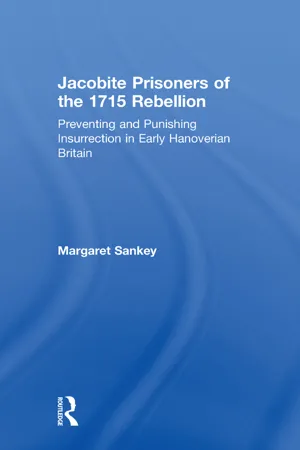
Jacobite Prisoners of the 1715 Rebellion
Preventing and Punishing Insurrection in Early Hanoverian Britain
- 196 pages
- English
- ePUB (mobile friendly)
- Available on iOS & Android
eBook - ePub
Jacobite Prisoners of the 1715 Rebellion
Preventing and Punishing Insurrection in Early Hanoverian Britain
About this book
The Jacobite rebellion of 1715 was a dramatic but ultimately unsuccessful challenge to the new Hanoverian regime in Great Britain. It did, however, reveal serious fault lines in the political foundations of the new regime which enormously restricted the government's freedom of action in the suppression of the rebellion, and effectively made the treatment of the rebels in its aftermath the true test of the new dynasty's legitimacy and stability. Whilst the rulers of England had traditionally dealt harshly with internal rebellion, monarchs and their ministers had to find a delicate balance between showing the power of the regime through the candid exercise of force while maintaining their own reputation for justice and clemency. As such George I and his government had to tailor their reaction to the 1715 rebellion in such a way that it effectively discouraged further participation in Jacobite insurgency, undercut the rebels' ability to challenge the state, and made clear the regime's intention to use a firm hand in preventing rebellion. At the same time it could not cross the line into tyranny with excessive or sadistic executions and had to avoid giving offence to powerful magnates and foreign powers likely to petition for the lives of the captured rebels. To accomplish this feat, the Hanoverian Whig regime used a programme far more subtle and calculated than has generally been appreciated. The scheme it put into effect had three components, to put fear into the rank-and-file of the rebels through a limited programme of execution and transportation, to cripple the Catholic community through imprisonment and property confiscation, and, most crucially, to entertain petitions from members of the elite on behalf of imprisoned rebels. By following such a strategy of retribution tempered with clemency, this book argues that the Hanoverian regime was able to quell the immediate dangers posed by the rebellion, and bring its leaders back into the orbit of the government, beginning the process of reintegrating them back into political mainstream.
Chapter 1
Prelude to Rebellion in England and Scotland
When George I acceded to the British throne in August 1714, he did so without official resistance. No Jacobite army prevented him from coming to London, nor did the population rise against him. It was, however, quickly apparent that the Hanoverian Succession was far from universally popular, and that George I had also inherited a whole calendar of occasions on which the British people could express their dissatisfaction, not only with their king, but with Whigs, Tories, local politicians, landlords, taxes, neighbors and religious differences. On 20 October 1714, the day of George I’s coronation, rioting broke out across Britain, with fracas in Canterbury, Cirencester, Chichester, Gloucester, Hereford, Salisbury, Bedford, Birmingham, Chippenham, Norwich, Reading and Oxford, not counting minor acts of protest by particular individuals.1
The government wisely chose to ignore most of the protests, considering that attempts at repressing them would only aggravate the population, and gauging them as not simply anti-Hanoverian, but a mix of protest against local and national problems. The king of misrule, who appeared to disrupt one of the coronation day parades brandishing a turnip (a common iconographic joke about George I, painting him as a German clod), could also be interpreted as ridicule of regional bigwigs. Much of the violence was also attributed to the fact that the protesters were likely to be met with counter-demonstrations by supporters of the new government, who, like the householder in Shoreditch who displayed an owl in a basket decorated with oak leaves, a crucifix and wooden shoes, were equally willing to ridicule their opponents and engage in street scuffling to demonstrate their convictions. Also, unlike Henry St. John, Viscount Bolingbroke, and later the Jacobite exiles in Europe, the government considered the demonstrations separate from an organized plot against the state, certainly destructive, dangerous and unruly, but without a cohesive goal, plan, or leader. These were annoying, but they were not the Sacheverell riots.2
The tolerance shown by the new king seemed unaccountable and foolhardy to the Dutch ambassador, who urged that the government make an example of rioters who had terrorized Bristol on Coronation Day 1714, but instead the king went with the findings of a local grand jury, which simply fined and briefly imprisoned them for unruly conduct, a crime, but not treasonous behavior. Daniel Defoe was deeply concerned about the effect the constant disrespect would have on the king’s reign, advising:
The meddling with hawkers and ballad-singers may be thought a trifle, but it ceases to be so when we consider that the crying and singing such stuff, vile as it is, make the government familiar and consequently contemptible to the people, warms the mind of the rabble, who are more capable of action than speculation, and are animated by noise and nonsense.3
The days on which the disturbances occurred were stacked against the Hanoverians, with only 5 November, the combination Guy Fawkes/Torbay Landing day (William III landed at Torbay to take the throne during the Revolution of 1688), the birthdays of George I (28 May), William III (15 November), and the Prince of Wales (30 October) and George I’s accession and coronation days being exclusively Hanoverian. Others, like Restoration Day, celebrating the return of Charles II, the martyrdom of Charles I and the birthday of Queen Anne were increasingly claimed as protest days, with extras like the birthday of the Duke of Ormonde added in April 1715. Increasingly, local authorities, especially if they were biased against the government themselves, were unwilling and unable to prevent attacks on nonconformist Protestant chapels (known at the time as ‘meeting houses’) and the violence escalated unchecked, pushing those attacked to defend themselves. Windows were smashed, bell ropes cut, slogans chanted and effigies of the king, Martin Luther (in reference to the new king’s religion at birth), John Calvin and local Whig politicians paraded and burned.4
The rioting and protest became much more charged with the impeachment of Bolingbroke, Robert Harley, the Earl of Oxford and James Butler, the Duke of Ormonde, the most prominent members of Queen Anne’s last Tory government. The House of Commons’ secret committee began meeting in April 1715 to investigate them, and on 9 June 1715 Robert Walpole took five hours to read the charges against them in the Commons, announcing that ‘those who had been employed for the last four years would be shown the most prolifigate, Frenchified, abandoned ministers that ever endeavored to betray their country,’ and that their friends would be embarrassed to stand up for them when the evidence was laid before the house. Bishop Francis Atterbury of Rochester led a fierce attack on the impeachment, particularly against the leading spokesman for the ministry in the Lords, the Duke of Argyll, and Tory mobs responded by attacking more than fifty meeting houses across England between June and August. The authorities were convinced that Ormonde had been ‘practicing on the mob to show themselves if he should happen to be sent to the Tower … [because] the mob were mightily in favor of the Duke.’5
While Oxford held his ground, and remained in England, Bolingbroke and Ormonde made things much easier for the government by fleeing the country. Bolingbroke, who lost his nerve after the ministry seized his papers, borrowed £20,000 on his estates, placed all of his assets in trust for his wife, administered by six political allies, and left for France on 26 March 1715, disguised as the servant of one of the French diplomats in London. Ormonde, too, was shaken by the proceedings and left London for Richmond, where he planned to lead an uprising in western England to prepare the way for a landing by French troops. Ormonde counted on an upswell of support from Oxford, Plymouth, Bristol and Exeter, buttressed by former officers, who had served under him in Flanders, and had been turned out of their commissions by the new administration to make vacancies for their own clients. On news that troops were on their way to arrest him, however, Ormonde decamped for France on 21 July 1715, leaving the rising he and Bolingbroke had planned in the hands of a circle of second-tier leaders, most of whom had not been privy to the planning of the rising, and were at a tremendous disadvantage.6
With the planned rising in England thrown into disarray, the government took three measures to stamp out any possibility of its being carried on or revived by the continued rioting. The first move was the Riot Act. A particularly violent protest had taken place on 28/29 May in Bristol, during celebrations of George I’s birthday and Restoration Day. The government, fed up with continued disturbances, sent a commission of Oyer et Terminer, which was greeted by crowds chanting ‘No Roundheads, No Jefferies, No Western Assizes’ in reference to the harsh treatment of Monmouth’s rebels after the 1685 rebellion in the West Country. Instead of indicting them for treason, however, the jury again turned in bills for riot and misdemeanor, sentencing eight men to a fine and imprisonment. To add insult to injury, the rioters then lodged a suit for wrongful imprisonment against John Blackwell, the constable who had arrested them. The government thereafter moved all subsequent trials for riot into the Court of King’s Bench in London, but a more expeditious way to counter disorder in the localities had to be found lest the government lose control of the situation there.7
The Whig majority in Parliament responded by passing the Riot Act, a greatly resented measure that was also referred to bitterly as the ‘Hanoverian Proclamation.’ This allowed any official to order a group of twelve or more to disperse upon one public reading of the Act. If they did not disperse, remaining in the vicinity became a capital offense (treason), and the remaining crowd could be fired upon or otherwise forcibly dispersed without legal liability on the part of soldiers or magistrates for any harm they might inflict on the rioters’ persons. The government now had a powerful instrument by which they removed prosecutions of civil disturbances from the jurisdiction of local juries, made such disturbances an offense against the government and protected officers of the law, like Blackwood. By 1 August 1715, two rioters who attacked the Kingswood Meetinghouse at King’s Norton had been prosecuted under the Riot Act and immediately executed.8
Next, on 31 July 1715, the king announced in Parliament the suspension of habeas corpus for 12 months. Habeas corpus had last been suspended in 1708, in response to a projected Jacobite invasion, and suspension allowed the government to arrest and detain suspected persons and search private property without warrants or appeal to the courts. Many Whigs were uneasy at the move, which, although considered a useful tool against the rebellion, also challenged rights many of them considered fundamental to the constitution. Joseph Addison, writing in his popular Freeholder, tried to put a good face on it, arguing
As self-preservation by all honest methods is the first duty of every community as well as every private person, so the public safety is the general view of all laws. When therefore, any law does not conduce to this great end, but on the contrary, in some extraordinary and unnatural junctures, the very observation of it would endanger the community, that law ought to be laid asleep for such a time, but the proper authority. This is the very intention of our Habeas Corpus Act, namely, the preservation of the liberties of the subject.
With the passage of this Act, orders could be drawn up for the apprehension of any suspected person, with the added bonus that the government could now take up irksome publishers and writers, who would cool their heels in jail until they had, in the ministry’s view, sufficiently reflected on their behavior and been thoroughly financially inconvenienced without the government having to try or sentence them.9
Finally, in the same speech to Parliament, the king asked for and was voted funds to prepare the armed forces for a Jacobite rebellion and invasion. At the time, the army in mainland Britain consisted of only 8,000 effective troops, with a further 12,000 on the Irish establishment, which was clearly inadequate to meet the projected threat. Parliament authorized the raising of 13 new regiments, along with moving five dragoon and eight foot regiments to England and Scotland from Ireland, and requesting 6,000 Dutch troops guaranteed to Britain by the Barrier Treaties of 1709, while in Ireland, new regiments were ordered raised to replace those transferred to England and Scotland. George I, who cut a convincing military figure, used the encampment in Hyde Park by 3,000 soldiers as an opportunity to encourage popular loyalism, appearing in person as
… a good figure on horseback, followed by such a prodigious number of people who pressed around him to kiss his stirrup and huzza’d with such acclamations of joy and good will it is hoped by his friends that His Majesty will take more frequent opportunities of being seen by the people. One of the mob called out ‘High Church’ near the king at his going out of the park, and was immediately knocked down and used very scurvily by the rest.
Because of the king’s appearance, the encampment in the park also quickly became part of the social scene, as Dudley Ryder described after a visit on 28 July 1715, ‘the best of the nobility and gentry in England go to see and there is a constant line of coaches going and coming all the afternoon. I saw an abundance of pretty women there.’10
With these measures in place, the government could also easily put into execution existing measures to secure the country against the Jacobite threat. Using an Act established in the reign of James I, ‘to Prevent and Avoid Dangers Which May Grow by Popish Recusants’ and William and Mary’s ‘Act for the Better Securing the Government by Disarming Papists and Reputed Papists,’ Roman Catholics were ordered to remove themselves at least ten miles from London and confined to their homes, while local justices of the peace were empowered to seize horses, arms and search the houses of anyone whom two J.P.s, or in the case of a peer, two commissioned officers, suspected ‘to be disaffected to His Majesty or his government and may be probably aiding such insurrection or invasion.’ Ever mindful of protocol, even in cases of suspected treason, the privy council gave instructions that searches should be conducted by officers, not enlisted men, and that in the case of aristocrats, two officers must be present as witnesses to any search or seizure.11
In Middlesex alone, the sheriff arrested more than eight hundred Catholics and Non-Jurors under these acts, confining the prisoners in Newgate until they made bail for good behavior. In the north of England, constables hired extra help to engage in the roundup of suspicious persons, the magistrates of Aldston paying Joseph Bowmand and Thomas Dickinson £3 17s for arresting and transporting the...
Table of contents
- Cover
- Half Title
- Title Page
- Copyright Page
- Table of Contents
- List of Illustrations
- Acknowledgements
- Introduction
- 1 Prelude to Rebellion in England and Scotland
- 2 The Preston Gentlemen
- 3 Half-Pay Officers and Commoners after Preston
- 4 Transporting Treason
- 5 The Summer of 1716
- 6 Scotland 1715–16
- 7 The Carlisle Trials and the 1718 Grand Juries
- 8 The Forfeited Estates Commission in England and Scotland
- Conclusion
- Bibliography
- Index
Trusted by 375,005 students
Access to over 1.5 million titles for a fair monthly price.
Study more efficiently using our study tools.
Frequently asked questions
Yes, you can cancel anytime from the Subscription tab in your account settings on the Perlego website. Your subscription will stay active until the end of your current billing period. Learn how to cancel your subscription
No, books cannot be downloaded as external files, such as PDFs, for use outside of Perlego. However, you can download books within the Perlego app for offline reading on mobile or tablet. Learn how to download books offline
Perlego offers two plans: Essential and Complete
- Essential is ideal for learners and professionals who enjoy exploring a wide range of subjects. Access the Essential Library with 800,000+ trusted titles and best-sellers across business, personal growth, and the humanities. Includes unlimited reading time and Standard Read Aloud voice.
- Complete: Perfect for advanced learners and researchers needing full, unrestricted access. Unlock 1.5M+ books across hundreds of subjects, including academic and specialized titles. The Complete Plan also includes advanced features like Premium Read Aloud and Research Assistant.
We are an online textbook subscription service, where you can get access to an entire online library for less than the price of a single book per month. With over 1.5 million books across 990+ topics, we’ve got you covered! Learn about our mission
Look out for the read-aloud symbol on your next book to see if you can listen to it. The read-aloud tool reads text aloud for you, highlighting the text as it is being read. You can pause it, speed it up and slow it down. Learn more about Read Aloud
Yes! You can use the Perlego app on both iOS and Android devices to read anytime, anywhere — even offline. Perfect for commutes or when you’re on the go.
Please note we cannot support devices running on iOS 13 and Android 7 or earlier. Learn more about using the app
Please note we cannot support devices running on iOS 13 and Android 7 or earlier. Learn more about using the app
Yes, you can access Jacobite Prisoners of the 1715 Rebellion by Margaret Sankey in PDF and/or ePUB format, as well as other popular books in History & World History. We have over 1.5 million books available in our catalogue for you to explore.