eBook - ePub
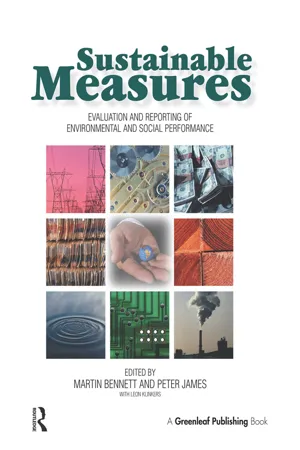
Sustainable Measures
Evaluation and Reporting of Environmental and Social Performance
- 586 pages
- English
- ePUB (mobile friendly)
- Available on iOS & Android
eBook - ePub
Sustainable Measures
Evaluation and Reporting of Environmental and Social Performance
About this book
Environmental and social performance measurement and reporting by business has become a high-profile issue during the 1990s. It is increasingly being requested by stakeholders and required by governments. Companies too are finding that they need better environmental and social performance data for effective internal management. And there are a growing number of standardisation initiatives – such as the ISO 14031 guidelines on environmental performance evaluation or the CERES Global Reporting Initiative (GRI) template for sustainability reporting – that are aimed at making it easier for more companies to take action, and for stakeholders to compare their progress.Sustainable Measures collects together most of the key work and individuals concerned with the topic from around the world. Contributions include: environmental and social reporting by John Elkington and colleagues at SustainAbility; the GRI discussion draft; Roger Adams and Martin Houldin on the FEE study of environmental reporting; Janet Ranganathan of the World Resources Institute on sustainability measures; and Martin Bennett and Peter James on ISO 14031 and the future of environmental performance evaluation. There are also chapters examining current practice in Austria, Denmark, India, Indonesia, Japan, the Netherlands and South Africa, developments in electronic reporting, as well as case studies of Baxter, Kunert, Niagara Mohawk, Unox, The Body Shop and the UK water industry, and an analysis of leading social reports.The book is essential reading for all academics, campaigners, policy-makers and practitioners with an interest in issues such as:The standardization and comparability of environmental and social performance measuresMeasuring and reporting on sustainable businessEco-points and other means of evaluating product impactsThe implementation of measurement and reportingBest practice in corporate environmental and social reportingNew means of communicating environmental dataEnvironmental performance evaluation in developing countries
Key Themes in Environmental, Social and Sustainability Performance Evaluation and Reporting
Martin Bennett and Peter James
ENVIRONMENTAL, social and sustainability performance evaluation and reporting (ESSPER) is an exciting topic. Only a minority of companies are doing it to any substantial degree, but practitioners in those that are can enjoy the satisfaction of helping their companies to adapt to new ways of doing business that help them to prosper while also contributing to the general good. Through this, they are making things happen that have previously only been dreamed of by academics and theorists. At the beginning of the decade, few would have imagined that large companies, to take just a few of the examples discussed in this book, would be:
- Implementing balanced performance scorecards with a substantial sustainability component
- Experimenting with ways of valuing natural and social capital
- Using their own reports and websites to publicise the views of their critics
The speed of change is such that it is difficult to keep track of everything that is happening, let alone to develop a coherent intellectual analysis of the field. Fortunately however, it is relatively straightforward—if slightly simplistic—to group much of the writing on the topic into six bodies of work, which are summarised in Section 1. The next three sections then discuss, in turn, environmental, social and sustainability performance evaluation. Section 5 considers developments and issues in reporting, Section 6 the topics of comparability, standardisation and benchmarking; Section 7 analyses issues of implementation and Section 8 examines links between environmental, social and sustainability performance and financial performance. A concluding section provides some thoughts on the current situation and future directions of development.
1. Approaches
It is always difficult—and, to those being classified, sometimes irritating—to group the work of different individuals into a limited number of categories. In addition, of course, there are always individuals who defy classification. However, the volume of writing on the topic makes this essential. We distinguish five reasonably cohesive bodies of work that address ESSPER in an integrated way. (There is of course, a considerable practitioner and academic literature on discrete areas such as environmental performance evaluation.) They are:
- Accountability/social responsibility
- Business viability
- Management accounting/performance measurement
- Organisational change
- Contrarian
Each of these has different strands within it, usually including a mainstream and a radical variant.
Accountability/Social Responsibility
The central argument of this body of work is that environmental and social challenges can be met only by creating a better-informed and more empowered civil society This requires a broadening of the scope of accountability from its traditional—and legally defined—focus on financial stakeholders to an accountability to external stakeholders generally and society as a whole. Until recently much of the work within this school was undertaken from an accounting perspective (Freedman 1993; Gray et al. 1993; Gray et al. 1996). Its advocates have pointed out that accountants and the accounting profession have much to contribute in this respect. Their experience is, or could be, valuable in the generation, collection and analysis of data on resources consumed and other aspects of performance, much of which will already be held within accounting records and systems (ICAA 1998). They also have expertise in verification of data collection and analysis methods and in reporting and communication of quantitative data.
These arguments have helped to create several initiatives by professional accounting bodies. These include reporting award schemes (see below), research on the topic (for example, Bennett and James 1998a; CICA 1993; Gonella et al. 1998), and developing guidance for their members. Chapter 14 by Adams et al. provides a summary of one such initiative, the Discussion Paper published by the European Federation of Accountants (FEE), which proposes a conceptual framework for environmental reporting.
In recent years, another strand—of social and ethical auditing—has become more prominent within the accountability school. This has stressed the qualitative, process, dimension of accountability as a continuous dialogue between an organisation and its stakeholders (Gonella et al. 1998). Conversely, there has also been a concern over an excessive emphasis on measurement and verification in other approaches, especially as these have become operationalised through mainstream accountancy and consultancy firms (Power 1997).
Business Viability
The ultimate purpose of this body of work is to support the traditional 'customers' of shareholders and lenders through better information and more effective corporate decision-making. However, much of the analysis overlaps with the accountability school by arguing that good linkages with social stakeholders are important elements in business viability (Plender 1997).
One area of focus has been highlighting the financial risks associated with poor environmental and social performance. These risks—for example, liabilities associated with a need to clean up contaminated land—can be considerable, especially in the USA. There have been several reports on this by financial regulators such as the Securities and Exchange Commission, and the accountancy profession, on both sides of the Atlantic (FEE 1996) (although an argument has been made that the standards themselves are adequate provided that they are properly followed and enforced [ICAEW1996]).
In recent years, environmental and social issues have also featured in the debate on reform of financial reporting (Centre for Tomorrow's Company 1998; ICAEW 1998). One reason for this suggestion is that they constitute an important aspect of the 'forward-looking information' of relevance to long-term shareholder value which regulatory authorities are seeking to encourage (FASB 1998).
A third, closely related, strand is that of corporate governance (Charkham 1994). There has been a long tradition of interest in worker representation, especially the German supervisory board model. This has translated into considerable activity on employee indicators and, in many cases, reports. More recently, several studies have suggested that successful business is increasingly about managing external relationships—primarily within the supply chain but also including other stakeholders (for example, RSA 1996). However, they have argued that the senior leadership of many companies is too narrow in its background and concerns to be successful in this. They believe that boards, and other leadership structures, require greater representation of, and should be more able to maintain a dialogue with, the needs of external stakeholders—including environmental and social ones. This requires more emphasis on the measurement and reporting of the information in which they are interested.
Management Accounting/Performance Measurement
This approach builds on the generic work of individuals such as Eccles (1991), Geanuracos (1997), Kaplan and Norton (1996a, 1996b), Johnson and Kaplan (1987) and Neely (1999). They have argued that business needs to pay greater attention to measuring and improving its non-financial performance if it is to meet its long-term financial objectives.
One theme in this school has been the generation and use of data to support internal environmental decision-making (Bartolomeo el al. 1999). Although not opposed to external reporting, much of the work notes the findings of conventional management accounting research that external reporting can compromise the collection and use of data for internal decision-making (Eccles 1991; Johnson and Kaplan, 1987; Kaplan and Norton 1996a). A second theme has been the need for ESSPER to focus within a 'balanced scorecard' of key performance measures (Kaplan and Norton 1996b). Bennett and James (1998a) have also pointed out some of the potential disadvantages of total disclosure and questioned whether financial accounting models for data disclosure through annual reporting are entirely appropriate when applied to environmental management. A more business-oriented approach might be based on detailed materials and waste accounting, which draws on traditional management accounting skills (Birkin and Woodward 1997). A related theme within this is an interest in developing a better understanding of environment-related (and, in principle, social-related) financial costs and benefits. Much work on this topic has been done by the US Environmental Protection Agency and others (Bennett and James 1998b).
Organisational Values
This body of work stresses the importance of organisational values in driving environmental and social performance.
One strand is that of total quality management (TQM). This began as a means of achieving continuous improvement by, in part, generating quantitative data on product defects and their causes, and is often operationalised in conservative and incremental ways. However, it is in essence a philosophy of management that stresses the importance of motivating employees through a sense of higher purpose, which is helping society by providing customers with better goods and services (Binney and Williams 1992; Grant et al. 1994). This is partially achieved through greater attention to, and measurement of, non-financial factors. Environmental and social performance have been explicitly linked to quality by the European Foundation for Quality Management (EFQM). This has developed a quality template against which companies can be assessed with the highest-scoring company each year winning the European Quality Award (EQA). The template contains a section on 'Impact on Society', dealing with environmental and social performance, which accounts for 6% of overall marks. A later section provides discusses the detailed implications of TQM for environmental performance measurement and reporting.
Another body of work on business ethics also argues that organisational values are the drivers of behaviour, including environmental and social behaviour (Newall 1996). Advocates of this view, such as Sheila Carmichael, argue that, if internal ethics are right, then appropriate performance and reporting will follow (SustainAbility/UNEP 1999a).
Contrarian
This body of work challenges many of the assumptions that have been made about ESSPER. Its advocates believe that a company's primary duty is to its shareholders and that, beyond compliance with the law, demands for corporate responsibility are asking them to do what they cannot and/or should not (Barry 1998; Friedman 1962; Rappaport 1998). Distracting from this duty serves only to create economic inefficiency. As Wealth—and the new technologies it creates and investment it allows in innovation—is the ultimate solution to environmental and social problems, the end-result is to impede these solutions and thereby actually worsen rather than improve environmental and social conditions (Simon 1996,1997).
A second argument is that much environmental data—and inferences drawn from it—are inaccurate and that many environmental problems are less serious than tends to be suggested by some environmentalists (Eberstadt 1996; Morris 1998; Simon 1997). Some also argue that the general public is less concerned about business environmental practices than environmentalists suggest—with a lack of public interest in environmental reports being cited as evidence (see below).
A third strand is that the environmental movement has no interest in changing this situation because its aims are political rather than environmental. Environmental problems are essentially a big stick with which to beat business and forward a political—many in this camp would say socialist—agenda. The composite result of these arguments is that companies should stop seeking dialogue with such groups—and certainly feel no imperative to prepare reports for them—and focus instead on environmental activities that are necessary to comply with (sensible) regulations and customer requirements.
The Relationship between Environmental and Social Issues, and Performance Evaluation and Reporting
As the preceding discussion demonstrates, one area of debate is over the
- Distinctiveness of environmental issues vis-à-vis social and/or economic ones
- Extent to which performance evaluation should be focused on internal management needs, as distinct from reporting to an external audience
There are two main arguments for not separating the environmental from the social, but instead trying to deal with them in an integrated fashion:
- That—together with the third area,economic development—they form closely interlinked components of a broader whole, which is sustainable development. The interlinkages are such that it could be distorting and misleading to analyse them separately.
- Sceptics argue that a cynical business might perceive that, it has an interest in such a separation. It could make it easier to focus the company's efforts on the less threatening topic of environmental performance evaluation and reporting, and to marginalise the more contentious issues involved in social performance evaluation and reporting. Environment is said to be more acceptable because it can presented as an operational business issue w...
Table of contents
- Cover
- Half Title
- Title
- Dedication
- Copyright
- Contents
- Forewords
- Introduction
- 1. Key Themes in Environmental, Social and Sustainability Performance Evaluation and Reporting
- Section 1: Evaluating Environmental Performance
- Section 2: Reporting Environmental Performance
- Section 3: Social and Sustainability Performance Evaluation and Reporting
- Bibliography
- Biographies
- Index
Trusted by 375,005 students
Access to over 1.5 million titles for a fair monthly price.
Study more efficiently using our study tools.
Frequently asked questions
Yes, you can cancel anytime from the Subscription tab in your account settings on the Perlego website. Your subscription will stay active until the end of your current billing period. Learn how to cancel your subscription
No, books cannot be downloaded as external files, such as PDFs, for use outside of Perlego. However, you can download books within the Perlego app for offline reading on mobile or tablet. Learn how to download books offline
Perlego offers two plans: Essential and Complete
- Essential is ideal for learners and professionals who enjoy exploring a wide range of subjects. Access the Essential Library with 800,000+ trusted titles and best-sellers across business, personal growth, and the humanities. Includes unlimited reading time and Standard Read Aloud voice.
- Complete: Perfect for advanced learners and researchers needing full, unrestricted access. Unlock 1.5M+ books across hundreds of subjects, including academic and specialized titles. The Complete Plan also includes advanced features like Premium Read Aloud and Research Assistant.
We are an online textbook subscription service, where you can get access to an entire online library for less than the price of a single book per month. With over 1.5 million books across 990+ topics, we’ve got you covered! Learn about our mission
Look out for the read-aloud symbol on your next book to see if you can listen to it. The read-aloud tool reads text aloud for you, highlighting the text as it is being read. You can pause it, speed it up and slow it down. Learn more about Read Aloud
Yes! You can use the Perlego app on both iOS and Android devices to read anytime, anywhere — even offline. Perfect for commutes or when you’re on the go.
Please note we cannot support devices running on iOS 13 and Android 7 or earlier. Learn more about using the app
Please note we cannot support devices running on iOS 13 and Android 7 or earlier. Learn more about using the app
Yes, you can access Sustainable Measures by Martin Bennett,Peter James,Leon Klinkers in PDF and/or ePUB format, as well as other popular books in Business & Business General. We have over 1.5 million books available in our catalogue for you to explore.