eBook - ePub
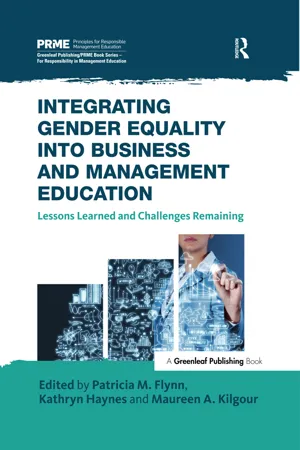
Integrating Gender Equality into Business and Management Education
Lessons Learned and Challenges Remaining
- 432 pages
- English
- ePUB (mobile friendly)
- Available on iOS & Android
eBook - ePub
Integrating Gender Equality into Business and Management Education
Lessons Learned and Challenges Remaining
About this book
This volume addresses the need to integrate gender equality into business and management education and provides examples of leading initiatives illustrating how this can occur from various disciplinary and global perspectives. Gender inequality has a long history in business schools and the workplace, and traditions are hard to change. Some disciplines remain resolutely gendered, affecting both women and men; and case materials on women leaders and managers are still rare.The chapters provide conceptual and research rationales as to why responsible management education must address the issue of gender equality. They also identify materials and resources to assist faculty in integrating gender issues and awareness into various disciplines and fields. These include specific case studies and innovations that assess or address the role of gender in various educational environments.The book is designed to help faculty integrate the topic of gender equality into their own teaching and research and gain support for the legitimacy of gender equality as an essential management education topic. This is the first book in a series on gender equality as a challenge for business and management education, published with the Principles of Responsible Management Education (PRME) Working Group on Gender Equality.
Part I
Trends and challenges in management education
1
Gender inequality in management education
Past, present and future
This chapter provides an historical perspective on gender in management education, reviews some current challenges to the achievement of gender equality and suggests concrete actions for the future. Since the 1970s, researchers have addressed four main areas in business schools and management education, identifying a wide range of issues concerning: students (numbers, relationships, MBA programs, careers, etc.); faculty (promotion and tenure, working conditions and pay, research evaluation, leadership, etc.); climate (harassment, environment, etc.) and programs (syllabi, curricula, orientation, sex-role stereotyping, etc.). This chapter looks at three specific issues that illustrate persistent gender inequality problems in business schools: (1) salary discrimination of female faculty in business schools; (2) sex-role stereotyping in the curriculum; and (3) the environment, a chilly climate which is sometimes violent, in which women study and work. This historical survey demonstrates that gender inequality has been an issue since women entered and started working in business schools in significant numbers; there is no shortage of research and proposals for change; and the current situation has both positive and negative elements, evidence of sporadic, but much desired progress. This chapter argues that the problem does not lie in the lack of study, data, sharing of best practices and proposed solutions, but in finding ways to transform research and recommendations into action for systemic change. The Principles for Responsible Management Education (PRME), business school leaders and the AACSB and other accreditation bodies can play important roles in permanently getting rid of gender inequality in business schools.
1.1 Introduction
The issue of gender inequality in management education is not new, notwithstanding the recent (2011) formation of the Principles for Responsible Management Education (PRME) Working Group on Gender Equality (WG) and the publication of this volume. The problems related to gender that are being addressed by the WG and by countless others working in higher education have been discussed and analysed by researchers going back decades. Not only have the issues been discussed, but solutions have also been proposed, many of which are (legitimately) being re-proposed in various contexts.
The purpose of this chapter is to provide a brief historical perspective on how the issue of gender in business schools has been discussed since the 1970s, review some current challenges and discuss how progress can be made in the future. I argue that the problem does not lie in the lack of study, data, sharing of best practices and proposed solutions. There are more than enough of these—many of which are discussed in this volume. While these are still necessary, it is important to determine ways to put research and recommendations into action for systemic change. I suggest that PRME can be a useful tool to not only orient teaching and research but also guide how the educational institutions (i.e. business schools) operate. PRME should commit to making gender equality an explicit part of its mandate.
Four major areas have preoccupied management education researchers regarding gender over the past number of decades, encompassing a wide range of issues: students (numbers, relationships, MBA programs, careers, etc.); faculty (promotion and tenure, working conditions and pay, research evaluation, leadership, etc.); climate (harassment, environment, etc.) and programs (syllabi, curricula, orientation, sex-role stereotyping, etc.). This chapter will look at three specific issues that relate to these areas, from both an historical perspective addressed in the academic literature and a current perspective, which is drawn from media coverage on gender and management education. The goal is to show that (1) gender inequality has been an issue since women started entering and working in business schools in significant numbers; (2) there is no shortage of research and proposals for change; and (3) the current situation has both positive and negative elements, pointing to sporadic, but much desired, progress.
1.2 The past becomes the present
There have been numerous and significant attempts to address the gender inequality problem in management education and in higher education more generally. The following refers to some of the insights from a very small non-exhaustive sample of the literature on the issue of gender in management education in the past decades, going as far back as the 1970s, a time before many current faculty members were even born. These are juxtaposed with a related issue that has garnered media attention in the last few years. The three issues are discussed below: (1) salary discrimination of female faculty in business schools (an issue affecting faculty); (2) sex-role stereotyping in the curriculum (an issue relating to programs and students); and (3) environment in which women study and work (an issue relating to the chilly climate and students). It is important to note that all of these areas are interrelated and have an effect on each other. McKeen et al. argued in 2000 of the interrelation between such issues as the number of female students with broader issues of climate, attitudes and curriculum:
… focussing only on tangible, measurable aspects of equality (such as the ratio of female to male students and the use of gender neutral language) is not sufficient to warm the chilly climate in management education. Rather, such observable, behavioural changes need to be followed by changes in attitudes. Initiatives that expose male and female business students to more female role models, to more discussion of gender issues throughout the business curriculum, and to courses on gender and diversity issues, among others, are important elements in initiating attitudinal change (McKeen, Bujaki and Burke, 2000: 365, 366).
1.2.1 Salary discrimination in business schools
In the past number of decades, attention has been called to pay disparities between male and female academic staff members, including business schools, resulting in numerous legislated, policy and collective bargaining initiatives to tackle the discrimination-based disparities. Recent research in various jurisdictions demonstrates that gender-based pay inequities still exists, in business schools and in universities more generally (e.g. in Burke et al., 2005; Doucet, Durand and Smith, 2008; Bell and Joyce, 2011; Doucet, Smith and Durand, 2012; Currie and Hill, 2013). For example, Bell et al. found that female faculty members earned 85% of male counterparts in publicly funded Association to Advance Collegiate Schools of Business (AACSB) and 83% in non-AACSB business schools (Bell and Joyce, 2011). Similar disparities of 15% were found as a result of a pay equity audit at the University of Western Australia (Currie and Hill, 2013). Researchers since the 1970s have tried to address this issue. For example, in 1979, Robertson found that gender-based disparities in pay and status were due to the fact that fewer female faculty members than male faculty members had held a doctorate. She argued that “this single factor greatly accounts for women’s inequity in rank and administrative position” (Robertson, 1979: 635). Given that most female faculty members currently hold doctorates, one could now assume that inequalities in rank and position have all but disappeared. Unfortunately, that is not the case and reminds us to look for other reasons to explain the inequalities.
Robertson predicted that the problems would diminish over time as more and more women are hired as “qualified” (with PhD) faculty members. For example, she suggested that
Increasing numbers of women business school faculty members should mean an increased emphasis on women’s topics in the business school curriculum (Robertson, 1979: 645).
She also suggested that the need for addressing and mentoring women will diminish over time:
Ironically, by the time that substantial numbers of faculty members are knowledgeable about and willing to discuss women in their courses, and to serve as role models and mentors, there will undoubtedly not be the great need that exists today for such discussion (Robertson, 1979: 645).
Unfortunately, despite the passage of time since 1979 and the fact that there are many more women with PhDs ready and able to “discuss women”, gender-based salary inequities persist, as do those who deny that pay inequality is an important issue. For example, the University of California Los Angeles (UCLA) business school (Anderson) posted a commentary on its blog of an Anderson professor who was denying in the Huffington Post that pay inequities between male and female business school professors were a result of discrimination. Chowdhry argued that closing the gender gap in business schools is “mathematically impossible” and that increasing the number of women hired will reduce the quality:
Simply finding evidence that women on average are paid less than men at most organizations does not necessarily prove that there is gender-based discrimination. Trying to cure gender imbalance by pushing organizations to hire more women will not only fail overall … but also … it would make the salary imbalance between men and women appear worse—because average quality of women will fall—at all organizations (Chowdhry, 2014).
In a rebuttal to Chowdhry’s argument that the only way to fix discrimination in business schools is to work on the “pipeline” (the supply side of the recruitment equation), Scott points out the circularity of his argument:
Chowdhry doesn’t understand why the “pipeline” argument is circular. The skewed dynamics in business school faculties—demeaning behaviors, dismissive remarks, unfair assessments, and lower pay—are pumped like toxins back into doctoral programs for professors and students alike to breathe. As long as that connection is ignored or denied, the candidate pool will be badly unbalanced … Potential female recruits will also continue to be deterred by the poor prospects for advancement (Scott, 2014).
Salary discrimination is just one of the many employment-related issues faced by female faculty members (Symons and Ibarra, 2014). In May 2014, The Wall Street Journal reported on “Allegations of Gender Bias at UCLA Anderson”:
One of the nation’s top-ranked business schools is “inhospitable to women faculty,” according to an internal academic review … Among the findings of the report, which was reviewed by The Wall Street Journal: Anderson is inconsistent in how it hires and promotes women as ...
Table of contents
- Cover
- Half Title
- Title
- Copyright
- Contents
- Acknowledgements
- The Women’s Empowerment Principles
- The Six Principles of PRME
- Introduction: identifying the key issues underlying gender inequality in management education and ways to reduce gender gaps
- Part I: Trends and challenges in management education
- Part II: Disciplinary perspectives
- Part III: Institutional perspectives
- Part IV: International perspectives
- Part V: Pedagogical approaches
- Concluding comments: going forward
- About the contributors
Trusted by 375,005 students
Access to over 1.5 million titles for a fair monthly price.
Study more efficiently using our study tools.
Frequently asked questions
Yes, you can cancel anytime from the Subscription tab in your account settings on the Perlego website. Your subscription will stay active until the end of your current billing period. Learn how to cancel your subscription
No, books cannot be downloaded as external files, such as PDFs, for use outside of Perlego. However, you can download books within the Perlego app for offline reading on mobile or tablet. Learn how to download books offline
Perlego offers two plans: Essential and Complete
- Essential is ideal for learners and professionals who enjoy exploring a wide range of subjects. Access the Essential Library with 800,000+ trusted titles and best-sellers across business, personal growth, and the humanities. Includes unlimited reading time and Standard Read Aloud voice.
- Complete: Perfect for advanced learners and researchers needing full, unrestricted access. Unlock 1.5M+ books across hundreds of subjects, including academic and specialized titles. The Complete Plan also includes advanced features like Premium Read Aloud and Research Assistant.
We are an online textbook subscription service, where you can get access to an entire online library for less than the price of a single book per month. With over 1.5 million books across 990+ topics, we’ve got you covered! Learn about our mission
Look out for the read-aloud symbol on your next book to see if you can listen to it. The read-aloud tool reads text aloud for you, highlighting the text as it is being read. You can pause it, speed it up and slow it down. Learn more about Read Aloud
Yes! You can use the Perlego app on both iOS and Android devices to read anytime, anywhere — even offline. Perfect for commutes or when you’re on the go.
Please note we cannot support devices running on iOS 13 and Android 7 or earlier. Learn more about using the app
Please note we cannot support devices running on iOS 13 and Android 7 or earlier. Learn more about using the app
Yes, you can access Integrating Gender Equality into Business and Management Education by Patricia M. Flynn, Kathryn Haynes, Maureen A. Kilgour, Patricia M. Flynn,Kathryn Haynes,Maureen A. Kilgour in PDF and/or ePUB format, as well as other popular books in Business & Business General. We have over 1.5 million books available in our catalogue for you to explore.