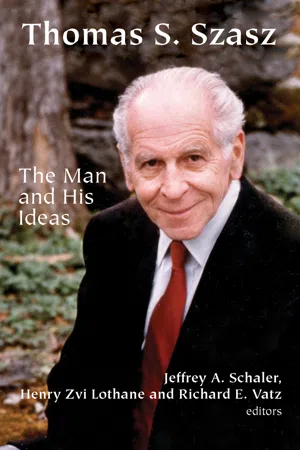
Thomas S. Szasz
  1. 216 pages
  2. English
  3. ePUB (mobile friendly)
  4. Available on iOS & Android
eBook - ePub

About this book

As it entered the 1960s, American institutional psychiatry was thriving, with a high percentage of medical students choosing the field. But after Thomas S. Szasz published his masterwork in 1961, The Myth of Mental Illness, the psychiatric world was thrown into chaos.

Szasz enlightened the world about what he called the "myth of mental illness." His point was not that no one is mentally ill, or that people labeled as mentally ill do not exist. Instead he believed that diagnosing people as mentally ill was inconsistent with the rules governing pathology and the classification of disease. He asserted that the diagnosis of mental illness is a type of social control, not medical science.

The editors were uniquely close to Szasz, and here they gather, for the first time, a group of their peers—experts on psychiatry, psychology, rhetoric, and semiotics—to elucidate Szasz's body of work. Thomas S. Szasz: The Man and His Ideas examines his work and legacy, including new material on the man himself and the seeds he planted. They discuss Szasz's impact on their thinking about the distinction between physical and mental illness, addiction, the insanity plea, schizophrenia, and implications for individual freedom and responsibility. This important volume offers insight into and understanding of a man whose ideas were far beyond his time.

Frequently asked questions

Yes, you can cancel anytime from the Subscription tab in your account settings on the Perlego website. Your subscription will stay active until the end of your current billing period. Learn how to cancel your subscription.
No, books cannot be downloaded as external files, such as PDFs, for use outside of Perlego. However, you can download books within the Perlego app for offline reading on mobile or tablet. Learn more here.
Perlego offers two plans: Essential and Complete
  • Essential is ideal for learners and professionals who enjoy exploring a wide range of subjects. Access the Essential Library with 800,000+ trusted titles and best-sellers across business, personal growth, and the humanities. Includes unlimited reading time and Standard Read Aloud voice.
  • Complete: Perfect for advanced learners and researchers needing full, unrestricted access. Unlock 1.4M+ books across hundreds of subjects, including academic and specialized titles. The Complete Plan also includes advanced features like Premium Read Aloud and Research Assistant.
Both plans are available with monthly, semester, or annual billing cycles.
We are an online textbook subscription service, where you can get access to an entire online library for less than the price of a single book per month. With over 1 million books across 1000+ topics, we’ve got you covered! Learn more here.
Look out for the read-aloud symbol on your next book to see if you can listen to it. The read-aloud tool reads text aloud for you, highlighting the text as it is being read. You can pause it, speed it up and slow it down. Learn more here.
Yes! You can use the Perlego app on both iOS or Android devices to read anytime, anywhere — even offline. Perfect for commutes or when you’re on the go.
Please note we cannot support devices running on iOS 13 and Android 7 or earlier. Learn more about using the app.
Yes, you can access Thomas S. Szasz by Jeffrey A. Schaler, Henry Zvi Lothane, Richard E. Vatz, Jeffrey A. Schaler,Henry Zvi Lothane,Richard E. Vatz in PDF and/or ePUB format, as well as other popular books in Medicine & Psychiatry & Mental Health. We have over one million books available in our catalogue for you to explore.

Information

Publisher
Routledge
Year
2017
Print ISBN
9781412865142
eBook ISBN
9781351295024

Part I Psychiatry and the World after Szasz

Jeffrey A. Schaler, Henry Zvi Lothane and Richard E. Vatz

1 Reminiscences of Thomas Szasz and His Ideas

Henry Zvi Lothane
After three decades of friendship with Szasz—born on April 15, 1920, died on September 8, 2012—I eulogized him in the obituary the Times (London) invited me to write. Immediately below is what I submitted:
Thomas Szasz, doctor of medicine, emeritus Professor of Psychiatry at SUNY, Syracuse, psychoanalyst and member of the International and American Psychoanalytic Associations, died after a fall at age 92, ending a long publishing career from 1947 to 2011. He became the best known and the most controversial psychiatrist in America and beyond following the publication of his 1961 book, The Myth of Mental Illness, subtitled Foundations of a Theory of Personal Conduct. Supported by a only a handful but branded in overwhelming numbers of his psychiatric colleagues as a denigrator, a fouler of his own nest, provocateur and traitor, let alone a paranoid schizophrenic, Szasz ignited highly emotional and acrimonious wars of words that are still continuing. In 2004, his follower, psychologist Jeffrey A. Schaler, edited Szasz Under Fire: The Psychiatric Abolitionist Faces his Critics, with Szasz’s own autobiographical sketch and responses to his critics (the quotes and material below are from that book).
Thomas Stephen Szasz was the second son born in Budapest to the upper middle class housewife Lily and Julius SzĂĄsz, a businessman. They were assimilated Jews who celebrated Christmas. He loved his mother and respected his father. He was a sickly child and nearly died of diphtheria: “My illnesses taught me the advantages of being ill: I knew what ‘secondary gain’ was decades before I heard the term and I learned to malinger.” He emigrated to the USA in 1938 and started his medical studies in 1941, completing a medical residency and subsequently a psychiatric residency. By 1950 he graduated from the Chicago Psychoanalytic Institute whose director was another Hungarian emigrĂ©, Franz Alexander, a leader in psychoanalysis and psychosomatic medicine. In 1951 he became a board certified psychiatrist.
Szasz argued that whereas medicine dealt with real illness of diseased organs, psychiatry was concerned with a mythical, that is, metaphorical, both fictitious and factitious, illness, a kind of malingering. However, he did not deny that “problems of living” are real but that such problems are part of psychology and sociology and have their legal, economic, social, and political aspects. Lost in the shuffle was the influence upon Szasz of a great American psychiatrist, Harry Stack Sullivan, who also portrayed psychiatric disorders as a problem in living, propounding a psychological and sociological conception of schizophrenia.
These views led Szasz to decry psychiatric diagnoses as fiction and to advance “a body of pleading of replacing psychiatric control and coercion with psychiatric cooperation and contract” and in 1970, together with sociologist Erving Goffman and lawyer George J. Alexander, to found the American Association for the Abolition of Involuntary Mental Hospitalization and its journal, The Abolitionist, campaigning that “both civil commitment and the insanity defense should be abolished.” Such a program and the rhetoric of “comparing psychiatric patients with slaves and psychiatrists with slaveholders” exacerbated the polarization even more. What was lost in these polemics was Szasz’s positive libertarian message: his humanism, his concern for the rights of the individual vs. the state, big business, or any other collectivist interest, criticized in his writings as “pharmacracy” and “the therapeutic state.” Let us not forget: Szasz may have also been reacting not only to the Holocaust but to the enslavement of his native Hungary by the Russian dictators. Not only was Szasz a staunch freedom fighter, he was tenacious in his responses to opponents. One is reminded of George Bernard Shaw’s condemnation of vaccination or Oscar Wilde’s epigrams.
However, two issues beg the question in this debate. If psychiatry, as he claimed, was a metaphorical profession treating a metaphorical illness, the same could be said of medicine: in overwhelming numbers, patients who visit doctors or hospital emergency rooms complain of various sensations that are not caused by lesions in organs but are bodily metaphors of emotional experiences and cries for help addressed to the doctor. From 1947 to 1957, still under the influence of the psychosomatics of Franz Alexander, Szasz published on the psychosomatic connection between feelings and the body, for example, “The psychology of bodily feelings in schizophrenia,” or the book Pain and Pleasure: A Study of Bodily Feelings. Thus, depending on the person and the life situation, body and mind may function as a metaphor for each other.
The other questions concern the role of coercion in society. For example, a person may not shout fire in a theatre filled with people and claim the First Amendment. Such an act may either be seen as a felony punishable by law with imprisonment or as folly justifying involuntary psychiatric hospitalization. Either way, society needs to control antisocial behavior whether it be labeled as immoral or illegal, sinful or sick. While Szasz seems to favor the ‘honest’ legal control over the ‘hypocritical’ psychiatric control, his main impact and intention should be seen as a crusade similar to Freud’s at the turn of the 20th century: to humanize the psychiatric profession, to make it interpersonal, to institute checks and balances against the temptation to become autocratic and despotic, as happened so many times to so many psychiatrists and their patients. For this Szasz deserves our everlasting gratitude. Szasz’s ethical message still rings true today as psychiatry, or healing the soul with empathy and sympathy is tempted to go scientific and regulate the brain with drugs. It is not a matter of an either/or but seeking an integrative approach to healing the whole person which requires regulating body and mind.
I met Szasz in 1964 and we became friends. In all those years he was a genteel interlocutor and wise guide.
Szasz’s former wife Rosine committed suicide in 1971, following their divorce. He is survived by daughters Dr. Margot Szasz Peters and Suzy Szasz Palmer, and one grandson, Andrew Peters. His brother George died soon after Szasz’s own death. The two were very close.
The Times’ obituary editors not only shortened and substantially edited what I submitted, but also failed to identify me as the author! The obituary was published anonymously in the Times on October 11, 2012: “Dr. Thomas Szasz psychiatrist and psychoanalyst who challenged the medical world with deeply unconventional views on the nature of mental illness” (p. 54).

When First Szasz and I Met

Szasz and I met in 1964 when he was a Professor of Psychiatry at Syracuse University’s Department of Psychiatry, chaired by Marc Hollender, MD., and I, a resident in psychiatry at Strong Memorial Hospital in Rochester, New York and the Rochester University Department of Psychiatry, founded by Distinguished Professor and Chairman Dr. John Romano, who was not an analyst, even though in the 1940s he had been a fellow in psychoanalysis in Boston together with Charles Brenner.

Some Personal Memories

Here are the events that led to my encounter with Szasz. After graduating as an MD from the Hebrew University Hadassah Medical School in Jerusalem in 1960, during my subsequent internship at Beilinson Hospital, I met Dr. Roy Waldman from Long Beach, NY and we became friends. He suggested I take the American foreign graduate examination (ECFMG) in case I would decide one day to study psychiatry in the United States. It happened sooner than I imagined. I took the exam and applied to a number of Eastern residency training programs. While awaiting the decision I spent nine months as resident in psychiatry at the Talbieh Psychiatric Hospital in Jerusalem led by Professor Heinrich Winnick, noted psychiatrist and psychoanalyst. I recall him saying that in America, to be somebody in psychiatry you had to be an analyst. At Talbieh I worked in a closed female ward, did not attend any courses, and scored some successes treating my women patients with common sense and empathy which my chief attributed to beginners’ luck.
Before settling down in Rochester I spent some days with the Waldmans in Syracuse, where Roy was already a politically active second year resident in psychiatry (see Schaler, 2004, p. 395). I continued to visit Roy who introduced me to Szasz’s ideas. One day I attended a teaching session led by Szasz and met him in person and in time the encounter blossomed into a friendship.
Meeting Szasz in Syracuse was a mind-blowing experience for me, compared with the traditional psychiatric atmosphere in Rochester. Older Rochester psychiatrists and analysts seemed to espouse ideas similar to Szasz, for example, Chicago trained Gordon Pleune (1965). Despite John Romano’s distancing himself from psychoanalysis after a sabbatical in England, psychoanalytic teaching was still strong in the Department even as it was now veering toward community psychiatry and actuarial research. Faculty members pursuing analytic training were analyzed by one of the two analysts in town, Sandor Feldman or Sidney Rubin, and shuttled on weekends to the Downstate Institute in Brooklyn to attend courses.
Another wonderful teacher was George L. Engel, a physician but not a psychiatrist, who was also trained in Chicago. He was a master at interviewing medical patients with a free-associative technique first described by Felix Deutsch. Engel’s likening the so-called hysteric’s behavior to the game of charades was in keeping with Szasz’s game theory analysis of such conduct but there was no love lost between them (see the remark by Szasz about Engel in Schaler, p. 49). Otherwise, starting with John Romano down, everybody was hostile to and suspicious of Szasz’s ideas about psychiatry. Thus one of the chief residents, Dr. Frederick Glaser (1965), acted as mouthpiece of this opposition discussing Szasz’s 1963 book Law, Liberty, and Psychiatry:
The dialectic of law and psychiatry is hardly a closed issue, and certain of Dr. Szasz’s points will have to be taken into account, at least, if a more satisfactory synthesis is to be achieved. One of the saddening aspects of his present book is that, because its strident tone, the baby may be lost in the bathwater. Many may, in their reaction to the excremental vision of American psychiatry, completely discount everything he has to say. . . . The question will inevitably be raised whether sanctions of some form ought to be taken against Dr. Szasz, not only because of the content of his views but because of the manner in which he presents them. He has not chosen to limit his discussion to professional circles, as his magazine article (not the first that he has written) testifies. In fact, he announces in the preface of his book that such dissemination is a part of his program, in a manner which seems to enjoin the raising of the standard of revolt (i–viii): “the book is addressed not only to lawyers, psychiatrists, and social scientists but also to intelligent laymen. Indeed the last may find it especially useful, for organized psychiatry poses a much graver threat to him than it does to the professionals.” Certain it is that Dr. Szasz’s writings will have devastating effects. (p. 1073)
I am not aware that such stones were ever thrown at any other American critic of psychiatry. Canadian-American sociologist Erving Goffman (not mentioned by Glaser) published his most famous book Asylums in 1961, the same year as Szasz’s The Myth of Mental Illness. Also influential, in Europe, more than in the United States, were the 1961 Michel Foucault’s Folie et deraison. Histoire de la folie a l’age classique (madness and civilization in the age of reason) and the 1969 Klaus Dörner’s BĂŒrger und Irre Zur Sozialgeschichte und Wissenschaftssoziologie der Psychiatrie (madman and bourgeois: A social science oriented history of psychiatry). Goffman tellingly characterized the asylums as a “total institutions” of which there were “five groupings”:
[1] Institutions established to care for persons felt to be incapable and harmless, these are the homes for the blind; [2] to care for persons felt to be incapable . . . and a threat to the community, albeit an unintended one . . . TB sanitaria, mental hospitals, and leprosaria; [3] organized to protect the community against what are felt to be intentional dangers to it: jails, penitentiaries, P.O.W. camps, and concentration camps; [4] institutions [for] for some worklike task . . . : army barracks, ships, boarding schools, work camps . . . ; [5] retreats from the world . . . : abbeys, monasteries, convents, and other cloisters . . . a classification not neat or exhaustive. (pp. 4–5)
Szasz’s use of the word myth produced seismic shocks but did not devastate psychiatry. And we shouldn’t fault Szasz for having used a provocative title to call attention to his ideas seeing how he imitated Freud having shocked his Viennese colleagues presenting cases of male hysteria or calling an infant’s sucking at the breast sexual. Concerning myths, Freud wrote in 1933 responding to Einstein: “It may perhaps seem to you as though our theories are a kind of mythology and, in the present case, not even an agreeable one. But does not every science come in the end to a kind of mythology like this? Cannot the same be said to-day of your own Physics?” (p. 211).
My decision to apply for analytic training in New York during my residency had multiple inspirations: teachers like Dan Schuster, Otto Thaler, and Sidney Rubin, and above all Sandor Feldman, like Szasz, another naturalized son of Hungarian Jews from Budapest, who once a week at 9:00 p.m. came from his home to teach a small self-selected group of residents: he read to us his notes of a three-year long analysis of a woman and kept adding new cases and examples to his fascinating book on mannerisms of speech and gestures in everyday life (Feldman, 1959).
But I was also influenced by Szasz. In all those years Szasz was for me a genteel interlocutor and wise guide. He wrote a great blurb for my 1992 book on Schreber and cited me in a number of his later books for which I in turn reciprocated with citing him and with blurbs for his books. A book that influenced my work with patients was his 1965 The Ethics of Psychoanalysis, in which he made reference to his Myth of Mental Illness.
Szasz’s Ideas on Freedom

Freedom and choice, as manifestations of autonomy and free will and an opposite of hard or soft determinism, are not usually discussed by psychiatrists or psychoanalysts. Approaching “the problem of freedom” in 1965 Szasz defined the meaning of “psychiatric symptoms” as “ideas, feelings, inclinations and actions that are considered undesirable, involuntary, or alien [thus] inappropriate [as judged by] the client himself; his relatives; the expert sympathetic with his desires; an expert openly or covertly antagonistic to him; or, finally by society in general . . . All entail an essential restriction of the patient’s freedom to engage in conduct available to others similarly situated in society . . . The common element in these and other so-called psychiatric symptoms is the expression of loss of control or freedom” (p. 13–14; emphasis added).
Applying the idea of freedom to psychotherapy, Szasz noted that “Freud’s great contribution lies in having laid the foundation for a therapy that seeks to enlarge the patient’s choices and hence his freedom and responsibility” (p. 16). Note that the man who called mental illness a myth did not shy from calling the client a patient and continues: “Since Freud’s death, the aim of analysis has been to free the patient from the constricting effects of his neurosis (the term neurosis meaning unconsciously determined, stereotyped behavior, in contrast to ‘normal,’ freely chosen, consciously determined conduct) . . . to give patients constrained by their habitual patterns of action greater freedom in their personal conduct . . . defined in terms of goals that man must establish for himself. This is the kind of freedom that no one can give another” (pp. 17–19).

Szasz and Essentialism versus Operationalism

Interestingly, the word myth was not in the index of Szasz’s 1965 book while the words freedom and liberty were not indexed in the 1961 book, nor was myth defined in an article entitled “the myth of mental illness” Szasz published in 1960, where he stated:
While I have argued that mental illnesses do not exist, I obviously did not imply that the social and psychological occurrences to which this label is currently being attached also do not exist. Like the personal and social troubles which people had in the Middle Ages, they are real enough. It is the labels we give them that concerns us and, having labeled them, what we do about them. While I cannot go into the ramified implications of this problem herein, it is worth noting that a demonologic conception of problems in living gave rise to therapy along th...

Table of contents

  1. Cover Page
  2. Half Title
  3. Title Page
  4. Copyright Page
  5. Dedication
  6. Contents
  7. Acknowledgments
  8. Introduction
  9. Part I Psychiatry and the World after Szasz
  10. Part II Exorcizing a Myth
  11. Part III Through a Szaszian Lens
  12. Part IV Afterthoughts
  13. About the Authors
  14. Index