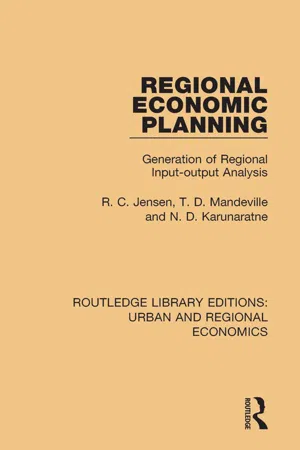
Originally published in 1979. Decision makers at all levels need sufficiently detailed information on regional economic structure in order to undertake consistent and comprehensive regional planning. A means is put forward here, elevating the impracticable regional input-output method, to that of an operational planning technique. This development represents a system which facilitates the examination both of the economic structure of individual regions in reasonable detail, and of the regional structure of the state economy. The technique, termed the Generation of Regional Input-Output Tables (GRIT), is designed for general use in the production of regional input-output tables, and other data sources contributing towards the holistic accuracy of the table, thereby providing accurate maximisation of input-output tables within a given budget constraint.
eBook - ePub
Regional Economic Planning
Generation of Regional Input-output Analysis
- 254 pages
- English
- ePUB (mobile friendly)
- Available on iOS & Android
eBook - ePub
Regional Economic Planning
Generation of Regional Input-output Analysis
About this book
Trusted by 375,005 students
Access to over 1.5 million titles for a fair monthly price.
Study more efficiently using our study tools.
Information
1 INTRODUCTION
1.1 Background and Objective of the Study
The increased concern with regional economic planning in recent years has been almost universal. Governments have shown more interest both in planning for individual regions, and in co-ordinated planning for systems of regions. This interest in economic planning has created demands for information which have presented a major challenge to the regional economist. This study is a response to a widely recognised need for governments to have at their disposal sufficient detailed information on regional economic structure to enable them to undertake consistent and comprehensive regional planning.
A comprehensive approach to regional economic planning will require that planning authorities have sufficient empirical support to enable them to: (a) consider each region individually (a ‘micro’ approach) in terms of its particular economic size and structure, and the likely effects on the economy of that region of economic policy decisions, significant economic events or of random factors such as climatic or industrial disturbances, and (b) consider either a state or nation as a group of regions (a ‘macro’ approach), so that the spatial distribution of economic activity and regional relationships might be considered in some detail.
In more specific terms, planning for regional development for the ‘macro’ approach requires a series of relatively detailed and compatible regional accounts; the ‘micro’ approach requires structural detail on individual regional economies and the capability to assess the regional impact of a given economic change on the component industries of each region. In many countries, such information is conspicuously lacking, and this has made a consistent approach to regional economic analysis a difficult task. For example, regional impact studies have tended to be somewhat haphazard, employing a variety of approaches:
(a) to ‘assume’ multipliers to be of a certain magnitude or within a given range of magnitudes. The assumed multipliers are normally gained from informed opinion and represent ‘best-guesstimates’ in the absence of data from comparable regions, or resources to complete an empirical study in detail;
(b) to ‘borrow’ multipliers from a previously completed study from a region of similar industrial structure;
(c) to ‘calculate’ multipliers by a variety of questionable techniques, often in the face of an almost complete lack of suitable regional data. In this case the multipliers derived must be of dubious value, but are often accepted as ‘reasonable estimates’ and assume an aura of authenticity which is not warranted.
In some circumstances the ‘borrowing’ or the ‘best-guessing’ of multipliers may be appropriate, for example in tentative or preliminary studies, or studies of relatively insignificant events which do not warrant a professional level of attention. Where the size or the importance of the impacting agent has warranted serious attention, regional Keynesian multipliers, economic base multipliers or input–output multipliers have been developed. Recent development in the calculation of regional Keynesian multipliers (Brownrigg, 1971, 1974; Greig, 1971) will ensure a wider and more productive use of this method of impact calculation. However, in common with the economic base approach, the Keynesian approach is suited best to measurement of total changes in the level of economic activity occasioned by an event, rather than an examination either of absolute levels of activity, or of the effects of the change on the individual sectors of the economy.
Another important disadvantage of the existing situation in the regional planning context is the inability of planning authorities to compare the multipliers derived by analysts in the various empirical studies. Inconsistencies appear not only in the approach of the analysts, i.e. ‘best-guesstimates’ versus an empirical approach, but also within the definitional context of multipliers with the same apparent meaning, and within the calculation procedures for similarly defined multipliers. It has been shown, for example, that variation in the method of reconciliation (Jensen and McGaurr, 1978) and in the methods of accounting (Jensen, forthcoming) can result in substantial variations in multipliers from the same input–output tables.
The objective of this study was the development of techniques to provide an empirical base for general application in regional economic planning, and to apply those techniques to the regions and state of Queensland, Australia. It was intended to devise a system which facilitated the examination both of the economic structure of individual regions in reasonable detail, and of the regional structure of the state economy. It was considered that such a requirement could be met only by the development of a series of input–output tables relating to the state and its constituent regions defined for the study. It was further recognised that the development of such a system of input–output tables would be feasible only if suitable techniques could be developed, or existing techniques modified, to derive the series of regional input–output tables largely from national input–output tables.
Input–output analysis is potentially an excellent descriptive device and a powerful analytical technique. In practice, the time and expense required to complete survey-based tables has restricted the application of the technique to ‘research’ rather than operational applications. Certainly input–output techniques appear to have played a relatively insignificant part in most regional planning decisions made by governments, due largely to the inability of analysts to produce input–output tables in the time span within which most decisions must be made.
Recent literature, reviewed in Chapter 3, describes attempts to produce input–output tables by non-survey, or largely mechanical means. These methods have the advantage of relative speed and low cost, but have attracted severe criticism for their apparent inaccuracies. The current ‘state-of-the-art’ appears to offer a choice between the more expensive and professionally respected survey-based table and the cheaper, less respected non-survey tables. The only further alternative is the so-called ‘hybrid’ table, which attempts to supplement mechanically produced elements of the table with insertions of survey-based data to improve the acceptability of the resulting table.
This study is the result of efforts by the authors to elevate input–output analysis from the category of a ‘research’ technique to one of operational application for regional planning and analysis. A system has been developed, termed the Generation of Regional Input–Output Tables (or GRIT) system which produces variable-interference non-survey based tables, essentially hybrid in nature. GRIT relies on a series of mechanical steps to produce regional coefficients, but provides the opportunity at three stages for the insertion of ‘superior data’, i.e. data considered by the analyst to be more reliable than those produced by the mechanical processes. The system is ‘variable-interference’ to the extent that the analyst is able to determine the extent to which he interferes with the mechanically produced tables by insertion of these superior data at various stages in the development of the tables. In this way, the judgement of the analyst is incorporated into the tables. It is argued later in Chapter 4 that such a system incorporates the advantages of both survey-based and non-survey tables, and avoids the cost extravagances of the former. The GRIT system allows the calculation of tables to the degree of accuracy which we would simply claim as ‘free from significant error’. It is later argued that since the smaller coefficients in an input–output table have an insignificant effect on the analytical uses of the tables, the method of calculation of these coefficients is seen as operationally irrelevant. The more significant coefficients in the tables warrant more attention, and may be corrected by the insertion of superior data. It is, therefore, argued that the analytical reliability of GRIT tables could be similar to that of survey-based tables.
The GRIT system was designed to incorporate the following features:
(a) that input–output tables and their attendant multipliers could be calculated for any region for which certain minimum levels of data are available,1 for example local government areas, planning regions, or any ad hoc region devised for a specific purpose;
(b) that the regional tables be consistent with the table developed for the economy as a whole;
(c) that, although the basic GRIT methodology for producing both state and regional tables is a combination of procedures for converting national tables to regional tables, sufficient flexibility exists to allow the insertion of other data at the discretion of the analyst. This facility will be applied where users have ‘superior data’,2 i.e. estimates of higher quality than those generated from national tables;
(d) that the system be capable of updating with minimum effort, as new data sources become available;
(e) that the input–output tables and multipliers derived for each region be directly comparable, both conceptually and by sector definition, and internally consistent within the system;
(f) that the application of the system in an empirical context involve a minimum of expense and time, consistent with a reasonable degree of accuracy, while allowing the subjective judgement of the analyst to be incorporated without difficulty;
(g) that the application of the system be sufficiently uncomplicated to encourage adoption by analysts without a high level of expertise in ‘conventional’ approaches in the preparation of input–output tables;
(h) that the system be designed as a series of modular components, each of which might be modified by the analyst.
1.2 Overview of the Study
Chapter 2 provides a brief introduction to input–output tables and multipliers, and refers to the main analytical uses of the technique. It is provided for readers with less familiarity with input–output, and to express formally the methods used for multiplier calculation in this study. Since this study is essentially a ‘hybrid’ approach, incorporating both the selective use of survey or superior data and non-survey methods of preparing input–output tables, Chapter 3 provides a brief introduction to the ‘survey versus non-survey’ debate, and discusses in some detail the literature relating to non-survey based tables. It is intended to provide a background to the non-survey techniques, some of which have been selected for use in this study.
Chapter 4 is the basic statement of approach adopted by the authors. It provides a broad perspective for the GRIT system; some thought is given in this chapter to the problems facing the regional input–output analyst, particularly with respect to the choice of techniques for table construction. The aims and features of the GRIT system are outlined, and some thoughts on the concept of accuracy in input–output tables are provided.
The remaining chapters focus more directly on the application of the GRIT system. Chapter 5 discusses the accounting conventions and constraints placed on the project. Chapter 6 describes in some detail the GRIT methodology, and Chapter 7 presents the empirical results of the study. The presentation of this book has been designed so that Chapter 7 is not overwhelmed with detail; the extensive use of appendices to record detailed empirical results leaves Chapter 7 in a more readable form. Finally, Chapter 8 undertakes a brief review of the GRIT system.
Notes
1. i.e. in this application, to the state regions of Queensland.
2. These ‘superior data’ are available from various statistical sources, and would be actively sought for industries known to be of special significance in each region.
2 INPUT-OUTPUT TABLES AND MULTIPLIERS
2.1 The Input-Output Transactions Table
An input–output table represents the economy to be studied in terms of aggregated industrial or commodity groups or sectors. They trace out the transactions in dollar terms between the sectors for a given year. Industries sell goods and services to other industries and to final users or ‘final demand’ and buy their inputs from other industries and primary sources. The transactions table summarises the inter-sectoral flows in a given period and is conventionally presented in matrix form. A hypothetical and much-simplified transactions table for a 3-sector economy is shown in Table 2.1. Each row indicates the flows from one sector to other sectors and to final demand. From Table 2.1, sector 1 sells $25,000 of its output to firms in the same sector, $20,000 to firms in sector 2, $15,000 of its output to sector 3, and $40,000 to final users. The columns show the purchasing pattern of each sector. Thus sector 3 purchases $15,000 of goods or services from sector 1, $10,000 of goods from sec...
Table of contents
- Cover
- Half Title
- Title Page
- Copyright Page
- Table of Contents
- List of Tables
- Preface
- Acknowledgements
- Map of Queensland Regions
- 1 Introduction
- 2 Input—Output Tables and Multipliers
- 3 Non-Survey Regional Input—Output Tables
- 4 The GRIT System in Perspective
- 5 Accounting Procedures
- 6 Methodology
- 7 Empirical Application of the GRIT System
- 8 A Review of the System
- Appendix I Flowchart of Methodology
- Appendix II Australian National Input—Output Classification
- Appendix III Sector Classification
- Appendix IV GRIT Computer Program
- Appendix V Mathematical Exposition of the GRIT Sequence
- Appendix VI Technical Appendix
- Appendix VII Non-Uniform (19- and 36-Sector) Transactions Tables for the Regions and State of Queensland
- Appendix VIII Multipliers: Non-Uniform Tables for the Regions and State of Queensland
- Appendix IX Inverse Matrices for the Eleven-Sector Tables (Open Model)
- Appendix X Inverse Matrices for the Eleven-Sector Tables (Closed Model)
- Appendix XI Inverse Matrices for the Non-Uniform Tables (Open Model)
- Appendix XII Inverse Matrices for the Non-Uniform Tables (Closed Model)
- Bibliography
- Index
Frequently asked questions
Yes, you can cancel anytime from the Subscription tab in your account settings on the Perlego website. Your subscription will stay active until the end of your current billing period. Learn how to cancel your subscription
No, books cannot be downloaded as external files, such as PDFs, for use outside of Perlego. However, you can download books within the Perlego app for offline reading on mobile or tablet. Learn how to download books offline
Perlego offers two plans: Essential and Complete
- Essential is ideal for learners and professionals who enjoy exploring a wide range of subjects. Access the Essential Library with 800,000+ trusted titles and best-sellers across business, personal growth, and the humanities. Includes unlimited reading time and Standard Read Aloud voice.
- Complete: Perfect for advanced learners and researchers needing full, unrestricted access. Unlock 1.5M+ books across hundreds of subjects, including academic and specialized titles. The Complete Plan also includes advanced features like Premium Read Aloud and Research Assistant.
We are an online textbook subscription service, where you can get access to an entire online library for less than the price of a single book per month. With over 1.5 million books across 990+ topics, we’ve got you covered! Learn about our mission
Look out for the read-aloud symbol on your next book to see if you can listen to it. The read-aloud tool reads text aloud for you, highlighting the text as it is being read. You can pause it, speed it up and slow it down. Learn more about Read Aloud
Yes! You can use the Perlego app on both iOS and Android devices to read anytime, anywhere — even offline. Perfect for commutes or when you’re on the go.
Please note we cannot support devices running on iOS 13 and Android 7 or earlier. Learn more about using the app
Please note we cannot support devices running on iOS 13 and Android 7 or earlier. Learn more about using the app
Yes, you can access Regional Economic Planning by R. C. Jensen,T. D. Mandeville,N. D. Karunaratne in PDF and/or ePUB format, as well as other popular books in Business & Business General. We have over 1.5 million books available in our catalogue for you to explore.