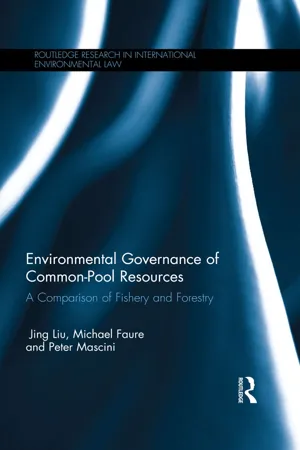
This book analyses the drivers of specific common pool resource problems, particularly in fisheries and forestry, examining the way in which private and public regulation have intervened to fight the common pool resource problem by contributing to the establishment and maintenance of property rights. It focuses on the various forms of regulation that have been put in place to protect fisheries and forestry over the past decades – both from a theoretical as well as from a policy perspective – comparing the concrete interaction of legal and policy instruments in eight separate jurisdictions.
eBook - ePub
Environmental Governance and Common Pool Resources
A Comparison of Fishery and Forestry
- 302 pages
- English
- ePUB (mobile friendly)
- Available on iOS & Android
eBook - ePub
Environmental Governance and Common Pool Resources
A Comparison of Fishery and Forestry
About this book
Trusted by 375,005 students
Access to over 1.5 million titles for a fair monthly price.
Study more efficiently using our study tools.
Information
1
Introduction
1.1 Background
1.1.1 Governing environmental problems: an intertwined system of public and private regulation
Apart from the intrinsic value of the earth’s systems, human beings are dependent on their natural environment for a respectable and prosperous life.1 The environment, however, has been threatened, for example by industrialization, urbanization and population growth. Many environmental problems, such as the diffusion of chemicals and other pollutants and the depletion of forests and fisheries have come into the public’s attention and have aroused broad concerns since the mid-twentieth century.
The prominence of these environmental problems has been accompanied by rising environmental public regulation. The last century has witnessed a rapid increase of international environmental agreements and international organizations governing various environmental problems. Many countries have also adopted domestic regulation. Nonetheless, despite the ongoing proliferation of international agreements and domestic regulation, environmental problems have persisted.
In the 1980s and 1990s, neoliberal ideas on free trade, liberalization, and privatization diffused globally.2 As a result, for example, attempts of developed countries to prevent illegal logging in tropical countries via import bans lost support. As governmental and intergovernmental options for addressing environmental issues were blocked or failed by the invocation of legislation that enabled free trade, states, NGOs and social movement groups put more energy and resources into non-governmental programmes – like nascent certification and monitoring efforts.3 For example, forest certification started to develop when the international community failed to conclude a legally binding forest agreement, while fishery certification emerged as a response to the perceived failure of international law to address overfishing.4
Public and private regulation are not functioning in isolation, but are intricately linked. Besides, domestic public regulation promotes or constrains the development of private and hybrid regulation via specific governance instruments.5 Moreover, public regulation and private regulation do not only interact, but also create multiple layers of rules regulating potential polluters.6 To what extent the interaction between public and private regulation induces more environmental friendly behaviour and hence contributes to mitigating environmental problems still remains a complicated question to be understood and answered.
1.1.2 Common-pool resources problems
There are countless environmental problems, caused by numerous drivers, which call for different regulatory regimes and instruments. This research focuses on one prominent problem: common-pool resources problems. Many natural resources, such as forests and fish stocks are common-pool resources: the exclusion of other users is very costly if not impossible (non-excludability) and exploitation by one user diminishes the availability for others (subtractability).7 Because exclusion is costly, when no institutions restrict access, resource users may tend to free-ride and to overexploit resources. In this case, ‘the tragedy of the commons’ scenario materializes.8 Scholars have identified basically three types of property rights to restrict access to common-pool resources: public, private, and communal.9 Extensive academic attention has been paid to how common-pool resources are protected under these different property rights and to the preconditions for each property right to function effectively.10 The effective functioning of property rights means that the overexploitation of common-pool resources is prevented by either excluding so many users that the subtraction of resources does not exceed levels of sustainability or making sure that present users do not exceed these levels.
In order to be able to be effective, property rights need to be affirmed by the state. For example, public regulation can affirm private ownership of forests via registration or the creation of (quasi-) private property rights11 on state-owned forests via granting concessions. Traditional community rights on forests also require the recognition in domestic law. States can also intervene, for example, by correcting market failures in case property rights are privatized.
Rather than operating separately, public and private regulation often interact. Their interaction influences the existence and performance of various property rights and can help to overcome their limitations. However, how such influence plays out in practice and contributes to the management of common-pool resources problems, has not been extensively studied yet. The main goal of this study is to explore this.
1.2 Research questions and problem definition
This research aims at exploring the question: how do public and private regulation interact to address common-pool resources problems via influencing the establishment and functioning of property rights? As mentioned before, basically three types of property rights can be used to address common-pool resources in order to avoid ‘the tragedy of the commons’: public, private, and communal. This research hence analyzes first how public and private regulation influences the establishment and functioning of public, private, and communal property rights. However, since all property rights have their limitations, the effectiveness of addressing the overexploitation of common-pool resource, also depends on whether public and private regulation compensate these limitations. This research will also analyse whether public and private regulation help to overcome the limitations of property rights in addressing common-pool resources problems.
Our theoretical framework will be applied to forestry and fishery governance. Problems associated with these two types of common-pool resources have caused broad attention: many countries have suffered deforestation and forest degradation and overfishing is a well-recognized problem in both high seas and areas falling under domestic sovereignty. Various types of property rights have been established for forestry and fishery in different jurisdictions. Forests are immobile resources growing on a certain area of land. Usually ownership can be established on a determined area of forests or the land the forests grow on. The forests or land can either be publicly owned, privately owned or communally owned. Fish resources are mobile and are usually claimed as state resources. Nevertheless, rights to access and harvest can be vested in private actors and communities.12 The property rights of forestry and fishery have traditionally been primarily regulated under domestic law. However, in recent decades, many private regulatory regimes, such as certification schemes, have also been implemented and have covered a substantial proportion of forests and fisheries.13 Such privatization schemes often rely on clear definitions of ownership.
Although it is the goal of this study to examine the effectiveness of addressing common-pool problems, it cannot make claims regarding the direct effects of property rights and the indirect effects of regulation on the extent to which there is deforestation, forest degradation or overfishing. These common-pool problems are caused by so many conjunctive factors that the empirical studies on which this analysis is based cannot isolate the impact that property rights and regulation exert on these problems. For example, natural fluctuations and border crossing human activities can impact deforestation, forest degradation, and overfishing at the same time as property rights and regulation do. However, what this study can and will try to answer is the question in what ways the preconditions are met that can induce the compliance and behavioural change that are necessary in order to be able to prevent the overexploitation of common-pool resources. More specifically this study focuses on the five following preconditions: the clarity with which property rights are defined, the monitoring and enforcement of property rights, the collection and sharing of information on which basis property rights can be based, the coordination of the actions of the stakeholders, and the scaling of the management of property rights. In the next chapter the choice for these five preconditions will be accounted for.
1.3 Methodology
An interdisciplinary approach is used in this study. Economic analysis is followed both in the theoretical set-up and in evaluating the practice in governing forest and fishery resources. Traditional economic analysis of property law has examined when and how different types of property rights are suitable.14 In the empirical part, this research will evaluate whether and how public and private regulation have contributed to the realization or jeopardizing of the necessary preconditions for the effective functioning of different types of property rights.
The governance literature is also essential for this research. The emergence and rapid prevalence of private and hybrid forms of regulation are comparatively new phenomena. Governance literature broadens the traditional understanding of the forms of regulation and helps to explain how and why private regulation emerges. Recent literature starts to analyse how public and private regulation interact, via the architecture of regulatory regimes. The various approaches in analyzing interaction inspire our analysis of public and private interaction in overcoming the limitations of property rights in addressing forest and fishery problems.
Another equally important approach is the doctrinal legal research. Property rights are a product of legal rules. They include a bundle of rights which ‘describe what people may and may not do with the resources they own’.15 In essence, property rights entails the rights to exclude all others from the use of these resources.16 Legal texts and case law provide the basis to understand the different types of property rights used in different jurisdictions.
In the empirical part of forest and fishery governance, nine purposely selected countries will be analysed as case studies. These case studies will show in what respects public and private regulation satisfy the necessary preconditions for property rights to be able to effectively address common-pool resources problems.
1.4 Structure
After this introduction, Chapter 2 will first present the types of property rights which can be used for common-pool resources and the preconditions under which they can function effectively. This will be followed by an analysis of the interaction of public and private regulation, as well as of the influence of this interaction on the preconditions of property rights’ proper functioning. After the theoretical framework the selection of the case studies will be accounted for.
The theoretical framework will be applied to forest governance in Chapter 3. Forests in different countries suffer from deforestation or forest degradation. In order to address these problems, in addition to public regulation, many private regulatory regimes have emerged and have spread rapidly in the last few decades, especially forest certification schemes. In this chapter, public, private and communal forests will be defined according to the ownership of forests or the land on which forests grow. Case studies of the following five countries will be presented: Indonesia, Bolivia, Canada, the United States, and Sweden. A comparison between them will be conducted to show how the interaction of public regulation and private certification influences the preconditions determining property rights’ contribution to manage forest degradation or deforestation in different national contexts and how it affects property rights limitations.
Chapter 4 will examine how property rights function and ways to overcome their limitations by the interaction of public regulation and private certification affect overfishing. Three main types of fishing rights will be discussed: limited entry, quotas, especially individual transferable quotas (ITQs), and territorial user rights for fisheries (TURFs). As explained later, these fishing rights subsequently show similarity with public, private, and communal property rights. Case studies of the following four countries will be presented: Mexico, South Africa, New Zealand and Japan. The comparison will show the role of public and private regulation to address overfishing under different property rights regimes.
Chapter 5 compares forest and fishery governance by following the theoretical structure discussed below. It first compares the individual elements: property rights, public regulation and private regulation concerning forestry and fishery. Then the similarities and differences of the interactions between public and private regulation concerning forest and fishery are explored. How such interactions influence the functioning of property rights is also examined. After the comparison of individual elements, this part provides an i...
Table of contents
- Cover
- Title
- Copyright
- Contents
- List of abbreviations
- Foreword
- 1 Introduction
- 2 Common-pool resources, property rights and public and private regulation
- 3 Forestry
- 4 Fishery governance
- 5 Comparative analysis
- 6 Concluding remarks
- References
- Index
Frequently asked questions
Yes, you can cancel anytime from the Subscription tab in your account settings on the Perlego website. Your subscription will stay active until the end of your current billing period. Learn how to cancel your subscription
No, books cannot be downloaded as external files, such as PDFs, for use outside of Perlego. However, you can download books within the Perlego app for offline reading on mobile or tablet. Learn how to download books offline
Perlego offers two plans: Essential and Complete
- Essential is ideal for learners and professionals who enjoy exploring a wide range of subjects. Access the Essential Library with 800,000+ trusted titles and best-sellers across business, personal growth, and the humanities. Includes unlimited reading time and Standard Read Aloud voice.
- Complete: Perfect for advanced learners and researchers needing full, unrestricted access. Unlock 1.5M+ books across hundreds of subjects, including academic and specialized titles. The Complete Plan also includes advanced features like Premium Read Aloud and Research Assistant.
We are an online textbook subscription service, where you can get access to an entire online library for less than the price of a single book per month. With over 1.5 million books across 990+ topics, we’ve got you covered! Learn about our mission
Look out for the read-aloud symbol on your next book to see if you can listen to it. The read-aloud tool reads text aloud for you, highlighting the text as it is being read. You can pause it, speed it up and slow it down. Learn more about Read Aloud
Yes! You can use the Perlego app on both iOS and Android devices to read anytime, anywhere — even offline. Perfect for commutes or when you’re on the go.
Please note we cannot support devices running on iOS 13 and Android 7 or earlier. Learn more about using the app
Please note we cannot support devices running on iOS 13 and Android 7 or earlier. Learn more about using the app
Yes, you can access Environmental Governance and Common Pool Resources by Michael Faure,Peter Mascini,Jing Liu in PDF and/or ePUB format, as well as other popular books in Law & Environmental Law. We have over 1.5 million books available in our catalogue for you to explore.