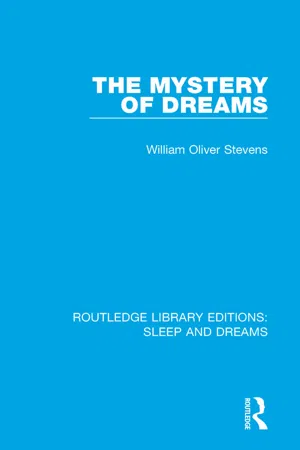
Originally published in 1950, this title includes instances of dreams in published records from both British and American societies of psychical research, covering six decades. This work had been previously inaccessible to the ordinary reader. Other stories have come from friends and acquaintances of the author and in his introduction he states that: 'the chief purpose of this collection is to present examples of apparently significant dreams, those that "come true", there will be no effort in these pages to debate possible explanations based on known laws, either of chance or of psychology. Readers are able to exercise their own ingenuity to this end. The material is offered here simply as evidence of a striking phenomenon in human consciousness, which, instead of being brushed aside as superstition, calls for serious study. It may have a profound bearing on the riddle of human personality.'
- 284 pages
- English
- ePUB (mobile friendly)
- Available on iOS & Android
eBook - ePub
The Mystery of Dreams
About this book
Information
Chapter One
The Dream in Literature
As a Literary Device
SINCE THE DREAM was regarded with superstitious awe from earliest times, it naturally appears in the ancient literatures as an important part of the epic or drama. Homer uses it, and always with high respect. In the Iliad it is usually Zeus who sends the dream; in the Odyssey it is generally Athene. In both poems a wraith or phantom appears to deliver a message, either the ghost of the dead or a divinity in person. In the Iliad it is always a man who is thus honored; in the Odyssey it is generally a woman who receives the message. Among these there is one striking instance of the symbolic dream, the one which showed Penelope the geese and the eagle, representing the suitors and her husband. But she was not sure what its portent was because it might have been one of those deceitful dreams that come through the “gates of ivory.”
The ghost of Patroclus that came to Achilles in his sleep is said to be the starting point in European literature for the apparition of the dead in dreams. In this instance the phantom spirit was not sent by any divinity but came of his own accord on a personal mission to his old friend.
Greek tragedy also employed the dream. Aeschylus made effective use of it. Sophocles employs it on occasion, but Euripides was evidently a skeptic as to its divine origin or its value to mankind.
As might be expected, all subsequent literature in Europe made full use of the dream. One amusing example is Lucian’s “The Dream or the Cock,” a satirical discourse on the virtues of poverty in the form of a dialog between a cobbler and a cock, who turns out to be Pythagoras in his transmigrated form. In the middle ages it appears, not merely as an incident to help the story along, like Nausicaa’s dream in the Odyssey, but as a literary form, as in the example just noted from Lucian. This idea became very popular with poets because it could excuse all sorts of wild and improbable happenings and an extravagantly romantic atmosphere.
In English literature of the medieval period there are the two poems, “Pearl” and “Piers Plowman,” both of which are started off as dreams. Chaucer has a dream prelude for his “Legend of Good Women,” and “The Book of the Duchess.” Also in the “Parliament of Birds,” the poet conveniently falls asleep. In these the dream has become a conventional device.
In the “Nun’s Priest’s Tale” of the Canterbury series, Chaucer starts off with a bad dream on the part of Chanticleer and there follows a deliciously humorous debate between him and Dame Pertelote, his wife, as to whether dreams really do foretell future events. She scoffs at his fears and his credulity; he stoutly holds his ground with a wealth of classical authority. But before the day is done the horrible dream does come true.
Perhaps the dreams in Shakespeare are too familiar for more than a passing reference here. Calpurnia, for example dreams that Caesar is being murdered. In Henry VI, Part II, Gloucester and his duchess compare their dreams, and the grimmest nightmare of all is the one that Clarence describes in Richard III.
Of course one would expect to find lavish use of the dream among the poets of the Romantic school, and so Blake, Keats, Shelley, and Wordsworth, make use of the device, each in his own way and all familiar to the lover of poetry.
To turn to prose, in the seventeenth century there is Bunyan’s great allegory of “Pilgrim’s Progress” put in the form of a dream, just as Langland had done with his own allegory, “Piers Plowman.” Even the materialist philosophy of the nineteenth century could not banish the dream from English literature. It is only necessary to mention Kipling’s “Brushwood Boy” and du Maurier’s Peter Ibbetson. In these stories the writers left behind the conventional pattern and struck out on new, mystical lines. Perhaps nothing in all the range of novels can rival for sheer romantic charm the story of Peter Ibbetson, the convict, and the Duchess of Towers meeting every night in an idyllic dream existence together.
Before leaving the role of dreams in literature one should add a word as to the crop of fairy tales in the nineteenth century, all of which are based on the time honored conventional dream-form. The grandfather of all these dreamed-up fairy tales is Ernst T. W. Hoffman. His work not only influenced writers but fascinated composers as well. Note the “Tales of Hoffman” by Offenbach and the “Nutcracker Suite” by Tchaikovsky. The latter composition is based on a long, fantastic Christmas tale, “Nutcracker and the King of the Mice,” in which a little girl has astonishing adventures with her toys, led by the hero Nutcracker.
No one needs to be reminded of Dickens’s Christmas Carol, or of Alice in Wonderland and its sequel, Behind the Looking Glass. One amusing example completely forgotten today is King George’s Middy, a story for boys which came out serially in a magazine and was later published in book form shortly after the appearance of “Alice.” The fantastic adventures of the midshipman hero are made plausible at the end because it turns out that he dreamed it all while ill three weeks with brain fever. The author was William Gilbert, father of the famous librettist of the Sullivan operettas, who, incidentally, made the drawings for the many little woodcuts sprinkled through the text.
Other popular fairy tales followed the same conventional dream pattern. Of course, very few people ever have a long continuous dream, but for story purposes every impossibility and absurdity is carried off successfully because “it is only a dream.”
One of the most conspicuous literary figures of our own century is George Bernard Shaw. No one, probably, has ever used the dream so daringly as he has done in two of his dramas. Act III of “Man and Superman” is one long dream, and a most fantastic one. Also in “Saint Joan” the lengthy Epilog is presented in the form of a dream.
As for opera, the most familiar instance is Elsa’s dream in “Lohengrin.” All these, and many other instances, serve to show the fascination the dream has had for writers and composers of all ages. However, this book is concerned with the mysterious aspects of a certain class of dreams. In literature and other creative arts the chief mystery of dream-influence springs from its relation to creative inspiration.
As a Source of Inspiration
One of the earliest traditions in English Literature is the story of Caedmon, related by the Venerable Bede in his Ecclesiastical History of England. Caedmon, we are told, was an unlettered man employed in the monastery at Whitby in the seventh century. The story is that since he had no gift like his fellows in improvising song, he retired one night in shame to his bed. In his sleep a heavenly visitant appeared to him and bade him sing “the beginning of created things.” When he awoke he found that he had the magic gift of poetry, and under the encouragement of the Abbess he wrote metrical paraphrases of chapters from Genesis, to the astonishment of all who knew him.
How much truth there is in this legend it would be hard to say after thirteen centuries. In fact, there are the inveterate skeptics who scoff at the idea that there ever was a Caedmon. But the inspiration of a dream is a phenomenon that belongs to our own day in ways no less extraordinary and difficult to explain than the legend of Caedmon.
Indeed, there are among writers, great and small, during the last century and a half, a number of instances of this inspiration furnished by a dream. The first one starts on a comedy note. Mrs. Ann Radcliffe was the author of so-called “Gothic romances” at the close of the eighteenth century. Being sometimes hard put to it to think up new horrors for her novels, she would deliberately stuff herself with highly indigestible foods, to try to induce a nightmare which might give her new ideas.
Probably the best known dream-inspired work is Coleridge’s beautiful fragment, “Kubla Khan,” composed in the year 1798, when Mrs. Radcliffe was at the height of her fame. How he came to write these lines is told by him in the preface to an edition of 1816:
“In consequence of a slight indisposition an anodyne had been prescribed from the effects of which he [the poet] fell asleep in his chair at the moment he was reading the following sentence, or words of the same substance, in Purchases Pilgrimage: ‘Here the Khan Kubla commanded a palace to be built, and a stately garden thereunto. And thus ten miles of fertile ground were enclosed with a wall.’ The author continued for about three hours in a profound sleep, at least of the external senses, during which time he has the most vivid confidence that he could not have composed less than from two hundred to three hundred lines . . . On awaking he appeared to himself to have a distinct recollection of the whole, and taking his pen, ink, and paper, instantly and eagerly wrote down the lines that are here preserved. At this moment he was unfortunately called out by a person on business . . . and detained by him above an hour, and on his return to his room found to his no small surprise and mortification that though he still retained some vague and dim recollection of the general purport of the vision, yet, with the exception of some eight or ten scattered lines and images all the rest had passed away.”
Tradition has it that a bill-collector was the evil genius who broke in on the poet that day and paralyzed the flow of those magic lines. Even as it stands—a mere fragment—“Kubla Khan” holds a unique place in English Literature for the sheer romantic wizardry of its pictures and the rhythm of its verses.
This dream poem was composed partly under the influence of what Coleridge calls “an anodyne.” It was probably some of the same substance which produced the Confessions of an English Opium-Eater by Thomas de Quincey, Coleridge’s friend. De Quincey began taking opium for severe neuralgic pains in his head while he was at the university, and he was never able to break off the habit entirely. The Confessions were followed by a still grimmer Suspiria de Profundis which described the marvelous and terrifying pictures induced by the drug.
De Quincey established himself as one of the great masters of style, and it is said that certain ambitious young hacks thought to rival his success by taking laudanum and bringing on dreams of their own, but without notable success. It is only fair to say that Coleridge and de Quincey are hardly examples of normal dream inspiration because of the drug that enchained them both, but it is interesting to note what it did to their imaginations in sleep.
In contrast with these men, creative inspiration came to Robert Louis Stevenson in a perfectly normal condition of sleep. His experience was so exceptional that it must be given in detail. His own complete story may be read in the “Chapter on Dreams” in his volume of essays, Across the Plains. Stevenson credits his inspiration to what he calls “the Little People,” or “Brownies,” who came to him with scenes, and plots and characters in his dreams. “In time of need he [Stevenson] sets to belaboring his brains after a story . . . and behold! At once the Little People bestir themselves in the same quest and all night long set before him truncheons of tales upon their lighted theatre.”
All the while that his dream consciousness was watching these stories develop he declares that he had no idea how they were coming out. He gives the examples of one in which he says, he had no guess whatever as to the motive of the leading female character in the plot until she came out with a dramatic speech at the climax. “Who are the Little People?” he asks. They must be “near connections of the dreamer’s . . . only I think they have more talent . . . they can tell him a story, piece by piece, like a serial, to keep him all the while in ignorance of where they aim. Who are they, then? . . . And for the Little People, what shall I say; they are but just my Brownies, God bless them! who do half my work for me while I am fast asleep, and in all human likelihood, do the rest for me as well when I am awake and fondly suppose I do it for myself. That part which is done while I am sleeping is the Brownies’ part beyond contention; but that which is done when I am up and about is by no means necessarily mine, since all goes to show the Brownies have a hand in it even then.”
For one of his most famous stories, “Dr. Jekyll and Mr. Hyde,” Stevenson says that after he had racked his brains for two days in vain to find a new idea for a story, he dreamed three scenes of “Dr. Jekyll” and the central idea of the voluntary change becoming involuntary. He mentions another tale not so well known, “Olalla,” the bulk of which came from his Brownies in a dream.
Here is a famous story-teller who credits what he calls his “Little People” with so much of his story ideas, brought to him in his sleep. He asks the obvious question, “Who are the Little People?” but neither he nor anyone else since has come forward with a satisfactory answer.
A contemporary of Stevenson, Swinburne, declared that the three opening stanzas of his poem, “Spring in Winter,” actually came to him in sleep.
One striking instance of dream composition in our own century is William Archer. He was a lifelong dreamer, and for ten years he actually kept a record of his dreams. In fact he wrote a book on the subject. But these dreams that he recorded, however picturesque and fanciful, seem to have no particular significance; they are not of the special sort that come true in any way. His friend, Bernard Shaw, however, tells of one which was of immense practical importance to Archer. Shaw had suggested that they collaborate on play-writing, but Archer had always insisted that he was unfitted for the work because he could not handle dialog.
Quite late in life, however, he had a dream which told a thrilling story. It had to do with an Asiatic Rajah who had been made cynical by his European education. But there was in his realm a Green Goddess, who had to be propitiated by human sacrifices. And it happened that there were some English prisoners who were just the thing for the purpose. And so on to the climax. This dream became a play, “The Green Goddess,” which was tremendously successful both in England and America.
Another instance of dream composition in our own day, though of a more obscure writer, is Edward Lucas White. He was a teacher of Latin and Greek in Baltimore boys’ schools, but he found time to write historical stories. He is an even more amazing example of this strange way of getting inspiration for fiction. In a long preface to his story, The Song of the Sirens, he describes his experience with dream composition. He says that he was always “haunted by imaginations, no matter what my task.” He was from boyhood a day-dreamer. But it was his sleep-life that inspired his stories. Some dreams he remembered only faintly on waking; others “even intensely.” Sometimes he would wake with a picture in mind, definite in all details. Such was the dream (February 17, 1906) on which he based the story, The Song of the Sirens. He saw it not as a painted picture but as if he were high on the mast of a ship looking down on the magic island and its people.
Sometimes, he says, he awakes with the sensation of just having read a story in a book. He can recall the form and the appearance of the book and can see “the last page, the size, shape, quality of paper, and size of type, with every letter of the last sentence.”
He cites his tale, The Flambeau Bracket, as an example of one that came to him in this way, “with the last three sentences, word for word as they stand, branded on my sight.” The horror of the revelation in the climax woke him up.
Another interesting phase is that he occasionally dreams the same dream over and over again. Sometimes there are intervals between recurrences, covering a few nights, other times spanning months or even years. His tale Dislova, he says, was written almost exactly as he dreamed it. The earlier part he dreamed repeatedly—sometimes twice weekly,—sometimes once in six months or so. The period covered in this dreaming of the same story extended over twelve years, from early in 1899 to February 20, 1911. On that night, and once only, he was given the ending. That climax, he writes, “amazed me more than—probably—the reader.” It came to him as a complete surprise.
In the “Afterword” to another book, Andivius Hedulio, the story of a Roman nobleman in a period of the Empire, White is explicit about its dream origin. “The phrasing of this book is mine; otherwise I am scarcely more responsible for it t...
Table of contents
- Cover Page
- Half Title
- Title Page
- Copyright Page
- Acknowledgments
- Introduction
- Chapter One The Dream in Literature
- Chapter Two Symbolism in Dreams
- Chapter Three The Solution of a Problem
- Chapter Four Telepathic Dreams
- Chapter Five Clairvoyant Dreams
- Chapter Six Warning and Prophetic
- Chapter Seven Warning and Prophetic Continued
- Chapter Eight Borderland Dreams
- Chapter Nine Concurrent and Reciprocal
- Chapter Ten Miscellaneous
- Conclusion
- Index
Trusted by 375,005 students
Access to over 1.5 million titles for a fair monthly price.
Study more efficiently using our study tools.
Frequently asked questions
Yes, you can cancel anytime from the Subscription tab in your account settings on the Perlego website. Your subscription will stay active until the end of your current billing period. Learn how to cancel your subscription
No, books cannot be downloaded as external files, such as PDFs, for use outside of Perlego. However, you can download books within the Perlego app for offline reading on mobile or tablet. Learn how to download books offline
Perlego offers two plans: Essential and Complete
- Essential is ideal for learners and professionals who enjoy exploring a wide range of subjects. Access the Essential Library with 800,000+ trusted titles and best-sellers across business, personal growth, and the humanities. Includes unlimited reading time and Standard Read Aloud voice.
- Complete: Perfect for advanced learners and researchers needing full, unrestricted access. Unlock 1.5M+ books across hundreds of subjects, including academic and specialized titles. The Complete Plan also includes advanced features like Premium Read Aloud and Research Assistant.
We are an online textbook subscription service, where you can get access to an entire online library for less than the price of a single book per month. With over 1.5 million books across 990+ topics, we’ve got you covered! Learn about our mission
Look out for the read-aloud symbol on your next book to see if you can listen to it. The read-aloud tool reads text aloud for you, highlighting the text as it is being read. You can pause it, speed it up and slow it down. Learn more about Read Aloud
Yes! You can use the Perlego app on both iOS and Android devices to read anytime, anywhere — even offline. Perfect for commutes or when you’re on the go.
Please note we cannot support devices running on iOS 13 and Android 7 or earlier. Learn more about using the app
Please note we cannot support devices running on iOS 13 and Android 7 or earlier. Learn more about using the app
Yes, you can access The Mystery of Dreams by William Oliver Stevens in PDF and/or ePUB format, as well as other popular books in Psychology & Cognitive Psychology & Cognition. We have over 1.5 million books available in our catalogue for you to explore.