"Richard has caught wonderfully in this text the sensitivity and delicacies of therapeutic interaction as well as the complex processes through which young people have to steer in their development towards adulthood. Richard's important and engaging text combines believable stories of young people with the provision of theoretical comment and developmental questions for the practitioner. I trust that this book will reach a wide audience of all those who are interested in and committed to the welfare and development of young people.' Colin Lago, in his Foreword 'This book goes a long way in explaining why the person-centred approach is so powerful with young people. It teases apart many of the fears, hurts, disappointments, familiar problems and social assaults that encourage adolescents to close off, turn to drugs, and attack others. After a clear and concise explanation of the theory, Richard takes us on amazing journeys into the heart and mind of the clients described in the book. They are struggling with many of the obstacles in the path of most children trying to grow up in this period of social toxicity. The book is a real gift to anybody interested in raising and counselling young people."
— Peggy Natiello, in the Foreword
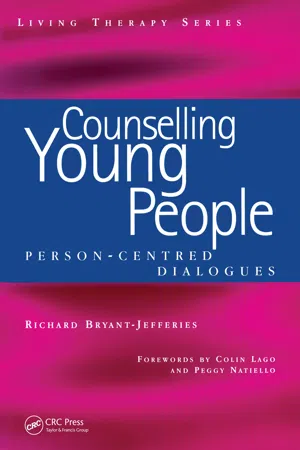
- 176 pages
- English
- ePUB (mobile friendly)
- Available on iOS & Android
eBook - ePub
About this book
Information
PART I
Counselling a young person in a youth counselling setting
Setting the scene
Sandy works for a youth counselling service which is based in a local YMCA. The service had a policy of fast-tracking young people where drugs were known to be involved. She has been working there for three years, and finds it very rewarding working with young people. She also works in other settings and has a small private practice.
Referrals are from various sources as well as self-referral. She enjoys the wide range of issues that her clients bring. The referral for Jodie had come from her mother. They had written back and said that they wanted confirmation from Jodie that she wanted to come. She had called and left a message, although it wasn’t very enthusiastic, so she was expecting her to be brought by an exasperated parent to be ‘sorted out’. She knew that there were drugs involved, and she was OK with that. She had done a placement in her training with a drug team and had attended drug awareness training sessions. It had really opened her eyes. And it was by no means an uncommon issue among the young people that she saw.
She wasn’t limited to any number of sessions with the young people that she saw, and she was grateful for that. She knew of other services that were not so fortunate.
Sandy is 38, not in a relationship, having gone through divorce five years previously, one of the results of the effect of her counselling training. It had marked a real change in her life, an expansion of her interests and a change of career. She had previously worked in a large departmental store. But that seemed a long time ago, almost a past life, if you believe in that possibility.
So she waited for her new client, Jodie, to arrive. It was always an apprehensive time, but she knew she was excited too. She believed passionately in the effectiveness of the person-centred approach and was looking forward to working towards forming a therapeutic relationship with Jodie.
CHAPTER 1
Counselling session 1: first contact – the counsellor keeps it low key
Sandy began the session by commenting on the nature of confidentiality and its limits, and the fact that there was no limit to the number of sessions; that was something they could decide on as they went along.
‘Yeah, that’s cool,’ had been Jodie’s response. She then lapsed into silence.
Sandy also mentioned that they had up to 50 minutes, but it was really up to Jodie to decide how much time she wanted, and how she wanted to use the time.
Throughout all that Sandy had said, Jodie had sat looking slightly to the side of Sandy, avoiding eye contact. She spoke, and as she did so shifted her focus. ‘Didn’t want to come today.’ Jodie now sat staring somewhat defiantly back at Sandy, her counsellor.
‘You look pretty angry at having to come at all.’
‘Yeah. My mum, she insisted I come. What does she know?’
‘What does she know?’
‘Not a lot.’
Jodie lapsed into silence. She really didn’t want to be there. Wanted to be out with her mates, up the town, hanging out, checking out the lads. Chilling out and having a few laughs.
‘So your mum knows not a lot and you really don’t want to be here, Jodie.’ Sandy sought to keep a focus on what Jodie had been saying, wanting her to feel heard, wanting to encourage her to feel listened to.
Jodie continued to sit and stare.
‘Pretty defiant, huh?’
Jodie didn’t reply. She was thinking of Mac, her ex-boyfriend – they hadn’t actually met up much, most of the time they had texted each other. But he was history. Nice bum though ...
Sandy continued to sit and wait. She wasn’t fazed by Jodie’s attitude. She fully accepted that Jodie had good reason to be the way that she was. She wanted her to feel quite accepted. She could sense that Jodie was very much with her own thoughts.
Offering warm acceptance is an important aspect of person-centred counselling. Jodie is being how she needs to be. That needs to be accepted. Right from the start of the counselling encounter, the person-centred counsellor is seeking to offer a therapeutic climate. Sandy is allowing her to be and not seeking to disturb that. She is attentive as well to her own body language and facial expression, seeking to convey openness to Jodie.
‘So, feel free to say anything you want to say, and feel free to say nothing. It’s up to you. And I really hope that I can be helped to understand whatever may be troubling you.’ She spoke authentically. This was what she hoped and she wanted to communicate it to her new client.
Typical bloody counsellor, Jodie thought, not that she knew what a typical bloody counsellor was, but it sounded the kind of nice sort of thing that she thought counsellors said, to make you like them, to make you trust them. She didn’t trust anyone, and she wasn’t going to trust this woman sitting opposite her. She decided to say nothing and the silence continued.
Sandy only had Jodie’s body language to empathise with, and she was sitting somewhat slumped in the chair, but she didn’t look relaxed. Much more preoccupied with her own thoughts. She began to look at her nails, rubbing the tips as if to somehow make them smoother. She had a kind of plum-coloured nail varnish, looked like it had been on for a few days, bit cracked round the edges. She had some like it herself at home. Sandy took in the young girl sitting before her. Her hair was quite long and dark, well past her shoulders. She would brush it away from her forehead every now and then, turning her head to one side as she did so. It was quite a dramatic movement in many ways. Her lipstick sort of matched her nails, well, nearly, but it was just a tad too pink. Sandy pulled herself out of her thoughts, realising that she wasn’t really focusing on Jodie, but had begun to sink into her own thoughts, speculations and, well, judgements.
‘I was just sitting here like you, looking at your nails. Good colour that, got some myself at home.’
The counsellor seeks to connect with the client, offering something of herself. She wants to offer the opportunity of dialogue with the client. She knows from experience that she could sit here throughout the hour without the client saying anything, and maybe there is a place for that with adults, but with a young person, aged 15, it felt more appropriate to try and encourage communication. Of course, the client is communicating silence, although it is a silence with attitude. Young people can find counselling really strange. Being faced with an adult can bring up all kinds of reactions and assumptions that may need to be overcome. Also, the nature of the actual interactions can seem odd at first.
Sandy does not speak out of a sense of anxiety. She is speaking from a wish to connect with Jodie, to find some way to help her to engage in the process. In reality, the process has already started. Silence and an attitude of not wanting to be there.
‘Oh yeah.’ Jodie continued to look at her own nails.
‘Yeah. Got it at...,’ she thought, ‘actually I’m not sure. Can spend hours getting them right, can’t you?’
Jodie blew out a short breath through her nose, making a kind of derisory sound. ‘Try telling my mum that.’
‘Your mum? Doesn’t understand ...’ Sandy didn’t manage to finish what she was saying, being interrupted by Jodie, who had moved in the chair, turning herself and slumping back down again, continuing to stare at her nails. She heard her take a deep breath and blow it back out heavily.
‘Mums, huh?’
‘Yeah.’ Jodie didn’t say any more; she still stared at her nails. She wondered if she could go yet, but guessed probably not. But she thought she’d try it. ‘Can I go now?’
‘If that’s what you really want to do.’
Jodie swept her hair to one side again; it had fallen back across her face. ‘You’re just saying that.’
‘Well, I am saying it, and I do mean it. If you want to go, if you want to be somewhere else, then, yeah, go for it. But if you do go, do you want to come back another time? I’d be happy to see you again. Sitting here like this can feel so unreal sometimes, hard to get used to. But I’d be happy to see you again.’
Jodie sort of went to get up, but stopped; something had stopped her but she didn’t know what. She had wanted to go, but somehow she was still sitting there. She wasn’t sure why.
‘It’s really weird, sitting here, I mean, I don’t know what to say, you know?’
‘Yeah, it is weird, and I do it every day and sometimes I don’t know what to say either.’
Jodie looked up. ‘You should know what to say. You’re the counsellor.’
‘Maybe, but I still don’t always know what to say.’
‘Oh.’ Jodie went back to her visual examination of her plum nails.
Another silence. It was broken by Jodie. ‘I’m just fed up.’
‘Just fed up?’ Sandy emphasised the ‘just’ in her response.
‘Yeah. It’s like, I don’t know, it’s like I can never get anything right. People always on my back. Always telling me what to do, what’s good for me. The fuck do they know.’
‘That can be tough, people always on at you.’
Jodie nodded.
Sandy felt a little more sense of connection to Jodie. She knew she needed to take it slowly and stay with her, but at the same time be true to herself as well. No point in trying to be what I’m not, she thought.
‘It’s mum, she doesn’t like me going out so much, gives me grief.’ She shook her head. ‘Fucking nightmare.’
‘Mhmm, fucking nightmare.’ Sandy dropped the tone of her voice as she spoke, allowing Jodie to reflect further on her feelings.
That was a surprise. Sandy didn’t look the kind of person who said ‘fuck’.
‘She doesn’t understand.’
‘Mhmm. They never do.’ Shit, thought Sandy, that was me and my mother, not Jodie and hers. ‘Yours doesn’t understand you, neither did mine.’
Jodie tossed her head back slightly. Who cares about your mum, that’s your problem, she thought to herself. And yet part of her also felt a kind of... she didn’t know how to describe the feeling, but it kind of felt like there was some kind of link, some sort of, yeah, sort of being somehow on the same side. Then the part of her that didn’t give a damn about what Sandy had experienced reasserted itself. ‘Don’t suppose yours was anything like mine.’
‘Probably not. Everyone’s different.’
‘Yeah, mine’s different all right, fucking nightmare. Does my head in. Does my fucking head in.’
Sandy nodded. ‘Yeah, does your head in, Jodie, does your fucking head in.’
Jodie felt herself smile but she tried to keep it to herself. She didn’t really want Sandy to see it. It was her smile, but it wasn’t important, and she didn’t want it seen. She didn’t want to smile, she wanted to feel pissed off. She liked feeling pissed off.
‘Just goes on at me, all the time, don’t wear that, don’t like you being with whoever, why can’t you help around the house, what do you do all day, always wanting money. Nag, nag, nag.’
‘Mhmm.’
‘She doesn’t let up. Now she’s really having a go, since she found the dope. Snooping round my room. Fuck it. And she brings me here, wants you to sort me out. “They’ll tell you.”’ She paused, before continuing. ‘Shit, I’m 15,1 want a life.’
‘Yeah, I really hear how important that is, you want a life.’ Sandy stayed with where Jodie had got to, deciding not to take her back to the dope. She didn’t want the session to become dope-centred, though she was going to ensure that Jodie was aware that she had heard her mention it.
While Sandy has knowledge about dope (cannabis) she is not going to allow the session to become ‘substance-centred’. Here, Sandy is seeking to build a relationship with Jodie. She wants to encourage Jodie to speak freely, to build a rapport with her. She didn’t want to jump in and start making judgements or giving advice. So, Jodie had some dope in her room. Lots of young people do. If she came on heavy about it, well, Jodie’d very likely walk out. What good would that serve? No, she wanted to place the emphasis on building a therapeutic relationship.
‘Yeah.’
‘And you smoke a bit of dope.’
Jodie nodded. ‘Nothing wrong in that, is there? Everyone does.’
‘Doesn’t feel wrong to you?’
‘No. I like it. Makes me feel good, yeah, takes the edge off everything, yeah, it’s cool. Yeah. And it gives me a bit of peace.’
‘So it gives you a lot of things, yeah?’
‘Yeah.’ Jodie was nodding. ‘Just like feeling kinda mellow, you know, yeah, nicely cool, with a little bit of sharpness too. Kind of makes my music sound better.’
‘That’s a good feeling. Nicely cool but a good effect on music’
‘You ever smoked?’
‘Uh-hu.’
Big question. Sandy gives an honest response. She hasn’t gone into detail, didn’t get a chance to as Jodie responded quickly. How much does a counsellor self-disclose? Could the setting affect how much a counsellor self-discloses? Maybe Sandy is more open because of her experience of working on placement at a substance misuse service. Maybe, maybe not.
‘So you’re not gonna be able to tell me to stop.’
‘I’m not here to tell you to stop.’
‘What are you here for then?’
‘To listen, to give you time and space to talk, to be real with you and hopefully you will be real with me.’ Sandy spoke genuinely. She didn’t see any point in speaking in any other way.
‘But you’re not gonna tell me to stop.’
‘No, what good would that do anyway?’
‘Not a lot.’
‘Well then. So you smoke a bit of dope. I can give you some information about it, what effects it has and stuff, got some new leaflets come through, info on all kinds of stuff.’
‘Yeah, such as?’
‘Pretty much everything. And stuff on overdose as well.’
‘That sounds scary. I only smoke a bit of puff.’
Puff and dope a...
Table of contents
- Cover
- Title Page
- Copyright Page
- Table of Contents
- Forewords
- Preface
- About the author
- Acknowledgements
- Introduction
- Part 1: Counselling a young person in a youth counselling setting
- Part 2: Counselling a young person in a school setting
- References
- Further reading
- Useful contact
- Index
Trusted by 375,005 students
Access to over 1.5 million titles for a fair monthly price.
Study more efficiently using our study tools.
Frequently asked questions
Yes, you can cancel anytime from the Subscription tab in your account settings on the Perlego website. Your subscription will stay active until the end of your current billing period. Learn how to cancel your subscription
No, books cannot be downloaded as external files, such as PDFs, for use outside of Perlego. However, you can download books within the Perlego app for offline reading on mobile or tablet. Learn how to download books offline
Perlego offers two plans: Essential and Complete
- Essential is ideal for learners and professionals who enjoy exploring a wide range of subjects. Access the Essential Library with 800,000+ trusted titles and best-sellers across business, personal growth, and the humanities. Includes unlimited reading time and Standard Read Aloud voice.
- Complete: Perfect for advanced learners and researchers needing full, unrestricted access. Unlock 1.5M+ books across hundreds of subjects, including academic and specialized titles. The Complete Plan also includes advanced features like Premium Read Aloud and Research Assistant.
We are an online textbook subscription service, where you can get access to an entire online library for less than the price of a single book per month. With over 1.5 million books across 990+ topics, we’ve got you covered! Learn about our mission
Look out for the read-aloud symbol on your next book to see if you can listen to it. The read-aloud tool reads text aloud for you, highlighting the text as it is being read. You can pause it, speed it up and slow it down. Learn more about Read Aloud
Yes! You can use the Perlego app on both iOS and Android devices to read anytime, anywhere — even offline. Perfect for commutes or when you’re on the go.
Please note we cannot support devices running on iOS 13 and Android 7 or earlier. Learn more about using the app
Please note we cannot support devices running on iOS 13 and Android 7 or earlier. Learn more about using the app
Yes, you can access Counselling Young People by Richard Bryant-Jefferies in PDF and/or ePUB format, as well as other popular books in Psychology & Pediatric Medicine. We have over 1.5 million books available in our catalogue for you to explore.