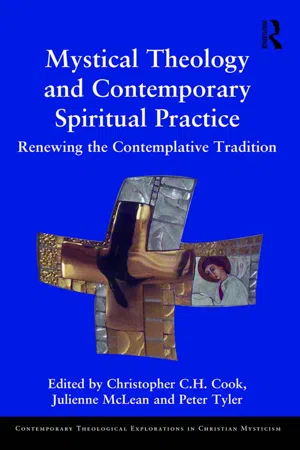
In Mystical Theology and Contemporary Spiritual Practice several leading scholars explore key themes within the Christian mystical tradition, contemporary and historical. The overall aim of the book is to demonstrate the relevance of mystical theology to contemporary spiritual practice. Attention is given to the works of Baron von Hugel, Vladimir Lossky, Margery Kempe, Ludwig Wittgenstein, Thomas Merton, and Francisco de Osuna, as well as to a wide range of spiritual practices, including pilgrimage, spiritual direction, contemplative prayer and the quotidian spirituality of the New Monasticism. Christian mystical theology is shown to be a living tradition, which has vibrant and creative new expressions in contemporary spiritual practice. It is argued that mystical theology affirms something both ordinary and extraordinary which is fundamental to the Christian experience of prayer.
eBook - ePub
Mystical Theology and Contemporary Spiritual Practice
Renewing the Contemplative Tradition
- 128 pages
- English
- ePUB (mobile friendly)
- Available on iOS & Android
eBook - ePub
Mystical Theology and Contemporary Spiritual Practice
Renewing the Contemplative Tradition
About this book
Information
1 Baron Friedrich von Hügel on the mystical element of religion
Has the Baron a message for us today?
Abstract
Central to the spiritual teaching of Friedrich von Hügel (1852–1925) was his distinction between the three elements of religion: (a) the historical-traditional-institutional; (b) the intellectual-rational-speculative; (c) the experiential-mystical. These correspond respectively to (a) childhood (sense and memory); (b) youth (question and argument); (c) maturity (intuition, feeling, volition); also to Father, Son and Spirit within the Trinity. Different persons feel a particular attrait to one specific element out of the three; von Hügel himself was attracted especially to the mystical element, which he saw as fundamental to all religion. Mysticism, he insisted, is not concerned primarily with the odd, the exceptional or the miraculous, but with ‘the supremely normal’. Mystical experience is possible for everyone; it is ‘the normal consciousness of mankind’, and there is no special faculty of mystical apprehension given to some but not to others. The true mystical attitude involves, not negative abstraction, but the revelation of the extraordinary in the ordinary, of the infinite in the finite.
The three elements
Baron Friedrich von Hügel (1852–1925) is chiefly remembered today for the threefold distinction that he drew between the different elements of religion: the historical, the rational and the mystical. There is first what he terms the historical-traditional-institutional element: ‘this sacred torch-race across the ages’, as he styles it.1 Next there is the rational-intellectual-speculative element: ‘Religion here becomes Thought, System, a Philosophy’, he writes.2 Thirdly, there is the experiential-mystical element: in the Baron’s words, ‘Here religion is rather felt than seen or reasoned about, is loved and lived rather than analyzed.’3
These three elements correspond respectively, so von Hügel argues, to the three ages of our human development: to childhood, to youth and to maturity. In childhood we rely chiefly on what we are told by others, on authority, on external facts, on what we see and remember; and this may be likened to the historical element of religion. In youth we begin to test what we are told, to challenge it through question and answer; and this may be equated with the rational element. In maturity we make greater use of intuition, feeling and volition; and this is similar to the experiential or mystical element. Summarizing the three aspects or stages, von Hügel observes: ‘I believe because I am told [childhood], because it is true [youth], because it answers to my deepest interior experiences and needs [maturity].’4
Alternatively, the three elements can each be linked with a particular person of the Trinity:
God the Father and Creator is conceived as corresponding to the sense-perception and Imagination, to Memory-power; God the Son and Redeemer, as the Logos, to our reason; and God the Holy Spirit, as corresponding to the effective-volitional force within us.5
There are intriguing parallels here with C.G. Jung’s essay, ‘A Psychological Approach to the Trinity’, where the Father corresponds to the stage of the child, the Son to the process of self-individuation and the emergence of ego-consciousness, and the Spirit to the embracing of the unconscious. But the Baron would scarcely have wished to follow Jung in expanding the Trinity into a quaternity, by including either the Blessed Virgin Mary or the devil!6
Different persons, so von Hügel is convinced, feel a particular attrait to one specific element out of the three. He himself was attracted especially to the mystical element, which he saw as fundamental to all religion. But he insists that all three elements are necessary for a balanced personhood or a balanced religious faith. They are complementary, not mutually exclusive. It is important to avoid an excessive emphasis upon one element at the expense of the other two. This leads him to draw attention to what he sees as certain dangers:
Women generally tend either to an excess of the external, to superstition [i.e. a distortion of the first element]; or of the emotional, to fanaticism [i.e. a distortion of the third element]. Men, on the contrary, appear generally to incline to an excess of the intellectual, to rationalism and indifference [i.e. a distortion of the second element] … The Latin races [tend] to Externalism and Superstition; the Teutonic races, to the two Interiorisms, Rationalism and Fanaticism.7
Here von Hügel surely falls into sexual and racial stereotypes that are less acceptable today than they would have been a hundred years ago. Perhaps fortunately, he does not attempt to classify the Orthodox peoples, whether Greek or Slav.
The Baron goes on to apply this threefold pattern to world religions, in a somewhat schematic fashion; but at the same time it has to be acknowledged that everything he says is based on his profound and wide-ranging reading on the subject. Brahmanism, in his view, has overemphasized the first element, the institutional or traditionalist. Buddhism displays an excess of ‘abstruse reasoning and pessimistic emotion’ (an overemphasis on the second and third elements). Islam, while combining all three elements, lays particular stress upon the first, the external element; and, at any rate in the person of its strictly orthodox representatives, it treats with suspicion the third or mystical element.8 (Presumably von Hügel would make an exception here in the case of the Sufis.)
All three elements, according to von Hügel, are evident in Judaism at the time of Christ: the Pharisees exemplify the first (‘external, traditional, authoritative’), the Sadducees the second (‘accommodating and rationalizing’), and the Essenes the third (‘experimental, ascetical and mystical’).9 Within Christianity, Abbot Joachim of Fiore ‘gives us the intuitional-emotive element [the third element] in a … purified, institutionally and rationally supplemented form’.10 The Quakers likewise manifest a predominance of the third element. The Baron thought highly of them: ‘The “Society of Friends”… measured by the smallness of its numbers, has given to the world an astonishingly large band of devoted lovers of humankind.’11 On the other hand, the Roman Catholic Church of his day had in his opinion inclined too far in the institutional direction.12
‘Religion can’t be clear’
Among the three elements, let us look in closer detail at the third, the mystical element. But, before we do so, let us consider three other points, which will enable us to place in context his assessment of this mystical element:
First, his understanding of truth as a bright light, surrounded by darkness;
Second, his dialectical approach, insisting always on the ‘friction’ of opposites;
Third, his interpretation of religion as a combination of external fact and inner experience.
1. Truth as a bright light. The Abbé Henri Huvelin, the French priest who acted as spiritual director to von Hügel, wrote to him: ‘Truth for you is a radiant point of light which gradually fades off into darkness.’13 The Baron himself used the same analogy:
The deeper we get into any reality, the more numerous will be the questions we cannot answer. For myself I cannot conceive truth, or rather reality, as a geometrical figure of luminous lines, within which is sheer truth, and outside of which is sheer error; but I have to conceive such reality as light, in its centre blindingly luminous, having rings around it of lesser and lesser light, growing dimmer and dimmer until we are left in utter darkness … Although the realm of light can and will be indefinitely enlarged, yet its borders will continue fringed – they will never be clear-cut frontiers.14
The conclusion which von Hügel draws from this is that we should be firm at the centre, while remaining free at the periphery.15 Alas...
Table of contents
- Cover Page
- Half Title
- Title Page
- Copyright Page
- Table of Contents
- List of contributors
- Acknowledgements
- Introduction: mystical theology: renewing the contemplative tradition
- 1 Baron Friedrich von Hügel on the mystical element of religion: has the Baron a message for us today?
- 2 What did Vladimir Lossky mean by ‘mystical theology’?
- 3 The mystical theology of Margery Kempe: writing the inner life
- 4 Unlikely mystics: Durham Cathedral as mystical space for ordinary people
- 5 The renewal of contemplative traditions: new monasticism and quotidian practices
- 6 Wittgenstein reads Merton: the mystical theology of two twentieth-century masters
- 7 Mystical theology and the renewal of contemplative spiritual practice
- Concluding reflections: mystical theology: renewing the contemplative tradition
- Index
Trusted by 375,005 students
Access to over 1.5 million titles for a fair monthly price.
Study more efficiently using our study tools.
Frequently asked questions
Yes, you can cancel anytime from the Subscription tab in your account settings on the Perlego website. Your subscription will stay active until the end of your current billing period. Learn how to cancel your subscription
No, books cannot be downloaded as external files, such as PDFs, for use outside of Perlego. However, you can download books within the Perlego app for offline reading on mobile or tablet. Learn how to download books offline
Perlego offers two plans: Essential and Complete
- Essential is ideal for learners and professionals who enjoy exploring a wide range of subjects. Access the Essential Library with 800,000+ trusted titles and best-sellers across business, personal growth, and the humanities. Includes unlimited reading time and Standard Read Aloud voice.
- Complete: Perfect for advanced learners and researchers needing full, unrestricted access. Unlock 1.5M+ books across hundreds of subjects, including academic and specialized titles. The Complete Plan also includes advanced features like Premium Read Aloud and Research Assistant.
We are an online textbook subscription service, where you can get access to an entire online library for less than the price of a single book per month. With over 1.5 million books across 990+ topics, we’ve got you covered! Learn about our mission
Look out for the read-aloud symbol on your next book to see if you can listen to it. The read-aloud tool reads text aloud for you, highlighting the text as it is being read. You can pause it, speed it up and slow it down. Learn more about Read Aloud
Yes! You can use the Perlego app on both iOS and Android devices to read anytime, anywhere — even offline. Perfect for commutes or when you’re on the go.
Please note we cannot support devices running on iOS 13 and Android 7 or earlier. Learn more about using the app
Please note we cannot support devices running on iOS 13 and Android 7 or earlier. Learn more about using the app
Yes, you can access Mystical Theology and Contemporary Spiritual Practice by Christopher C. H. Cook, Julienne McLean, Peter Tyler, Christopher C. H. Cook,Julienne McLean,Peter Tyler in PDF and/or ePUB format, as well as other popular books in Theology & Religion & Religion. We have over 1.5 million books available in our catalogue for you to explore.