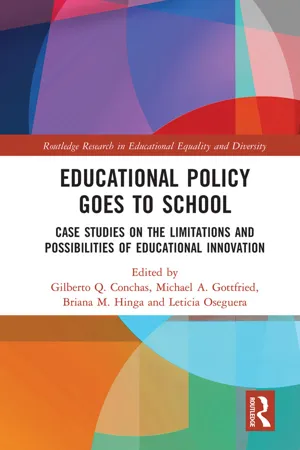
Educational policies explicitly implemented in order to reduce educational gaps and promote access and success for disenfranchised youth can backfire—and often have the unintended result of widening those gaps. In this interdisciplinary collection of case studies, contributors examine cases of policy backfire, when policies don't work, have unintended consequences, and when policies help. Although policy reform is thought of as an effective way to improve schooling structures and to diminish the achievement gap, many such attempts to reform the system do not adequately address the legacy of unequal policies and the historic and pervasive inequalities that persist in schools. Exploring the roots of school inequality and examining often-ignored negative policy outcomes, contributors illuminate the causes and consequences of poor policymaking decisions and demonstrate how policies can backfire, fail, or have unintended success.
eBook - ePub
Educational Policy Goes to School
Case Studies on the Limitations and Possibilities of Educational Innovation
- 280 pages
- English
- ePUB (mobile friendly)
- Available on iOS & Android
eBook - ePub
Educational Policy Goes to School
Case Studies on the Limitations and Possibilities of Educational Innovation
About this book
Information
1 Introduction
Conceptualizing the Intricacies that are Concomitant in Educational Policymaking that Determine Success, Backfire, and Everything in Between
Taken together, the historic, economic, sociopolitical, and moral debt that we have amassed toward Black, Brown, Yellow, and Red children seems insurmountable, and attempts of addressing it seem futile. Indeed, it appears like a task for Sisyphus. But as legal scholar Derrick Bell indicated, just because something is impossible does not mean it is not worth doing.
Ladson-Billings, American Educational Research Association (AERA)
Presidential Address, 2006)
Presidential Address, 2006)
Policy reform is often considered an answer to promoting equity in schools. However, history tells another story. Numerous policy reforms have come and gone while deep-rooted inequity within the school system persists. Gloria Ladson-Billing’s explanation of the “education debt” provides an elucidation of this problem (AERA Presidential Address, 2006).
Ladson-Billings reframes the focus away from the concept of an achievement gap (i.e., referring to disparities in standardized test scores between races and classes) to a focus on an achievement debt, explaining historical, economic, sociopolitical, and moral inequities rooted in the system. Historical debt refers to the legacy of inequitable policies and practices in schools. Economic debt includes funding disparities in education. The sociopolitical debt denotes the exclusion of people of color from the civic process. A moral debt points out the difference between what we state we believe to be right versus what we actually practice. The comprehensive intersections of these four debt categories paint a bleak picture for the hopes of education reform. Ladson-Billings—in her 2006 AERA Presidential Address—cites Derrick Bell as she explains that just because this debt seems hopeless to overcome, this does not mean it is not worth working toward.
In contrast to reforms addressing the achievement gap, addressing the education debt requires addressing systematic inequalities rooted in the system. This takes shifting the conversation from an achievement gap, which can exist without ownership, to the acknowledgement that the problem is owned in the form of education debt (Patel, 2015). A gap can be seen as something to fill, if a policy targets the right factor(s) to reform, without calling for a transformation in the conditions that created the gap. Attempts to reform the system by isolating and fixing factors within the system align with the understanding of reform as merely the reorganization of unethical practices that allows us to sleep at night (Wilderson, 2010).
This book attempts to understand ways we can work toward addressing the possibly insurmountable education debt, through policies. Rather than pose solutions to our education debt, the volume engages what it means for policies to address the education debt and how policies materialize within a system with deeply rooted inequities. We look at the intentions espoused by specific policies as well as the material unfolding of each policy. We include an analysis of the roll out of policies that met their stated intentions as policies, those that had unintended consequences, those that failed, and even those that backfired and made things worse. A look across studies opens a discussion about how stated intentions of policies materialize within a system that runs on debt.
What it Means for Policies to Address Achievement Debt
Scholars such as Gloria Ladson-Billings (2006) have critiqued the hegemony of the achievement gap paradigm, which has prioritized short-term solutions, and has promoted siloed investigations and interventions (Patel, 2015). What is often excluded from this discussion is how underlying systemic issues of racism, power, and politics shape both educational and social inequity. Moreover, researchers and policymakers often do not recognize the ways in which the achievement gap paradigm is rooted in historical processes that are intimately tied to anti-blackness, “culture of poverty” tropes and neoliberal restructuring (Baldridge, 2014; Dumas, 2014; Leonardo & Hunter, 2007; Sojoyner, 2016). This theoretical and policy perspective centers individuals and minoritized communities through a deficit lens. What has recently emerged from this perspective are shortsighted efforts such as personality-centered interventions to increase students’ “grit” in hopes of stimulating academic achievement (Duckworth & Gross 2014; McGee, 2016). Aside from the moral and philosophical issues that belie such efforts, these types of interventions do little to address the systems, and structures that constrain the life opportunities of minoritized youth. Disparities in educational opportunities cannot be truly addressed until policy is dedicated to transforming the social and institutional conditions that hinder the healthy development of all young people—especially those from minoritized communities (Welner & Carter, 2013). This calls for a broader analysis and understanding of the fundamentally racialized, gendered, and class-based nature of inequality and its consequences for all aspects of human development. Within this broader perspective, systemic change must be centered on inequities that intersect with education, which includes lack of access to physical and mental health resources, inadequate housing, extreme economic inequality, food insecurity, immigration status, de facto segregation and lack of access to enriching activities.
Angela Y. Davis (1990) once defined the word radical as “grasping things at the root.” The conceptual hegemony of the “achievement gap” is dependent upon an assumption that equity can be attained if: 1) the causal mechanisms that belie the systemic glitches are identified and that 2) these malfunctions can be ameliorated by liberal reforms or technocratic innovations. Scholars have noted the ways in which reform agendas fueled by colorblind ideologies and naïve meritocratic principles have often reduced and conflated equity with simplistic conceptions of “access” and ”equal opportunity” (Pollock, 2001; Lewis, 2003; Philip, Jurow, Vossoughi, Bang, & Zavala, 2017), which do not address the structural and institutional nature of inequality. This framing obstructs the opportunity for a radical analysis of the historical and structural social formations that are at the root of oppression and inequality (Gutierrez & Jaramillo, 2006; Patel, 2015). Such polemical topics are often excluded from mainstream policy and research discourse. Some influential social scientists and policymakers perceive these concepts as value-laden, not objective, and ultimately unscientific, which has relegated researchers who ask such questions to the margins of academia (Hale, 2008). In the context of the current political climate, some education researchers—specifically those in the learning sciences—have called for education scholars to embrace these dimensions of research and establish a political theory of learning that advocates for the rights of minoritized communities (Philip et al., 2017). Research and policymaking are not value-free, ahistorical, or decontextualized endeavors. Politicians and activists all along the political spectrum tend to agree; laws and budgets are essentially “moral documents” (Ryan, 2014).
Policy Outcome Continuum
We engage the discussion of how policies materialize along categories of backfire, failure, unintended consequences, and success. While backfire is included under the umbrella of policies with unintended consequences, it has its own special category. Backfire occurs when a policy or intervention has the exact opposite effect of what it was intended to do (see Gottfried & Conchas, 2016). Policies that backfire are distinct from policies that fail or even policies that have unintended consequences. Therein lies the conceptual utility of “backfire” versus failure. Defining this distinction is an intention and contribution of this edited volume. The addition of failure, unintended consequences, and success will further add clarity to backfire. While unintended effects can be positive or negative, backfire is always negative. We argue that there is a need to specifically identify policies that backfire, as unintended effects often provoke a “we should have seen that coming” face-palm moment and require a reworking of the program, and failure requires an entirely new policy or program (or not, depending on how stubborn the “deciders” may be); backfire suggests a fundamental misstep in the program design that failed to account for some vitally important factor or structural consideration, whatever its basis. This design flaw led to the program not just failing, not just having unintended effects, but having an iatrogenic effect, or creating greater harm as a result of the treatment. All social and educational policies are intended to do good, so the understanding of how and why they go wrong is essential to understanding how stated intentions play out in a system that runs on deep education debt.
Intentions of the Book
This book was written to learn from attempts to move toward equity in the education system. The strengths of this approach toward educational equity include its coverage of a continuum of policy adoption, from success to backfire, as described above. It is academic and action focused in that chapter authors include conceptual frameworks describing policy implications with practical examples for those tasked with implementing or adopting policy. Also, we offer an understanding of the policy outcome through an asset-based perspective and challenge chapter authors to push the conceptual boundaries of the achievement gap and shift the discussion toward a more complete understanding of inequity that accounts for racism, power, oppression, and the historical structural antecedents of educational inequality. That is, rather than blame the student or actor for less than promising outcomes, we explain how multiple actors often work together, through historically structured cultures, to shape conditions for how the policy materializes. Through lessons of each study, we offer ideas for future academics, practitioners, and policymakers to consider as they oversee/implement policy improvement. A final strength of this book is its inclusion of international perspectives. We extend the contextual features of this book by including domestic and international perspectives that illustrate each of our policy scenarios. This is a first, unique opportunity to present a multifaceted, multidisciplinary examination of when educational policy and practice do and do not converge—and what lessons we can learn.
This collection of chapters represents a multitude of disciplines and methodological approaches, located across the United States and internationally, and studies of different geographic regions and distinct youth and young adult populations—from early childhood education through adulthood. While the geographic scope and methodological approach varies, each chapter directly addresses three key questions:
- 1) What was the educational policy, and what educational intentions were espoused by the policy?
- 2) How did the policy materially unfold and how does this materialization fit within the categories of success, unintended consequences, failure, or backfire?
- 3) What might explain the outcome? And, what can we learn to structure policies that enact stated intentions?
The first question is central to any analysis of policy. It provides the landscape by which we can examine how a policy set out to reduce schooling gaps for a particular minoritized group. Once we understand the landscape (e.g., intention and goals) of the policy, it is feasible to move to addressing question two. Here, each chapter will evaluate the divergence between intention and material reality. Question two provides an analysis of the implementation of the policy and provides evidence of outcomes across the continuum. Finally, of great importance to this book is question three. This final question addresses reasons for the outcome—i.e., providing the readers with specific explanations and useful conclusions that may be used to address the achievement debt.
Organization of Book
Part I of the book focuses on the contributions of educational policies that backfire and make things worse for the populations the policies were intended to help.
In Chapter 2, “How Urban Education Choice Campaigns in Detroit Masqueraded as Equity and Social Justice and Worsened the Status Quo,” Brownell discusses the schooling context in Detroit, and how school enrollment restrictions prevented disenfranchised populations from accessing education. While the notion, “I’m in” was propagated among the Midtown population, the policy backfired: quality schooling excluded specific populations through admissions criteria, which perpetuated the existing opportunity gaps for the city’s youth and parents in the most underprivileged sectors.
In Chapter 3, “When Policies that Impact Students with Significant Disabilities in Michigan Backfire,” Deschaine discusses the role of PA 198 in Michigan, a policy that established segregated schools for students with significant disabilities in 1971. While at the time the policy was considered “best practice” among educators, Deschaine argues that the segregation of schools for these students was met with the rise of pressure for the mainstreaming and normalization of access to general education classrooms. This chapter discusses several policies that attempt to provide support for students with significant disabilities, but emphasizes their backfire on individuals and school districts.
In Chapter 4, “When Zero-Tolerance Discipline Policies in the United States Backfire,” Potter and Boggs situate the discussion of policy backfire using zero-tolerance discipline policies in schools. Through a sociological framework, the authors contend that zero-tolerance discipline policies undermine student educational attainment. Moreover, these policies, though originally intended to make schools safer, have reinforced and increased the school-to-prison pipeline, a clear perpetuation of the problem that these policies were trying to solve.
In Chapter 5, “When Free Schools in England and Charter Schools in the United States Backfire,” Downes and Simon describe the Academies Act of the UK, a policy intended to create additional choice and competition for schooling for greater social mobility for students. Similar to the invention of charter schools in the U.S., the Academies intended to reduce inequity in schools by eliminating barriers seen to be blocking student success. However, research suggests that these Academies backfired and heightened stratification and debilitated social mobility in UK schools, amplifying opportunity gaps for students.
Part II examines the contributions of policies that failed. They may have been crafted with good intentions but clearly failed to reach their aims via a collapse in sustainable infrastructure to attain policy goals.
In Chapter 6, “When High-Stakes Accountability Measures Impact Promising Practices in an Indigenous-Serving Charter School,” Anthony-Stevens juxtaposes the aims of a culturally responsive, local charter school with the realities of harsh accountability policy embedded within Adequate Yearly Progress (AYP) benchmarks. Using ethnographic research to portray an Indigenous-serving charter middle school in Arizona, the author illustrates the clear satisfaction of students, parents, and teachers with the school’s learning environment for its students. Yet, with the school’s failure to meet AYP thresholds, the school was forced to close its doors to its students. Anthony-Stevens suggests that while the goal of culturally responsive schooling was clearly desirable, this goal failed in the context of accountability measurement for this school, and more work is needed to understand potential for sustainable, equitable educational change.
In Chapter 7, “How Public-Private Partnerships Contribute to Educational Policy Failure,” Fernandez, Loya, and Oseguera highlight the policy failure of a federally sponsored college access program. An analysis of the program reveals that overall implementation was hindered due to consistent communication breakdowns between schools and private, non-profit organizations. While the partnership between public and private entities is popular among reform efforts, the authors argue that these partnerships are not enough to reduce opportunity gaps for students. Further, they conclude that evaluation of programs is a key component to understanding policy success or failure, as these evaluation efforts lead to better coordination between stakeholders and improve the ability for program staff to collect informative data.
In Chapter 8, “The Failure of Accountability in the Milwaukee Parental Choice Program,” Ford and Vélez discuss the results and overall failure of the Milwaukee Parental Choice Program (MPCP). Due to the fact that MPCP was not held accountable among voters in the community, the program was never richly embedded within the city’s education infrastructure. The authors argue that without a democratic mechanism to keep the program accountable, MPCP inevitably failed. They suggest possible soluti...
Table of contents
- Cover
- Title
- Copyright
- Contents
- 1 Introduction: Conceptualizing the Intricacies that are Concomitant in Educational Policymaking that Determine Success, Backfire, and Everything in Between
- 2 How Urban Education Choice Campaigns in Detroit Masqueraded as Equity and Social Justice and Worsened the Status Quo
- 3 When Policies that Impact Students with Significant Disabilities in Michigan Backfire
- 4 When Zero-Tolerance Discipline Policies in the United States Backfire
- 5 When Free Schools in England and Charter Schools in the United States Backfire
- 6 When High-Stakes Accountability Measures Impact Promising Practices in an Indigenous-Serving Charter School
- 7 How Public-Private Partnerships Contribute to Educational Policy Failure
- 8 The Failure of Accountability in the Milwaukee Parental Choice Program
- 9 How Centralized Implementation Policies Failed the Austrian New Middle School Process
- 10 The Unintended Consequences of School Vouchers: Rise, Rout, and Rebirth
- 11 Challenges and Unintended Consequences of Student-Centered Learning
- 12 School Discipline Policies That Result in Unintended Consequences for Latino Male Students’ College Aspirations
- 13 When Special Education Policy in Ontario Creates Unintended Consequences
- 14 Latina/o Farmworker Parent Leadership Retreats as Sites of Agency, Community Cultural Wealth, and Success
- 15 Bilingual and Biliterate Skills as Cross-Cultural Competence Success
- 16 Diversity-Driven Charters and the Construction of Urban School Success
- 17 Reflecting on the Institutional Processes for College Success Among Chicanos in the Context of Crisis
- 18 Reframing the Problematic Achievement Gap Narrative to Structure Educational Success
- Contributor Bios
- Index
Trusted by 375,005 students
Access to over 1.5 million titles for a fair monthly price.
Study more efficiently using our study tools.
Frequently asked questions
Yes, you can cancel anytime from the Subscription tab in your account settings on the Perlego website. Your subscription will stay active until the end of your current billing period. Learn how to cancel your subscription
No, books cannot be downloaded as external files, such as PDFs, for use outside of Perlego. However, you can download books within the Perlego app for offline reading on mobile or tablet. Learn how to download books offline
Perlego offers two plans: Essential and Complete
- Essential is ideal for learners and professionals who enjoy exploring a wide range of subjects. Access the Essential Library with 800,000+ trusted titles and best-sellers across business, personal growth, and the humanities. Includes unlimited reading time and Standard Read Aloud voice.
- Complete: Perfect for advanced learners and researchers needing full, unrestricted access. Unlock 1.5M+ books across hundreds of subjects, including academic and specialized titles. The Complete Plan also includes advanced features like Premium Read Aloud and Research Assistant.
We are an online textbook subscription service, where you can get access to an entire online library for less than the price of a single book per month. With over 1.5 million books across 990+ topics, we’ve got you covered! Learn about our mission
Look out for the read-aloud symbol on your next book to see if you can listen to it. The read-aloud tool reads text aloud for you, highlighting the text as it is being read. You can pause it, speed it up and slow it down. Learn more about Read Aloud
Yes! You can use the Perlego app on both iOS and Android devices to read anytime, anywhere — even offline. Perfect for commutes or when you’re on the go.
Please note we cannot support devices running on iOS 13 and Android 7 or earlier. Learn more about using the app
Please note we cannot support devices running on iOS 13 and Android 7 or earlier. Learn more about using the app
Yes, you can access Educational Policy Goes to School by Gilberto Conchas, Michael Gottfried, Briana Hinga, Leticia Oseguera, Gilberto Conchas,Michael Gottfried,Briana Hinga,Leticia Oseguera, Gilberto Q. Conchas, Michael Gottfried, Briana M. Hinga, Leticia Oseguera in PDF and/or ePUB format, as well as other popular books in Education & Education General. We have over 1.5 million books available in our catalogue for you to explore.