Originally published in 1986, this book takes an inter-disciplinary approach to the options for energy in the future. Written in a clear, easy-to-read style, it proposes that future solutions should not be based solely on cost, given our plentiful energy resources, but on ecological, human and ethical considerations. The book features a quantittive review of energy sources, supported by numerous figures and tables, that includes such long-term solutions as nuclear fission and solar energy. The book allows engineers and students to easily weigh the pros and cons of all energy options to realistically plan for the future.
eBook - ePub
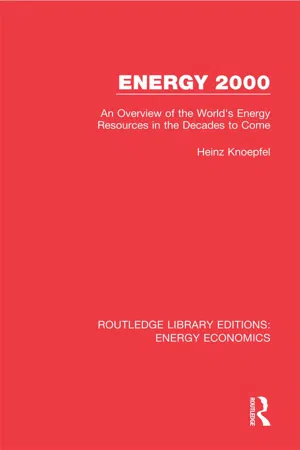
Energy 2000
An Overview of the World's Energy Resources in the Decades to Come
- 188 pages
- English
- ePUB (mobile friendly)
- Available on iOS & Android
eBook - ePub
CHAPTER 1
Energy Today
Energy is perhaps the most significant single quantity defining the world in and around us. It is of basic importance in physics and biology, as well as in most manifestations of our industrialized society. Energy means not only fuel for transportation and for heating, fertilizers for agriculture, and chemical products for industry, but also food and housing for man’s well-being. The great scientist Boltzmann suggested in 1886 that life is primarily a struggle for energy.
1.1 AN ENERGY PRIMER
Energetic unrest
Energy has always played an explicit and important role in the development of our civilization, particularly so in the last two centuries. The advent of the steam engine at the end of the eighteenth century heralded a new and fundamental application of energy which was to provide the motive force for the socioeconomic revolution of our modern era. One of the immediate consequences was to shift the textile mills from the countryside (where they harnessed power from watercourses) to the cities. The birth of industry came about in socially difficult circumstances; not until a century or so later were the working masses to share to any real extent the benefits of the greater productivity made possible by this new form of energy.
Steamy railway
Another sector revolutionized by the steam engine was transport. The year 1825 saw the inauguration in England of the first railway in history. On the basis of the great number of empirical results obtained by the manufacturers of steam engines, a more precise and scientific analytical approach was developed, which eventually provided the basis of thermodynamics and, on a more general level, of modern physics.
Energy is today only partially a technological problem, as it depends strongly also on socioeconomic and political considerations and, above all, on fundamental choices to be made on the basis of moral value judgments on our way of life.
Lights at the fairground
In 1973, when the effects of the hard line adopted by the major Arab oil producers in the wake of events in the Middle East reached the west, it was almost as if a fairground had been hit by a power cut. Nevertheless, at first through inertia and then out of sheer necessity, the big wheel of the consumer society did not in fact stop turning, although it did lose some of its momentum temporarily and there were economic difficulties in certain areas. The system has rapidly adapted itself to the new situation, and energy on the market is again plentiful. Those years already seem far away and the preoccupations about energy forgotten.
Energy in politics
Nevertheless, what has remained is the awareness of people of the almost total dependence of our way of life on what could in fact be defined as the most important raw material of the world economy, i. e., energy in its many diverse forms. The 1973 crisis also revealed the vast economic interests and political implications at international levels which center on energy. At any rate, it heralded the end of a consumer society based on very cheap energy which had been the hallmark of the 1960s, and the beginning of a positive, although not altogether painless development toward a new economic situation characterized by what could be described as a slowed-down consumer society. For the rich, industrialized nations the containment of energy consumption turned out to be a positive process. The situation was, and is, totally different in the developing and poor countries where progress is conditioned upon a substantial increase in the consumption of energy, i.e., on the necessity to have cheap and abundant energy.
Demanding investments
Dollars in a barrel
The economic implications of energy are impressive and far-reaching. Apart from the final commercial cost of energy, something of which we, as consumers, are perfectly aware, the huge investment needed to exploit energy sources must also be considered. At the eleventh World Energy Conference in Munich in 1980, a report by the Dresdner Bank estimated that the non-Communist countries will have to spend up to $10 trillion (1013 in constant 1979 dollars) to meet the energy demand up to the year 2000. This enormous capital investment would be required to restructure present energy supplies (e.g., oil will come from more remote and hostile areas, and will require increasingly sophisticated recovering techniques); to shift the emphasis away from oil more toward nuclear energy, gas and coal; to increase the share of electricity in the overall energy consumption; to build the necessary gross distribution systems (pipelines and electricity grids). Even if the effective capital requirement should turn out to be much less than anticipated, as a consequence of changing energy scenarios and lower consumption levels (see in Sec. 5.1), the mentioned figure stresses the importance of the energy business in the investment market.
Energy payoff
The exploitation of a new energy source generally requires huge extracting facilities and power plants, which in themselves absorb large amounts of energy to be set up: The preparation of materials, such as the extraction and processing of metals, requires energy as well as raw materials. Consider, for a nuclear source, the energy required for the whole uranium fuel cycle (from ore extraction and purification to enrichment and preparation of the reactor fuel, up to the reprocessing of the spent fuel; see Chap. 3) and the massive power station itself. The energy payoff time in this case is typically 3 to 5 years, meaning that the energy output of the electronuclear power plant over 3 to 4 years is needed to cover the energy investment required to get the plant into operation in the first place.
The oil eater
This interconnection between energy and materials also points to a critical dependence of the cost of materials (and of food) on the cost of energy; and vice versa (Sec. 1.2 and 1.3). This is one of the reasons why the poor and developing countries (without their own energy sources) must be most concerned about the future availability and cost of energy, whereas the industrialized western nations should well be able to ride the wave of energy-related problems and manage the corresponding financial difficulties.
Heat not wanted
Large consumption of energy by man negatively influences the environment, a problem that mostly hits the consumer society. In large conventional power stations, as we shall see, roughly one-third of the primary energy derived from oil, coal, or nuclear sources is converted into electricity; the remaining two-thirds are released as heat into the atmosphere surrounding the power station, whence the so-called problem of thermal pollution. In order not to disrupt the ecological equilibrium by excessive heating of natural waters, cooling towers are often needed and these constitute the most imposing and sight-disturbing part of the installation.
Smoke gets in the air
A more serious problem is atmospheric pollution caused by certain types of conventional power stations. A large, but standard 1 gigawatt (1 billion watts) coal-fired electric power station consumes 10000 tons of coal daily, much of which is released into the atmosphere in the form of carbon dioxide and also produces roughly 600 tons of ash and over 200 tons of sulfur dioxide. Despite the filter required by the new laws in force, a significant part of these products is released into the atmosphere and is then dispersed over a large area.
Nuclear energy could be one of the important primary energy sources of the future (Sec. 4.5). Although it has already an important share (e.g. in 1984 one quarter of the European Community’s electricity is from nuclear origin), its future role is still open to debate (Sec. 3.1 and 3.3).
No learned debates
An underlying feature of these various aspects of the energy problem is poverty: 25% of the world’s population suffers from malnutrition because of poverty, and approximately half a million human beings die of hunger every year. Poverty is a type of pollution which generates suffering and hate and which kills. And poverty cannot be overcome unless enough energy is available. The poor peoples of the world are not overly concerned by our learned debates on pollution and the potential dangers of radioactivity; these drawbacks can be eliminated or mitigated by means of suitable, possibly expensive measures which will in any case have to be paid for by the richer nations.
Riding on the top
Many of the problems discussed or mentioned so far in this chapter find a logical ordering around the evolution curve shown in Fig. 1.1. As energy consumption per capita increases, income also increases in a spiraling interconnection, and the nations thereby develop from preindustrial into an industrial society. This is the transformation in which most countries on the earth are presently involved—some are still far behind; others, like the industrialized western nations, ride on the top of this evolution.
A lean mix
In relat...
Table of contents
- Cover
- Half Title
- Title Page
- Copyright Page
- Table of Contents
- PREFACE
- 1. ENERGY TODAY
- 2. ENERGY IN MANKIND’S EVOLUTION
- 3. NUCLEAR FISSION ENERGY
- 4. ENERGY TOMORROW
- 5. ENERGY: THE FUTURE
- REFERENCES
- SUBJECT INDEX
Trusted by 375,005 students
Access to over 1.5 million titles for a fair monthly price.
Study more efficiently using our study tools.
Frequently asked questions
Yes, you can cancel anytime from the Subscription tab in your account settings on the Perlego website. Your subscription will stay active until the end of your current billing period. Learn how to cancel your subscription
No, books cannot be downloaded as external files, such as PDFs, for use outside of Perlego. However, you can download books within the Perlego app for offline reading on mobile or tablet. Learn how to download books offline
Perlego offers two plans: Essential and Complete
- Essential is ideal for learners and professionals who enjoy exploring a wide range of subjects. Access the Essential Library with 800,000+ trusted titles and best-sellers across business, personal growth, and the humanities. Includes unlimited reading time and Standard Read Aloud voice.
- Complete: Perfect for advanced learners and researchers needing full, unrestricted access. Unlock 1.5M+ books across hundreds of subjects, including academic and specialized titles. The Complete Plan also includes advanced features like Premium Read Aloud and Research Assistant.
We are an online textbook subscription service, where you can get access to an entire online library for less than the price of a single book per month. With over 1.5 million books across 990+ topics, we’ve got you covered! Learn about our mission
Look out for the read-aloud symbol on your next book to see if you can listen to it. The read-aloud tool reads text aloud for you, highlighting the text as it is being read. You can pause it, speed it up and slow it down. Learn more about Read Aloud
Yes! You can use the Perlego app on both iOS and Android devices to read anytime, anywhere — even offline. Perfect for commutes or when you’re on the go.
Please note we cannot support devices running on iOS 13 and Android 7 or earlier. Learn more about using the app
Please note we cannot support devices running on iOS 13 and Android 7 or earlier. Learn more about using the app
Yes, you can access Energy 2000 by Heinz Knoepfel in PDF and/or ePUB format, as well as other popular books in Business & Business General. We have over 1.5 million books available in our catalogue for you to explore.