This collection originally published in 1985. This volume contains two of Charles F. Parham's influential works; A Voice Crying in the Wilderness and Everlasting Gospel. Charles F. Parham was an American preacher and evangelist, and was one of the two central figures in the development of the early spread of Pentecostalism. He was also the first preacher to articulate Pentecostalism's distinctive doctrine of evidential tongues. This title will be of interest to students of nineteenth-century religious and social history.
- 132 pages
- English
- ePUB (mobile friendly)
- Available on iOS & Android
eBook - ePub
The Sermons of Charles F. Parham
About this book
Information

CHAPTER I
LIFE SKETCH
__________
The Work of Calvary Wrought in One Life
__________
The call to preach:—Preachers are born, not manufactured; this fact is proven by the record of nearly all Bible characters. Though modern individuals have many of them chosen the ministry as a profession, either because of its ease and moral atmosphere or from its remunerative value which some have been able to obtain by having reached the upper rounds of the ladder in scholarly attainments. These ministers have drawn many into ethical societies but usually fail in the real conversion an experimental knowledge of salvation from sin, among their adherents.
Nevertheless, God is (even in these days) calling men to preach, who know it as well as their conversion (some of them better) who are conscientiously following the directions of God’s Holy Spirit and meeting with deserved success.
The earliest recollection we have of a call to the ministry was when about nine years of age; and though unconverted, realized as certainly as did Samuel that God had laid His hand on us, and for many years thereafter endured the feeling of Paul,—“woe is me, if I preach not the gospel.” This continued for years, until reading how men were drafted for the Civil War, how others volunteered; also that the drafted ones fought because they had to, while the volunteers fought for the glory that was in it. Then and there, surrendering all the feeling of “woe is me if I preach not the gospel,” and all the papers as a drafted soldier, we enlisted as a volunteer in the army of the Lord, henceforth fighting for the glory.
Now a word to men and women who have a call from God to preach, who have been accepted by your Church or society or not. Preach you must and preach you will have to whether you are received properly licensed or not; God will not cast you off or fail to own your labors. If you do not obey, there is left you in this world only a path of thorns—misery, woe, want and nothing that you touch shall prosper and in the world to come, a long, long night with no morn beyond.
Being very sick and weakly, our early days were spent at light tasks; or, when well enough at herding cattle.
Our parents emigrated to Kansas in an early day, and coming thither in a prairie schooner, the library was of small proportions. It contained—as we remember,—“The letters from Hell,” a natural history; a few antiquated school books; a dictionary; a history of all nations, recording facts from early historic times until 1878; and last but not least the Bible. These last two books were the most valuable in preparing us for the work which has now developed upon us.
The Bible was almost a constant companion; and though unconverted, time and again we used to round up the cattle upon an eminence, and give them a rousing sermon upon the realities of a future life; whether of the “minstrels of bliss” or “the wailing of the damned.”
Many times in these later days, when accosted with the remark that you show great patience with the younger people and with many of the older ones who do not attentively follow your remarks, we have been glad to tell them that we received our training for the ministry by preaching to cattle, which indifferently munched away, while we described, with the intensity of youthful imagination, the condition of futurity.
Thus, with no preconceived ideas, with no knowledge of what creeds and doctrines meant, not having any traditional spectacles upon the eyes to see through,—for our parents were not religious—we scarcely knew anything about Church and Sunday School; preachers seeming to be as scarce in those parts as hen’s teeth; really we don’t remember them to have invaded that country until it became quite thickly settled, and the yellow-legged chicken became part of the marketable produce, and once in a while—at least when the preacher came—formed a change of diet which we were sorely in need of. We don’t remember to have ever heard but one or two preachers before reaching the age of thirteen years, and were converted in a meeting held by Brother Lippard of the Congregational Church.
These facts are stated to show that the early study and impression of the Scriptures were entirely unbiased; thus by becoming thoroughly familiar with it and reading it just as it says and not being warped by preconceived notions or interpretations we have been enabled to weather the theological gales and outstrip the clergy who attempted to tear away the main-sail and wrap it in the dogmatical confines of a single organization ; thus by turning the rudder of the ship, have been guided through storms of persecution, passing the forts whose guns were loaded with fierce hatred and cruel prejudice, able today to say: The ship sails in the peaceful seas of full salvation.
And at this dawning of the great Millennial days—the Son of Righteousness arising with healing in His wings, realize the power of the ends of the world, the age to come, the Restitution of all things; having been privileged to stand with the apostles, and again see the signs, wonders, and mighty deeds, with all the nine gifts of the Holy Ghost revisit the Church.
Other scenes and the memories may fade, but who shall ever forget the place where God first spake to the soul!
The preacher who was holding meetings in a school-house said,—on Thursday evening that unless some one made a start, the meeting would close on Sunday ; so on the road home, we decided to start the next evening. There were several reasons why this decision was made; first and uppermost, was to keep the meeting running, as it was quite an innovation and enjoyabe place to spend the long evenings, and although we had never decided in our mind when we should become a Christian, that was in the vague future, sometime. Yet, owing to sickness and always feeling thus inclined, it did not require much urging to decide; we stood up and were immediately marked down as a convert. No interest seemed to be shown whether really converted or not, but the idea seemed to prevail that if a person made a strong resolution and did the best they could that was all that was required.
On the road home that night, the Holy Spirit wrought deep and pungent conviction on our heart; and from the knowledge already obtained from the Scriptures, knew it would be utterly impossible to live a Christian life, without a real conversion. Some people may try it, but in all the years of experience since, we have never known a single individual who made a success of the Christian life, who did not have a deep and pungent conviction for sin, repenting with a godly sorrow for the same, with the restitution to fellow creatures of all wrongs. Yea, and we have also learned that the blood of Jesus Christ never blots out any sin between man and man that can be righted; but if this is impossible, the blood of Jesus Christ graciously covers. So on that night when weighed down by mighty conviction being unable to pray, we tried to sing, (which was an impossibility to do until years afterward, when in answer to prayer, God supplied the need, and gave ability to lead the hymns in meeting) ; so humming that old familiar song,—“I am Coming to the Cross,”—had reached the third verse when with face upturned, and meaning every word of it;
“Here, I give my all to Thee,
Friends, and time and earthly store,
Soul and body Thine to be;
Wholly Thine forever more.”
While repeating the word “wholly,” there flashed from the Heaven, a light above the brightness of the sun; like a stroke of lightning it penetrated, thrilling every tissue and fibre of our being; knowing by experimental knowledge what Peter knew of old, that He was the Christ, the Son of the living God. Though the devil has accused and thrown many doubts and fears into our mind in regard to other things, and the perfidy and indifference of many so-called Christians has nearly thrown us into infidelity; yet the experience of that night years ago, has ever been, “an anchor to the soul, both sure and steadfast.”
“Oh happy day, that fixed my choice.
On Thee, my Saviour and my God.”
Nothing worthy of note happened in the following years. We became a Sunday School teacher and worker and (at the age of fifteen) held the first public meetings which were followed with marked results. After teaching a short time, entered college at sixteen; pursuing the religious work with more vigor than the studies, for which were often severely reprimanded and graded down in the examination.
Most sectarian schools afford the best facilities for back-sliding, the religious influence being often dominated by back-slidden, super-annuated preachers; who, if they are not back-slidden before, are in great danger of it after being superannuated and located in the College town of their denomination; for many of them are not willing to live a quiet and peaceful life, but having been in the habit of having their own way so long, seek to rule the affairs of the Church and College upon old and prosaic lines, and are soon outclassed by younger men of more progressive, and in many cases, deeper spiritual truths.
The Southwestern Kansas College was not then and is not now, a good place to back-slide; but for all that, we backslid.
The thought of the ministry, with no special abiding place, its many starvation stations and hard scrabble circuits, was not near so alluring as some other professions; especially when coupled with this, the ministry seemed generally to be considered a great burden on society, which they don’t seem to be able to get rid of, and which they are unwilling to support. Of whom it is often said they demand more salary than the school teacher, and in return do the community little or no good; usually working about one sixth the time the teacher does. Having been a collecting steward and being thoroughly educated and trained in all the grafts and gambling schemes used to obtain money, until it seemed that it was absolutely necessary to put a poultice of oysters, strawberry short cake or ice cream on the people’s stomachs to draw or burst open their purse strings.
We became disgusted with the prospect; at the same time were seriously tormented with the promise, we had made the Lord when converted, to go to Africa as a missionary.
Having been an invalid for many years, the devil suggested that it would be a most philanthropic work to become a physician; to relieve the suffering of humanity, and then, by and by, have a nice home and some ease and comfort in this world.
Accordingly we chose our studies with this end in view; but the lamp of life faded. The devil tried to make us believe that we could be a physician and a Christian too; losing ground day after day, became not only guilty of sins of omission but sins of commissions as well, until our associates failed to recognize us as longer being a Christian. Yet as certain as are God’s mercies, so certain are His judgments, which are often times mercies in disguise.
For months we suffered the torments of hell, and the flames of rheumatic fever, given up by all physicians and friends.
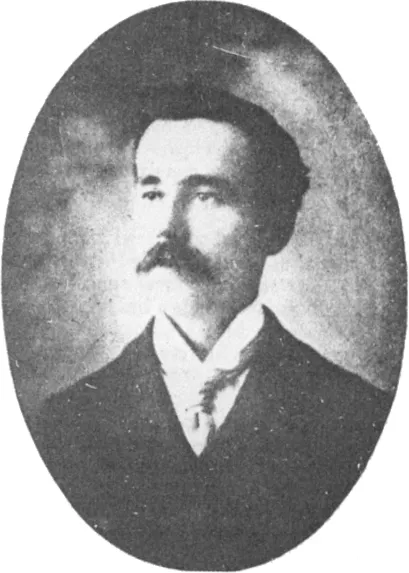
EVANGELIST CHARLES FOX PARHAM
(From a photograph taken about the time of writing this book.)
While thus suffering many deaths, knowing we were in rebellion against God, earnestly desiring and coveting to die—vainly expecting relief of soul and body by it—yet realizing the fact that God was dealing with us, and we could not die.
The preacher came to see us, but we despised the sight of him. This is truly a fact that no one ever back-slides except they either blame the preacher or some other saint of God for it.
So in the ministry, when enjoying the deep truths of God, we have preached a gospel of hearts—or love; and when down in our experience, we preached a gospel of clubs.
Out in Colorado, where they have a great many thousand sheep, in the winter time when it is very cold and they don’t get sufficient feed, they eat the wool off one another; so it is with God’s sheep, either in the pulpit or pew, if they are dwelling in a cold atmosphere without sufficient food, you will invariably find them eating the wool off each other.
When the preacher came to see us, we put on a very sanctimonious air, and gave vent to a good many expressions we did not feel inside, so as to get rid of him.
After months of suffering in this manner, we became very much emaciated; one day when the physician called to see others in the house, he was brought in to see us. From weakness and an over dose of morphine—which we were privileged to eat as we desired—we were in a semi-conscious condition, but heard the physician say we could last but a short time.
How we would liked to have told him that we knew a great deal better! There was a consciousness within, that while we were suffering from disobedience and being sorely punished, some day we would surrender our arms of rebellion, and preach the everlasting gospel.
The next morning there came to us so forcibly all those wonderful lessons of how Jesus healed; why could He not do the same today?
We repented like a prodigal, received the pardoning kiss, and made a consecration, promising God that—whatever the cost—whether it be Africa, the streets, or the slums, life or death we would serve Him.
Then came into our inner life that wonderful cleansing power that I learn later was sanctifying grace; while to our body came the mighty power of healing. God wanted the will; from that day to this, we have never felt a call to Africa.
The disease was killed; at that time we felt that God simply healed us because He had a special work for us to do. Though receiving a marvelous touch of healing, yet like many of our brethren today there remained one feature of the disease from which we had not been delivered.
Our ankles had been so swollen and inflamed for months, that when the disease left, the binding sinews and cartilage were so misplaced, it left the joint absolutely without support. Eventually we learned to walk, or rather to hobble along on the sides of our feet; and like many who have not received complete healing today, wondered why we were not entirely healed.
Our experience may be of benefit to you; we had disobeyed God, and for this reason He refused to grant complete healing.
Physicians said there was no help for this infirmity in the ankles; nothing in medical science could reach the case. But one night, months later, after faithfully performing our vow, we knelt under an old oak tree and there plead with God, who had promised to supply all our needs, bringing such forcible arguments in our prayer as these; that we could not afford to be hauled everywhere we went, and telling Him that He knew successful evangelistic work could not be carried on without house to house visitation; having given our life to the ministry, He would have to give us work to do every day, for we were determined not to be known as a lazy preacher.
While thus pleading for deliverance, we suddenly realized what a man at the Beautiful Gate found; our impotent ankles were instantly healed, we leaped upon them and have never felt a tremor in them since.
From that time on, we had a similar experience in healing to that of the justified life,—sometimes up and sometimes down, getting sick and taking the Lord for our Healer and at other times taking medicine; until twenty-four years of age, when we realized the mighty power of God in sanctifying the body from disease as He had from inbred sin.
At the age of nineteen, we were called to fill the pulpit of Dr. Davis—founder of the Baker University of Baldwin, Kans.,—which we held for two years.
Finding the confines of a pastorate, and feeling the narrowness of sectarian churchism, we were often in conflict with the higher authorities, which eventually resulted in open rupture; and we left denominationalism forever, though suffering bitter persecution at the hands of the church, who seemed determined if possible, our soul should never find rest in this world or the world to come.
Oh, the narrowness of many who call themselves the Lord’s own!
Five years were spent in evangelistic work; hundreds were converted, scores sanctified, and a few healed.
Thi...
Table of contents
- Cover Page
- Half Title
- Title Page
- Copyright Page
- Contents
- A Voice Crying in the Wilderness
- The Everlasting Gospel
Trusted by 375,005 students
Access to over 1.5 million titles for a fair monthly price.
Study more efficiently using our study tools.
Frequently asked questions
Yes, you can cancel anytime from the Subscription tab in your account settings on the Perlego website. Your subscription will stay active until the end of your current billing period. Learn how to cancel your subscription
No, books cannot be downloaded as external files, such as PDFs, for use outside of Perlego. However, you can download books within the Perlego app for offline reading on mobile or tablet. Learn how to download books offline
Perlego offers two plans: Essential and Complete
- Essential is ideal for learners and professionals who enjoy exploring a wide range of subjects. Access the Essential Library with 800,000+ trusted titles and best-sellers across business, personal growth, and the humanities. Includes unlimited reading time and Standard Read Aloud voice.
- Complete: Perfect for advanced learners and researchers needing full, unrestricted access. Unlock 1.5M+ books across hundreds of subjects, including academic and specialized titles. The Complete Plan also includes advanced features like Premium Read Aloud and Research Assistant.
We are an online textbook subscription service, where you can get access to an entire online library for less than the price of a single book per month. With over 1.5 million books across 990+ topics, we’ve got you covered! Learn about our mission
Look out for the read-aloud symbol on your next book to see if you can listen to it. The read-aloud tool reads text aloud for you, highlighting the text as it is being read. You can pause it, speed it up and slow it down. Learn more about Read Aloud
Yes! You can use the Perlego app on both iOS and Android devices to read anytime, anywhere — even offline. Perfect for commutes or when you’re on the go.
Please note we cannot support devices running on iOS 13 and Android 7 or earlier. Learn more about using the app
Please note we cannot support devices running on iOS 13 and Android 7 or earlier. Learn more about using the app
Yes, you can access The Sermons of Charles F. Parham by Charles F. Parham in PDF and/or ePUB format, as well as other popular books in Theology & Religion & History of Christianity. We have over 1.5 million books available in our catalogue for you to explore.