- 258 pages
- English
- ePUB (mobile friendly)
- Available on iOS & Android
eBook - ePub
The Turks and Islam in Reformation Germany
About this book
Although their role is often neglected in standard historical narratives of the Reformation, the Ottoman Turks were an important concern of many leading thinkers in early modern Germany, including Martin Luther. In the minds of many, the Turks formed a fearsome, crescent-shaped horizon that threatened to break through and overwhelm. Based on an analysis of more than 300 pamphlets and other publications across all genres and including both popular and scholarly writings, this book is the most extensive treatment in English on views of the Turks and Islam in German-speaking lands during this period. In addition to providing a summary of what was believed about Islam and the Turks in early modern Germany, this book argues that new factors, including increased contact with the Ottomans as well as the specific theological ideas developed during the Protestant Reformation, destabilized traditional paradigms without completely displacing inherited medieval understandings. This book makes important contributions to understanding the role of the Turks in the confessional conflicts of the Reformation and to the broader history of Western views of Islam.
1
Sixteenth-Century Bestsellers
Once only on the edges of early modern European scholarship and on the margins of maps, the Ottoman Turks have begun to be recognized as an important part of the mental world of sixteenth-century Europeans. As is the case with many kinds of otherness, when one becomes aware of them, the Turks seem to be everywhere in the period. In the first half of the sixteenth century alone, for example, over 600 books, pamphlets, ballads, and broadsheets with the Turks and/or Islam as the main subject were published in Western Europe. Throughout Europe, pamphlets reported one Ottoman victory after another. As far away as England, the ‘Turk’ was a catchword for unexpected attack and invasion. The confluence of this perceived danger with the Renaissance interest in the exotic produced a knowledge hunger that was fueled by the development of new print technology. Although it is tenuous to argue that the quantity of publication on a topic alone demonstrates the level of contemporary importance, it seems clear that sixteenth-century Europeans were fascinated with the Ottomans.1
One particularly important subgenre of this Turcica was captivity narratives. For much of Western Europe in the Late Middle Ages and Renaissance, these narratives were among the few available sources concerning life in the Ottoman Empire behind what might be termed the ‘crescent curtain.’ Apart from Venetian news reports, until the mid-sixteenth century reports from former captives provided the most extensive information.2 The wide distribution and multiple editions of these writings reflect a perennial human interest in stories about adventure, danger, and the exotic. There seems to have been something particularly intriguing about those that had been subjected to slavery and lived to tell the tale. The insider information they brought back both intrigued and scandalized their readers.3
Captivity narratives played a much greater role than simply entertainment, however. They had an enormous impact on the shaping of Western views of Islam. These ex-slaves wrote with authority. They could speak the languages of the Ottoman Empire. They had spent long years inside Turkey, seeing society in a way that, for example, a reporting itinerant traveler could not.4 Of course, the former captives did not and could not perfectly translate Turkish culture into written Latin. (Although there is much that is of interest in these writings even to historians of the Ottoman Empire.) The primary value of these writings is what they say about developing attitudes within Europe, and in particular, Western understandings of the Turks and Islam (See Figure 1.1).
In Reformation Germany two publications by former slaves of the Turks were particularly important. The Tractatus de moribus Turcarum, (c.1480) [Pamphlet on the Customs of the Turks] attributed to George of Hungary, and Bartholomew Georgijevic’ two-part publication De Turcarum ritu et caeremoniis [On the Rituals and Ceremonies of the Turks] and De afflictione tam captivorum quam etiam sub Turcae tributo viventium Christianorum [On the Afflictions of the Captive Christians Living under the Tribute of the Turks] (both 1544).5 Both of these publications were reprinted numerous times and in whole or in part were translated into several vernaculars. These two authors are especially important for three reasons. Taken together, they give significant insight into the type of information about Islam that was widely circulated in Europe during the period. In comparison with material on Islam from earlier in the medieval period, considerably more information, and more accurate information, is known. In addition, because both authors claim to have written out of the experience of Ottoman slavery and escape, these documents can add to our understanding of religious boundaries between Islam and Christianity as imagined and constructed by early modern Europeans. These texts draw boundaries in a myriad of ways, from religious practices to bathroom etiquette and food culture. Finally, although the supposed regional origins and life stories of both former captives are remarkably similar, because they were penned almost seventy years apart, a comparative reading demonstrates considerable diversity in European responses to Islam and points to important developments in Western responses to the Muslim Ottomans from the Late Middle Ages to the early modern period that highlight the important transitional nature of the period. One central focus of this study is the analysis and comparison of these two publications (See Figure 1.2).
Of course, escaped slave reports make up only a fraction of the body of Western literature about Islam and the Turks in early modern Europe. The historical confluence of Ottoman expansion and the development of widespread moveable type printing created an explosion of small booklets and broadsheets about the ‘exotic’ Turks. This production was directly tied to the military conflict with the Ottoman Empire. Some pamphlets on the Turks were published each year, but production soared during periods of more intense military confrontation, especially the 1529 siege of Vienna, the 1532 Ottoman campaign, and the 1542 annexation of Hungary. When the threat increased, general interest in the Turks increased as well.
Although nearly every land with a printing industry published “little booklets on the Turks” (in German: Türkenbüchlein) the majority were published in Italy, France, the Low Countries, and especially in Germany. During the first half of the sixteenth century alone, more than 350 pieces
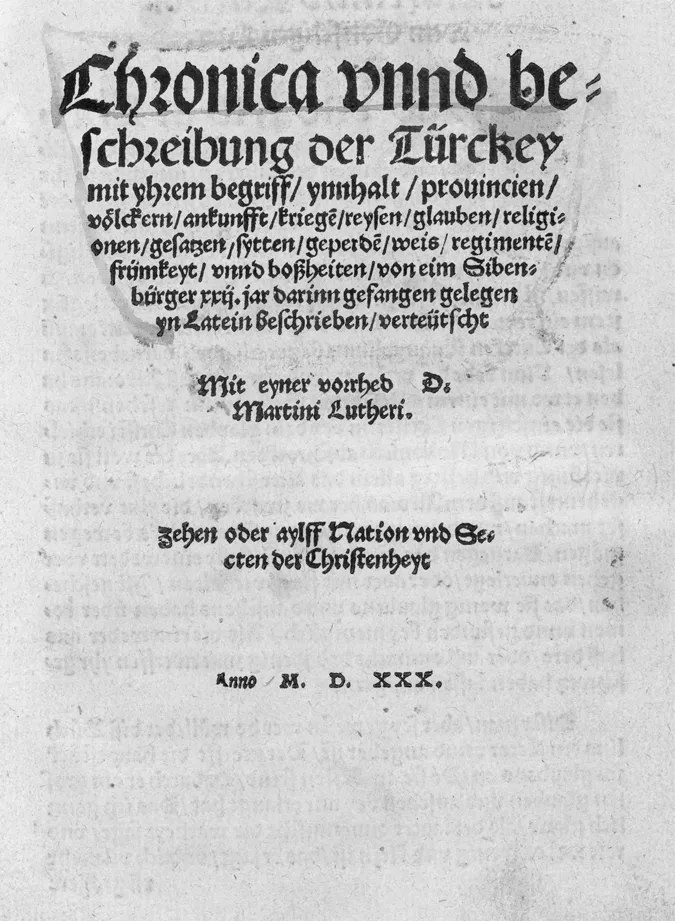
Figure 1.1 Martin Luther’s edition of George of Hungary, 1530
Courtesy of Houghton Library, Harvard University. *GC5 L9774 En530t, Houghton Library, Harvard University
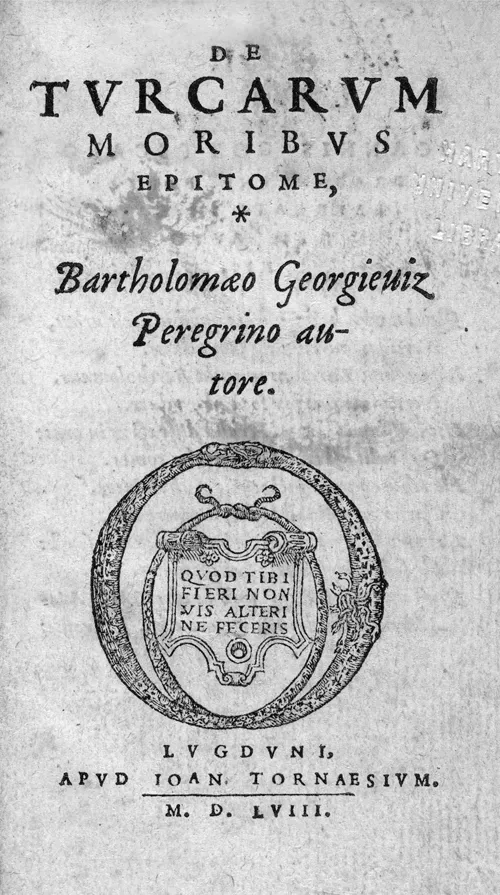
Figure 1.2 Georgijevic, De turcarum moribus, 1558
Courtesy of Houghton Library, Harvard University. *ZHC5 G2958 552ℓd, Houghton Library, Harvard University
of literature specifically on the Turks were published in German-speaking lands. Very little of the significant body of sixteenth-century Turcica has been translated into English,6 despite the importance of this genre of literature in early modern Europe. This specific period is not only interesting because of the large number of publications on the Turks. It represents a high point of the Ottoman Empire’s push into Central Europe and, at the same time, a significant event in the intellectual history of Western Europe due to the development of the Protestant Reformation. From the beginning of Protestantism, understandings of the Turks and evaluations of appropriate responses to them became embroiled in confessional debates.
Interest in the Turks was not limited to any genre. All printed genre contain works on the Turks. As has been expertly analyzed by Charlotte Colding Smith, visual images, some proclaiming their basis in eyewitness accounts, were broadcast by means of single-leaf woodcuts and illustrated publications small and large.7 Secular ballads and spiritual hymns concerning the Turks were printed. Sermons and prayers against the Ottomans were published along with political speeches and Reichstag decisions. Early newspapers (in German: Neue Zeitungen) kept interested people up to date on the latest events.8 In fact, according to Andrew Pettegree, “by far the greatest stimulus to the growth of the European news industry was the relentless encroachment of the Ottoman Empire.”9
Organization of the Study
This study summarizes the views of Islam and the Turks presented in the great outpouring of literature on the Ottomans produced in German-speaking lands during the first half of the sixteenth century, that is, during the first generation of Protestant Reformers. While some of this literature originated outside of German-speaking lands, vernacular translations brought them into the German milieu and blended with the already significant number of native publications. Germans seemed to have been particularly interested in the Turks, in part due to the Hapsburg-Ottoman rivalry but also because the first generation of German Reformers (especially Martin Luther) were themselves interested in the Turks and Islam.10 In order to understand these publications, two layers of context need to be established. I begin with a short summary of the intellectual context through a survey of the development of Western attitudes toward Islam and the Turks prior to 1520. The political context is established through a summary of the engagement between the Ottomans and Europe in Reformation-era Germany.
A central contribution of this study is the content analysis of more than 300 publications from German-speaking lands that discuss the Turks and/or Islam and were printed between 1520 and 1550, that is, between the accession of Sulaiman the Magnificent and publication of the final edition of Theodor Bibliander’s Qur’an. Most of the authors of these publications make no distinction between the ‘Turks’ and Islam and often use the terms as synonyms. However, for reasons of topical analysis, I devote one chapter to descriptions of social, cultural, and military aspects of the Turks in particular. A second chapter surveys understandings of religious aspects of Islam that sometimes were applied to the Muslim world more generally.
There are two questions at the heart of most of these publications: why are the infidel Turks seemingly invincible against Christendom? What is the appropriate Christian response? The chapter ‘Holy Terror’ surveys the answers to the first question found in these pamphlets and the chapter ‘Holy War’ discusses answers to the second. Here, too, the Protestant Reformation, as seen for example both in Martin Luther’s absolute denunciation of the Crusade as a blasphemous confusion of spiritual and temporal, and in various Anabaptist disavowals of all warfare, was a catalyst for new developments that influenced the history of Christian-Islamic relations. I conclude with a more detailed comparison and contrast of the two main escaped slave narratives in the broader context of the Reformation in Germany. In appendices are found lengthy selections both of George of Hungary and Bartholomew Georgijevic. No modern English translation of either of these influential publications has previously been available. The translations have been made from their printings accompanying the first published Latin Qur’an, Theodor Bibliander’s Machumetis saracenorum principis (1543, second edition 1550). This three-volume equivalent of an ‘encyclopedia of Islam’ is the form in which these pamphlets would have been read by scholars throughout Europe during the sixteenth and seventeenth centuries.11 Because of their attempt to provide Europeans not only with theological and political guidance concerning the Turks but also because they attempted to portray all aspects of life and culture concerning the Ottoman, George of Hungary and Bartholomew Georgijevic provide the best short summary of the general understandings of Islam and the Turks available to Western Europeans (See Figure 1.3).
Paradigm Shifts
Over the last twenty-five years, several studies of the perceptions of the Muslim world in Western Europe have challenged th...
Table of contents
- Cover
- Title
- Copyright
- Dedication
- Contents
- List of Figures
- 1 Sixteenth-Century Bestsellers
- 2 The Intellectual Context: Western Views of Islam in the Late Middle Ages
- 3 The Political Context: Hapsburg-Ottoman Relations in the Sixteenth Century
- 4 Knowledge and Depictions of Islam and the Religious Life of the Ottoman Turks in Reformation Germany
- 5 Knowledge and Depictions of the Turks
- 6 Holy Terror: Depictions of the Islamic Threat and Its Causes
- 7 Holy War and Its Discontents: Responses to the Ottoman Advance
- 8 Escaped Slaves of the Turks: George of Hungary and Bartholomew Georgijevic
- 9 Early Modern Transformations of the Image of Islam in the West
- Appendix 1: Martin Luther and Philip Melanchthon, Recommendation Letter for Bartholomew Georgijevic
- Appendix 2: Selections from George of Hungary, Tractatus de moribus Turcorum [Booklet on the Customs of the Turks]
- Appendix 3: Selections from Bartholomew Georgijevic, De afflictione tam captivorum quam etiam sub Turcae tributo viventium Christianorum [On the Afflictions of the Captive Christians Living Under the Tribute of the Turks] and De Turcarum ritu et caeremoniis [On the Rituals and Ceremonies of the Turks]
- Index
Trusted by 375,005 students
Access to over 1.5 million titles for a fair monthly price.
Study more efficiently using our study tools.
Frequently asked questions
Yes, you can cancel anytime from the Subscription tab in your account settings on the Perlego website. Your subscription will stay active until the end of your current billing period. Learn how to cancel your subscription
No, books cannot be downloaded as external files, such as PDFs, for use outside of Perlego. However, you can download books within the Perlego app for offline reading on mobile or tablet. Learn how to download books offline
Perlego offers two plans: Essential and Complete
- Essential is ideal for learners and professionals who enjoy exploring a wide range of subjects. Access the Essential Library with 800,000+ trusted titles and best-sellers across business, personal growth, and the humanities. Includes unlimited reading time and Standard Read Aloud voice.
- Complete: Perfect for advanced learners and researchers needing full, unrestricted access. Unlock 1.5M+ books across hundreds of subjects, including academic and specialized titles. The Complete Plan also includes advanced features like Premium Read Aloud and Research Assistant.
We are an online textbook subscription service, where you can get access to an entire online library for less than the price of a single book per month. With over 1.5 million books across 990+ topics, we’ve got you covered! Learn about our mission
Look out for the read-aloud symbol on your next book to see if you can listen to it. The read-aloud tool reads text aloud for you, highlighting the text as it is being read. You can pause it, speed it up and slow it down. Learn more about Read Aloud
Yes! You can use the Perlego app on both iOS and Android devices to read anytime, anywhere — even offline. Perfect for commutes or when you’re on the go.
Please note we cannot support devices running on iOS 13 and Android 7 or earlier. Learn more about using the app
Please note we cannot support devices running on iOS 13 and Android 7 or earlier. Learn more about using the app
Yes, you can access The Turks and Islam in Reformation Germany by Gregory J. Miller in PDF and/or ePUB format, as well as other popular books in History & World History. We have over 1.5 million books available in our catalogue for you to explore.