![]()
1
Introduction to Cognitive Approaches in Wireless Sensor Networks
1.1 Introduction
Wireless sensor networks (WSNs) are constituted of small-size, lightweight, low-power nodes deployed in large numbers. They are used in a variety of applications, such as environment monitoring, health care, precision agriculture, security, food safety, water quality monitoring, intelligent transportation, smart grid communications, and so forth. Advancement in the field of low-power very-large-scale integration (VLSI) and embedded systems, together with the convergence of communication and computing technologies, has enabled the miniaturization of the sensing, processing, and communication devices. This has led to an expansion in the application domain for sensor networks. Researchers now believe that WSNs are the key enabling technology for ambient intelligence where a network of these tiny sensing devices would enable environment-aware, personalized, and adaptive computing based on real-time requirements of end users. However, communication in sensor networks is challenged by the limited availability of energy. The multiple, often conflicting, optimization objectives have always been a challenge to achieve because the restricted interactions among the layers of the protocol stack makes it difficult to cater to the varied goals of the network elements while simultaneously catering to the end objective of the network as a whole.
To address these problems, cross-layer design approaches have been proposed. This design paradigm allows information sharing among layers and enables the joint optimization of problems at different layers. However, including information from all layers leads to reduced modularity and increased adaptation loops, making the system more complex to handle. These limitations have been acknowledged by the research community, and more holistic approaches are being investigated.
In order that sensor networks become part of pervasive computing environments, they need to become proactive rather than reactive. They must have the ability to learn the changes in the environment, infer from past behavior about the best course of action, and be able to predict future behavior based on what best suits the application needs. In other words, we are talking of introducing cognitive behavior in sensor networks.
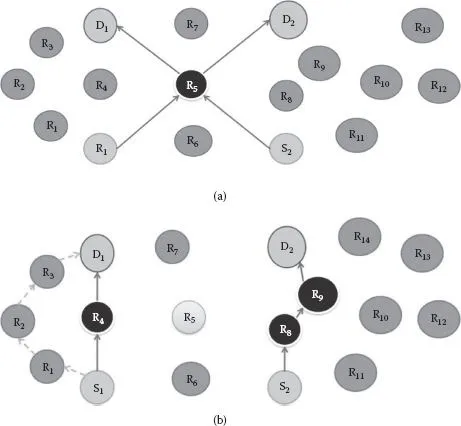
Cognition refers to the ability to be aware of the environment, learn from past actions, and use that information to make future decisions that benefit the network. Unlike intelligence that focuses only on decision mechanisms, cognition focuses on information from the environment [1]. Thus the ability to learn becomes a key differentiator between a cognitive network and a noncognitive one [2]. To illustrate the idea of introducing cognition in a wireless network, consider the example in Figure 1.1. S1 and S2 are the source nodes that are trying to route data to destination nodes D1 and D2. Out of the available relay nodes, it is determined that node R5 has the lowest link outage probability to D1 and D2. Hence S1 starts routing data through R5. In the meantime, S2 also starts routing a high traffic of data through R5 (indicated by the solid paths). When multiple source nodes start routing their data through this node, the route through R5 may get congested. But a cognitive network with learning capabilities will be able to identify and predict the congestion at R5 by observing the decrease in throughput at the source nodes, for example. Sharing this observation with all the nodes in the network, the cognitive network would be able to respond to congestion proactively by routing the data through a different path involving nodes R4, R8, and R9 as shown in Figure 1.1(b). This helps to preserve nodes like R5, thus maintaining network connectivity and providing reliable data transfer, which are especially important in sensor network applications. Based on the application, the network may be also able to choose between minimizing the number of hops (by choosing route S1→R4→D1) and minimizing power, irrespective of the number of hops (by choosing route S1→R1→R2→R3→D1), for example. Thus we can see that introducing cognition in a wireless network can be advantageous. Now let us go on to understand the objectives of introducing cognition in WSNs.
FIGURE 1.1
Traditional and cognitive routing in sensor networks. (a) Classical routing in a sensor network. (b) Cognitive routing in response to congestion.
The following points summarize the objectives of incorporating cognition in sensor networks:
• Make the network aware of and dynamically adapt to application requirements and the environment in which it is deployed.
• Provide a holistic approach to enable the sensor network to achieve the end-to-end goals of the network; that is, gather information about the channel conditions from the physical layer, network status from network and MAC layers, and application requirements from the application layer, and then use memory of past actions and their outcomes in making informed decisions and optimizing the multiple objectives in the network.
• Enable the use of sensor networks in ambient intelligent environments.
Gathering information from all layers of the protocol stack will enable the sensor network to get a holistic view of the changes in the network: changes in application requirements, changes in the channel status at the physical layer, or the connectivity status of the network nodes. Let us look at the kind of information that is expected to be gathered from these network elements.
1.1.1 Application Layer Requirements
In a sensor network, end-user requirements may change over time or during a specific duration of time even if the deployed network is for a specific application. For example, in an environment monitoring application, coverage, connectivity, and high tolerance toward service disruptions are important aspects influencing the network lifetime. Here the normal function of the sensor network deployment is event monitoring. Hence the connectivity and coverage criteria play an important part in ensuring network lifetime maximization. After a certain duration of time, some nodes may die out, and this leads to a scenario where there is reduced data redundancy. There is now an increased need for reliable data transmission from the source node to the sink. Thus the reliability criterion gets added in addition to coverage and connectivity requirements. Moreover, if some nodes have cameras deployed, then there may be a demand for increased bandwidth when the end user wishes to turn on the camera modules at some chosen nodes.
In the case of a smart grid monitoring application, coverage, connectivity, real-time processing, bidirectional communication, and security are important requirements of this application. These requirements may change over time. For example, data transfer from photovoltaic (PV) panels does not need to take place at night. However, during daytime, the produced power and the stored power need to be communicated to the control center in quasi real-time. A similar example concerns the battery levels of electric vehicles, which do not need to be transmitted all the time. However, when electric vehicles request battery charging, their battery levels have to be transmitted to the grid’s control center. During the charging process, the battery levels need to be transmitted as well. For the smart grid, data security requirements vary according to the deployed nodes and their respective roles.
The above scenarios explain how the application/end-user requirements may change over time for an application-specific deployment of a sensor network. Thus application requirements are representative of the end-to-end goals of the data flow in the network. Application demands should be given top priority during decision making and optimization in a cognitive sensor network.
1.1.2 Physical Layer Constraints and Requirements
The physical channel conditions such as path loss, signal-to-interference plus noise ratio (SINR), transmission power limitations based on remaining battery power at the node, and data rate constrain the physical layer and play a role in deciding whether the application requirements can be satisfactorily met or will have to be toned down. Hence the demands and constraints of the physical layer (PHY) are fully taken into account in cognitive decision-making while catering to the end-to-end network goals.
1.1.3 Network Status Sensors
The medium access control (MAC) and network (NWK) layers together provide information about the network status. While the network layer manages the routing scheme, connectivity, and role of the nodes (router/cluster head) in the network, the MAC layer handles node associations/disassociations, channel access control, enabling/disabling the radio, and beacon management. Security is handled by both layers. All this information from the NWK and MAC layers will be very useful in cognitive decision-making. For instance, when there is information available about the routing scheme from the network layer, channel conditions at the PHY, and application-layer requirements, a cognitive network may find that under the existing PHY conditions, the current routing scheme will not help achieve the demands of the end user. Hence, it may decide to instruct the NWK layer to adopt a different routing scheme because the current one is not able to cater to the network’s end-to-end goals.
In order to achieve these objectives, learning the network conditions, having a memory of past actions, predicting future network conditions, and cognitive decision-making should be the core components of the system design.
Subsequent sections of the chapter are organized as follows: Section 1.2 presents the related work in the field of cognitive networks and cognitive sensor networks. A generic example of cognitive network architecture is presented in Section 1.3, followed by the conclusions in Section 1.4.
1.2 Related Work
Physical layer cognitive radio (CR) techniques [8] are the subject of Chapter 2. These techniques may be used in sensor networks and other networks. The reason for including CR in this book is that it represents an advanced and well-established physical layer awareness of the spectrum availability and use.
It is often believed that the layered architecture of the sensor network protocol stack hampers the network’s ability to cater to multiple optimization objectives. Though cross-layer design has been popular, the interactions remain limited to a few layers. The network-wide performance goals are not accounted for. It provides reactive, memoryless adaptations of past outcomes for a given set of inputs. Cross-layer interactions lead to reduced architectural modularity, which in turn leads to increased instability and the high cost of maintaining the network. An overview of cross-layer design approaches is given in Chapter 4, which compares various cross-layer approaches and highli...