Electrochemical Supercapacitors for Energy Storage and Delivery
eBook - ePub

Electrochemical Supercapacitors for Energy Storage and Delivery

Fundamentals and Applications

  1. 373 pages
  2. English
  3. ePUB (mobile friendly)
  4. Available on iOS & Android
eBook - ePub

Electrochemical Supercapacitors for Energy Storage and Delivery

Fundamentals and Applications

About this book

Although recognized as an important component of all energy storage and conversion technologies, electrochemical supercapacitators (ES) still face development challenges in order to reach their full potential. A thorough examination of development in the technology during the past decade, Electrochemical Supercapacitors for Energy Storage and Delivery: Fundamentals and Applications provides a comprehensive introduction to the ES from technical and practical aspects and crystallization of the technology, detailing the basics of ES as well as its components and characterization techniques.

The book illuminates the practical aspects of understanding and applying the technology within the industry and provides sufficient technical detail of newer materials being developed by experts in the field which may surface in the future. The book discusses the technical challenges and the practical limitations and their associated parameters in ES technology. It also covers the structure and options for device packaging and materials choices such as electrode materials, electrolyte, current collector, and sealants based on comparison of available data.

Supplying an in depth understanding of the components, design, and characterization of electrochemical supercapacitors, the book has wide-ranging appeal to industry experts and those new to the field. It can be used as a reference to apply to current work and a resource to foster ideas for new devices that will further the technology as it becomes a larger part of main stream energy storage.
Frequently asked questions

Yes, you can cancel anytime from the Subscription tab in your account settings on the Perlego website. Your subscription will stay active until the end of your current billing period. Learn how to cancel your subscription.
At the moment all of our mobile-responsive ePub books are available to download via the app. Most of our PDFs are also available to download and we're working on making the final remaining ones downloadable now. Learn more here.
Perlego offers two plans: Essential and Complete
  • Essential is ideal for learners and professionals who enjoy exploring a wide range of subjects. Access the Essential Library with 800,000+ trusted titles and best-sellers across business, personal growth, and the humanities. Includes unlimited reading time and Standard Read Aloud voice.
  • Complete: Perfect for advanced learners and researchers needing full, unrestricted access. Unlock 1.4M+ books across hundreds of subjects, including academic and specialized titles. The Complete Plan also includes advanced features like Premium Read Aloud and Research Assistant.
Both plans are available with monthly, semester, or annual billing cycles.
We are an online textbook subscription service, where you can get access to an entire online library for less than the price of a single book per month. With over 1 million books across 1000+ topics, we’ve got you covered! Learn more here.
Look out for the read-aloud symbol on your next book to see if you can listen to it. The read-aloud tool reads text aloud for you, highlighting the text as it is being read. You can pause it, speed it up and slow it down. Learn more here.
Yes! You can use the Perlego app on both iOS or Android devices to read anytime, anywhere — even offline. Perfect for commutes or when you’re on the go.
Please note we cannot support devices running on iOS 13 and Android 7 or earlier. Learn more about using the app.
Yes, you can access Electrochemical Supercapacitors for Energy Storage and Delivery by Aiping Yu,Victor Chabot,Jiujun Zhang in PDF and/or ePUB format, as well as other popular books in Physical Sciences & Energy. We have over one million books available in our catalogue for you to explore.

Information

Publisher
CRC Press
Year
2017
eBook ISBN
9781351832830
Edition
1
Subtopic
Energy

1

Fundamentals of Electric Capacitors
—————

1.1 Introduction

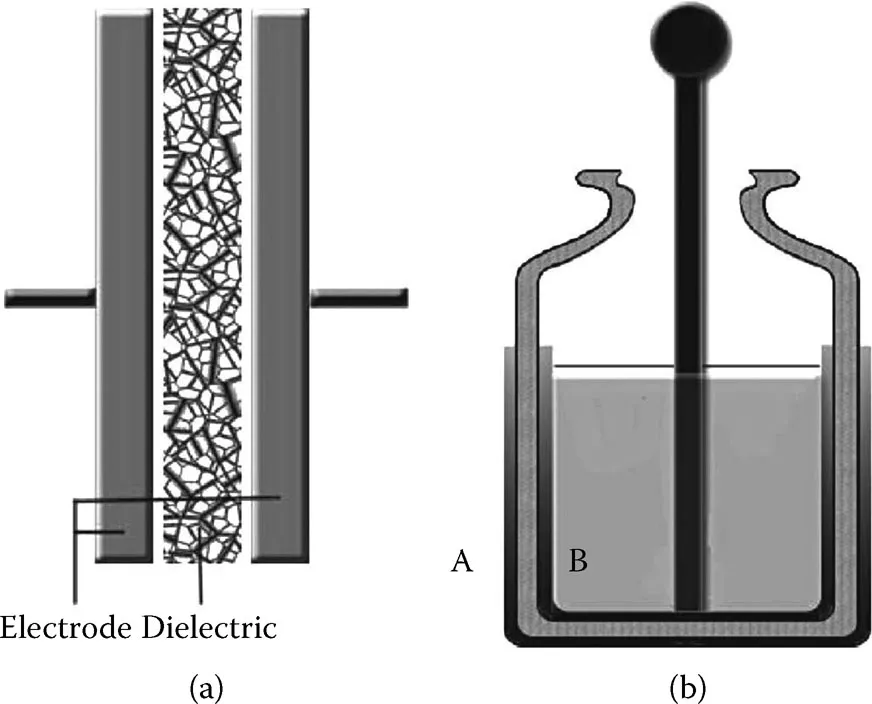
An electric capacitor has a sandwich structure containing two conductive plates (normally made of metal) surrounding a dielectric or insulator as shown in Figure 1.1a. Common dielectrics include air, oiled paper, mica, glass, porcelain, or titanate. An external voltage difference is applied across the two plates, creating a charging process. During charging, the positive charges gradually accumulate on one plate (positive electrode) while the negative charges accumulate on the other plate (negative electrode). When the external voltage difference is removed, both the positive and negative charges remain at their corresponding electrodes. In this way, the capacitor plays a role in separating electrical charges. The voltage difference between the two electrodes is called the cell voltage of the capacitor. If these electrodes are connected using a conductive wire with or without a load, a discharging process occurs—the positive and negative charges will gradually combine through the wire. In this way, the capacitor plays a role for charge storage and delivery. Before we start a deeper discussion about capacitors, explanations of their history and some fundamental concepts may be useful.

1.1.1 History

Thales of Miletus, a philosopher, discovered electric charges when he rubbed amber with a cloth and observed magnetic particle attraction. Since then, the act of rubbing two non-conducting materials together to induce a charge has been treated as a demonstration of the triboelectric effect. In 1745, a better understanding of electrostatics and electrochemistry led to the invention of a condenser, as shown in Figure 1.1b. In the first condenser, two important factors determined charge separation and charge storage: the dielectric thickness and the surface area of the conductive materials. With technological advancements in materials and manufacturing, condensers evolved into modern capacitors that are now used in electrical systems.
Early capacitors were created from a Leyden jar as shown in Figure 1.1b. A capacitor consisted of a glass vessel whose interior and exterior were coated with metal foil. The foils acted as the electrodes and the jar acted as the dielectric. The foil coverings stopped before the jar’s mouth to prevent arc discharge. When capacitors became more prevalent in the twentieth century, their structures were designed to be more practical and economical in storing electrostatic charges as shown in Figure 1.1a. This structural change was very important after both world wars when demands for electronic parts increased. Capacitors were used in complex electronic systems, resulting in greater production and standardization programs to ensure the reliability and quality of the capacitors. Significant effort to meet quality and reliability requirements contributed to the successful improvements of modern electronics. Smaller and lighter capacitors possess greater capabilities and stability in adverse conditions and over wide temperature ranges.
fig_001
FIGURE 1.1
(See color insert.) (a) Simplified schematic of capacitor design. (b) Cross-sectional schematic of Leyden jar (water-filled glass jar containing metal foil electrodes on its inner and outer surfaces, (denoted A and B).
This chapter reviews the fundamentals of capacitors and emphasizes the critical parameters of dielectric materials and the constructi...

Table of contents

  1. Cover
  2. Half Title
  3. Series Title Page
  4. Title Page
  5. Copyright Page
  6. Table of Contents
  7. Series Preface
  8. Preface
  9. Authors
  10. 1 Fundamentals of Electric Capacitors
  11. 2 Fundamentals of Electrochemical Double-Layer Supercapacitors
  12. 3 Fundamentals of Electrochemical Pseudocapacitors
  13. 4 Components and Materials for Electrochemical Supercapacitors
  14. 5 Electrochemical Supercapacitor Design, Fabrication, and Operation
  15. 6 Coupling with Batteries and Fuel Cells
  16. 7 Characterization and Diagnosis Techniques for Electrochemical Supercapacitors
  17. 8 Applications of Electrochemical Supercapacitors
  18. 9 Perspectives and Challenges
  19. Index