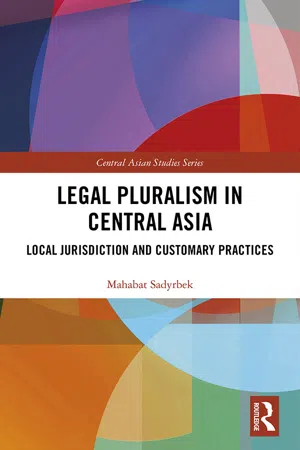
Legal Pluralism in Central Asia reports on historical, anthropological and legal research which examines customary legal practices in Kyrgyzstan and relates them to wider societal developments in Central Asia and further afield. Using the term legal pluralism, the book demonstrates that there is a spectrum of approaches, available avenues, forms of local law and indigenous popular justice in Kyrgyzstan's predominantly rural communities, which can be labelled living law. Based on her extensive original research, Mahabat Sadyrbek shows how contemporary peoples systematically address challenging problems, such as disputes, violence, accidents, crime and other difficulties, and thereby seek justice, redress, punishment, compensation, readjustment of relations or closure. She demonstrates that local law, expressed through ritually structured communicative exchange, through dictums and proverbs with binding characters and different legal practices or processes undertaken in specific ways, deem the solutions appropriate and acceptable. The reader is thereby enabled to see the law in people's deepest assumptions and beliefs, in codes of shame and honour, in local mores and ethics as well as in religious terms. In this way, the book reveals the dynamic, changing and living character of law in a specific context and in a region hitherto insufficiently researched within legal anthropology.
eBook - ePub
Legal Pluralism in Central Asia
Local Jurisdiction and Customary Practices
- 238 pages
- English
- ePUB (mobile friendly)
- Available on iOS & Android
eBook - ePub
About this book
Information
1 Introduction
Research focus and questions
Llewellyn and Hoebel’s (1941) book ‘The Cheyenne Way’ revolutionized the methods of legal anthropology by introducing the analysis of individual cases and by applying the case-law lawyer’s point of view to unsystematic assortment of legal material.1 The book’s preoccupation with cases as a major trend in the field continues to challenge any researcher who sets out to study the ‘law’ and ‘law-ways’ of local communities in a legally pluralistic arena. The question remains: how do members of a local community resolve conflicts and how do they remedy strife situations? It is a matter which all societies have to deal with, in spite of the fact that most local communities are incorporated into nation-states. They usually find not one but many ways to handle grievances, trouble, conflict or disputes (Nader and Todd 1978: 8). They follow not one but numerous notions of justice based on descent, territory, ethnicity and socio-economic conditions, interacting and intersecting with its own mode of argumentation, compromises, and negotiations, as well as standards for the evaluation of behaviour. Many societies employ several procedures and some basic procedural modes. For example, adjudication, arbitration, mediation and negotiation are used worldwide, albeit in different forms. The crucial variables include the presence or absence of a third party; the basis of the third party’s intervention; and the type of outcome or decision followed and implemented by the disputing parties (Benda-Beckmann 2007: 12). The conflict can take place between or within different social fields of society and the choice of the forum depends on the nature of the conflict, existing resources as well as the disputants (Merry 1979, 1982; Moore 1978; Danzig and Lowy 1975). In order to gain first-hand insight into how people in Kyrgyzstan resolve their conflicts, let us consider the following narratives of the representatives of two conflicting parties (Case No. 1):
I was actually innocent, and I did not need any disclaiming statement from the family of this young man, whom I accidentally hit and who died from his heavy injuries. But I caused his death anyway, and it made me afraid of ‘being prosecuted by the victim’s blood’.2 Therefore, I handled this case according to our own Kyrgyz tradition:3 I took my parents and some intimate friends and brought the body to his native village. As Kyrgyz custom requires, I had to bear all the expenses for the funeral.4 My family served there for three to four days. After the burial, I told them that I want to get rid of the decedent’s blood by making amends. The village elders and local imam mediated the negotiation. Through the investigation of my colleagues, I heard that this man started to build a house in one of these new settlements in the capital. Thus, I quickly obliged myself to finish this house for the widow and her two sons. With all my brothers and cousins I completed it within several months, so the family could move in before the onset of winter. Kyrgyz say ‘blood demands blood’ or ‘it brings misfortune if you remain tied to the kun of someone’. As a Kyrgyz, I believe in it.5 Furthermore, I thought of his children and felt indebtedness (ubal) towards their future. Now, after having done my duty, I feel relieved of these ill-feelings.
(Almaz*, 23 September 2011)
The brother of the deceased elucidated the process from his own point of view as follows:
Well, we had to accept his apology. On the one hand, it was perhaps God’s will that the life of my brother ended this way. On the other hand, this man behaved according to our tradition: he fell on his knees in front of us with his entire family and bore all the expenses for the mourning feasts until the fortieth day. Then he offered his service for my brother’s kun.6 Completing the house for the family would be otherwise on my neck and it would be a very difficult task for me alone. We didn’t think of charging him in a state court, because it brings nothing.7 Moreover, I doubt that I would ever be able to afford it. [Because] you should travel to the city and the process usually takes a long time, requires enormous fees and a lot of documents … all this is expensive. Moreover, this guy worked in an organ [governmental institution], that means you cannot win the case.
(Mayrambek, 11 September 2011)
This case provides us first with an idea of a situation of legal pluralism in Kyrgyzstan in which several thriving legal systems and laws operate – that of the state, of local tradition and custom, and of Islam. The long accounts further unravel some of the ways in which people seek to resolve troublesome issues. It is a dispute between people who were accidentally drawn into difficulties. They are strangers to one another but share the same basic outlook and values, and recognize that they live in the same society, and this is not physical, but moral, emotional and economical. On this basis, people have developed procedures that can be called into operation when trouble arises: calling on the aggrieved, bearing expenses according to local ‘tradition’, asking for forgiveness and taking responsibility for causing harm (see Part II). There is an intervention by a third party composed of local elders and religious dignitaries. There is also an awareness of the existence of an official justice system, which is described by the brother of the deceased as arbitrary, expensive, time-consuming and corrupt. The encounter between the two parties shows their relative social positions and real economic facts of life, which play an important role not only in the process of negotiation but also determine its denouement. A complex of fragments of conversations and interlocking scenarios reveal societal constraints and expectations that frame the process. Moreover, the involvement of the family and relatives of both disputing parties highlights the specific features of social organization and the shared common sense of both sides during the trouble (see Chapter 3).
What I learned from this trouble-case went far beyond the province of a general understanding of law and justice. The most important thing was the warning for me not to set out to present a corpus juris of strictly defined and specific rules of law in a way that would adequately reflect the indigenous norms actually governing the resolution of disputes. I rather aim to provide a coherent arrangement of broad concepts, guiding principles and multiple, overlapping, sometimes contradictory and uncodifiable sources of law, the practical application of which (amply illustrated by case material) varies with virtually every case. I see my first task in this anthropological study to provide an adequate, exploratory and ethnographic elaboration of law and legal practices in Kyrgyzstan. My main guiding questions include: what do persons in Kyrgyzstan do when they have grievances? In what ways do they seek redress within the confines of their societal rules, and which practical mechanisms, strategies and procedures do they prefer and apply to certain situations of conflict? Which kinds of laws, law ways and social relations, and which concepts and institutions do they draw upon in a particular social setting? What are the actors, authorities and social agencies with law and decision making capacities? How do individuals and communities generate order and maintain social equilibrium, serve or make justice, or more precisely, how do they ensure its actualization and attainment?
In attempting to answer these questions, I have chosen a concrete field of legal pluralism for observation and analysis. Most cases deal with severe accidents causing very serious human and material loss, which includes the potential risk of heavy conflicts and bloody clashes. In this context, I observe at close range the battle of conflicting claims – especially centred on the disputing, negotiating and working out of compromise – to identify some of the central concepts, and to reveal the dynamic interactions between actors and agents, all of whom are motivated by their individual agendas, interests and beliefs. Of particular import to my research is probing the uncharted areas between societal restraint and individual motivation, between respect for and adherence to community values and ideals, and the tendency of individuals to bend rules and norms to their own ends, to engage with instances suitable for their purposes. The book delivers an exhaustive description of ‘living law’ in terms of which people conduct themselves and in terms of which trouble-cases and disputes are settled within a socio-structural and economic context.
Remarks on research state
Central Asia as a region and as a field of study is not a tabula rasa in legal anthropology, but it has been insufficiently explored and scantily linked to the cross-cultural studies of law. Having been under Russian spheres of influence, the region was largely inaccessible to Euro-American legal anthropologists and field scholars in previous decades. Tsarist Russian and Soviet ethnography has described and analysed legal norms and the social structure of communities in the region within the larger colonial and administrative project. This still constitutes the bulk of the historiographic sources to which I shall return in greater detail in Chapter 2. After the political opening of the region, a great number of research projects, studies and ethnographies in a range of disciplines were undertaken. In the legal anthropology field, the main focus has been on the history of law during the period of Russian colonialism in Central Asia in the nineteenth and early twentieth centuries. Significant publications are modelled by Ildikó Bellér-Hann (2005, 2008), Sergey Abashin (2005), Olga Brusina (2000, 2005, 2006), Paolo Sartori (2010, 2011, 2012, 2014), Paul Georg Geiss (2001, 2003, 2007), Virginia Martin (2001, 2004) and Botakoz Kassymbekova (2016). These engage contemporary academic debates on legal pluralism, colonialism, imperial and global history, and provide valuable insights into bureaucratic and judicial practices under Tsarist rule. Based on archival research, these studies show how the tools of violence and coercion were employed by Soviet officials and alike to implement Soviet versions of modernization and industrialization. However, questions pertaining to how colonial subjects interacted with Russian authorities and local officials, as well as how local norms and concepts are maintained during the Soviet period, are dealt with only to a limited extent in these publications.
Most Western-language works explore normative pluralism in relevant countries of the region from the perspectives of the state, democracy and rule of law or within the context of human rights violations and informal governance structures. They are generally concerned less with traditional law than with acculturation and development, and not-state forms of justice (e.g. Kachkeev 2007, 2012; Geiss 2007; Cummings 2013; Knieper 2006; Baiturova 2006). Mechanisms of social control and the ways in which these are related to honour, shame and tradition have been discussed much more within the well-researched area of bride kidnapping in Kyrgyzstan and Kazakhstan (Werner 1997, 2009; Kleinbach and Babaiarova 201); Kleinbach and Salimjanova 2007; Kleinbach et al. 2005). Another well-represented topic is that of the court of elders (Beyer 2006, 2007, 2010a; Merrell 2010, 2011, 2013). Studies on current legal practices, dispute management techniques, and traditional approaches to conflict resolution, and the role of violence in the structures and methods of maintaining order are under-represented and rare. Giovarelli and Akmatova’s (2002) study is probably the most cited with regards to customary practices in Kyrgyzstan; however, due to its limited volume, many issues are touched upon superficially. Worth mentioning are the publications of the Aigine Cultural Research Centre on Traditional Conflictology (Sadɪr uulu 2013; Samakov 2013) as an instruction with folkloristic and historical references. Anthropological studies modelled on ethnographic descriptions of Judith Beyer (2010a) and David Merrell (2013) provide the most extensive knowledge about legal pluralism in Kyrgyzstan. Based on original fieldwork, Merrell’s dissertation deals with the normative order of the Uyghur minority on a national, community and individual level. Merrell considers, how this order is created and maintained through ‘Ittipak’ society and by respected male elders; and how a Muslim woman in Toshtemir city (pseudonym) in northern Kyrgyzstan exerts normative authority by mediating bride kidnapping cases. Except for a few overlaps pertaining to issues of authority, the role of elders and the state, my research follows different paths. I rather draw upon the work of Judith Beyer, who conceptualizes salt (custom) as customary law based on her observations and interactions with the inhabitants of two villages in the province of Talas in Northern Kyrgyzstan. She describes how elders perform authority, how the hierarchical relations between old and young are transmitted and acted out, how particular divorce cases are dealt with, how mourning rituals take place and how certain exchange practices are followed – all according to salt. She comes closest to an emic conception of one of many legal repertoires in Kyrgyz society which has standardized and cognitive elements, and which helps people achieve a sense of normativity, continuity and orderliness in their lives and their relations to one another. However, her observations and findings – within the definition of my methodical investigation – are limited to trouble-less cases (Holleman 1973: 593), easily accessible fields of law and normal practices (which usually constitute the common frame of reference by which trouble-cases are judged). In contrast to Beyer, I offer an assortment of concrete and properly recorded trouble-cases which are rich in their individual content and reveal various legal repertoires, procedural modes, dispute techniques, principles, regularities and concepts of conflict resolution. Certainly, some intersections with her findings, especially with regards to the role of elders and their function in community life, people’s reciprocal obligations, customary practices during burials etc., cannot be absolutely avoided since we deal with the same society. In order not to repeat her analysis, on the one hand, and keeping in mind the limitations of this work on the other, trouble-less cases and minor disputes like the allocation and transfer of land within the family, marriage/divorce, or management of inheritance, are used only as references. Occupying the privileged position of a native researcher, I hope, for my part, to sufficiently convey the concepts and to illuminate the structures of legal reasoning and legal thinking of local people embodied in vernacular language and embedded in the matrix of socio-economic relationships.
Book’s structure
This book is divided into three parts. Part I is the more theoretical portion in which research design, historical background and social organization are elaborated. Part II consists of a number of case studies that contain differen...
Table of contents
- Cover
- Half Title
- Title Page
- Copyright page
- Table of Contents
- List of figures
- Preface
- Acknowledgements
- Notes on the text
- PART I
- PART II
- PART III
- Conclusion
- Index of cases
- Glossary
- Bibliography
- Index
Trusted by 375,005 students
Access to over 1.5 million titles for a fair monthly price.
Study more efficiently using our study tools.
Frequently asked questions
Yes, you can cancel anytime from the Subscription tab in your account settings on the Perlego website. Your subscription will stay active until the end of your current billing period. Learn how to cancel your subscription
No, books cannot be downloaded as external files, such as PDFs, for use outside of Perlego. However, you can download books within the Perlego app for offline reading on mobile or tablet. Learn how to download books offline
Perlego offers two plans: Essential and Complete
- Essential is ideal for learners and professionals who enjoy exploring a wide range of subjects. Access the Essential Library with 800,000+ trusted titles and best-sellers across business, personal growth, and the humanities. Includes unlimited reading time and Standard Read Aloud voice.
- Complete: Perfect for advanced learners and researchers needing full, unrestricted access. Unlock 1.5M+ books across hundreds of subjects, including academic and specialized titles. The Complete Plan also includes advanced features like Premium Read Aloud and Research Assistant.
We are an online textbook subscription service, where you can get access to an entire online library for less than the price of a single book per month. With over 1.5 million books across 990+ topics, we’ve got you covered! Learn about our mission
Look out for the read-aloud symbol on your next book to see if you can listen to it. The read-aloud tool reads text aloud for you, highlighting the text as it is being read. You can pause it, speed it up and slow it down. Learn more about Read Aloud
Yes! You can use the Perlego app on both iOS and Android devices to read anytime, anywhere — even offline. Perfect for commutes or when you’re on the go.
Please note we cannot support devices running on iOS 13 and Android 7 or earlier. Learn more about using the app
Please note we cannot support devices running on iOS 13 and Android 7 or earlier. Learn more about using the app
Yes, you can access Legal Pluralism in Central Asia by Mahabat Sadyrbek in PDF and/or ePUB format, as well as other popular books in Social Sciences & Regional Studies. We have over 1.5 million books available in our catalogue for you to explore.