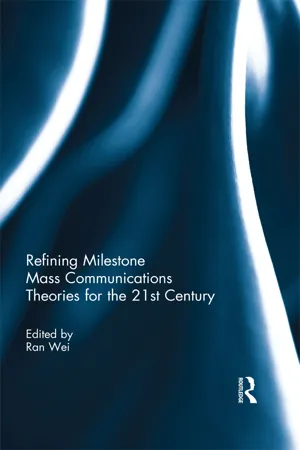
The 'Milestones' essays in Mass Communication and Society are reflective and analytical articles by the most notable scholars in the field. These classic essays address 21st century issues from the pioneers of media and communication studies, including Elihu Katz on new media and social movements, George Gerbner on cultivation analysis, and Dietram Scheufele on political communication. As technologies evolve and mass communication becomes mobilized and democratized - more individual and also more social - these landmark scholars provide ideas about how established theories may be applied in new ways, and how future research can expand our understanding of mass communication as its reach and effects grow ever larger. This book will be essential reading for both students and researchers of Mass Communications Research.
- 200 pages
- English
- ePUB (mobile friendly)
- Available on iOS & Android
eBook - ePub
Refining Milestone Mass Communications Theories for the 21st Century
About this book
Information
Introduction: Milestones Studies Define the Field
School of Journalism & Mass Communications University of South Carolina
“To give faculty and students easy access to the latest ideas and thoughts of the top scholars in our field,” wrote David Demers (1998, p.3), editor of Mass Communication and Society from 1998 to 2000, who introduced the Scholarly Milestones Essay in 1998. Highlighting established scholars writing about the current state of research in the field, the journal published two essays that year, from Melvin DeFleur (1998) and George Gerbner (1998), two prominent scholars and theorists.
According to my count, the feature has resulted in eight Milestones essays, including contributions from Ellen Wartella (1999), Sandra Ball-Rokeach (2001), and the late Steve Chaffee (2000), among others. These stand-alone essays crafted by the leading scholars in the field are thought-provoking; they served as a source of inspiration for young scholars as well as a valuable resource in graduate seminars across the country. The citations and downloads confirm those achievements.
Any discipline, whether it is hard sciences, economics, management, psychology, sociology or another area in social sciences, is built on the bedrock of fundamental theories and classic studies, i.e., “milestone” studies. One example from physics would be Galileo’s experiment with falling objects at the Leaning Tower of Pisa. Landmark researchers who are associated with a theory, a model, or a study have lasting influence because their work explains an important aspect of the field and provides a foundation on which other researchers can build (Lowery & DeFleur, 1995). Sigmund Freud comes to mind for psychology; Max Weber and Robert E. Park are good examples in sociology. The Milestones essays stopped appearing in Mass Communication and Society during the early 2000s, but I resurrected the feature in 2014 when I became the journal’s fifth editor.
Milestones are markers of the field; they offer a historic referent point, and I believe the feature “Scholarly Milestones Essay” is now a legacy of the journal. These essays define our field in terms of research focus, topical streams, and theoretical lenses to make sense of the communication phenomena in society. Even at a time when some forms of mass media are in decline, Milestone studies will continue to influence research for generations. My aspirational goal as editor of Mass Communication and Society is to publish work from inspiring authors and top scholars in the field to help other scholars draw on that work. I want the journal to serve as a forum for us to discuss the state of research and explore emerging trends to advance cutting-edge theory and further empirical research.
Some scholars have wondered whether 20th century mass communication theories can be applied in the emerging age of new communication technologies, global reach, and cultural revolutions in the digital 21st century. Teasing out the common issues and mastering the long-lasting theoretical constructs, which can apply to today’s new realities and guide our current research, are a challenge for communication scholars. In responding to these challenges, this book presents a compilation of essays that show how the foundational theories remain relevant and vital to understanding the implications of digital media and social networking sites. Milestones essays have encompassed agenda-setting, framing, cultivation and uses and gratifications theories, among many others, and this book contains the seminal works from which researchers continue to build new extensions for the 21st century.
More recent contributions to the Milestones essays include the 2014 work by Elihu Katz, co-author with Paul Lazarsfeld of the 1955 classic on two-step flow theory, Personal Influence: The Part Played by People in the Flow of Mass Communications. In his “second retirement” from academic life, this Distinguished Trustee Professor of Communication continues to contribute to mass communications research and inspires scholars around the world. Katz’s Milestones essay reflects on the effects of political communication, extending his research into the age of evolving new media and how this is enhancing deliberative democracy. Katz’s essay is one example of how the classic theories of the 20th century remain as foundations for the digital age in the 21st century. “New” media always coincide with social change: print, radio, television, Internet, smartphones, streaming, and mobile technology. In the case of the fascinating and sometimes confusing effects of social media, the Katz essay provides a timely perspective to make sense of the evolution of new media in fostering and enhancing deliberative democracy. Both the long-range view essay and empirical studies of ongoing political events, I believe, contribute to the theorization of media effects in the digital age.
Melvin DeFleur’s 1998 essay, “Where Have All the Milestones Gone? The Decline of Significant Research on the Process and Effects of Mass Communication” reminded us that mass communication research has been known to draw the best researchers and scholars into high-paying professions and away from the academy. We now know that with the transformation of traditional print media and the emergence of mobile media, academia is once again afforded new golden opportunities for teaching and research, which we haven’t seen in decades. Steven Chaffee and Miriam Metzger (2001) touched on “The End of Mass Communication?” in their 2001 essay, which I include in this volume with another essay published in 2014 titled “Reevaluating ‘The End of Mass Communication?”’ by Gabriel Weimann, Nirit Weiss-Blatt, Germaw Mengistu, Maya Mazor Tregerman, and Ravid Oren (2014). The newer essay describes the development of several communications theories in the age of new media, such as agenda setting, audience effects, and the digital divide. The authors concluded that “old communication theories never die; they just readjust” (p. 174).
Other essays in this compilation comprise three general areas. The first is the overview or elaboration of a particular theory, such as George Gerbner’s 1998 essay, “Cultivation Analysis: An Overview.” This Milestones essay discusses how television viewing and cultural indicators will continue into the 21st century, and we have seen these effects evolve from Internet streaming, binge viewing, and on-demand television.
Thomas Ruggiero’s synthesizing 2000 contribution, “Uses and Gratifications Theory in the 21st Century,” is a foundational work that has been cited 289 times just since our journal went digital in 2009. Dietram Scheufele’s 2000 essay on “Agenda-Setting, Priming, and Framing Revisited: Another Look at Cognitive Effects of Political Communication” created a new analytical model for these media effects theories, and has been cited 140 times in a short period of six years. Both Ruggiero and Scheufele provide insights into how research from the past confirms the application of such theories for future innovations. Essays such as these provide a head start for present-day researchers who focus on the effects of social and interactive media, as well as smartphones that provide instant access to television viewing and social networks for civic engagement and political mobilization.
The second area of this collection includes Milestones essays that define a particular research stream, such as Sandra Ball-Rokeach’s 2001 contribution, “The Politics of Studying Media Violence: Reflections 30 Years After The Violence Commission.” Ball-Rokeach addresses here the political forces that might intrude on new media research, as they did with her own work. She points out that violence in media still has an influence on audiences, and we have seen in the intervening years that media violence has only grown in availability of content and new platforms. Ellen Wartella’s 1999 essay “Children and Media: On Growth and Gaps,” reminds us how little research is performed on media programming for young people and she presents a useful developmental research model to aid in such research. In the age of infants’ smartphone use and learning to read on tablets, this work provides a much needed foundation for addressing the gap between research, content production, and policy.
This book also contains reflections and critiques of the field, its research paradigms and its roots, such as Steven Chaffee’s “George Gallup and Ralph Nafziger: Pioneers of Audience Research,” about the non-academic creators of research methods who showed us that opinions in numbers were “facts that carried their own messages” (p. 99). Hanno Hardt’s 1999 essay, “Shifting Paradigms: Decentering the Discourse of Mass Communication Research,” addresses the alternative discourses that challenge dominant ideology and media systems, returning communication to a participatory—even emancipatory—practice that embraces culture as well as the public. Furthering this line of argument, Elihu Katz’s 2014 essay, “Back to the Street: When Media and Opinion Leave Home” addresses how 20th century mass media—newspapers, radio, and television—drove people inside their homes to consume them, while 21st century social media has served to mobilize audiences and to bring them “outside” again.
In the era of digital media, the field of mass communication faces a greater threat of further fragmentation (Weaver, 1988, 2000) due to emerging specialized subfields such as internet studies, political entertainment, and mobile communication, to name a few. I believe such a trend heightens the need for Milestone essays in mass communication research, which help us tease out common issues and focus on new insights based on the enduring theoretical constructs. Jeffres and his colleagues (2008) observed that in previous decades, mass communication scholars were “more adventuresome in advancing ‘new’ theories and less hesitant to ‘create’ theory.” They noted that the 1970s in particular “bore witness to the emergence of several such theories—from the knowledge gap and agenda-setting to cultivation.” The continued and fast-paced growth in the media industry provides us now with more, not less, opportunity to revive the “adventuresome” spirit in developing general media and social theories.
Milestones are not just markers of progress; they also point out new directions for travelers with a long journey ahead. The relatively young field of communication research has a long way to go to become a respectable discipline in social sciences. The Milestones essays included in this book enhance and extend valued theories that continue to prove their relevance and validity with ever-evolving digital and mobile media access. These essays represent expansive contributions to the field, and define topical areas for innovative systematic research in mass communications, whether in new media agendas, production, multi-screen media effects, cultural or social identity. These are the classics that not only stand the test of time, but continue to serve as foundations for research, technology, and civic engagements yet to come. It is my goal that readers will learn and be inspired to help us reach new milestones, which we will then publish in future issues of Mass Communication and Society.
Last, but not the least, I would thank Ms. Emily Ross, Editor, Routledge Special Issues as Books, who has been supportive of this edited volume. She acted promptly on the proposal and provided professional guidance on preparing the manuscripts. My editorial assistant at the University of South Carolina, Ms. Jane O’Boyle, has worked tirelessly with me on this book project from conception to production. The wisdom and experience in book publishing she brought to this book are exhibited in the pages of this volume. My thanks go to both.
References
Ball-Rokeach, S. J. (2001). The politics of studying media violence: Reflections 30 years after the violence commission. Mass Communication and Society, 4(1), 3–18.
Chaffee, S. H. (2000). George Gallup and Ralph Nafziger: Pioneers of audience research. Mass Communication and Society, 3(2–3), 317–327.
Chaffee, S. H., & Metzger, M. J. (2001) The end of mass communication? Mass Communication and Society, 4(4), 365–379.
DeFleur, M. L. (1998). Where have all the milestones gone? The decline of significant research on the process and effects of mass communication. Mass Communication and Society, 1(1–2), 85–98.
Demers, D. (1998). Inaugural essay. Mass Communication and Society, 1(1–2), 1–4.
Ewan, S. (2000). Memoirs of a commodity fetishist. Mass Communication and Society, 3(4), 439–452.
Gerbner, G. (1998). Cultivation analysis: An overview. Mass Communication and Society, 1(3–4), 175–194.
Hardt, H. (1999). Shifting paradigms: Decentering the discourse of mass communication research. Mass Communication and Society, 2(3–4), 175–183.
Jeffres, L., Neuendorf, K., & Bracken, C. C. (2008). Integrating theoretical traditions in media effects: Using third-person effects to link agenda-setting and cultivation. Mass Communication and Society, 11, 470–491.
Katz, E. (2014). Back to the street: When media and opinion leave home. Mass Communication and Society, 4(1), 1–8.
Lowery, S. A., & DeFleur, M. L. (1995). Milestones in mass communication research: Media effects. (3rd edition). White Plains, NY: Longman.
Wartella, E. (1999). Children and media: On growth and gaps. Mass Communication and Society, 2(1–2), 81–88.
Weaver, D. H. (1988). Mass communication research: Problems and promises. In Nancy W. Sharp (Ed.), Communications Research (pp. 21–38). Syracuse, NY: Syracuse University Press.
Weaver, D. H. (2000). Mass communication research at the end of the 20th century: Looking back and ahead. Paper presented to the International Conference of School of Journalism and Communication, Chinese University of Hong Kong, Hong Kong.
Weimann, G., Weiss-Blatt, N., Mengisto, G., Tregerman, M. M., & Oren, R. (2104). Reevaluating ‘The end of mass communication?’ Mass Communication and Society, 17(6), 803–829.
Back to the Street: When Media and Opinion Leave Home
The Annenberg School for Communication University of Pennsylvania
To achieve “deliberative democracy,” Gabriel Tarde’s formula not only demands the press hold a nation together, but also offers an agenda of issues that serves as a kind of menu for discussions in cafés and salons, which leads, in turn, to more considered opinions, and thus provides the consensual valuations that inform political, economic and aesthetic actions. The elements of the formula consist of press, conversation, opinion, and action. I argue that the long-run effect of the mainstream media—the newspaper, but even more the radio and television—moved politics off the street and into the home, hence the concern over “the narcotizing dysfunction” of the news media. In the era of the Internet, I argue that media—old or new, mass or social—are far from being the whole of the story. It is some combination of these media, plus word of mouth, plus some rather well-known elements of social-movement theory, plus the social psychology of collective behavior that help to explain. But let us not lose sight of the different functions served by the different media. If the mass media—newspapers, radio, and television—may be said to have moved people “inside,” the social media...
Table of contents
- Cover
- Title
- Copyright
- Contents
- Citation Information
- Notes on Contributors
- 1. Introduction: Milestone Studies Define the Field
- Part I: Classic Theories for the 21st Century
- Part II: Enduring Research Streams
- Part III: Reflections and Future Directions
- Index
Trusted by 375,005 students
Access to over 1.5 million titles for a fair monthly price.
Study more efficiently using our study tools.
Frequently asked questions
Yes, you can cancel anytime from the Subscription tab in your account settings on the Perlego website. Your subscription will stay active until the end of your current billing period. Learn how to cancel your subscription
No, books cannot be downloaded as external files, such as PDFs, for use outside of Perlego. However, you can download books within the Perlego app for offline reading on mobile or tablet. Learn how to download books offline
Perlego offers two plans: Essential and Complete
- Essential is ideal for learners and professionals who enjoy exploring a wide range of subjects. Access the Essential Library with 800,000+ trusted titles and best-sellers across business, personal growth, and the humanities. Includes unlimited reading time and Standard Read Aloud voice.
- Complete: Perfect for advanced learners and researchers needing full, unrestricted access. Unlock 1.5M+ books across hundreds of subjects, including academic and specialized titles. The Complete Plan also includes advanced features like Premium Read Aloud and Research Assistant.
We are an online textbook subscription service, where you can get access to an entire online library for less than the price of a single book per month. With over 1.5 million books across 990+ topics, we’ve got you covered! Learn about our mission
Look out for the read-aloud symbol on your next book to see if you can listen to it. The read-aloud tool reads text aloud for you, highlighting the text as it is being read. You can pause it, speed it up and slow it down. Learn more about Read Aloud
Yes! You can use the Perlego app on both iOS and Android devices to read anytime, anywhere — even offline. Perfect for commutes or when you’re on the go.
Please note we cannot support devices running on iOS 13 and Android 7 or earlier. Learn more about using the app
Please note we cannot support devices running on iOS 13 and Android 7 or earlier. Learn more about using the app
Yes, you can access Refining Milestone Mass Communications Theories for the 21st Century by Ran Wei in PDF and/or ePUB format, as well as other popular books in Languages & Linguistics & Linguistics. We have over 1.5 million books available in our catalogue for you to explore.