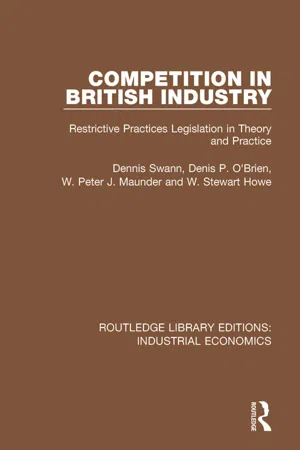
This book, first published in 1974, presents the findings of a research project and considers their implications for public policy. The project was designed to find out what effect the 1956 Restrictive Trade Practices Act (and the subsequent legislation of 1968) had on British industry. The Act was a decision in favour of competition against a background of well-entrenched and widespread restrictive agreements, and this book examines in depth its impact in eighteen selected industries.
eBook - ePub
Competition in British Industry
Restrictive Practices Legislation in Theory and Practice
- 228 pages
- English
- ePUB (mobile friendly)
- Available on iOS & Android
eBook - ePub
Competition in British Industry
Restrictive Practices Legislation in Theory and Practice
Chapter 1
COMBINATION AND THE STATE
The day of the fixed price has come, and such a development must be considered as a real condition of social and economic progress.
British Electrical and Allied Manufacturers’ Association, 1930.
I. EARLY COMBINATION
Although in the nineteenth century the dominant economic philosophy was one of free competition this does not mean that restrictive agreements and arrangements of various kinds were not to be found. As Clapham observed,
There had been in various industries a good deal of quiet price fixing without formal association all through the nineteenth century. ‘Free and open competition’ had never been perfectly attained, or even universally and sincerely desired.1
Ashworth maintains that despite the stress on the virtues of unrestricted competition, associations of producers in the same industry or district were common in the 1840s. They may, however, have become less common the next quarter of a century.2 This view concurs with that of Clapham who observed,
The prosperity and the economic outlook of the third quarter of the century had reduced the occasions for such co-operation; and there is some reason to think that there was less of it in the middle ’seventies than there had been before 1850.3
Several studies have thrown light on the existence of combinations in the first half of the nineteenth century. The coal owners of the Tyne and Wear had ‘limited the vend’ but were eventually thwarted by the competition of rail-borne coal. Barker and Harris in their study of St Helens throw light on price-fixing associations, local in character, in salt and coal production during the first three decades of the century.4 Flint glass producers too had their local associations and as early as 1812 representations were made to the government on matters relating to the excise duty. As Barker and Harris observe,
Although the minutes are chiefly concerned with the excise talks, the question of price regulation cropped up with regularity.5
For example, in 1831 the flint glass trade held a meeting at Lichfield and the various deputations agreed on a net minimum price list. Later the Warrington district producers agreed to adhere to it.6 Bottle glass producers too are recorded in 1845 as fixing the price of their product.7 Window glass was a fertile field for restrictive activity. Barker in his study of Pilkingtons traces understandings back to the seventeenth century. He points out that
There were relatively few units of production and it was, therefore, easy for the handful of manufacturers to join together to prevent cut-throat competition by fixing the selling prices of their goods. They could also, if they so wished, unite to prevent any interloper from breaking into their circle.8
The St Helens Crown Glass Company was indeed a member of the Crown Glass Association and there is evidence to suggest that the latter came into existence about 1825. Direct price-fixing in respect of sales to merchants and dealers was followed in 1838 by output restriction by means of quotas. Those who sold below Association levels were in turn undersold by the Association and driven out of business. Barker and Harris also show that alkali and soda producers were getting together at least as early as 1838-the Alkali Association itself dating from 1860.9
Soap makers too exhibited an early taste for consensus as opposed to the ruthless individualism we have been led to expect. There was a London and Country Association of Soap Manufacturers in the late 1830s although local associations had existed previously. In the 1850s there is clear evidence concerning the activities of a North of England Soap Association-this was purely concerned with price-fixing in a period when war was interfering with tallow supplies from Russia and causing the raw material price to rise. In 1867 the United Kingdom Soap Makers’ Association came into being and it continued in one form or another for upwards of sixty years. The Association was, however, dominated by London producers-the northern producers therefore also participated in their own Northern Soap Makers’ Association. In respect of prices an extremely uneasy alliance existed between the two. However, Musson’s verdict is that, despite the constant accusations and counter-accusations of treachery, double-dealing, fraud and evasion of agreed rules, the national Association did reduce, even though it could not abolish, cut-throat competition, and agreed changes in price were sometimes achieved.10
II. THE COMBINATION MOVEMENT 1880–1914
Although the third quarter of the century may have witnessed a diminution of restrictive activity, the last two decades of the century were quite different. The growth of combination in the shape of formal trade associations and informal agreements as well as mergers (the latter were then termed trusts) were cardinal features of the period. By the middle of the 1880s, according to Clapham,
A network of trade associations, more or less formal, more or less efficient, covered a good part of the industrial field.11
Associations were indeed sufficiently numerous in the 1880s for Joseph Chamberlain as president of the Board of Trade to instruct his officials to open direct personal contacts with them and chambers of commerce on all important matters of policy and day to day administration.12 The movement towards combination continued in the earlier years of the present century and gained a real impetus during the First World War. As a result, when in 1919 the Committee on Trusts reported it observed,
We find that there is at the present time in every important branch of industry in the United Kingdom, an increasing tendency to the formation of trade associations and combinations, having for their purpose the restriction of competition and the control of prices.
Many of the organisations which have been brought to our notice have been created in the last few years and by far the greater part of them appear to have come into existence since the end of the nineteenth century…. There has been a great increase in the creation of trade associations during the period of the war.13
Professor John Hilton, in a memorandum to the Committee, estimated that there were at least 500 industrial trade associations in existence.
During the period 1880–1914 a wide range of industries were cartelised. Prominent among these was iron and steel. Pig iron producers in various regions of Britain were organised into local associations. According to Macrosty,
The ironmasters or their representatives also meet regularly in the daily or weekly pig iron markets, held at the local Metal Exchanges, and at the quarterly trade meetings at Birmingham, where they have opportunities of discussing the condition of the trade and exchanging views. In this way they informally thresh out a common price, for in a restricted market each man’s business is easily known. When any attempt is made to regulate production it is usually done through the local pig iron trade associations, and not by the formation of any special kartell; this flexibility of constitution is particularly English.14
Such arrangements are reported by Macrosty as existing as early as 1881. Malleable iron was also organised. There was an informal ring producing marked bar iron and in 1895 an Unmarked Bar Association was formed. The latter was an arrangement between Midlands and Northern Counties producers15 but in addition combinations among Scottish malleable iron producers also date at least from the 1880s. The rail trade was highly organised-in 1883 British producers joined German and Belgian firms in forming the International Rail Syndicate. The decade 1878–1887 marked the transition from the use of iron to that of steel in ship construction and as early as 1885 there are reports of a combination of Scottish producers of boiler plate and ship plate. Production of this product in Scotland was indeed organised on a rigorous basis. By the end of the century the Scots had separate boiler plate and ship plate associations whilst in 1898 a Boiler Plate Association was also organised in Lancashire and the North East had its own Plate Association. Tube production was also cartelised. In 1898 English boiler-tube producers attempted to form an association. By 1901 there were both Scottish and English associations working in alliance. Relations were soon severed but in 1902 a truly British effort to advance prices was successfully manifested. Galvanised sheet was also organised. As early as 1883 a Galvanised Iron Trade Association-a largely Midlands organisation-was fixing prices. In 1905 a step forwards was taken when a national association was formed-the National Galvanised Sheet Association-to which 95 per cent of producers in the Midlands, Lancashire, London, the North-East, Scotland and Wales were parties. By the turn of the century a wide variety of metal trades-particularly in the Midlands-were regulating prices. There were associations concerned with axles, tinned sheet, hoops, gas strip, galvanised holloware, galvanised wire netting, as well as brass founding and nail making.16 These were merely the tip of the iceberg. There was also considerable activity in the iron founding trade. The Monopolies Commission report on cast iron rainwater goods for example indicates that in 1911 foundries in various parts of the kingdom came together to form the National Light Castings’ Association – the forerunner of the British Iron Founders’ Association. The Commission, however, observed that there had been in existence for many years previously local and sectional associations but none of them was effective for the purpose of trade regulation.17 This tendency towards the formation of national in place of local organisations has already been noted in the case of galvanised sheet.
Trade association price-fixing-in the language of the times ‘terminable agreements’-were also evident in the textile industry to a limited degree but generally where they existed they were predecessors of permanent amalgamations. For example, the amalgamations in 1895 and 1896 which established a dominant position for J. & P. Coats were preceded by a sales association-the Central Thread Agency. Likewise the amalgamation of 1897 which led to the English Sewing Cotton Company grew out of the Association of English Sewing Cotton Makers founded in 1888. Again the Bleachers’ Association-an amalgamation dating from 1900-was an outgrowth of trade association activity. The amalgamation prospectus observed,
For a great number of years past, there have existed in the Manchester bleaching trade voluntary associations for the regulation of prices in different branches of the business, and for other purposes, and these have worked in harmony with the merchants as well as to the advantage of the trade; but it has been realised that the full advantages of co-operation can be secured only by amalgamation, for the success of which the existence and organisation of these associations give exceptional facilities. The present amalgamation has secured the adhesion of many firms who were not previously members of any price association.18
The year 1899 also witnessed an amalgamation which created the Yorkshire Woolcombers’ Association. The latter, however, had been preceded by an association of firms in the Bradford district, formed in or about 1893, for the purpose of preventing price cutting. In 1894 the Yorkshire dyeing trade entered into an alliance for regulating prices-this in turn was followed by two amalgamations-one in 1899 which created the Bradford Dyers’ Association and another in 1900 which led to the formation of the British Cotton and Wool Dyers’ Association. In the light of the above, it is perhaps worth noting that the remark made to the Select Committee on Labour in 1890 to the effect that in the woollen trade of the West Riding there was ‘not a single particle’ of organisation amongst employers was wearing thin by 1900, although it is true that spinning and weaving, as opposed to combing and dyeing, were notably absent from the list of ‘organised...
Table of contents
- Cover
- Half Title
- Title Page
- Copyright Page
- Table of Contents
- Acknowledgements
- Introduction
- 1 Combination and the State
- 2 Legal Background
- 3 The Theory of Competition Policy
- 4 The Impact of the Legislation
- 5 The Fair Trading Legislation, 1973
- Index
Trusted by 375,005 students
Access to over 1.5 million titles for a fair monthly price.
Study more efficiently using our study tools.
Frequently asked questions
Yes, you can cancel anytime from the Subscription tab in your account settings on the Perlego website. Your subscription will stay active until the end of your current billing period. Learn how to cancel your subscription
No, books cannot be downloaded as external files, such as PDFs, for use outside of Perlego. However, you can download books within the Perlego app for offline reading on mobile or tablet. Learn how to download books offline
Perlego offers two plans: Essential and Complete
- Essential is ideal for learners and professionals who enjoy exploring a wide range of subjects. Access the Essential Library with 800,000+ trusted titles and best-sellers across business, personal growth, and the humanities. Includes unlimited reading time and Standard Read Aloud voice.
- Complete: Perfect for advanced learners and researchers needing full, unrestricted access. Unlock 1.5M+ books across hundreds of subjects, including academic and specialized titles. The Complete Plan also includes advanced features like Premium Read Aloud and Research Assistant.
We are an online textbook subscription service, where you can get access to an entire online library for less than the price of a single book per month. With over 1.5 million books across 990+ topics, we’ve got you covered! Learn about our mission
Look out for the read-aloud symbol on your next book to see if you can listen to it. The read-aloud tool reads text aloud for you, highlighting the text as it is being read. You can pause it, speed it up and slow it down. Learn more about Read Aloud
Yes! You can use the Perlego app on both iOS and Android devices to read anytime, anywhere — even offline. Perfect for commutes or when you’re on the go.
Please note we cannot support devices running on iOS 13 and Android 7 or earlier. Learn more about using the app
Please note we cannot support devices running on iOS 13 and Android 7 or earlier. Learn more about using the app
Yes, you can access Competition in British Industry by Dennis Swan,Denis P. O'Brien,W. Peter J. Maunder,Stewart Howe in PDF and/or ePUB format, as well as other popular books in Business & Business General. We have over 1.5 million books available in our catalogue for you to explore.