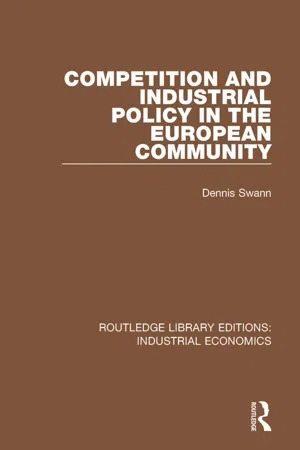
This book, first published in 1983, is primarily concerned with the economic policies of the European Economic Community and the European Coal and Steel Community. It explains in detail how the common market was established and how it was maintained. Free competition cannot be created merely by removing customs duties and quotas: it is also necessary to attack the many non-tariff barriers which would otherwise impede free movement. Moreover, the Community sought to develop an industrial policy, notably in relation to the ECSC, to provide a stance towards declining industries suffering from Developing World competition.
- 222 pages
- English
- ePUB (mobile friendly)
- Available on iOS & Android
eBook - ePub
Competition and Industrial Policy in the European Community
1 Definitions and distinctions
Competition policy and industrial policy defined
As the title of this book indicates the focus of this study is the competition and industrial policies of the European Communities (EC). The title is however in need of some immediate amplification since it could be taken to imply that the book is directly concerned with national competition and industrial policies. This is not the intention. The book takes as its context attempts by member states to integrate their economies. The matters under discussion will therefore be the powers and policies arising from (a) the Paris Treaty of 1951, which find their expression in the European Coal and Steel Community (ECSC); and (b) the Rome Treaty of 1957, which similarly find their expression in the European Economic Community (EEC). We shall therefore be concentrating on policies evolved at Community level although inevitably we shall have to take account of the interaction between national and Community policies. Given that the Paris Treaty was merely concerned with coal and steel, while the Rome Treaty covers the rest of the economy (except certain nuclear matters1), inevitably there will be a bias towards EEC policies although the more dirigiste character of the Paris Treaty will mean that the space devoted to the ECSC will not fully reflect the minority position of coal and steel in the economy of the present-day Community.
It is equally important that we begin with some definitions since neither of the phrases ‘competition policy’ nor ‘industrial policy’ are entirely free from ambiguity. Competition policy is often thought of narrowly in terms of laws and executive organs concerned with restrictive business practices, monopolies, mergers and related phenomena. The antitrust dimension, to borrow a useful American term, is indeed an important ingredient of a policy designed to create and maintain competition. However in the context of economic integration, in which a major aspect is the elimination of barriers to trade between states, it is clearly imperative that other elements should be considered. The act of eliminating tariffs itself helps to open national markets to competition from producers located in other member states. However we have to recognize that there are a whole host of factors which can inhibit2 competitive trade flows even if tariffs have been eliminated. This point was quite clearly understood by those who devised the detailed provisions of the founding treaties. Hans von der Groeben, who was the first Commissioner to be assigned the competition portfolio under the Rome Treaty, observed in 1961:
It is … beyond dispute … and the authors of the Treaty were fully aware of this – that it would be useless to bring down trade barriers between Member States if the Governments or private industry were to remain free through economic and fiscal legislation, through subsidies or cartel-like restrictions on competition, virtually to undo the opening of the markets and to prevent, or at least unduly to delay the action needed to adapt them to the Common Market. (EPD 1961)
Some of these barriers – they are referred to as non-tariff barriers – consist of administrative complications which arise when goods cross frontiers.3 Some of them arise from disparities between the indirect taxation systems of different member states. This type of problem pales into insignificance when compared with the effects of subsidies, referred to by von der Groeben, which distort competition and confer artificial competitive advantages; the effects of differing national laws and standards in respect of the design and composition of goods, which have the possibility of totally blocking trade flows;4 the effect of buy-national policies adopted by governmental agencies and nationalized industries and recommended to the general public, and finally the discriminatory powers enjoyed by certain state monopolies. Within the Community context competition policy addresses itself to these problems as well as to the more familiar ones associated with antitrust activity.
It should however be added that the ECSC complicates matters further. While we might be willing to adopt the broader definition of competition policy we would nevertheless normally assume that, provided enterprises behaved in a genuinely competitive manner in the market, the way in which they made their competitive offers could be left to them. But in the case of the Paris Treaty rules have been laid down about the method of pricing – these relate to questions of price publicity and also prescribe the circumstances in which, and the degree to which, prices can be reduced below publicized levels.
As we can see there are no great difficulties to be encountered in attempting to arrive at a definition of the meaning of competition policy, even in the special circumstances of an economic integration exercise. When we come to industrial policy, matters are otherwise. It is true to say that academic economists still attend conferences in the hope that they might acquire a clearer view of what it really consists of and of course, and in fairness, what rationale if any lies behind it. There appear to be no overriding principles which enable us to produce a clear-cut agreement as to where to draw the line or, to put it another way, what to include and what to exclude. What we shall do therefore is to identify those ingredients about which there appears to be fairly general agreement.
Before we proceed to the identification of those ingredients we should note the somewhat obvious but unassailable point that industrial policy can be defined as the attitude of governments (and in our case international bodies) towards the industries for which they have some form of responsibility or which lie within their constituency. It would therefore be perfectly possible to describe laisser faire as being a form of industrial policy. Under such a system whether and how industries expanded or contracted would be left to market forces. If demand increased, profits would rise, existing firms would expand production and in due course new firms might enter the industry – supply would thus be augmented. If demand decreased, profits would fall, indeed losses might occur, existing firms would curtail output and some might exit from the industry – supply would decline. Thus individual industries would react to the shifting balance of demand and would redeploy resources accordingly. All this would be accomplished by the invisible hand of the price system. There would be no visible hand of state-interference nudging and steering industries this way and that. In matters of industrial structure the desire to profit maximize would induce firms to adapt to efficient scales of operation – scales which would also best ensure their survival. Equally matters of performance, such as Research and Development (R & D) spending, would be determined by market forces and the quest for profit.
If however we had phrased our earlier statement somewhat differently in terms of leaving the course of events to be determined by the free play of competitive market forces then the policy would have to be somewhat different. All the evidence suggests that, while it would not be true to say that if businessmen are left to themselves competition would totally disappear out of the window, there is no doubt that it would be significantly attenuated. Evidence suggests that businessmen do not like to compete but prefer to achieve at least an element of order as opposed to the hurly-burly of the competitive market place. It would therefore be necessary to have some form of antitrust policy in order to maintain competition. Antitrust policy is therefore properly to be viewed as a form of interventionism. It is also apparent that competition policy and industrial policy are not incompatible. Rather, competition policy may be regarded as an ingredient of industrial policy and indeed in terms of definitions the latter may be said to encompass the former. In most accounts of industrial policy commentators more or less automatically include a treatment of competition policy. The reader may therefore wonder why this book is not simply entitled ‘Industrial Policy in the European Community’! The answer is that such a title would be misleading since whereas the competition dimension is well developed within the Community and thus will inevitably constitute a major part of our canvas, the non-competition element is relatively much less well developed, although the latter point is truer of the EEC than the ECSC.
Although we have recognized that industrial policy could be entirely passive, in practice it must be admitted that when economists talk about industrial policy they are usually referring to an active interventionist policy. Moreover they are not just referring to interventionism in the form of maintenance of competition but to other forms of intervention as well. What are these other forms of intervention?5
One relates to the active involvement of the state in the adjustment of particular industries to changes in the market and to other changes such as, for example, new technological opportunities. The objective may be to facilitate expansions as well as contractions of industrial output, capacity and employment. Perhaps we can begin with contractions since one of the major reasons for recent government interference has been the desire to assist in the adjustment of industries faced with the problem of competition from low wage Newly Industrializing Countries (NICs) as well as from more developed sources such as Japan.6 These problems have since 1974 been overlaid by a recession of activity following the Oil Crisis. In the EC context textiles and steel are industries in such difficulties. It is however important to recognize that although difficulties may stem from competition from outside the Community, they may also stem from competition from within the grouping. A particular industry in one member state may succumb to competition from more efficient counterparts in other member states. The classic case of this was the experience of Belgian coal in the early days of the ECSC. The Belgian coal industry consisted of relatively inefficient pits operating in poor geological conditions. Although the demand for coal was declining in the face of cheap oil, the output and employment of the Belgian industry fell much more rapidly than that of its more efficient rivals in the Ruhr and elsewhere who, as a result of the creation of the ECSC, were able to penetrate Belgian domestic and export markets (McLachlan and Swann 1967, 44–50). Then again a decline of employment may proceed from the success of an industry in increasing labour productivity. For example, the clothing industry in the Community has experienced a substantial decline in employment in recent years. Some of this decline was due to NIC penetration but a major part of it in most member states during the 1970s was caused by increased productivity (De La Torre 1981, 124–48). Ironically one of the defensive reactions in such circumstances is to increase efficiency via even greater labour productivity but although this may help to stem the decline in output it only helps to accelerate the decline in employment.
The forms of intervention which are felt to be appropriate when declines of output and employment are being experienced are extremely diverse. However the following are not untypical: (a) measures including financial assistance to assist in the slimming down of capacity (this may be accomplished via mergers); (b) measures to facilitate the movement of resources into other industries; (c) measures to increase the efficiency and competitiveness of the remainder of the industry; (d) measures to facilitate or encourage a move up-market to more sophisticated goods and higher technologies where import competition may be less intense and the price factor less important. All this has on occasions been accompanied by protection. The latter has been viewed as a temporary phenomenon or as a device for slowing down the pace of (as opposed to preventing) import penetration. Either way the rationale put forward in defence has been that the industry would be afforded a breathing space within which to adjust. Typical examples of such protective policies have been, at the international level, the Multi-Fibre Arrangement which has set a limit to the growth of textile and clothing imports (although in practice it has not always been so generous); at the Community level, the negotiations between the EC Commission and third countries aimed at limiting exports of steel to the EC (this has been coupled with levies on artificially low-priced imports) and, on the national plane, various government to government and industry to industry arrangements designed to limit export efforts into certain markets – the latter are referred to as auto-limitation agreements.
Critics might object that this is an unduly flattering description of official intervention in industries in difficulties and that although some policies have contained a positive adjustment element, others have in practice consisted of ‘lame-duck’ rescues with too little or indeed no real rationalization element. Certainly in the UK selective intervention has not been motivated solely by the need to facilitate the process of contraction and competitive adjustment but has indeed been designed to keep firms in existence on the grounds that the unemployment consequences would be unacceptable and also that there were balance of payments or security advantages to be derived from keeping the firms in production.
Industrial policy also manifests itself in attempts to facilitate the expansion of firms or industries, notably when new products and technologies are emerging. The UK government’s financial assistance through the agency of the National Enterprise Board (NEB) towards the development of microelectronics is a particularly good example. The taking of participatory stakes in individual firms was a key feature of the 1974–9 Labour government’s industrial strategy and has also been a feature of French post-war policy (Hough 1979, 191). This sort of selective intervention is sometimes referred to as ‘picking the winners’. Economists have sought to justify such interventions on a number of grounds. They have argued that inadequate information may result in private enterprises failing to identify opportunities for future development which may be more readily apparent to governments. This, it is alleged, is likely to be so in the case of new technology where the access of government to the results of basic research enables it better to forecast industrial applications. It is also asserted that state involvement is necessary because private enterprise is deterred by the risks involved. Not only are the outcomes uncertain but also some projects require large capital outlays and involve long gestation periods. There is however another school of thought which believes that businessmen are much more adept than civil servants at identifying the winners.
Again it has to be said that although picking winners may appear to be motivated by no more than a desire to speed up industrial reaction to new opportunities, in practice other motives are often at work. These include the desire to avoid the harmful consequences for employment (and the balance of payments) of failing to grasp significant new technological opportunities and the security advantage of having a domestic source of supply.
Policies for steering particular sectors have on occasions been generalized within the framework of national indicative plans. The French economy in the post-war period is the case par excellence. The function of the plan was to provide a forecast of the development of the economy over a five-year period. It should be emphasized that this was a growth rather than an adjustment exercise. The global plan was broken down by sector and industry and an attempt was made to reconcile the expansion of the various sectors and industries. Industrialists were involved in the formulation of targets. It was anticipated that this involvement would generate the view that the plan was feasible and that this in turn would induce firms and industries to conduct their investment activity on the basis of it. The plans were justified on the grounds that they gave rise to more favourable growth expectations and that these in turn produced more favourable growth performances. Although the phrase ‘indicative planning’ suggests an essentially voluntaristic exercise, it should be noted that the French government disposed of a large range of inducements and that these were deployed in line with the objectives of the plan.
In a developed economy context, picking winners often seems to mean sifting out promising new technologies. This conveniently leads us on to another aspect of industrial policy, namely the encouragement and support given to R & D activity. This may be selective, in which case it has much in common with the policy approach outlined above, although of course it may focus more on the earlier process of generating new discoveries (basic research and invention) as opposed to the later process of financing the development of marketable products and processes (innovation). On the other hand R & D policy may be general rather than selective, being designed to encourage and assist firms throughout the economy to devote more resources to R & D. Whatever the form, the policy may manifest itself in terms of R & D activity carried out by the government (possibly in co-operation with industry and the universities) or it may consist of the encouragement of industry-performed R & D by means of fiscal incentives, credits and grants, the promotion of co-operative research activities and government R & D contracts to industry.
At the European level it is quite apparent that Community organs have a clear power and obligation to discharge an R & D role in certain areas (e.g. Euratom, the European Atomic Energy Community). Beyond that however the development of a Community role depends on the identification of areas of common interest in which common programmes can eliminate wasteful duplications of effort and can pull together a level of financial support which may be beyond the means of individual states.
Industrial policy also consists of actively intervening to influence the structure of firms in particular industries. This often takes the form of policies designed to encourage mergers, although there is no reason why in principle it should not consist of policies designed to facilitate divestitures. Legislation with the latter intention in mind has been proposed for the US (Swann 1979, 312). Typical examples of policies following the selective merger path are the creation of the Industrial Reorganization Corporation (IRC) in the UK in 1966 by the 1964–9 Labour government. The IRC had a number of functions but the one for which it is especially remembered is that of acting as a merger broker. The object in facilitating mergers was not the achievement of greater size as such but the establishment of units which could compete successfully on world markets (Howe 1978, 220–330). A policy of encouraging mergers has also been a conspicuous aspect of French industrial policy (Hough 1979, 197–8) and did in fact lead to the creation of the Industrial Development Institute in 1970 in imitation of the UK’s IRC.
Within the Community context the adaptation of industrial structures mainly takes the form of facilitating cross-frontier mergers and other cross-frontier joint arrangements and, on a wider plane, takes in the whole question of enterprises being able to organize their activities (e.g. relations between parents and subsidiaries...
Table of contents
- Cover
- Half Title
- Title Page
- Copyright Page
- Table of Contents
- Abbreviations
- General editor’s preface
- Author’s preface
- 1 Definitions and distinctions
- 2 Tariffs, quotas and equivalent measures
- 3 Non-tariff barriers – the sta
- 4 Non-tariff barriers – cartels
- 5 Non-tariff barriers – concentrations and other issues
- 6 Industrial policy – the EEC
- 7 Industrial policy – the ECSC
- 8 Concluding assessment
- Appendix
- Notes
- References
- Select bibliography
- Index
Trusted by 375,005 students
Access to over 1.5 million titles for a fair monthly price.
Study more efficiently using our study tools.
Frequently asked questions
Yes, you can cancel anytime from the Subscription tab in your account settings on the Perlego website. Your subscription will stay active until the end of your current billing period. Learn how to cancel your subscription
No, books cannot be downloaded as external files, such as PDFs, for use outside of Perlego. However, you can download books within the Perlego app for offline reading on mobile or tablet. Learn how to download books offline
Perlego offers two plans: Essential and Complete
- Essential is ideal for learners and professionals who enjoy exploring a wide range of subjects. Access the Essential Library with 800,000+ trusted titles and best-sellers across business, personal growth, and the humanities. Includes unlimited reading time and Standard Read Aloud voice.
- Complete: Perfect for advanced learners and researchers needing full, unrestricted access. Unlock 1.5M+ books across hundreds of subjects, including academic and specialized titles. The Complete Plan also includes advanced features like Premium Read Aloud and Research Assistant.
We are an online textbook subscription service, where you can get access to an entire online library for less than the price of a single book per month. With over 1.5 million books across 990+ topics, we’ve got you covered! Learn about our mission
Look out for the read-aloud symbol on your next book to see if you can listen to it. The read-aloud tool reads text aloud for you, highlighting the text as it is being read. You can pause it, speed it up and slow it down. Learn more about Read Aloud
Yes! You can use the Perlego app on both iOS and Android devices to read anytime, anywhere — even offline. Perfect for commutes or when you’re on the go.
Please note we cannot support devices running on iOS 13 and Android 7 or earlier. Learn more about using the app
Please note we cannot support devices running on iOS 13 and Android 7 or earlier. Learn more about using the app
Yes, you can access Competition and Industrial Policy in the European Community by Dennis Swann in PDF and/or ePUB format, as well as other popular books in Business & Business General. We have over 1.5 million books available in our catalogue for you to explore.