- 152 pages
- English
- ePUB (mobile friendly)
- Available on iOS & Android
eBook - ePub
Apomixis in Angiosperms
About this book
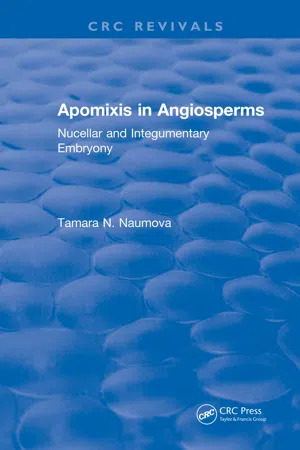
Apomixis in Angiosperms: Nucellar and Integumentary Embryony is based on original cytoembryological data and critically reviewed literature on more than 250 species from 57 families of angiosperms. The book covers the complete process of nucellar and integumentary embryo formation and viable seed development within species, families, and among angiosperms in general. Many species (some of which are economically important) characterized by adventive embryony are listed. The book also provides an original simple classification of apomixis and offers a new approach to differentiating embryological structures in cases of apomixis and amphimixis.
Apomixis in Angiosperms: Nucellar and Integumentary Embryony will be a useful reference for embryologists, botanists, cytologists, geneticists, and plant breeders. It will also benefit any researcher interested in studying somatic embryo formation in tissue culture.
Information
Chapter 1
GENERAL ASPECTS
Reproduction is a fundamental problem of theoretical botany and at the same time is of primary practical importance. Angiosperms are reproduced in most cases by seeds. The embryo and endosperm of a seed can be formed in two ways: by amphimixis or by apomixis. In the case of amphimixis the embryo and endosperm are produced as the result of double fertilization. No fusion of the gametes is observed in apomixis; formation of the embryo, endosperm, and embryo sac is rather diverse, but it also leads to production of viable seeds. Apomictically originated embryos and developing plants have genetically inherited properties different from those of amphimictic ones.
Apomixis occurring in nature contributes to seed productivity and genetic stability of the flowering plants. Embryological data on apomixis are scanty. Terminology of apomixis is complicated and confusing and classifications of this phenomenon are numerous, but none of them is universally accepted. Apomixis is most diverse among angiosperms compared to all other representatives of the plant and animal kingdoms. Underlying causes are a peculiar development of generative structures of the flowering plants: structural and functional features of the ovule, spore type of meiosis, and potentialities of the embryo sac cells in respect to their reproductive functions.
Nucellar and integumentary embryony (collectively called adventive embryony) is one of the most widely spread types of apomixis in nature; the embryo is formed from separate nucellus or integument cells but is developed in the embryo sac and produces a viable seed. Polyembryony, the formation and development of several embryos in a single seed, is typical of adventive embryony. It is generally caused by the formation of several initial cells (embryocytes) which can be developed into nucellar or integumentary embryos.
Adventive embryony has been studied inadequately. Embryological investigations carried out so far are for the most part fragmentary. Information on adventive embryony cited in publications on general embryology and apomixis does not provide a comprehensive picture of this phenomenon.1-9 The role of adventive embryony in the system of apomixis and angiosperm reproduction remains undefined, due to the limited knowledge available and the unique characteristics of this phenomenon. Some investigators exclude adventive embryony from apomixis and regard it as equivalent to vegetative multiplication6,10-13 or consider adventive embryony a remarkable means of vegetative propagation,14 sometimes comparing it to cleavage polyembryony;15 other researchers included it in apomixis, but often treat it separately from its other types.16-27 There is no unanimous opinion among scientists on this issue. Data on the evolutionary significance of adventive embryony are practically lacking. Many questions associated with embryology of flowering plants which possess this type of apomixis remain unresolved. Thus, adventive embryony is not clearly understood. Therefore, we believed it necessary to trace carefully all the successive stages of development of species with adventive embryony.
Interest in adventive embryony is not surprising because in the plant kingdom it can occur only among angiosperms and is connected with the realization of reproductive potentiality, not only by specific cells of the ovule (megasporocytes), but also by other nucellus or integument cells (embryocytes). This property illustrates totipotentiality exhibited by the ovule cells which can be widely used in practice. Adventive embryony becomes of current significance because it is found in a number of economically important plants belonging to genera such as Citrus, Mangifera, Malus, Ribes, Beta, and some genera of the family Poaceae. For practical purposes, it can be used to maintain heterosis, to stabilize hybrids, and to produce virus-free and disease-resistant forms of plants. Moreover, the species with adventive embryony might be employed as promising objects for works in tissue culture.
The aim of the present work is to develop a comprehensive characteristic of adventive embryony as one of the modes of seed reproduction in angiosperms and to reveal main cytoembryological regularities that underlie this phenomenon. This highlights major problems of embryological development of the species with nucellar and integumentary embryony on the basis of original data and a survey of literature with respect to representatives of more than 250 species from 57 families of angiosperms. Ultrastructural investigations on initial cells of adventive embryos (embryocytes) have been carried out for the first time. A list of species with nucellar and integumentary embryony is compiled which also includes other types of apomixis and references. Occurrence of this phenomenon is examined within species, genera, families, and among angiosperms in general. An original classification of apomixis and amphimixis is suggested.
As a result of the present studies, some new principles are proposed with respect to the development of male and female generative structures, development of sexual and adventive embryos, and peculiarities of endospermogenesis. Ultrastructural investigations offered a means to reveal typical features of embryocyte differentiation and to gain new insight into adventive embryony and the problem of apomixis in general. It was shown that structural transformations of the embryocyte protoplast in many aspects were similar to those of the protoplasts of other embryonic structures developing in the ovule. The research results reveal evidence for common regularities in differentiating embryological structures in the case of both apomixis and amphimixis. Apart from the above practical purposes, these data might also be helpful in solving theoretical aspects of the problem of seed production.
Chapter 2
HISTORICAL BACKGROUND
Investigations of angiosperms dating to the 19th century showed that seeds could be produced without pollination and fertilization. Smith, an English scientist from the Royal Botanical Gardens at Kew, was the first to discover (in 1841) normally formed and viable seeds of a female specimen of the dioecious Australian plant Alchornea ilicifolia in the absence of male individuals.28 This report and information on polyembryony encouraged scientists to undertake wider and more profound studies of generative structures.
The first embryological studies of plants characterized by polyembryony were made by Strasburger.29 He found that additional embryos could be formed in the seed without fertilization, directly from nucellus cells adjacent to the embryo sac. He called such embryos adventive (Adventivkeime) embryos and the phenomenon as a whole adventive embryony. It was described by Strasburger using the following species: Funkia ovata, Alchornea (Coelebogyne) ilicifolia, Citrus aurantium, Mangifera indica, Euonymus latifolia, Gymnadenia conopsea and Nothoscordum fragrans. Adventive embryony was the first type of asexual reproduction discovered in flowering plants. In this case separate cells of nucellus were capable of functioning as a zygote. Apart from adventive embryony, other instances of embryo formation in angiosperms without fertilization were later described. For those cases and the phenomenon as a whole, the term apomixis was suggested to denote the formation of a new organism without fusion of the gametes.30-31 Vegetative multiplication was also included by Winkler in the notion of apomixis. Somewhat later the term agamospermy was introduced that covered all cases of reproduction via seeds without fusion of the gametes. These terms are still widely used and we employ them along with other necessary notions generally accepted in this field. The term adventive embryony is used in the present work, as in works by many other researchers, as an equivalent to nucellar or integumentary embryony. The early works by Strasburger29 in the field of adventive embryony were followed by a series of further studies. This phenomenon was soon observed in many plants: Ficus roxburghii, Erythronium americanum, Allium odorum, Opuntia vulgaris, O.ficus-indica, O. rafinesquii, Spiranthes cernua, Alchemilla sp., Euphorbia dulcis, Colchicum autumnale, Wikstroemia indica, Mangifera indica, Eugenia jambos, Zanthoxylum bungei, Citrus aurantium, C. nobilis, and Smilacina racemosa?30,32-45 Most of these early embryological works stated primarily only the presence of adventive embryos in the seed. Observational results had much in common with the pictures described by Strasburger,29 though some additional data were naturally obtained. Ganong35 found in particular that the egg cell of O. vulgaris degenerated and all embryos of the seed were of nucellar origin. It was shown in the example of some species of Alchemilla that nucellar embryos could start developing prior to endosperm and their development could be unrelated to pollination.39 In the course of the study of Euphorbia dulcis, the development of embryos from unfertilized egg cell and synergids was observed along with adventive embryo formation.40
During this period embryological investigations of economically important plants characterized by adventive embryony were also started: Mangifera, Euphorbia, and Citrus.42-44 The work by Osawa44 deserves particular notice. He closely examined the development of two sterile varieties of the genus Citrus:Washington navel orange (C. aurantium) and Unshiu (C. nobilis); in parallel some fertile representatives of the genus were under study. Various anomalies were found in the formation of the embryo sacs and pollen grains, though no differences in the development of the ovule and its envelopes were encounted in fertile and sterile forms. Osawa’s drawings were executed so carefully and accurately that even nowadays they are presented in manuals on plant embryology.
One of the first Russian works in the field of adventive embryony belongs to Tretjakov33 from the Moscow Botanical Garden who studied Allium odorum. The work was later continued by Modilewsky,46-47 who showed that embryos of this species could arise from an egg cell, synergids, antipodal or integument cells. It was noted that embryos could develop only in the presence of the endosperm which arises from fertilization. Due to possible formation of embryos from both nucellus and integument cells, adventive embryony was subdivided into nucellar and integumentary embryony.46-48 These concepts were first introduced into the classification by Webber.49
Further studies revealed the occurrence of adventive embryony in many representatives of flowering plants. We have compiled a list of the angiosperm species characterized by nucellar and integumentary embryony on the basis of major relevant publications and our research data.
There are no comprehensive publications on adventive embryony at present. Basic data on this phenomenon are presented in works dealing with apomixis in general terms or in outlines of plant embryology. Any interested reader will see how confusing the problem is but will fail to find definite answers in these publications. Most specific works on embryology of taxa with nucellar and integumentary embryony which we will discuss later have been unfortunately disregarded as a general characteristic of the phenomenon.
The first classification of apomixis was given by H.Winkler30 Adventive embryony was not discussed. Of significant interest is a later work by this author14 where he examined separate forms of apomixis, its nature and origin, and its biological significance. Winkler was the first to draw attention to differences in alternations of nuclear phases and generations in the case of amphimixis and apomixis. Since this point was mentioned in later works by other investigators, we shall treat it at some length. Starting from the principles based on alternations of nuclear phases in the plant ontogenesis, Winkler subdivided apomixis into three types: (1) vegetative multiplication, (2) apogamy, and (3) parthenogenesis. He places reproduction by means of spores, offsprings, bulbs, etc. into vegetative multiplication. Winkler regards adventive embryony as a remarkable means of vegetative multiplication since a new sporophyte (adventive embryo) arises from an old sporophyte (the ovule cells) and as a consequence there is no alternation of nuclear phases and generations. Adventive embryony, in Winkler’s opinion, is characterized by the formation of “offsprings” (propagation sprosse) within the ovule directly from its cells; these offsprings then penetrate into the embryo sac and are transformed into adventive embryos which are considered as “runners” of the sporophyte. Though taking into account that in adventive embryony, like apogamy and parthenogenesis, seeds are still produced, Winkler applies the collective term “agamospermy” to all three types of apomixis. Apogamy includes the cases of apomictic origin of a sporophyte (embryo) from vegetative cells of the game-tophyte (synergids). Apomictic production of a sporophyte from the embryo cell (egg cell) is referred to by Winkler as parthenogenesis. Two latter types of apomixis are subdivided into reduced and unreduced ones.
The classification of apomixis developed by Winkler is illustrated when a phenomenon is examined using...
Table of contents
- Cover Page
- Title Page
- Copyright Page
- Table of Contents
- Chapter 1 General Aspects
- Chapter 2 Historical Background
- Chapter 3 Structural and Functional Aspects of Nucellar and Integumentary Embryony
- Chapter 4 Occurrence of Nucellar and Integumentary Embryony and Its Evolutionary Significance
- Chapter 5 Apomixis and Amphimixis in Seed Production of Flowering Plants
- Chapter 6 A List of Species with Nucellar and Integumentary Embryony
- References
- Abbreviations/Illustrations
- Index
Trusted by 375,005 students
Access to over 1.5 million titles for a fair monthly price.
Study more efficiently using our study tools.
Frequently asked questions
Yes, you can cancel anytime from the Subscription tab in your account settings on the Perlego website. Your subscription will stay active until the end of your current billing period. Learn how to cancel your subscription
No, books cannot be downloaded as external files, such as PDFs, for use outside of Perlego. However, you can download books within the Perlego app for offline reading on mobile or tablet. Learn how to download books offline
Perlego offers two plans: Essential and Complete
- Essential is ideal for learners and professionals who enjoy exploring a wide range of subjects. Access the Essential Library with 800,000+ trusted titles and best-sellers across business, personal growth, and the humanities. Includes unlimited reading time and Standard Read Aloud voice.
- Complete: Perfect for advanced learners and researchers needing full, unrestricted access. Unlock 1.5M+ books across hundreds of subjects, including academic and specialized titles. The Complete Plan also includes advanced features like Premium Read Aloud and Research Assistant.
We are an online textbook subscription service, where you can get access to an entire online library for less than the price of a single book per month. With over 1.5 million books across 990+ topics, we’ve got you covered! Learn about our mission
Look out for the read-aloud symbol on your next book to see if you can listen to it. The read-aloud tool reads text aloud for you, highlighting the text as it is being read. You can pause it, speed it up and slow it down. Learn more about Read Aloud
Yes! You can use the Perlego app on both iOS and Android devices to read anytime, anywhere — even offline. Perfect for commutes or when you’re on the go.
Please note we cannot support devices running on iOS 13 and Android 7 or earlier. Learn more about using the app
Please note we cannot support devices running on iOS 13 and Android 7 or earlier. Learn more about using the app
Yes, you can access Apomixis in Angiosperms by Tamara N. Naumova in PDF and/or ePUB format, as well as other popular books in Biological Sciences & Biology. We have over 1.5 million books available in our catalogue for you to explore.