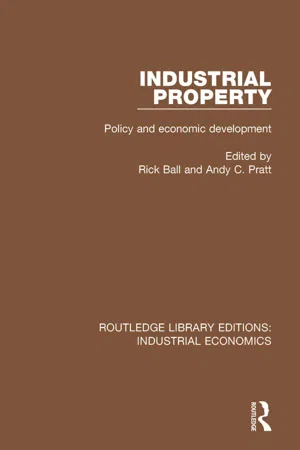
This volume, first published in 1994, is the first collection of original research on the relationships between industrial property and economic development. The contributors, all specialists in their field, highlight the emerging conflicts between the users and the providers of industrial premises; conflicts that may undermine economic potential. The need for flexibility in the use and provision of industrial premises is explored in three contexts: the transformation of the urban fringe; the development of hi-tech premises; and the redevelopment of old or derelict premises.
eBook - ePub
Industrial Property
Policy and Economic Development
- 220 pages
- English
- ePUB (mobile friendly)
- Available on iOS & Android
eBook - ePub
1 Industrial property, policy and economic development
The research agenda
Andy C. Pratt and Rick Ball
INTRODUCTION
Some of the most potent symbols of an industrial age are to be found in its built environment. The literary descriptions of ‘dark satanic mills’ in Blake’s poem or ‘Coketown’ in Dickens’ novel Hard Times evoke vivid images. Likewise, in our contemporary media – in video – the standard signifier of ‘recession’ is either a decaying brick built multi-storey mill or a foundry clad in rusty corrugated iron. Growth and dynamism are signified by a hi-tech, low-rise, glass-fronted building in a lush park or campus setting.
Buildings are important, as is their financing, construction and site planning. Property development, construction, surveying and planning are major professions. It is not surprising that some attention has been paid to the needs and problems of commercial property development (see for example Rose 1985; Radcliffe 1978; Darlow 1982; Scarrett 1983; Ball 1988; Healey and Nabarro 1990; Healey et al. 1992). What is surprising is that so little attention has been paid specifically to industrial property. Recent books have acknowledged this oversight (Cadman and Austin-Crowe 1983; Fothergill et al. 1987; Morley et al. 1989; Wood and Williams 1992). However, their focus has been predominantly a procedural one, whether they are written from the perspective of the planner, surveyor or developer. What they fail to fully acknowledge is the significance of the activities that these buildings house and exactly what the needs of their occupants might be.
Clearly, industry is more than a collection of buildings. Researchers have, quite rightly, concerned themselves with attempting to understand the activities that are carried out within these buildings. However, in doing so, they have perhaps excluded all consideration of buildings. Most work on industrial location, organization and activity makes the unwritten assumption that a ‘demand’ for an industrial building will be met, unproblematically, with a ‘supply’. We are not disputing that, in many cases, this 2 Industrial Property assumption has held good. However, we want to argue in this book that there are an increasing number of cases where such an assumption is no longer valid. Furthermore, we believe that this fact has important consequences for our understanding of industrial development.
The breakdown of the relationship between the ‘supply’ of and ‘demand’ for industrial property can be illustrated by a few examples. First, in reports of the shortage of small industrial premises (Coopers and Lybrand Associates/Drivers Jonas Associates 1980). Second, by the work by Fothergill et al. (1985) highlighting the constraints of much of the existing stock of industrial buildings in inner urban areas. Third, with the long-running provision – since the 1930s – of industrial premises (advance factory units and industrial estates) by both central and local government (Slowe 1981; Loebl 1988).
This last example does remind us that this is not a new issue. Harvey (1989: 88) reminds us that, ‘the geographical landscape that results is the crowning glory of past capitalist development. But at the same time . . . it imprisons and inhibits the accumulation process within a set of physical constraints’ There is constantly a need to overcome the limitations of the old, worn out, or inappropriate built environment. While Harvey is referring to the process of urbanization more generally, this view has particular resonance for those interested in the industrial built environment. Surprisingly, few have explored this issue in any detail.
A less obvious point, but one that this book is based upon, is that the interests of property development and investment may not, at any particular site, coincide with the needs of industrialists. It is this fact that results in the breakdown between ‘supply’ and ‘demand’. It is this new set of relationships which, we would argue, needs to be investigated. We would stress that we are not suggesting some sort of ‘gestalt shift’, where concern is focused solely on property developers and investors at the expense of industrialists or planners. We are calling for new conceptualizations of both the uneven process of development and the unevenness of the property development process. This will require account to be taken of new ‘actors’ and ‘institutions’.
It is, we would argue, the dramatic restructuring of the British economy in the post-war period – particularly post-1975 – that has pushed the consideration of industrial property to the forefront. But, of course, the property sector has itself undergone a period of restructuring. One of the distinctive developments in the last twenty-five years has been the emergence in the UK of a distinct and separate property development and investment sector that has had an increasing influence on the location decisions and activities that may be carried out within buildings. The indications are that the UK property market is one of the most advanced in this process; as such, the eyes of those in neighbouring European states must be upon it. If our argument is valid, the implication is that researchers and planners interested in industrial development and policy will need to consider the production of property as well as the traditional aspects of industrial organization. We would argue that this has not been done before. This book is an attempt to develop such an understanding.
If research is to be promoted in this field some sort of institutional focus will also be required. It is perhaps significant that, historically, research on industrial property and economic development has occupied a ‘half world’ between several disciplines and professional areas of expertise. The Society of Property Researchers (SPR) was established in 1987 as a professional body concerned with raising the profile of the commercial property researcher more generally.1 The SPR has close links with the Royal Institute of Chartered Surveyors (RICS). It is a positive sign that two of the current SPR committee members (Colin Lizieri and Nick Axford) are contributors to this book. Nevertheless, property research continues to be dominated by the concerns of retail and office property investment. Academics – mainly geographers, estate managers and planners – have been primarily concerned with aspects of industrial location and regional development. Recently, academic research groups, notably the ‘Economic Geography Study Group’ of the Institute of British Geographers (IBG), have organized meetings on the theme of industrial property and economic development:2 the editors of this book have been committee members of this group. More generally, as can be noted from the institutional and professional affiliations of the contributors, a broad range of research interests and professional expertise has been brought together in this book. It is our collective hope that it will encourage, by example, further work in the field.
Another important forum for debate about issues related to property production and economic development is the Bartlett International Summer School (BISS). BISS aims to develop an interdisciplinary perspective on the development of the built environment, with particular emphasis on the production process. It was established in 1979 and has met annually since. The conference proceedings are published.3 However, few contributions to BISS have, as yet, focused primarily on industrial property. We are glad that one of the contributors to this book – Dick Pratt – has been active in BISS.
Research work also needs a publication outlet and a forum for debate. In this context the establishment of Land Development Studies in 1984 (now renamed Journal of Property Research) is to be welcomed. However, the index of published articles reveals just two specifically on industrial property.
The remainder of this chapter is dedicated to setting the context for research in industrial property and economic development. First, a set of issues surrounding the restructuring of industrial production, primarily resulting in employment loss in manufacturing production (de-industrialization), and gain in high-tech and office activities, are discussed. The significance of organizational changes that affect the use of individual industrial spaces – flexible specialization and post-Fordism – are also highlighted. Second, the restructuring of the property production sector is considered. Here a set of issues is raised concerning the use and suitability of property for occupants as provided by developers and investors. Third, the implications of the increasing flexibility of both industrial property production and industrial property use are considered as a research problem in itself. Fourth, the contribution of industrial property to British regional and local economic policy is reviewed. The general failure to consider the role of property in economic development in the context of an industrial strategy is highlighted as both a problem and an area for future research.
INDUSTRIAL RESTRUCTURING
The most obvious place from which to begin investigating the changing nature of industrial property and its relationship to industrial activity is to consider the changes that have occurred with regards to the organization of industrial production in the last two decades. In the 1970s, Britain, along with much of western Europe and the United States, experienced a progressive contraction of the manufacturing sector. This is commonly referred to as de-industrialization. De-industrialization is strictly a descriptive term. Nevertheless, it has generated considerable debate about its causes and possible implications for both local, regional and national economies (see Blackaby 1981; Martin and Rowthorn 1986).
It is not difficult to imagine what the implications of this deindustrialization are for the industrial buildings of Britain – dereliction and vacancy (see Chapter 8; and figures from King & Co. in Chapter 2). This state of affairs should not surprise us. After all, previous periods of industrial change have left behind their own legacy in the form of derelict industrial environments. Some have now received a new lease of life as tourist attractions, for example, Coalbrookedale, near Telford, or the Jewellery Quarter in Birmingham (see Chapter 5).
Some researchers have sought to point out that the existing building stock – or rather the restrictions placed on it by planning or landownership – has in fact been a’ causal factor itself in urban de-industrialization (Fothergill, Kitson and Monk 1985). Others have sought to place deindustrialization within a broader frame of reference. Here, explanation turns upon the longer-term consideration of organizational changes. First, in terms of the organization of the production process within firms – for example, the organization of the labour process or the factory layout. Second, in terms of the scale and operation of the firm, both through the nature of linkages and alliances with other firms and the spatial scale of operations – local, regional, national or transnational.
A particularly useful conceptualization of this organizational change is that broadly termed ‘Regulation Theory’ (see Dunford and Perrons 1983; Allen and Massey 1989; Lipietz 1992). A central idea is that of ‘Fordism’ which refers to a particular set of relationships linking a form of industrial organization and a form of state organization. The industrial organization comprises a Tayloristic labour process, i.e. one in which each job is broken down into small tasks. These are timed and measured, and an employee is allocated to completing one task. These various tasks are linked via the production line. There is a strict division between the ‘thought work’ of designers and managers, and the ‘hand work’ of the production line operatives. Efficient mass production of goods is the goal. The state organization comprises of a welfare state and arrangements for collective bargaining. The goal is mass consumption. The balance of mass consumption and mass production makes the system work.
It has been argued that the Fordist ‘compromise’ which produced such impressive growth in the post-war years broke down in the mid-1970s with underfunding of the welfare state and the end of collective wage bargaining. Underconsumption and falling profitability followed. Attempts were made by producers to lower wage costs by setting up branch plants (using state subsidies and exploiting lower wages in peripheral areas). In the late 1980s this strategy too was in disarray.
The emergence of mass production techniques and Tayloristic labour processes to make them work required new spaces and buildings. The old premises were clearly incompatible. Some of these were developed in towns and the largest examples were invariably on new sites. The emergent planning system, and central government’s attempts to disperse industry, clearly assisted in this process. The peculiarity of these new buildings, perhaps, militated against anything but owner-occupation for the most. Private industrial estates were developed at Trafford Park (Manchester) in the 1890s, at Slough in the 1920s, and at various locations around London in the 1930s (see Pratt 1994). On these estates it was the smaller units that were rented; larger units were built by occupants. The state also emerged as a provider of industrial premises at the local and central scale from the 1930s onwards. It was not until the 1970s that industrial buildings emerged as an investment vehicle, beyond the interest of specialist developers.
Recently, the debate has highlighted the emergence of other solutions to the Fordist problem: post-Fordism and Flexible Accumulation. Post-Fordism is based upon batch, not mass, production. It is characterized by a social division of labour within a local economy or industrial district (as opposed to within a firm). Piore and Sabel (1984) argue that these new industrial districts bear a strong similarity to those identified in nineteenth century England by Alfred Marshall. Northern Italy and southern Germany are often cited as contemporary examples of these new industrial spaces. Other authors point to the emergence of ‘high-tech’ new industrial spaces in southern California, and near Boston (Scott 1988).
Harvey’s (1987) work on Flexible Accumulation is relevant here. He refers to what he terms the ‘switching crises’ whereby investments are shifted from one industrial sector and/or location to another more profitable one in the pursuit of profits. We might highlight a particular example of this process; disinvestment in manufacturing stock and re-investment in property dealing. The obvious consequences that Harvey picks up on are the draining of investment from particular locations and sectors and the increasing competition between cities and regions for a dwindling pool of investors.
What is conspicuous by its absence from these contemporary debates is any concern with the industrial built environment (but see Pratt 1991). The assumption would seem to be that supply simply follows demand. However, this assumption does not hold. The contemporary discussion of industrial districts in Italy refe...
Table of contents
- Cover
- Half Title
- Title Page
- Copyright Page
- Table of Contents
- List of figures
- List of tables
- Preface
- Twenty-Three Years On: Andy C. Pratt
- 1 Industrial property, policy and economic development: the research agenda: Andy C. Pratt and Rick Ball
- 2 Documenting recent trends in industrial property investment: the information requirements of the private sector from a practitioner perspective: Nick Axford
- 3 Information sources for non-commercial research on industrial property and industrial activity: Andy C. Pratt
- 4 The funding of developments on derelict and contaminated sites: Paul M. Syms
- 5 New land uses: the recommodification of land for new uses on the city fringe: Dick Pratt
- 6 High technology firms and the property market: John Henneberry
- 7 The new partnership: the local state and the property development industry: Rob Imrie and Huw Thomas
- 8 Charting the uncharted: vacant industrial premises and the local industrial property arena: Rick Ball
- 9 Property ownership, leasehold forms and industrial change: Colin Lizieri
- Name index
- Subject index
Trusted by 375,005 students
Access to over 1.5 million titles for a fair monthly price.
Study more efficiently using our study tools.
Frequently asked questions
Yes, you can cancel anytime from the Subscription tab in your account settings on the Perlego website. Your subscription will stay active until the end of your current billing period. Learn how to cancel your subscription
No, books cannot be downloaded as external files, such as PDFs, for use outside of Perlego. However, you can download books within the Perlego app for offline reading on mobile or tablet. Learn how to download books offline
Perlego offers two plans: Essential and Complete
- Essential is ideal for learners and professionals who enjoy exploring a wide range of subjects. Access the Essential Library with 800,000+ trusted titles and best-sellers across business, personal growth, and the humanities. Includes unlimited reading time and Standard Read Aloud voice.
- Complete: Perfect for advanced learners and researchers needing full, unrestricted access. Unlock 1.5M+ books across hundreds of subjects, including academic and specialized titles. The Complete Plan also includes advanced features like Premium Read Aloud and Research Assistant.
We are an online textbook subscription service, where you can get access to an entire online library for less than the price of a single book per month. With over 1.5 million books across 990+ topics, we’ve got you covered! Learn about our mission
Look out for the read-aloud symbol on your next book to see if you can listen to it. The read-aloud tool reads text aloud for you, highlighting the text as it is being read. You can pause it, speed it up and slow it down. Learn more about Read Aloud
Yes! You can use the Perlego app on both iOS and Android devices to read anytime, anywhere — even offline. Perfect for commutes or when you’re on the go.
Please note we cannot support devices running on iOS 13 and Android 7 or earlier. Learn more about using the app
Please note we cannot support devices running on iOS 13 and Android 7 or earlier. Learn more about using the app
Yes, you can access Industrial Property by Rick Ball, Andy C. Pratt, Rick Ball,Andy C. Pratt in PDF and/or ePUB format, as well as other popular books in Business & Business General. We have over 1.5 million books available in our catalogue for you to explore.