- 416 pages
- English
- ePUB (mobile friendly)
- Available on iOS & Android
eBook - ePub
About this book
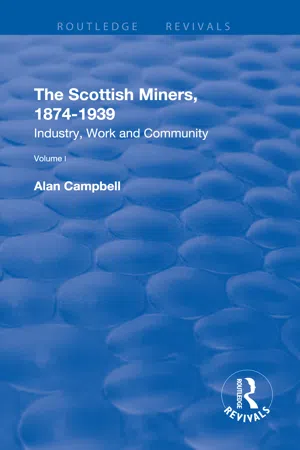
The Scottish miners experienced enormous changes during these sixty-five years. Enjoying a high degree of autonomy underground throughout the nineteenth century, their work situation was transformed in the twentieth as Scotland became the most intensively mechanised of the British coalfields. Grievances generated by this change led to strike rates in Scotland being up to ten and fifteen times higher than in the major English coalfields. Such militancy displayed considerable geographical variation however, and the translation of grievances into industrial conflict was mediated by variables rooted in the community as well as the pit. A central theme of this volume is to explore the differences between the four principal mining regions in Scotland through the detailed study of ten localities within them. This innovative, two-tiered comparison is used to analyse the competing loyalties of class, gender and ethnicity, to map the uneven terrain of popular protest and social disorder, and to challenge traditional stereotypes of 'a peaceable kingdom'. This historical sociology of the Scottish coalfields frames the analysis of trade unionism and politics which is developed in the companion volume to this book.
Information
Contents
Preface
List of Tables
List of Figures
List of Maps
List of Abbreviations
Introduction
1 Coal and capital
2 The independent collier
3 Mechanisation
4 Localities and social structures
5 Housing, women’s work and gender relations
6 Authority relations and social order
7 Ethnic and religious identities
Conclusion
Index
Preface
This book had its origins in autobiographical traces. Some of my earliest childhood memories are of the Lanarkshire coalfield. My mother’s family lived in the coal and steel-making town of Cambuslang, and its surrounding landscape of collieries and slag heaps, its buildings and glowing steelworks, even the cadences of its accent, were very different from those of Dumfries and Aberdeen where I grew up. My maternal grandparents came from County Mayo, one a Catholic, the other a Protestant. My grandfather had lived in the United States for a period, where family legend held him to have worked as a Pinkerton’s Agent, before settling in Cambuslang and running a second hand clothing business in Glasgow. When I married, my wife’s father came from a staunchly Orange, mining family in Bellshill, and her childhood memories of its deeply ingrained sectarianism added to my curiosity about the coalfield and its miners. Such interests stimulated my doctoral research, which was later published as The Lanarkshire Miners: a social history of their trade unions, 1775-1874 in 1979. Thereafter, I turned to new areas, but my engagement with the labour process debate led me back towards underground mechanisation, which proceeded more rapidly in Scotland than elsewhere in Britain, and this gradually developed into a broader concern to unravel developments in the Scottish coalfields after 1874. This and the companion volume are the eventual outcome.
In my research, I have incurred many debts which I am glad to acknowledge here. Several thanks are due to Ian MacDougall. All Scottish labour historians are indebted to his efforts on the Scottish Labour History Society’s Catalogue of Some Labour Records in Scotland, but none more so than those obliged to work south of the border. His heroic endeavours as an oral historian have also placed the autobiographies of many working-class men and women in the public domain, including a number from the coalfields who are mentioned in these texts. In addition, he answered some initial queries and directed me towards several veteran miners to interview. I am particularly grateful to Hugh Sloan, Johnny Boyle and Jas Miller, from Methil, and to Mary Docherty of Cowdenbeath, for recording their memories of coalfield life with me. Rob Duncan shared his extensive knowledge of the coal and steel communities of the Clyde valley in periodic discussions, and introduced me to David Meek, of Motherwell, whose clear reminiscences of underground work are drawn on in chapters . Bill Gilby generously made available a number of taped interviews conducted by himself and Martin Sime in Fife in the 1970s, while Billy Kay and Matthew Spicer of BBC Scotland kindly provided me with transcripts of the many interviews they made for the three-part television series Miners, broadcast in 1989.
Immensely valuable though such oral sources are and many of the interviewees are now sadly dead these volumes are not primarily works of oral history but are rooted in extensive archival research. Despite the pressures upon public sector employees in the last decade, I am constantly amazed by the unfailing helpfulness of librarians and archivists, and wish to record my thanks to the staff at the following institutions: the National Library of Scotland, including its Map Room, the Scottish Record Office, the Registrar General for Scotland, the Public Record Office, the National Museum of Labour History, the British Library Newspaper Library, Manchester Central Reference Library, the University of Glasgow Business Record Centre, the Sidney Jones Library, University of Liverpool, the John Rylands Library, University of Manchester, Methill Public Library and the William Gallacher Memorial Library, Glasgow Caledonian University.
I also wish to acknowledge the support of the University of Liverpool’s Research Development Fund, which allowed me to conduct a preliminary survey of sources during study leave in 1988; the Nuffield Foundation, Grant number: SOC/181 (1838), which permitted field work in 1989; and the Economic and Social Research Council, which granted me a Senior Research Fellowship in 1995-6 to complete archival research and write a draft manuscript (Award number: H524427500795). Without this vital financial support, these volumes would not have been written.
Participants at numerous conferences and seminars have offered constructive criticism of the preliminary sketches of the material contained in this volume over the years, but the following events deserve special mention: the Second International Mining History Congress, Bochum, 1989, allowed me to present findings on localities and militancy; the Seventh British-Dutch Conference on Labour History, held at Groningen in 1990 on the theme of ‘regional implantation’, informed the discussion of regions which structures this volume; the Third International Mining Congress, Denver, 1994, provided valuable discussion of mine mechanisation; the Manchester seminars held in 1995 by contributors to the collection of essays, Miners, Unions and Politics, 1910-1947, which I coedited, helped further to refine my ideas.
I would also like to thank the many individuals who have encouraged or assisted me in my research or discussed aspects of the content of this volume with me, even though some will almost certainly disagree with my interpretations: John Benson, Roy Church, Don Dingsdag, Rob Duncan, Nina Fishman, David Gilbert, John Halstead, David Howell, Merfyn Jones, Bill Knox, John Laslett, Renee Leboutte, Dave Lyddon, Joseph Meiling, John McIlroy, Arthur Mclvor, Charlie McMaster, Suzanne Najam, Quentin Outram, Fred Reid, Sandy Renfrew, Klaus Tenfelde and Chris Wrigley. Finally, special thanks to Alec McAulay, formerly of Ashgate Publishing, for his long-standing support of labour history generally, but particularly for his faith in this project; to the staff and inmates of the Cumberland Bar, Edinburgh, for reminding me there is a real world beyond academe; to Sue and Pavlos of the Roof Garden, Symi, for providing an annual retreat while overlooking Greece’s most beautiful harbour; to Jenni, for her laughter, if not her occasional injunctions that her father should write about something more interesting than miners; and especially to Sheila, for all her encouragement and...
Table of contents
- Cover
- Halftitle Page
- Title Page
- Copyright
- Table of Contents
Trusted by 375,005 students
Access to over 1.5 million titles for a fair monthly price.
Study more efficiently using our study tools.
Frequently asked questions
Yes, you can cancel anytime from the Subscription tab in your account settings on the Perlego website. Your subscription will stay active until the end of your current billing period. Learn how to cancel your subscription
No, books cannot be downloaded as external files, such as PDFs, for use outside of Perlego. However, you can download books within the Perlego app for offline reading on mobile or tablet. Learn how to download books offline
Perlego offers two plans: Essential and Complete
- Essential is ideal for learners and professionals who enjoy exploring a wide range of subjects. Access the Essential Library with 800,000+ trusted titles and best-sellers across business, personal growth, and the humanities. Includes unlimited reading time and Standard Read Aloud voice.
- Complete: Perfect for advanced learners and researchers needing full, unrestricted access. Unlock 1.5M+ books across hundreds of subjects, including academic and specialized titles. The Complete Plan also includes advanced features like Premium Read Aloud and Research Assistant.
We are an online textbook subscription service, where you can get access to an entire online library for less than the price of a single book per month. With over 1.5 million books across 990+ topics, we’ve got you covered! Learn about our mission
Look out for the read-aloud symbol on your next book to see if you can listen to it. The read-aloud tool reads text aloud for you, highlighting the text as it is being read. You can pause it, speed it up and slow it down. Learn more about Read Aloud
Yes! You can use the Perlego app on both iOS and Android devices to read anytime, anywhere — even offline. Perfect for commutes or when you’re on the go.
Please note we cannot support devices running on iOS 13 and Android 7 or earlier. Learn more about using the app
Please note we cannot support devices running on iOS 13 and Android 7 or earlier. Learn more about using the app
Yes, you can access The Scottish Miners, 1874–1939 by Alan Campbell in PDF and/or ePUB format, as well as other popular books in Storia & Storia mondiale. We have over 1.5 million books available in our catalogue for you to explore.