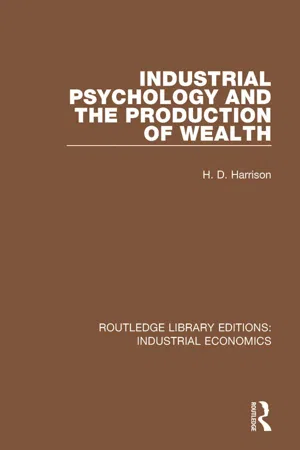
During the First World War, the necessity of increased production without increased human effort led to the practical investigation of the whole question by trained psychologists. This book, first published in 1924, deals with the methods they employed and with the results they obtained, and examines the wide-reaching effects which the application of these discoveries would have upon industrial organisation.
- 194 pages
- English
- ePUB (mobile friendly)
- Available on iOS & Android
eBook - ePub
Industrial Psychology and the Production of Wealth
INDUSTRIAL PSYCHOLOGY
AND THE
PRODUCTION OF WEALTH
CHAPTER I
INDUSTRIAL PSYCHOLOGY AND SCIENTIFIC MANAGEMENT
“THE knowledge of causes and secret motions of things; and the enlarging of the bounds of human empire, to the effecting of all things possible” 1 was the not ignoble aim which Francis Bacon, the great father of modern science, set for himself and his followers. In the pursuit of that aim the thinkers of some three centuries have revolutionised man’s ideas of himself and his environment, and have endowed their posterity with achievements more useful and more marvellous than all those of which the previous history of mankind—with its thousands of years, the rise and fall of civilisations and dynasties and the drums and tramplings of innumerable conquests—bears record. The scientists of to-day are pressing forward towards the same goal even more swiftly than their predecessors.
One important indication of the rapidity of intellectual progress is that it has become a truism to say that fundamentally there is but one science of the universe. There seems to be a kind of Tom Tiddler’s ground on which the most advanced thinkers in every science ultimately find themselves to be trespassing,1 a common centre upon which artists and scientists alike, starting from the most widely different premises and with apparently very diverse aims, find themselves converging and to which the general name of Philosophy is commonly given.2 Thus in the recent investigations3 into the structure of the atom the physicist, chemist, mathematician, mechanician and metaphysician, have all been engaged with remarkable success; while Mr. de la Mare has portrayed Poetry gazing fearlessly into the eyes of “shaggy Science nosing in the grass” and laughing aloud to find reflected “In those grey deeps the azure of her own.”1
Until man knows everything about every-thing, then, he will never know everything about anything; and the realisation of this essential unity of knowledge may explain, and so put us on our guard against, the grave dangers both for science and for humanity which seem to result from comparatively great advances in one or two branches of science unbalanced by corresponding progress in other fields of human knowledge. The scientific discoveries and mechanical inventions of the eighteenth century exploited by the baser passions of selfishness and greed, and unaccompanied by any of the knowledge of psychology and physiology and undeterred by political, social or humanitarian considerations, produced the squalor and misery of the Industrial Revolution.2 And to-day some of our publicists1 are warning us that the enormous increase in man’s control over physical force which is a distinguishing feature of recent years, if unaccompanied by a wide-spread improvement in the education and moral character of mankind, may end in the self-annihilation of civilised society.
Hence we cannot but be thankful for any tendencies in modern scientific thought which promise to redress the balance overweighted by previous concentration on only one or two aspects of human knowledge. The nineteenth century was the Age of Mechanics; the twentieth bids fair to become noteworthy as the Age of Psychology. But recently acknowledged as a science, Psychology has extended its sway from the conscious states of the human mind, to which it was limited a decade or so ago, over the realms of the subconscious and even the unconscious. It has shown the inter-relation between body and mind to be far more wonderful, more complicated and more subtle than would have been credited by either the psychologist or the physiologist of the nineteenth century. It has invaded the realms of art—do not our shelves groan under the burden of psychological novels which trace through sequel after sequel the history of one man’s schooldays and adolescence and leave him still in his prime after traversing half a dozen weighty volumes ?1 A few months ago our bookshops were besieged by people who wanted works on Psycho-Analysis and dream-interpretation; while Freud’s name is for ever on the tongues of modern educationists.
It is not surprising, then, to find that the psychologist has entered the factory with his apparatus, his tests and his notebook, and has begun to apply to industry the new and highly specialised knowledge of human behaviour and the functioning of the mind of man which the new psychology2 has made available.
The applications of psychology to industry are literally innumerable, and it is no exaggeration to say that, scientifically applied, this new knowledge will revolutionise man’s economic life. It promises to increase production without increasing effort and while decreasing discontent and unhappiness. By so doing it will promote welfare and enrich life not for any section of the people alone, but for the community in general.
Yet the benefits that Science can bestow upon Industry, so obvious to the onlooking philosopher, are apt to be suspected if not altogether denied by the working classes. Not without reason, perhaps, they fear their economic superiors, “even bringing gifts”; and they have not forgotten “the tragedy that seemed to set science in the lists against happiness and knowledge against freedom.”1 And just as the newly invented machines, doing in one hour work that formerly took ten hours, and giving to the educated observer visions of an Eldorado rich beyond the dreams of avarice, seemed to the Luddites of 1811 to threaten only economic enslavement, so the American Scientific Management Movement has aroused in the minds of many of the workers such grave distrust as to defeat its own ends. Nevertheless any attempt to estimate the economic importance of Industrial Psychology must include some reference to the pioneer work done by Frederick Winslow Taylor and his disciples and successors.
The term “Scientific Management” has been very prominent in the United States throughout the last dozen years,1 and although the name is now disappearing, borne away on the tide of new names, new ideas, new movements with which America seems to be inundated every twenty years or so, the fundamental ideas of the movement live on and are to be traced in the activities of the “Efficiency Engineers,” in the “Personel Administration” Movement, and even to some extent in such schemes of “Industrial Democracy” as Mr. Leitch outlines in his Man to Man. 2 These fundamental ideas are concerned with what may be termed the “administration” of factories as distinguished from the commercial policy and technology.3 This is a matter which has been grossly neglected, especially in England, with the result that great and indefensible wastes of human effort occur. “Scientific Management” aims at preventing these wastes by getting “the right man to use the right tools in the right way”1 under the best possible conditions. According to the principles laid down by the best exponents of Scientific Management, there are two distinct stages to be observed in the introduction of the new system; the first consists in reorganising the factory from the point of view of the material conditions; the second in changing the methods of work, the hours of labour and the distribution of work and rest periods, in trying to apply human effort with the same economy and scientific accuracy as we have been able to apply machine power.
It is in dealing with the problems presented by the reorganisation of the material factors that the Scientific Management movement has had its greatest successes. Its influence in this direction has been all for the good.It has insisted on the careful study of the organisation of the factory from the point of view of saving unnecessary expenditure of human effort such as is incurred when, in the course of manufacture, an article is taken from end to end of a large factory several times to undergo different processes when it might have been arranged that the different machines should be placed in the order in which the processes had to be performed and one passage through the factory would have sufficed.1 Great savings have been made by proper “routing”; by wise placing of store rooms, offices and machinery; by insisting on the use of the best machines and tools for every purpose; by the prevention of lost time in innumerable ways; and by the prompt adoption of labour-saving devices. The work of the Planning Department has been very valuable in this direction and an enormous advance on the old haphazard methods which held the field before. Great attention has been paid, too, to the discovery and application of the best processes, and the best ways of running the different machines. Taylor’s work on the best methods of cutting metals2 produced highly beneficial results—the same machines directed by the same operatives but using the slide-rule, which enabled them to arrange the speed and feed of the machine to the best advantage for different metals, were able to produce from two-and-a-half to nine times the output without adding to the effort or the overhead expenses. The changes which were introduced in this first step towards Scientific Management were not by any means new—the only difference was the completeness and minuteness with which all the equipment of the factory was overhauled in order to get as far as was possible by such means the conditions of maximum efficiency for each worker.
The greatest difference between the older types of management and that introduced by Taylor was in the careful examination which was made of those factors which directly affect the efficiency of the “human machine” —the methods of work, the arrangement of tools and materials on the work bench, the height of the bench, the percentage of time “under load” and the distribution of natural rest pauses, the best possible combination for each kind of work of rest and activity, the hours of labour, the system of payment, and the effects of changes in these variants on that efficiency. Looking at the work of Taylor, Gantt and Emerson in this direction in the light of the latest developments of psychological and physiological knowledge, it is fatally easy to underestimate the importance of the pioneers who called attention to the need for research into these matters if only by their mistakes in attempting to eradicate the evils consequent on past neglect. In so far as they insisted on the application of knowledge based on experiment to the determining of hours of labour, and showed the advantages to be gained by properly arranged intervals for rest and refreshment, they opened a new field for the investigations of psychology. In so far as they insisted on the evil effects of rate-cu...
Table of contents
- Cover
- Half Title
- Title Page
- Copyright Page
- Preface
- Table of Contents
- Abbreviations
- Chapter I Industrial Psychology and Scientific Management
- Chapter II Vocational Selection and Guidance
- Chapter III Fatigue
- Chapter IV Motion Study and the Adjustment of Material Conditions to the Worker
- Chapter V Various Psychological Factors Affecting Industry
- Chapter VI Conclusion
- Index
Trusted by 375,005 students
Access to over 1.5 million titles for a fair monthly price.
Study more efficiently using our study tools.
Frequently asked questions
Yes, you can cancel anytime from the Subscription tab in your account settings on the Perlego website. Your subscription will stay active until the end of your current billing period. Learn how to cancel your subscription
No, books cannot be downloaded as external files, such as PDFs, for use outside of Perlego. However, you can download books within the Perlego app for offline reading on mobile or tablet. Learn how to download books offline
Perlego offers two plans: Essential and Complete
- Essential is ideal for learners and professionals who enjoy exploring a wide range of subjects. Access the Essential Library with 800,000+ trusted titles and best-sellers across business, personal growth, and the humanities. Includes unlimited reading time and Standard Read Aloud voice.
- Complete: Perfect for advanced learners and researchers needing full, unrestricted access. Unlock 1.5M+ books across hundreds of subjects, including academic and specialized titles. The Complete Plan also includes advanced features like Premium Read Aloud and Research Assistant.
We are an online textbook subscription service, where you can get access to an entire online library for less than the price of a single book per month. With over 1.5 million books across 990+ topics, we’ve got you covered! Learn about our mission
Look out for the read-aloud symbol on your next book to see if you can listen to it. The read-aloud tool reads text aloud for you, highlighting the text as it is being read. You can pause it, speed it up and slow it down. Learn more about Read Aloud
Yes! You can use the Perlego app on both iOS and Android devices to read anytime, anywhere — even offline. Perfect for commutes or when you’re on the go.
Please note we cannot support devices running on iOS 13 and Android 7 or earlier. Learn more about using the app
Please note we cannot support devices running on iOS 13 and Android 7 or earlier. Learn more about using the app
Yes, you can access Industrial Psychology and the Production of Wealth by H.D. Harrison in PDF and/or ePUB format, as well as other popular books in Business & Business General. We have over 1.5 million books available in our catalogue for you to explore.