Originally published in 1986, this work discusses the development in Dacca of western-style municipal organization and its financial and practical problems and also explores the economic transition of the city after 1840. It is one of the few urban studies which carries through from the 'old order' to the new administrative towns of British rule and attempts to show what happened to the communities of townsmen in the period of adaptation. It casts new light on the function and organization of Indian urban societies in the colonial period, on the transfer of western institutions and the organization and composition of Bengali trade outside Calcutta.
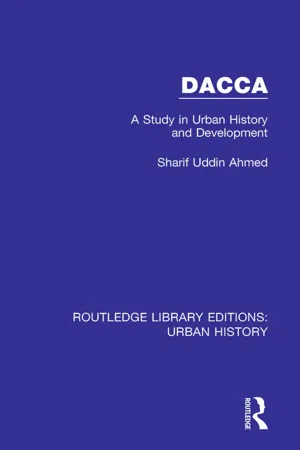
- 290 pages
- English
- ePUB (mobile friendly)
- Available on iOS & Android
eBook - ePub
CHAPTER VII
URBAN SOLUTIONS
The Bengal Act III of 1864 which led to the establishment of the Dacca Municipality was a landmark in the city’s urban development. The institutional infrastructure of municipal administration was a direct product of governmental intervention. Several earlier Acts, as has been seen, had failed to achieve permanent results because they lacked teeth. Local public works and services had, therefore, of necessity been mainly government-financed, in Bengal by use of the surplus of the chaukidari taxes. However, the government’s tight financial situation had allowed it to do very little.
The mutiny of 1857–8 had severely shaken the financial foundations of the Government of India. Post-mutiny financial embarrassment led to the imposition of local taxes for local purposes as the best means of relieving the central government. It was James Wilson, the new Finance Member of the Governor-General’s Council, especially sent from Whitehall to bring ’Indian finances to equilibrium’, who suggested the policy of financial decentralization.1
Soon afterwards the report in 1863 of the Army Sanitary Commission drew the attention of the Government of India to the generally unhealthy and insanitary conditions of most Indian towns and cities and urged the need for reform, further stimulating the central government’s interest in local affairs.2 In 1864 the need to relieve the central exchequer became even more acute when, at the instance of the European business community, the Government of India chose to abolish the income tax which had been introduced by Wilson as his immediate means of raising additional revenue. It was therefore resolved by the Government of India that ‘the cost of town police forces must in future be directly borne by the townsfolk themselves.’ In compensation, all towns laid under this burden were permitted to establish municipal institutions and authorized to raise, within the framework of government rules, the necessary revenues for urban needs. The manner in which these municipal institutions should be set up was left to the provincial authorities to determine.3
The resolution was quickly taken up by the Bengal Government. In March 1864, it passed the Municipal Improvement Act, Act III of 1864. The new Act did not repeal Act XXVI of 1850, but instead of ‘demanding an application from the inhabitants of the town as an essential condition for the establishment of the municipality’, it empowered the government to establish one anywhere it thought necessary without any prior application. Under the Act such municipalities were empowered to raise funds for ‘improvement, education and other local objects’ by levying rates upon houses, lands, animals, trades and other sources.4
The new Act was officially extended to Dacca on 1 August 1864. A government notification also defined the area over which the Dacca Municipality would exercise its jurisdiction. This area included the city proper and the few outlying suburbs like the mahallas of Jafarabad, Sultanganj and Dayaganj not shown in the 1859 map of Dacca prepared by the Revenue Surveyor.5 A body of twenty-one commissioners was appointed by the government to run the municipal administration. They included three ex-officio members: the Divisional Commissioner, the District Magistrate and the Executive Engineer. Though, apparently by an oversight in the drafting of the Act, the Civil Surgeon did not appear as an ex-officio commissioner, in Dacca he was always appointed a commissioner. The seventeen ordinary members of the Municipality were A. D. Dunne, J. P. Wise, D. R. Lyall, G. Bellet, J. G. N. Pogose, M. David, Khwaja Ahsanullah, Jagannath Roy Chowdhury, Mitterjeet Singh, Govinda Chandra Dutt, Madhu Sudhan Das, Mirza Ghulam Pir, Muhammad Akmal Khan, Syed Abdul Mujeed and Ram Kumar Bose.6 Of the total of twenty-one commissioners, eight were officials (six Europeans and two Indians) and thirteen non-officials. This ratio was roughly maintained throughout the period until the introduction of the elective system. By occupation eleven of the thirteen non-officials were big zamindars and the other two were a banker and a merchant. Many of these non-officials were also members of the former committee.
The first batch of ordinary commissioners was appointed by the government. Thereafter the Divisional Commissioner and District Magistrate nominated new members, choosing mostly from among persons whom they considered able and loyal to the government, though only after regular consultations with prominent members of the existing body. Indeed a letter from Magistrate Henry Beveridge suggests that in 1866 a number of the new members had been selected and nominated by the municipal commissioners themselves, Khwaja Abdul Ghani prominent among them.7 The result was that the committee very soon became something of a clique, selected from among the commissioners’ friends and supporters.
The chair of the municipality went ex-officio to Edward Drummond, the District Magistrate, who with the Divisional Commissioner selected a European landholder A. D. Dunne as his vice-chairman. He was succeeded, after a short interval by George Bellet, a professor of the Dacca College, who held the office twice before his transfer to the Presidency College, Calcutta.8
The first meeting of the municipality was held at the Divisional Commissioner’s office on 11 August 1864, and was attended by six Europeans, three Armenians and seven Indians—a non-official majority. The proceedings began with a proposal from the chairman, Edward Drummond, that in view of the urgent need of funds for urban improvement, the rate of assessment upon houses and other landed properties in Dacca should be fixed for the year at the maximum limit permitted by the Act, namely seven and a half per cent of their annual rental value. Dr Alexander Simpson, the Civil Surgeon seconded this proposal. The motion led to considerable discussion and to counter proposals, J. G. N. Pogose, the Armenian zamindar, moving that the rate should be fixed at five per cent. In the end, however, the chairman’s proposal was adopted by a majority of three. Next, the chairman proposed that the commissioners should empower the vice-chairman and himself to appoint a secretary at a monthly salary of 300 rupees. This also was seconded by Dr Simpson and was carried unanimously. Then Dr Simpson himself proposed a tax upon wheeled carriages, horses and elephants, Khwaja Abdul Ghani seconding the motion. However, Dr Simpson afterwards withdrew the proposal until the results of the collection of the tax on property were known. The chairman then proposed that a house be rented and furnished as the Municipal Office. This was accepted unanimously. Finally it was unanimously resolved, on the proposition of the chairman, that the commissioners should act as assessors of rates for the different mahallas of the city.9
The proceedings of the first day, however, set the pattern of the future meetings; all the important proposals came from the chairman or the European members, the native commissioners taking a secondary role in the deliberations. There were various reasons for this Indian apathy. Clearly to many the pattern of executive action established in Mughal days was still seen as the norm. The Divisional Commissioner and District Magistrate, and the European secretary—only once did the Armenian S. J. Sarkies break the run of European secretaries—had inherited the Mughal mantle of initiative and authority, and no attempt was made to mobilize the Indian majority to oppose or influence them. Witness the contrast in Ahmedabad where the native commissioners often led by the Nagarseth and the Kazi—the two traditional guardians of the city—practically determined the pattern of municipal administration.10 In Dacca, most of the native commissioners being landholders and merchants had businesses outside the city which prevented their regular attendance at meetings.11 Finally it may well be surmised that few of the Indian members were anxious to be actively associated with a committee whose first concern was to impose a new burden of taxation upon the citizens of Dacca, many of whose uncivic practices springing from past licence were now curtailed.
The newly-established Dacca Municipality being vested with legal power and authority went about its tasks vigorously. A house near the cutcherry was rented to accommodate the Municipal Office, and a European secretary, M. King, was appointed with an appropriate staff. The secretary ran the office, and had general supervision of conservancy works. Fourten tahsildars (tax-collectors) were appointed, each at a monthly salary of fifteen rupees, and ten overseers to supervise the conservancy work and to enforce the municipal regulations. A number of sweepers, road-coolies, bricklayers, gardeners, carpenters and bhisties were also appointed.
Once the commissioners had been appointed the government handed over to them the surplus funds which had been allowed to the former Municipal Committee: Rs. 12,045 from the chaukidari collections and Rs. 2,382 from the Committeeganj fund, together with Rs. 10,440 from the Local Fund for the repairs of roads.12 The Magistrate also handed over all the properties of the former Committee, including the Committeeganj market and the old cantonment lands, and in July 1865 made over all the public ferries and pounds situated within the limits of the Municipality, and the income accruing from them, as from 1 May 1865.13
The first major act of the Municipality, however, irritated many and injured others, reminding the Daccaites that a new regime had appeared on the scene which would not allow them to continue their traditional way of life. This was the levy of rates upon houses and lands which the commissioners had decided to assess themselves in order to save money on hired staff. Each commissioner was entrusted with the assessment of certain mahallas.14 It was a novel experiment.
However, complaints and criticism soon followed that the commissioners were assessing rates unfairly, levying low rates upon their own or relatives’ houses while imposing high rates upon others. The Dhaka Prokash, edited by Dina Nath Sen, the educationist and social reformer, and having a wide circulation among the English-educated and upper-class Indians throughout East Bengal, remarked with characteristic acidity,
The way in which the commissioners have assessed the house tax will support our assertion [that they were mostly unfit to discharge municipal responsibilities properly], and the unfairness they have displayed is sufficient to excite pain, anger and laughter. We have heard that many of them fixed the tax while sitting in their own houses, and that others did the same from the road-side, assessing some of the houses at a much higher rate than was fair. In some instances the rate is low enough, but generally they have been very unmerciful, fixing, for instance, the value of a thatched house that would scarcely bring one hundred rupees at two hundred rupees per annum. Many of the proprietors have pleaded against this kind of assessment, and prayed the commissioners to sell their houses at that rate, or try to procure tenants to pay such a rent, but in vain. Is not this a specimen of the injustice and ignorance of the tax gatherers?15
Indeed many of the householders of Imamganj, Madarjhanda, Champatali and Nalgola petitioned the Municipality against the commissioner Madhu Sudhan Das, a leading banker and property owner, for fixing excessively high rates upon their houses and properties while assessing his own properties at lower rates.16
The commissioners appointed an assessment subcommittee to consider such petitions and to he...
Table of contents
- Cover
- Half Title
- Title Page
- Copyright Page
- Table of Contents
- ABBREVIATIONS
- PREFACE
- NINETEENTH-CENTURY DACCA: SOME VIEWS
- INTRODUCTION
- I DACCA: THE HISTORICAL SETTING
- II A CENTRE OF PROVINCIAL ADMINISTRATION
- III A CENTRE OF EDUCATION
- IV ECONOMIC REVIVAL: TRADE, COMMERCE AND MANUFACTURES
- V DEMOGRAPHIC AND PHYSICAL CHANGES
- VI THE STRUGGLE FOR URBAN RENEWAL
- VII URBAN SOLUTIONS
- VIII GROWTH OF ELECTIVE LOCAL GOVERNMENT
- CONCLUSION
- GLOSSARY
- BIBLIOGRAPHY
- INDEX
Trusted by 375,005 students
Access to over 1.5 million titles for a fair monthly price.
Study more efficiently using our study tools.
Frequently asked questions
Yes, you can cancel anytime from the Subscription tab in your account settings on the Perlego website. Your subscription will stay active until the end of your current billing period. Learn how to cancel your subscription
No, books cannot be downloaded as external files, such as PDFs, for use outside of Perlego. However, you can download books within the Perlego app for offline reading on mobile or tablet. Learn how to download books offline
Perlego offers two plans: Essential and Complete
- Essential is ideal for learners and professionals who enjoy exploring a wide range of subjects. Access the Essential Library with 800,000+ trusted titles and best-sellers across business, personal growth, and the humanities. Includes unlimited reading time and Standard Read Aloud voice.
- Complete: Perfect for advanced learners and researchers needing full, unrestricted access. Unlock 1.5M+ books across hundreds of subjects, including academic and specialized titles. The Complete Plan also includes advanced features like Premium Read Aloud and Research Assistant.
We are an online textbook subscription service, where you can get access to an entire online library for less than the price of a single book per month. With over 1.5 million books across 990+ topics, we’ve got you covered! Learn about our mission
Look out for the read-aloud symbol on your next book to see if you can listen to it. The read-aloud tool reads text aloud for you, highlighting the text as it is being read. You can pause it, speed it up and slow it down. Learn more about Read Aloud
Yes! You can use the Perlego app on both iOS and Android devices to read anytime, anywhere — even offline. Perfect for commutes or when you’re on the go.
Please note we cannot support devices running on iOS 13 and Android 7 or earlier. Learn more about using the app
Please note we cannot support devices running on iOS 13 and Android 7 or earlier. Learn more about using the app
Yes, you can access Dacca by Sharif Uddin Ahmed in PDF and/or ePUB format, as well as other popular books in History & World History. We have over 1.5 million books available in our catalogue for you to explore.