First published in 1979, Urban Poverty in Britain 1830-1914 examines the plight of the poor in towns as a direct result of industrialization. This valuable study examines the major causes of poverty – low pay, casual labour, unemployment, sickness, widowhood, large families, old age, drink and personal failings – and society's response to the problem. It also pays attention to the changes in food consumption brought about by migration to the urban areas. Detailed accounts of specific problems and specific situations are combined with a look at the broader questions, and subsequently provides a thorough account of urban poverty in this period.
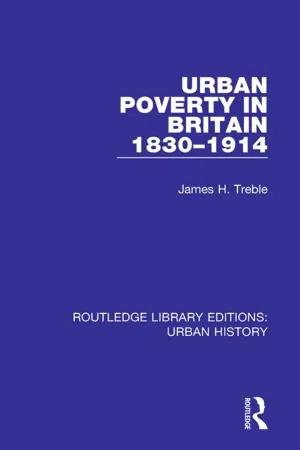
- 216 pages
- English
- ePUB (mobile friendly)
- Available on iOS & Android
eBook - ePub
Urban Poverty in Britain 1830-1914
Chapter 1
Poverty and the Urban Labour Market 1830–1914: Low Pay
Throughout these decades poverty amongst the urban able-bodied was primarily the product of a volatile, highly imperfect, and in certain areas, glutted labour market. Yet to many contemporaries this would have appeared to be a harsh verdict, for the operation of Adam Smith’s ‘invisible hand’, despite the social strains generated by significant structural changes in industry, had yielded substantial benefits to the working classes. New processes and growth points during the course of these years had widened significantly the spectrum of occupations available to the working man and facilitated his transference from the relatively poorly rewarded sectors of the economy, agriculture among them, to more highly remunerated urban outlets. Tangible indicators of this process of change were, to the trained eye of the social observer, everywhere apparent. At their most spectacular they were represented by the creation of new settlements whose fortunes were often linked to a single industry. Crewe, Wolverton and Swindon were essentially the creation of the railway industry, while the transformation of Jarrow and Barrow-in-Furness in the post-1860 era owed much to their ability to exploit the burgeoning iron shipbuilding market. Similarly Coatbridge in Lanarkshire and Middlesborough in the North Riding were to develop, in the post-1830 world, from humble rural origins into mature industrial communities upon foundations of coal, iron and steel. But of perhaps greater significance than this kind of striking discontinuity in social experience was the impact of economic growth upon areas with traditional industrial backgrounds. For example, Coventry’s prosperity had in the 1830s and 1840s, been intimately bound up with the silk-ribbon industry. But after 1870, beginning with the manufacturing of sewing machines, it was to undergo a second industrial revolution as an engineering city. By 1901 cycle and motor car production was the largest single source of employment for its male labour force. In like manner Dundee’s virtual monopoly of the jute trade began only in the 1860s, while Glasgow, dominated by cotton in the 1830s, was, by the closing years of the nineteenth century, a centre of excellence in the spheres of steel shipbuilding and marine and general engineering. Internal migration and/or a high natural rate of population increase could also, however, be generated by the growth in the volume of commodities and goods handled in Britain’s ports. Liverpool’s numbers were in large measure sustained by the growing scale of its commercial operations. In like manner the virtual trebling of Cardiff’s population between 1871 and 1911 was a reflection of its emergence as the principal port for exports from the South Wales coalfield.1 If, therefore, there were several occupations which were destroyed by technological advance in this period – handloom weaving and wool-combing among them, – contemporary middle-class opinion still believed that economic change had produced over time a balance-sheet favourable to the progress of the working classes.
Reinforcing this trend was the fact that the inevitable concomitant of industrialisation was urbanisation. As the work of Saville has demonstrated, between 1851 and 1911 many predominantly rural counties in England and Wales, including Rutland, Cornwall, Huntingdonshire, Radnor, Anglesey and Montgomeryshire, experience an actual decline in their populations. Yet others, with small elements of industry and commerce within their boundaries, lost part of their natural rate of increase to the towns. Into this last category came Oxfordshire, Lincolnshire, Dorset and Shropshire.2 In Scotland an identical pattern was to emerge. The researches of Malcolm Gray have shown that whole areas of the rural South-East of Scotland were strongly affected by migration in the post-1851 decades. In the rural parishes of East Lothian and Berwickshire there was a net migration rate of between ten and twenty per cent between 1861 and 1871. Again, in the Central District the largely rural county of Perthshire suffered an even more severe drain in numbers in the same decade.3 These trends, once begun, were not to be reversed. Indeed, between 1851 and 1891 Perthshire’s population declined in unbroken fashion, while the subsequent rise was of the most modest proportions. But as their stationary and/or falling numbers indicate, it was in some areas of the Highlands and more particularly the Borders that the pressures of rural migration were most strongly felt in the 1851–1911 period.4
The social impact of this movement was twofold. Firstly, most of these migrants helped to accelerate the already high rates of growth of Britain’s urban communities. Equally important, they were bound to shift over time the distribution of population in British society. Whereas 48.3 per cent of the population of England and Wales was described as urban-based in 1841, that figure had soared to seventy per cent four decades later.5 As with England and Wales, so with Scotland; for by the early 1870s the industrial pre-eminence of its West-Central belt was already assured, with Glasgow alone housing 16.5 per cent of the country’s people. Secondly, the very fact that the rural dweller had changed his domicile, automatically meant, in many people’s eyes, that he had increased his chances of securing improved money wages and of benefiting from some measure of upward social mobility. In this analysis urbanisation and industrialisation were thus the twin pillars upon which working-class improvement was based.
Many of the more optimistic writers in the late Victorian period tirelessly emphasised the massive dimensions of this advance. Leone Levi was to argue that between 1857 and 1884 great benefits had accrued to working classes:
In a large number of instances working men of 1857 have become middle-class men of 1884. Many a work man of that day has now a shop or an hotel, has money in the bank or shares in shipping or mills. Cases of rising from the ranks are by no means as rare as we might imagine. But working men of the present day are much better off than they were twenty-seven years ago, for all wages are higher. In 1857 the wages of common labourers were 15s. to 17s. a week; now they are from 20s. to 22s., showing an increase of 30 per cent.
More specifically, after trying to calculate how the national income was distributed between the various classes, he claimed that the average income of the families of ‘the labouring classes’ had risen by fifty-nine per cent between 1851 and 1880.6 Surveying a slightly longer time-span, Levi’s fellow social statistician, Robert Giffen, arrived at much the same verdict. According to Giffen, when account had been taken of occupational shifts, ‘there is … nothing to be astonished at in an average improvement of the money wages of “working classes” in the last fifty years [1837–1886] amounting to 100 per cent. When the facts are considered, such an improvement is, in reality, antecedently probable.’7 Finally – although this list could be considerably extended – Sir Thomas Brassey concluded in 1885 that the consensus amongst economists lent ‘no support to the vague impression which prevails that the rich are growing richer and the poor poorer than before. Progress – real progress – has been made towards a more satisfactory social order.’ By way of qualification, however, he conceded that ‘we are very far from having attained to an ideal state of perfection.’8
Few of these claims would be accepted uncritically today. Harold Perkin, in a comprehensive critique of Levi’s and Giffen’s methodology, has argued that, when allowance is made for unemployment and changes in occupational structure, the rise in average money wages was restricted to a more modest thirty-nine per cent.9 But even this estimate might err on the side of generosity since our knowledge of unemployment is largely confined to those cyclical crises which periodically afflicted the economy. What social historians tend to play down is the impact of casuality, seasonality and technological unemployment upon living standards, although there are good grounds for arguing that these forms of unemployment and underemployment actually increased between 1840 and 1890. (See Chapter 2). Nevertheless, when all these caveats have been entered and when Levi’s impressionistic evidence of social mobility on the heroic scale has been qualified, the reality of working-class advance remains. For one thing, from the 1850s onwards the friendly societies, those bastions of working-class thrift, experienced an almost uninterrupted increase in their membership until the outbreak of the First World War. Furthermore, there was increasing participation of the working classes in the savings’ bank movement, although, if the Greenock returns for 1905–6 were at all representative of the West of Scotland – 32.5 per cent of the deposits made in that year were for under £1 and 83.6 per cent for under £5 – the level of annual savings remained on the small scale.10 Other pointers to rising real income, particularly in the last four decades of our period, included the growth of industrial assurance, catering for death and funeral benefits, and the gains which accrued to whole elements of ‘the labouring classes’ from the retailing revolution, a revolution which was distinguished not only by the proliferation of privately owned multiple and departmental stores but also by the expansion of the co-operative movement in England, Wales and Scotland. Yet these landmarks to social betterment encapsulate only one aspect of the social history of the working classes. Ranged alongside them was the existence of a pervasive and widespread urban poverty problem, whose incidence fluctuated over time according to the state of trade and secular trends at work in the economy, but whose dimensions were scarcely hinted at in the published statistics relating to able-bodied pauperism in England and Wales. Most deeply entrenched amongst the unskilled, although its boundaries were by no means coterminous with the market for unskilled labour, its two salient characteristics – low pay and an irregular pattern of employment – remained unchanged throughout the period under review. It is with the first of these facets of the poverty question that the remainder of this chapter is concerned.
I
Inadequate earnings were highlighted by both Charles Booth and Seebohm Rowntree as a fundamental cause of urban poverty. Among a substantial segment of Booth’s Class D, for example, – a class which he defined as being engaged in a perpetual struggle to attain subsistence, – the head of the household was employed in work which in the late 1880s was rarely subject to ‘broken time’ but which was consistently badly paid. In like manner Rowntree discovered that 640 out of the 1465 families – or 51.95 per cent of the total – who lived in a state of primary poverty in York during 1899–1900, were thus placed because the chief wage-earner, although regularly employed, was poorly remunerated.11 This situation was not to alter in any significant respect during the business boom which preceded the outbreak of the First World War. As late as 1912–13 low pay was singled out by A.L. Bowley and A.R. Burnett-Hurst as the principal route to primary poverty amongst the population sample which they had analysed in four towns of markedly divergent socio-economic structures. As they pointed out, ‘actually one-half of the households below the poverty line at Warrington and Reading, nearly one-half at York, and one-third at Northampton were living in poverty because the wages of the head of the household were so low that he could not support a family of three children or less.’ Such poverty was thus ‘not intermittent but permanent, not accidental or due to exceptional misfortune, but a regular feature of the towns concerned.’12 But if this was the position at the beginning of the twentieth century, there can be no doubt that social deprivation existed on a much more formidable scale in the earlier part of our period, particularly in the pre-1870 era, when food and commodity prices – rent excepted – were on trend certainly higher and money earnings appreciably lower than subsequently.
Qualitative evidence to support this thesis can be found in several quarters. Leon Faucher, for instance, after a cursory discussion of the mores of Manchester’s Irish community, concluded that ‘the rate of wages for unskilled labourer (although higher in a large town like Manchester then elsewhere) is yet so low [in 1844] as to require almost constant labour to secure a living, even upon their low standard.13 Friedrich Engels, in his contemporaneous survey of the same geographical area but written from a very different ideological perspective, was not seriously to dissent from these findings. Moreover, these views of outside observers were graphically underlined by the personal testimonies of the recipients of low pay. To John White, an Irish weaver domiciled in the ‘cotton capital’ of Lancashire, low pay had meant systematic privation:
for thirteen years he had toiled for a large, a young and helpless family that never could assist him. He had worked early and late, until on three separate occasions through mere exhaustion he had fainted and fallen out of his loom … it was well known to many who were present, that during that time he had not spent twelvepence in malt liquor or anything else of the kind.14
To a female shoebinder in the London ‘slop’ shoe trade, earning 3/1½d. per week in the late 1840s, insufficient supplies of foodstuffs – ‘the way in which I take my meals generally is what I call worrying the victuals’ – were accompanied by a perpetual fear of homelessness: ‘my work wouldn’t allow me to pay rent … I live with this good woman and her husband. The rent is half-a-crown a week, and they allow me to live with them rent free … If it wasn’t for them I must go to the workhouse; out of what little I earn I couldn’t possibly pay rent.’15 To Irish rag-collectors, earning in and around Bradford 1s. to 1/6d. per day in 1849, an inadequate income meant cramped, and spartanly furnished living accommodation.16 For all it entailed a reduced expectation of life.
More recently there has been an attempt to transmute the level of poverty which prevailed amongst the lowly paid in the pre-1860 world into statistical form. John Foster, for example, using in a modified form Bowley’s revision of Rowntree’s primary poverty scale and making appropriate adjustments for the movement of prices, has argued that in 1849, a buoyant year in the national economy, fifteen per cent of Oldham’s, twenty-eight per cent of Northampton’s, and twenty-three per cent of South Shields’s, families were inadequately nourished.17 But within his sample, it was the households of the unskilled who fared worst, for whereas only fourteen per cent of the households of Oldham’s skilled factory workers experienced the devastating effects of underfeeding in their daily lives, the total for those of the labouring class was thirty-five per cent.18 Again, Anderson, employing as his ‘consumption standard … the original Rowntree primary poverty line based on York data for 1898–1900’, has concluded that approximately twenty per cent of the families included in his sample of Preston’s population in 1851, lived in a state of grinding poverty.19 Finally, Norman Murray, in a most exhaustive analysis of the living standards of the handloom weavers, has calculated that half of Scotland’s weaving population – and this includes all fabrics and all grades – fell below the primary poverty line in 1834.20 In the context of this discussion, however, these findings must be subject to certain qualifications. Firstly, while Foster and Anderson are assuming the existence of conditions of full employment for all the wage-earning members of their samples, Murray has taken into account the reality of broken time in whatever guise it appeared within the weaving community. Secondly, whereas Anderson excluded income derived from lodgers from his inquiry, Foster believed that all lodgers who were not related to the families with whom they were staying, contributed ‘1s. profit on their keep’ to the households concerned.21 Thirdly, Anderson’s sample was to some extent biased against the low paid since handloom weavers and certain female ‘sweated’ occupations – pre-eminently dressmakers and laundresses – were excluded from his remit.22 In addition, all three authors are concerned with aggregate family income and not the earnings of the male heads of households. None the less, despite the validity of these points, these data, considered as a whole, serve to provide further proof of the deleterious effect of poorly remunerated labour upon working-class living standards.
There remains, however, formidable methodological problems when an attempt is made to draw the parameters of those areas of the labour market which yielded scant financ...
Table of contents
- Cover
- Half Title
- Title Page
- Copyright Page
- Table of Contents
- Preface
- Introduction
- Chapter 1 Poverty and the Urban Labour Market 1830-1914: Low Pay
- Chapter 2 Poverty and the Urban Labour Market 1830-1914: Underemployment and Unemployment
- Chapter 3 Other Causes of Poverty 1830-1914 91
- Chapter 4 The Alleviation of Poverty Among The Abie-Bodied 1830-1914: A Study of Palliatives and Expedients
- Chapter 5 The Socio-Economic Characteristics of Poverty 1830-1914: Food and Housing
- Conclusion
- Sources and References
- Index
Trusted by 375,005 students
Access to over 1.5 million titles for a fair monthly price.
Study more efficiently using our study tools.
Frequently asked questions
Yes, you can cancel anytime from the Subscription tab in your account settings on the Perlego website. Your subscription will stay active until the end of your current billing period. Learn how to cancel your subscription
No, books cannot be downloaded as external files, such as PDFs, for use outside of Perlego. However, you can download books within the Perlego app for offline reading on mobile or tablet. Learn how to download books offline
Perlego offers two plans: Essential and Complete
- Essential is ideal for learners and professionals who enjoy exploring a wide range of subjects. Access the Essential Library with 800,000+ trusted titles and best-sellers across business, personal growth, and the humanities. Includes unlimited reading time and Standard Read Aloud voice.
- Complete: Perfect for advanced learners and researchers needing full, unrestricted access. Unlock 1.5M+ books across hundreds of subjects, including academic and specialized titles. The Complete Plan also includes advanced features like Premium Read Aloud and Research Assistant.
We are an online textbook subscription service, where you can get access to an entire online library for less than the price of a single book per month. With over 1.5 million books across 990+ topics, we’ve got you covered! Learn about our mission
Look out for the read-aloud symbol on your next book to see if you can listen to it. The read-aloud tool reads text aloud for you, highlighting the text as it is being read. You can pause it, speed it up and slow it down. Learn more about Read Aloud
Yes! You can use the Perlego app on both iOS and Android devices to read anytime, anywhere — even offline. Perfect for commutes or when you’re on the go.
Please note we cannot support devices running on iOS 13 and Android 7 or earlier. Learn more about using the app
Please note we cannot support devices running on iOS 13 and Android 7 or earlier. Learn more about using the app
Yes, you can access Urban Poverty in Britain 1830-1914 by James Treble in PDF and/or ePUB format, as well as other popular books in History & World History. We have over 1.5 million books available in our catalogue for you to explore.