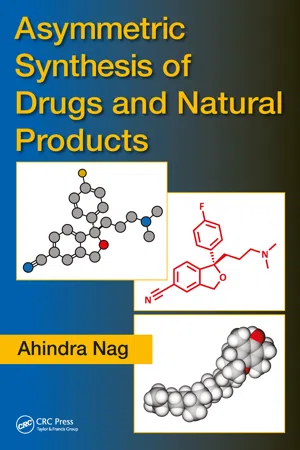
This book focuses on different techniques of asymmetric synthesis of important compounds, such as drugs and natural products. It gives insightful information on recent asymmetric synthesis by Inorganic, Organic and Enzymatic combinations. It also emphasizes chiral compounds and design of new catalyst for synthesis of compounds.
- 498 pages
- English
- ePUB (mobile friendly)
- Available on iOS & Android
eBook - ePub
Asymmetric Synthesis of Drugs and Natural Products
About this book
Information
1
Basic Stereochemical Approaches to Natural Products and Drugs
CONTENTS
1.1Basic Concept of Chirality
1.2Meso Compounds
1.3Tautomerism and Valance Tautomerism
1.4Conformation
1.5Fischer Projection and Absolute Configuration
1.6Chiral Resolution
1.6.1Crystal Picking
1.6.2Chemical Separation
1.6.3Biochemical Separation
1.6.4Chromatographic Separation
1.7Application of Enantiomers in Drugs and Natural Products
Problems
Answers
References
1.1Basic Concept of Chirality
An asymmetric carbon atom (known as the stereogenic center) is attached to four different groups1 termed a chiral (pronounced as kiral). The word chiral derives from the Greek word cheira meaning hand, which is closely related to optical activity. For a molecule to have chirality, it must not possess a plane, a center, or a fourfold alternating axis of symmetry. Molecules which are mirror images of each other are termed enantiomers (from the Greek entatios meaning opposite) and need chiral recognition to be separated. Enantiomers react1,2,3,4,5,6 at different rates with other chiral compounds and may have different solubilities in the presence of an optically active solvent. They may display different absorption spectra under circulatory polarized light. Enantiomers may have different optical rotations, which could be either (+), that is, dextrorotatory (clockwise), or (−), that is, levorotatory (anticlockwise), and can be determined by a polarimeter. The optical purity of a mixture of enantiomers is given by
where
αobs is the experimentally observed rotation
c is the concentration in g/mL
l is the path length of the cell used, expressed in dm (=10 cm)
Enantiomeric excess7 is one of the indicators of the success of an asymmetric synthesis. The enantiomeric excess (eep) of a product is determined by chromatographic methods using the following formula:
where [d] and [l] are the concentrations of the mixture of the products.
Enantiomeric ratio7 (E) is calculated from the extent of conversion (c) and the enantiomeric excess (eep) of the product using the following equation:
The stereoisomers of a compound that are not mirror images of each other are termed diastereomers (Figure 1.1). They have different physical characteristics, such as refractive indices, specific rotations, melting and boiling points, crystalline structures, and different solubilities in different solvents. They possess different chemical properties when reacted with chiral and achiral reagents and different rates of reaction due to different values of ΔH. Diastereoselectivity2 is the preference for the formation of one or more diastereomers over the other in an orga...
Table of contents
- Cover
- Halftitle Page
- Title Page
- Copyright Page
- Contents
- Preface
- Contributors
- Chapter 1 Basic Stereochemical Approaches to Natural Products and Drugs
- Chapter 2 Diastereoselective Addition of Organometallic Reagents to Chiral Carbonyl Compounds
- Chapter 3 Enantiomerically Pure Compounds by Enantioselective Synthetic Chiral Metal Complexes
- Chapter 4 Chirality Organization of Peptides and π-Conjugated Polyanilines
- Chapter 5 Diastereoselective Syntheses of 3,4,5-Trihydroxypiperidine Iminosugars
- Chapter 6 Use of Specific New Artificial or Semisynthetic Biocatalysts for Synthesis of Regio- and Enantioselective Compounds
- Chapter 7 Bioactive Natural Products and Their Structure–Activity Relationships Studies
- Chapter 8 Asymmetric Biocatalysis in Organic Synthesis of Natural Products
- Chapter 9 Asymmetric Synthesis of Biaryls and Axially Chiral Natural Products
- Chapter 10 Palladium-Catalyzed Asymmetric Transformations of Natural Products and Drug Molecules
- Chapter 11 Enantioselective Organocatalysis from Concepts to Applications in the Synthesis of Natural Products and Pharmaceuticals
- Chapter 12 Chiral Building Blocks for Drugs Synthesis via Biotransformations
- Chapter 13 Chiral Medicines
- Chapter 14 Drug Delivery Systems
- Problems to Be Solved
- Index
Trusted by 375,005 students
Access to over 1.5 million titles for a fair monthly price.
Study more efficiently using our study tools.
Frequently asked questions
Yes, you can cancel anytime from the Subscription tab in your account settings on the Perlego website. Your subscription will stay active until the end of your current billing period. Learn how to cancel your subscription
No, books cannot be downloaded as external files, such as PDFs, for use outside of Perlego. However, you can download books within the Perlego app for offline reading on mobile or tablet. Learn how to download books offline
Perlego offers two plans: Essential and Complete
- Essential is ideal for learners and professionals who enjoy exploring a wide range of subjects. Access the Essential Library with 800,000+ trusted titles and best-sellers across business, personal growth, and the humanities. Includes unlimited reading time and Standard Read Aloud voice.
- Complete: Perfect for advanced learners and researchers needing full, unrestricted access. Unlock 1.5M+ books across hundreds of subjects, including academic and specialized titles. The Complete Plan also includes advanced features like Premium Read Aloud and Research Assistant.
We are an online textbook subscription service, where you can get access to an entire online library for less than the price of a single book per month. With over 1.5 million books across 990+ topics, we’ve got you covered! Learn about our mission
Look out for the read-aloud symbol on your next book to see if you can listen to it. The read-aloud tool reads text aloud for you, highlighting the text as it is being read. You can pause it, speed it up and slow it down. Learn more about Read Aloud
Yes! You can use the Perlego app on both iOS and Android devices to read anytime, anywhere — even offline. Perfect for commutes or when you’re on the go.
Please note we cannot support devices running on iOS 13 and Android 7 or earlier. Learn more about using the app
Please note we cannot support devices running on iOS 13 and Android 7 or earlier. Learn more about using the app
Yes, you can access Asymmetric Synthesis of Drugs and Natural Products by Ahindra Nag in PDF and/or ePUB format, as well as other popular books in Physical Sciences & Pharmaceutical, Biotechnology & Healthcare Industry. We have over 1.5 million books available in our catalogue for you to explore.