This book, first published in 1948, examines four industries studied as part of the Nuffield College Reconstruction Survey, begun in 1941. These studies, despite their apparent diversity, have a number of features in common. One is geography, and another, more pressing, is the relation of industry to the Government and the public. The studies serve as part of the historical background of reconstruction, and they carry many lessons in economic organization.
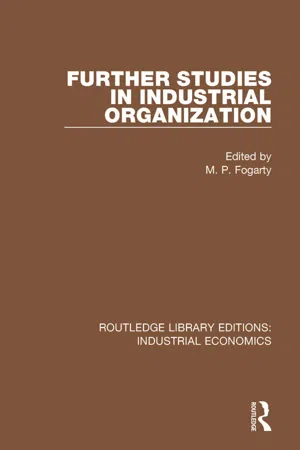
- 238 pages
- English
- ePUB (mobile friendly)
- Available on iOS & Android
eBook - ePub
Further Studies in Industrial Organization
CHAPTER I
FLOUR-MILLING
By Mrs. H. V. EDWARDS
FLOUR-MILLING represents one of the most highly mechanized and organized industries of modern times. The basic principles on which the processes of milling are founded are, of course, far from new. Corn was being ground on handstones or querns as far back as six thousand years ago. Mechanization of the milling operation developed gradually throughout the centuries. At first millstones were driven by hand or by cattle; the next stage was the development of the water-wheel about 400 or 500 B.C., and this method was common until windmills began to come into prominence some thousand years later. The windmill-watermill era continued up to the time of the invention of the steam engine, the first steam-driven mills being operated in 1784. All these methods were similar in principle as far as the actual milling of the grain was concerned, and it was only the driving mechanism which underwent any real changes. In the latter half of the eighteenth century, however, experiments were made abroad on a new type of milling process, which reduced the grain not by simple crushing or grinding, but by a more gradual and gentle method. The new type of mill was called the roller mill, and it consisted in essence of two metal rollers, each with a finely toothed surface, which in turning against each other broke open the grain without crushing it. The new method remained in the experimental stage for many years, and it was not until the 1820’s that serious attention was paid to it on any commercial scale. From this time onward improvements and further developments in technique proceeded apace, and by the 1870’s the roller system had obviously come to stay. German millers in particular were using rollers to a considerable extent. The British milling industry had not yet taken up the new process, but were now definitely showing signs of interest, and in 1877 a deputation of millers went to Hungary to see the roller mill for themselves, and were favourably impressed. Four years later a demonstration was held in the Agricultural Hall, London, at which a number of complete milling plants were erected and operated. In the next decade the new system was quickly adopted by a number of the more progressive millers in this country, most of whose names are famous in the industry to-day.
At the same time the structure of the industry was undergoing a radical alteration. This came about through the large-scale development of wheat-farming in the prairie countries at a cost considerably lower than was possible at home. Home wheat production in consequence entered a period of rapid decline, and failed to keep pace with the consumption needs of a rapidly growing population. Imported wheat supplies advanced in importance, until in 1939 they accounted for about nine-tenths of the flour-milling industry’s requirements.
Thus the development of the industry and changes in its structure came about in two main ways: the development of mechanization led to the concentration of production in larger units; and the growing dependence on wheat imports led to the location of mills at the ports, country mills declining in importance as home-grown crops contributed a decreasing proportion of the industry’s supplies, and as the large units at the ports invaded their markets.
Between the beginning of the century and the outbreak of the Great War development along both these lines was taking place at a fairly rapid rate. The War of 1914-18 arrested this development, and to a certain extent reversed the trends of the preceding years. The need to economize in shipping made for a considerable increase in the use of home-grown grain, and this brought with it a resuscitation of the country mills, many of which expanded their output considerably beyond pre-war production. Consequently, at the end of control in 1921 there was an excess of productive capacity, and a period of intense competition followed, during which the industry experienced very lean times. Only the strong were able to survive. At the end of the ’twenties the industry, through the leadership of the largest concerns, got together and reorganized. The total capacity of the industry was reduced to proportions commensurate with the country’s current consumption, and output was fixed between mill and mill so as to prevent over-production. This was, in fact, a classic example of rationalization. The organization remained solid during the ensuing ten years up to the outbreak of war in 1939—though it was showing some signs of wavering towards the end—and during this period the industry enjoyed considerable prosperity.
The industry itself is singularly clear-cut, representing as it does a processing rather than a manufacturing industry. There is no great diversity of either raw materials or of products, though both are of many different grades and prices. Mechanization, in virtue of the extreme regularity and standardized nature of production, has been able to advance to very great lengths; and this industry, which produces sufficient flour for the needs of over forty million people, employs the services of only about 15,000 operatives.
The milling industry of Great Britian to-day claims to be the foremost in the world, and there are no serious contestants to this claim. On the technical side, British milling engineers have for years been the forerunners in many fields of development; and the British milling industry has achieved a standard of organization not surpassed in any other country in the world.
TECHNICAL PROCESSES
Modern milling, as has been said, is very highly mechanized. In the most modern mills the whole system, from the arrival of the grain at the mill to the delivery of the flour and meal in bags, is completely mechanized, and it is said that the only scope for further mechanization (apart from minor improvements of design of existing machinery) lies in more complete automatic control, though this is already far advanced. There are one or two mills specializing in stone-ground flour which operate on the old principles of grinding, but apart from these one or two exceptions the methods and machinery used are the same throughout the industry, in both large and small mills. The latter lack the elaborate systems and specialized machinery of the larger units, but in the main part of the milling process the machinery is essentially similar, and the larger units merely comprise greater numbers of the respective machines.
The passage of the material through a mill from the grain to the flour stages usually takes place in a downward direction from the top floor of the mill to ground-level, in order to make full use of gravity in the transfer of the grain from one stage to the next. A mill may comprise anything from four to seven floors, though many of the smaller mills may have fewer than four. Intake of the grain at all but the smallest mills is by elevator or suction. Bucket elevators are employed at some of the medium-size mills, but where the volume of grain used is large enough to justify them pneumatic suction plants are generally employed. The grain is received in a storage silo, sometimes receives a preliminary cleaning, and is transferred as required to a small service silo feeding the wheat-cleaning plant or screen-room. In the case of the large modern mills the silos are of reinforced concrete; in many small- to medium-size mills they are of laminated wood. Silos normally hold at least one month’s wheat requirements, which in the case of the larger mills amounts to some 5,000 tons. In the screen-room all impurities are removed from the grain by special sorting machines which throw off the various types of foreign matter (or ‘screenings’) into their respective groups, such as maize, oats, barley, or melilot. The wheat is now washed and, in all but the smaller mills, is conditioned by heating and by augmenting or diminishing the moisture content in order to bring the grains to the most suitable texture for the milling process which follows.
The actual milling process is extremely elaborate in practice, but the principles involved are clear. It is a very gradual process, and its aim is to separate the outer parts of the grain from the starchy interior. A normal wheat grain consists of about 83 per cent of endosperm, which is the inner portion of the grain and forms the food reserve on which the wheat embryo or ‘germ’ draws for its early growth. This portion consists mainly of starchy material and provides the basic raw material of white flour. The outer layers of the grain form about 15 per cent of its weight and are commonly known as bran. The germ, which is easily detected in the grain on account of its oily appearance, makes up about 2 per cent of the wheat. This, being the live part of the grain, is rich in both fats and vitamins, and provides one of the main sources of natural vitamin B.
The mechanical operations involved are carried out on series of rollers, and the stages in the passage of the wheat through the mill are broadly as follows:
1. Breaking open of the wheat grain and scraping the interior endosperm (which yields the flour proper) from the outer skins (which make up the bran) in successive stages. This is carried out on the ‘Break’ Rolls, of which there are normally four sets. They consist of a pair of finely fluted cylindrical rollers, usually about three feet long, revolving at different speeds. After the grain has passed through the first ‘break’ the resultant stock is sifted and graded by being passed over sieves of progressively finer mesh (now commonly carried out by means of the agitating Plansifter, which has an action similar to ordinary hand-sieving); and the fine flour and bran made during the roller process are also drawn off by purifiers, which carry out the division by a combination of sieving and separation by means of air currents (or ‘aspiration’). The numerous grades of stock separated off by this sorting process are passed through to the appropriate processing rollers—either the next Break Roll or the Reduction Rolls. A similar process of sifting, grading, and sending the stocks forward to different parts of the mill follows the passage through each of the four Break Rolls.
2. The reduction rolls grind the stock down into flour, each different type of stock going to a different roll.
3. The flours and meals ground on the reduction rolls are now ‘dressed’, i.e. sifted through silk bolting cloths of varying mesh. The number of grades of flour produced in the mill varies: in the larger mills the number of grades usually falls between twenty and thirty; the smaller country mills usually limit themselves to about five.
4. The different varieties of flour are made by running together proportions of selected grades.
5. The coarser parts of the wheat grain, representing about 30 per cent of its weight (in normal times), are also divided off into various grades of wheat feed (or offals as they were formerly called); these are used for cattle feed. The germ, which may or may not be drawn off from the stock, is generally separated off about halfway through the milling process. Some of the germ is unavoidably mixed in with the flour, and if it is not sifted off the rest of the germ finds its way into the feed.
All the different grades of stock and flour which are separated out during the milling process are examined from time to time during the day. The different stocks are laid out in piles and are tested, usually by the foreman, for texture and colour. In this way faults which may have occurred in the machinery, or adjustments which might with advantage be made in their setting, are determined. The finished flour stocks graduate in colour from the creamy white types to the light brown tones of those which are nearest to the feed stocks.
The reason for the success of the roller milling process was that it enabled the endosperm of the wheat grain to be more completely freed from the outer skins of the grain and from the germ. Under the older method of milling by grindstones much of the outer husk was reduced to powder and could not be separated off from the flour. This, by present ...
Table of contents
- Cover
- Half Title
- Title Page
- Copyright Page
- Table of Contents
- PREFACE
- INTRODUCTION
- I. FLOUR MILLING: Mrs. H. V, Edwards
- II. THE WHITE FISH INDUSTRY: R. K. Kelsall, in collaboration with Professor H. Hamilton, Dr.F. A. Wells, and K. C. Edwards.
- III. THE GRANITE INDUSTRY: Professor H. Hamilton
- IV. THE BREWING INDUSTRY OF EDINBURGH: Dr. Mary Rankin
- INDEX
Trusted by 375,005 students
Access to over 1.5 million titles for a fair monthly price.
Study more efficiently using our study tools.
Frequently asked questions
Yes, you can cancel anytime from the Subscription tab in your account settings on the Perlego website. Your subscription will stay active until the end of your current billing period. Learn how to cancel your subscription
No, books cannot be downloaded as external files, such as PDFs, for use outside of Perlego. However, you can download books within the Perlego app for offline reading on mobile or tablet. Learn how to download books offline
Perlego offers two plans: Essential and Complete
- Essential is ideal for learners and professionals who enjoy exploring a wide range of subjects. Access the Essential Library with 800,000+ trusted titles and best-sellers across business, personal growth, and the humanities. Includes unlimited reading time and Standard Read Aloud voice.
- Complete: Perfect for advanced learners and researchers needing full, unrestricted access. Unlock 1.5M+ books across hundreds of subjects, including academic and specialized titles. The Complete Plan also includes advanced features like Premium Read Aloud and Research Assistant.
We are an online textbook subscription service, where you can get access to an entire online library for less than the price of a single book per month. With over 1.5 million books across 990+ topics, we’ve got you covered! Learn about our mission
Look out for the read-aloud symbol on your next book to see if you can listen to it. The read-aloud tool reads text aloud for you, highlighting the text as it is being read. You can pause it, speed it up and slow it down. Learn more about Read Aloud
Yes! You can use the Perlego app on both iOS and Android devices to read anytime, anywhere — even offline. Perfect for commutes or when you’re on the go.
Please note we cannot support devices running on iOS 13 and Android 7 or earlier. Learn more about using the app
Please note we cannot support devices running on iOS 13 and Android 7 or earlier. Learn more about using the app
Yes, you can access Further Studies in Industrial Organization by M.P. Fogarty in PDF and/or ePUB format, as well as other popular books in Business & Business General. We have over 1.5 million books available in our catalogue for you to explore.