- 482 pages
- English
- ePUB (mobile friendly)
- Available on iOS & Android
eBook - ePub
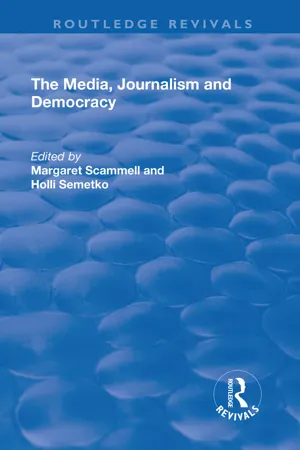
The Media, Journalism and Democracy
About this book
This title was first published in 2000. Offering original insights into the relationship between media and democratic theory, this volume brings together a renowned collection of international specialists who examine media and democracy, professional journalism, the anatomy of content and the current issues which concern both institutions. Challenging conventional discourse, this comprehensive collection contains the most incisive and informative articles on this fundamental subject.
Information
Part I
Media and Democracy: Key Debates
[1]
For the Negative
THOMAS E. PATTERSON
Fourth Branch or Fourth Rate? The Press's Failure to Live Up to the Founders' Expectations
The founders were philosophical liberals. They believed in the Lockean ideal of negative government, which holds that government governs best by staying out of people's lives, thus giving individuals as much freedom as possible to determine their own pursuits. The First Amendment said no to government: "Congress shall make no law... abridging the freedom of speech, or of the press."
The First Amendment was a response to the autocratic rule of kings and mandarins. In the democratic constitutions that were written a century later, after the Industrial Revolution had produced unforeseen concentrations of private power, there were also provisions for positive government. It no longer made sense to believe that government was the sole threat to liberty or that government action invariably threatened freedom. Private power could be suffocating, and public power could be liberating. In some situations, greater freedom was possible only if government intervened to redress inequities, to establish the conditions that would help people to realize their human potential, or to impose public obligations on private organizations.
The First Amendment was also a reflection of the nature of the late 18th century press. In 1791 there were no mass media of communication. A large newspaper counted its circulation in the hundreds, not in the hundreds of thousands. Also, there was no journalism—there were no reporters and no news stories. The First Amendment was ratified to protect the expression of opinion, not the production of information. The printer and the pamphleteer were the press.
A century later, the press was a very different institution. Newspaper ownership had outpriced even the political parties, much less the average citizen. Social and technological change had made possible a national news system centering on the wire services and mass-circulation newspapers. Shortly after the turn of the century, Charles Horton Cooley (1909) wrote that the change was so substantial "as to constitute a new epoch in communication" (pp. 80-81). The 20th century would bring a further transformation in the form of the radio and television networks and a pattern of chain ownership that would eventually embrace three fourths of the nation's dailies (Bagdikian, 1990).
Any realistic evaluation of whether the press has met the founders' expectations must be made in the context of the great changes that have taken place in the two centuries since the First Amendment was written. Even if the debate were narrowly confined to legal grounds, the standards of 1791 would not apply. The question of constitutional interpretation is not how the founders would settle today's disputes by yesterday's standards but what they had in mind by a particular provision. The founders' expectations, moreover, cannot be settled by mere reference to legal briefs. The critical question is one of sustained performance: What has the press done in its 200-year history to enhance free expression in America?
I will argue that the establishment press has done a poor job of responding to the challenge of the First Amendment. I will suggest that the establishment press has done remarkably little to enhance the First Amendment, that the establishment press has an overly self-centered conception of the First Amendment, and that the establishment press has squandered its precious First Amendment rights on a commercial binge that has lasted for more than a century and a half.
Whither the Intrepid Press?
The Pentagon Papers and the Watergate affair are towering achievements in the history of the First Amendment. For a few years in the early 1970s, the establishment press resisted attempts by government to quiet its voice and, in the process, greatly strengthened the nation's commitment to constitutionalism.
The Pentagon Papers and the Watergate affair, however, are lonely outposts in the history of the press and the First Amendment. During the entire 19th century, for example, there was no Supreme Court case that emerged from a titanic battle between the press and the national government over the limits of the First Amendment.
It was not until two cases in 1919 that the Supreme Court offered a judgment on the First Amendment. Neither case was provoked by an intrepid journalist who had challenged the powers that be. The defendants were draft protesters and anarchists who had been arrested and convicted for protesting America's involvement in World War I. In upholding their convictions under the Espionage Act of 1917, the Supreme Court rejected a literal interpretation of the First Amendment. The Court held in Schenck, 249 U.S. 47 (1919), that the "make no law" provision of the First Amendment did not apply to actions that posed "a clear and present danger" to the nation's security. The mainstream press had no apparent objection to this restriction on the First Amendment.1 Astonishingly, the press did not even protest the Abrams (250 U.S. 616, 1919) decision that narrowed free expression severely by saying that it could be prohibited whenever it promoted a "bad tendency."
Twelve years later, the establishment press, with some reluctance, backed Jay Near's case when it reached the Supreme Court. Mr. Near was the publisher of a Minneapolis weekly newspaper that regularly made scurrilous attacks on Blacks, Jews, Catholics, and labor union leaders. His paper was closed down on authority of a state law that banned "malicious, scandalous, or defamatory" publications. Near appealed the shutdown, and the Supreme Court ruled in his favor, saying that the Minnesota law was "the essence of censorship" (Near v. Minnesota, 283 U.S. 697 [1931]). This was a landmark decision; it was the first time the Supreme Court had addressed the issue of prior restraints, and it protected press freedom from infringement by the states (the First Amendment applied originally to action by the federal government only). However, the mainstream Minnesota newspapers and much of the New York press hesitated in their support for Near. The Minneapolis Star was the only major newspaper in Minnesota to laud the Supreme Court's decision but said in an editorial: "The court's decision need not signalize the return of scandal sheets to Minnesota. There are laws enough to handle the situation if they are used and enforced with nerve and determination" (Friendly, 1981, p. 158).
Two decades later, during the early years of McCarthyism, the press was strangely silent as the junior senator from Wisconsin waged his vulgar war on free expression. Based on his study of news content during the McCarthy period, the newspaperman Edwin R. Bayley (1981) concluded the following:
What is most surprising in the examination of newspaper performance in the McCarthy period is not that so much news of McCarthy was published in some papers, but how little was published in many others, especially in the first years. The timidity of the wire services, the fear of controversy on the part of publishers, and an apparent lack of understanding of the importance of the issue by many editors worked to deprive many readers of full information ... The editing of McCarthy stories seemed singularly inept. Wire service stories containing important news were often overlooked, and choked-up overnight leads took the play; the few interpretive pieces by agency reporters were iargely ignored by editors; headlines seemed to substantiate McCarthy's charges and even to exaggerate them.
(pp. 218-219)
Press freedom received a major boost in New York Times Co. v. Sullivan, 376 U.S. 259 (1964), but the achievement cannot reasonably be credited to the press. The case began, not with the action of a journalist, but with a Times advertisement in which civil rights leaders accused Alabama officials of physically abusing black citizens during civil rights demonstrations. An Alabama state court found the Times guilty of libel for printing the advertisement, which compelled the newspaper to appeal the decision. The Supreme Court ruled that libel of a public official requires proof of actual malice, which was defined as a knowing or reckless disregard for the truth with intent to damage the official's reputation. This imposing standard of proof for libel is a monument to the Court's commitment to the civil rights movement rather than to the press itself.
The United States' involvement in the Persian Gulf War provides a recent example of the establishment press's less-than-zealous pursuit of First Amendment freedoms. The press was substantially restricted during the war. Military authorities severely limited journalists' travel and required reporters to have a military escort; allowed journalists to interview only selected soldiers and usually had a superior officer standing nearby as the interviews took place; and subjected all news reports to review by military censors. Journalists critical of the war were kept out of the media pool, which included a small number of journalists who were allowed to act as stand-ins for the full press corps. The American press only mildly protested the military's tight censorship. A suit by The Nation and other liberal publications that charged that the censorship policy imposed an unconstitutional prior restraint on freedom of the press was not joined by a single major news organization, print or television.
The establishment press, in summary, has avoided the forefront of the fight for free expression in the United States. Although a chief beneficiary of the gains from the struggle, the press has contributed surprisingly little to what has been won.
Whose Amendment Is It Anyway?
The writers of the Constitution were practitioners of the art of intentional ambiguity. They meant for their document to last for generations, which required that it espouse first principles and that it do so in the most general of terms (Levy, 1985, p. 348). The founders used expansive words, as illustrated by the "necessary and proper" clause (or, as it is called, the elastic clause) that was used in granting Congress the authority to make the laws that would carry out its enumerated powers. There is no reason to believe that the First Amendment was the exception to this constitutional approach. The First Amendment's prohibition on actions that would inhibit free expression was boldly stated. As Levy (1985) has noted, the founders "gave constitutional recognition to the principle of freedom of speech and press in unqualified and undefined terms" (p. 349).
This expansive notion of the First Amendment was expressed in the constitutional argument that justice Oliver Wendell Holmes put forth in his opinions on the Schenck and Abrams cases. His opinion in Abrams, which Lerner (1943) described as "the greatest utterance on intellectual freedom by an American" (p. 306), argued that the First Amendment was intended to foster a "free trade in ideas" (p. 306) that can exist only when government allows for free expression and only when citizens have reasonable opportunities to have their opinions heard in the marketplace.
Holmes's argument was not a 20th-century facelift to a 1791 idea. Holmes was acknowledging that the great changes in the economy, society, and communication required a concept of press freedom that recognized the rights of leaders and audiences in addition to the rights of media owners and media professionals.
The principles that Holmes expounded were similar to those embodied in the Federal Communications Act of 1934. Broadcasters would be substantially free from governmental interference but would be obligated to give voice to opposing candidates for public office. Later, the fairness doctrine imposed a positive obligation on broadcasters to recognize the communication rights of their audience: They would be required to cover important issues of public concern and would have to air opposing positions on these issues. Broadcasters could take positions on public issues, but they could not use their privileged position as the holder of a scarce frequency to suppress the views of those with whom they disagreed.
Broadcasters rejected the notion that the First Amendment gave the listening public any right to hear ideas that the broadcasters did not want them to hear. The broadcast industry fought against the fairness doctrine from the beginning, and the issue finally reached the Supreme Court in the late 1960s. In Red Lion Broadcasting Co. v. FCC, 395 U.S. 367 (1969), the Supreme Court upheld the constitutionality of the fairness doctrine, applying much of the same reasoning that Holmes had used a half century earlier. The Court said: "It is the purpose of the First Amendment, to preserve an uninhibited marketplace of ideas in which truth will ultimately prevail, rather than to countenance monopolization of that market, whether it be by the Government itself or a private licensee" Red Lion Broadcasting Co. v. FCC, 395 U.S. The Red Lion decision articulated a trustee model of public communication in which the paramount interest is that of the public and not that of the news organization, which, in return for its privileged position, must serve the public's interest rather than its own.
Broadcasters argued that the Red Lion decision betrayed two centuries of tradition, an argument that was not factually true. State cases in the 19th century (the First Amendment did not apply to state authority until the early 1900s when it was selectively incorporated through the Fourteenth Amendment) were settled by the common law principle of the public benefits of that expression, not by the principle that press freedom entails no obligations on the part of its user (Gleason, 1990, p. 4). Furthermore, the idea that freedom of the press is the right of a small group of citizens only cannot be reconciled with the founders' philosophy. Rights were seen as inalienable—held by all and surrenderable by none. This view of the First Amendment was affirmed by the Supreme Court in Associated Press v. U.S., 326 U.S. 20 (1945):
Surely a command that the government itself shall not impede the free flow of ideas does not afford non-governmental combinations a refuge if they impose restraints upon that constitutionally guaranteed freedom. Freedom to publish means freedom for ail and not for some.
(326 U.S. 20, 1945)
However, many journalists today apparently think that press freedom is their private preserve. U.S. journalists were asked in a recent survey whether they believed press freedom "is intended primarily to enable the news media to freely communicate the information and opinions they deem important [or whether it] is intended primarily to enable the many groups in society to freely express the values and beliefs they deem important." Only 24% of the respondents said press freedom exists primarily for the society's sake.2
In claiming freedom of the press as an exclusive right, the media assume the power to decide who else will also enjoy the right and under what conditions their right will be recognized. The groups who are likely to be kept out are the unpopular ones, precisely those whose voices were meant to be protected through the First Amendment. However, even this concern is beside the point. The question of constitutional rights is not a question of noblesse oblige. Freedom of the press has very little meaning in a mass society unless interests have a right to have their views expressed through the mass media of communication (Barron, 1973). At present, they do not have that right: "From a marketplace of ideas perspective, the dominant trend is that media institutions have arisen to monopolize the marketplace, gradually forcing out the individual's voice" (Schwarzlose, 1989, 34).
Why do the American media have such a self-centered view of press freedom? Part of the answer is undoubtedly found in the American legal tradition, but I would submit that the answer rests also with the historical development of American journalism. The press, as I argued in the previous section, has gone through history without much testing and debate of its constitutional rights and responsibilities. The First Amendment and journalism did not grow up together; theirs is not a deeply nurtured relationship.
As a result, journalists' notions of press freedom are, in a word, immature. Journalists conveniently overlook the fact that they are themselves the instruments of a powerful institution. In all aspects—technology, markets, ownership patterns, and influence—the media bear little resemblance today to the press that the founders sought to protect. The media, indeed, have the very characteristic the founders wanted to protect against—the awesome capacity to restrict the boundaries of public debate.
Journalists use th...
Table of contents
- Cover
- Half Title
- Title
- Copyright
- Contents
- Acknowledgements
- Series Preface
- Introduction
- PART I MEDIA AND DEMOCRACY: KEY DEBATES
- PART II PROFESSIONAL JOURNALISM: TOWARDS UNIVERSAL NORMS
- PART III NEWS: THE ANATOMY OF CONTENT
- PART IV MEDIA AND JOURNALISM: NEW CHALLENGES IN A CHANGING WORLD
- Name Index
Trusted by 375,005 students
Access to over 1.5 million titles for a fair monthly price.
Study more efficiently using our study tools.
Frequently asked questions
Yes, you can cancel anytime from the Subscription tab in your account settings on the Perlego website. Your subscription will stay active until the end of your current billing period. Learn how to cancel your subscription
No, books cannot be downloaded as external files, such as PDFs, for use outside of Perlego. However, you can download books within the Perlego app for offline reading on mobile or tablet. Learn how to download books offline
Perlego offers two plans: Essential and Complete
- Essential is ideal for learners and professionals who enjoy exploring a wide range of subjects. Access the Essential Library with 800,000+ trusted titles and best-sellers across business, personal growth, and the humanities. Includes unlimited reading time and Standard Read Aloud voice.
- Complete: Perfect for advanced learners and researchers needing full, unrestricted access. Unlock 1.5M+ books across hundreds of subjects, including academic and specialized titles. The Complete Plan also includes advanced features like Premium Read Aloud and Research Assistant.
We are an online textbook subscription service, where you can get access to an entire online library for less than the price of a single book per month. With over 1.5 million books across 990+ topics, we’ve got you covered! Learn about our mission
Look out for the read-aloud symbol on your next book to see if you can listen to it. The read-aloud tool reads text aloud for you, highlighting the text as it is being read. You can pause it, speed it up and slow it down. Learn more about Read Aloud
Yes! You can use the Perlego app on both iOS and Android devices to read anytime, anywhere — even offline. Perfect for commutes or when you’re on the go.
Please note we cannot support devices running on iOS 13 and Android 7 or earlier. Learn more about using the app
Please note we cannot support devices running on iOS 13 and Android 7 or earlier. Learn more about using the app
Yes, you can access The Media, Journalism and Democracy by Margaret Scammell,Holli Semetko in PDF and/or ePUB format, as well as other popular books in Politics & International Relations & Political Process. We have over 1.5 million books available in our catalogue for you to explore.