eBook - ePub
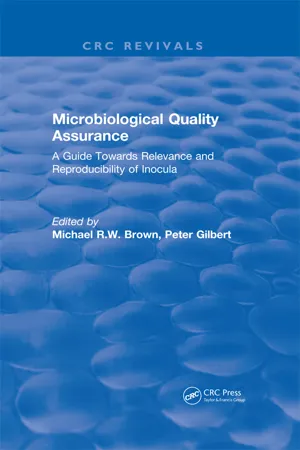
Microbiological Quality Assurance
A Guide Towards Relevance and Reproducibility of Inocula
- 317 pages
- English
- ePUB (mobile friendly)
- Available on iOS & Android
eBook - ePub
Microbiological Quality Assurance
A Guide Towards Relevance and Reproducibility of Inocula
About this book
Microbiological Quality Assurance: A Guide Towards Relevance and Reproducibility of Inocula sheds light on the difficulties of obtaining results in the test tube that will be reproducible and relevant for a wide variety of tests. This book explores the current state of research in this area and troubleshoots the problems that may be encountered in setting up appropriate cultures. The text divides naturally into three sections-growth conditions, post-growth conditions, and applications. This book serves as a valuable resource for clinical microbiologists, pharmacologists, and anyone doing in vitro experiments.
Information
Applications
3.1
Factors Affecting the Reproducibility and Predictivity of Performance Tests
Introduction
In the preceding chapters consideration has been given to those factors, relating to the growth of microrganisms, which influence their physiological status. Accordingly, detailed analyses have been presented of the growth of microorganisms in batch and continuous culture (Chapters 1.2 and 1.4), starvation responses (Chapter 1.3), dormancy (Chapter 1.5), and the effects of adhesion to surfaces (Chapter 1.6). Each of these has been considered in terms of the phenotypic and genotypic change that they might facilitate. The objective of the present chapter is to put this information into a context of inocula preparation for performance tests. These must not only be reproducible in their response, but they must also respond to the tests in a meaningful way. While much of what will be described can be inferred from the literature, few direct studies have been made, or accounts given, relating to the reproducibility and predictiveness of microbial challenge inocula. This chapter is intended to redress the balance, others address the key issues of post-growth, pretest treatment of the inoculum (Chapter 2.2), and storage of test strains (Chapter 2.1).
Reproducibility and Predictivity of Inocula Grown in Batch Culture
Nutritionally rich, complex growth media have evolved and become commonplace in our laboratories, not only because they will support the growth of a wide range of species (i.e., multipurpose media), but also because they maximize the rates of growth. This is often for the convenience of the laboratory and its staff, rather than part of a considered approach to definition of the inoculum (Gilbert, Brown and Costerton, 1987). The growth of microorganisms in batch culture and the consequences of closed nutrient environments have been described extensively in other contributions to this volume (Chapters 1.2 and 1.3). In essence, growth commences in the presence of nutrients which, in terms of their nature and availability, meet and probably exceed the requirements of the organisms. The initial, adaptive phase of growth (lag), customizes the cells for the available sources of critical nutrients. The tendency, after this, to define cultures as early, mid- or late-logarithmic phase is a recognition that, in complex media, the physiology of the organisms changes as the growth of the culture progresses. Typically inocula for test procedures are cultured in either the logarithmic or the stationary phase of growth.
REPRODUCIBILITY OF LOGARITHMIC PHASE INOCULA
Once growth and multiplication of the cells has started then the concentrations of each nutrient will steadily decrease, and secondary metabolites and waste products of growth will accumulate. So long as the concentration of each critical nutrient remains well in excess of its Ks, then exponential increases in cell number/biomass will be observed, within the population. Under such circumstances the rate of growth will be at μmax for the nutrient which is present and utilized most slowly (i.e., the growth-rate-limiting step involves some aspect of the uptake and metabolism of that substrate — Monod, 1950; Herbert, Ellsworth and Telling, 1956). While μmax is, by definition, the specific growth rate of a population when all nutrients are in excess (see Chapters 1.2 and 1.4), it will vary according to the origins of each essential nutrient. Thus, growth rates will change if glucose is supplemented by glycerol or succinate, or if nitrogen is provided as a mixture of amino acids rather than as inorganic ammonium salts. Thus, it is common for cells taken from their log phase, within different complex media, to have substantially different growth rates, and consequently different physiologies.
The rate of consumption of each nutrient from the medium will depend upon the growth rate of the cells and the conversion efficiency of that nutrient into cellular mass (molar yield, Y). Thus, carbon and nitrogen sources will be consumed more rapidly than trace metals, which will disappear only slowly from the growth medium. Concentrations of nutrients which restrict the rate of growth of individual cells are independent of their molar yield. Thus, during the initial phase of growth in batch culture, rates of growth might be limited by the available concentration of a nutrient which possesses a high Ks and high molar yield. As growth proceeds, then nutrients with lower molar yields will be consumed more rapidly. When the available concentration of one of these reduces to a level where it becomes rate limiting for growth, then conditions in the culture will change. In such instances the growth curve would appear to be bi- or multiphasic (Morita, 1988). If inocula are harvested close to or during such a transition period, then day to day, batch to batch reproducibility of the inoculum will suffer adversely. Multiphasicity such as this should not be confused with diauxy, where a number of alternative carbon or nitrogen sources are used succesively by the cells with interjoining secondary lag periods.
If inocula are to be prepared from batch cultures, then care must be exercised that the cells are consistently harvested when they are in an unambiguous physiological state. Clearly the medium that is employed must be fully understood.
Provided that definition of the medium is not mistakenly confused with a complete description of the medium, then chemically defined growth conditions can offer such a possibility. In this respect there are numerous defined media described in the literature which simply list the ingredients together with their starting concentrations. Through detailed analysis, it would be possible fully to define Brain Heart Infusion Broth, but such definition would not make the cells, harvested in mid-log phase, any more reproducible from batch to batch.
Definition of a medium (see also Chapter 1.2) should ensure that a full characterization of the organism’s requirements for growth has been made. Particularly such a characterization should ensure that
- Oxygen demand by the culture does not, at any time during the growth, exceed the rate of dissolution of oxygen into the medium.
- A single nutrient (i.e., carbon or nitrogen), derived from a single source, should determine the rate of growth of the culture throughout the log phase.
- Each element required for growth is gained from a single source, or all of the available sources are present to an excess of the overall culture requirements (i.e., still in excess in stationary phase).
- The medium is sufficiently buffered that pH does not change.
Oxygen restriction will not cause stationary phase; rather, growth will proceed at a rate determined by the rate of dissolution of oxygen to the culture. This is in turn affected by, for example, flask shake rates, size, shape, and contents. As growth slows and cell density increases, then the steady-state oxygen concentration will fall. This will give rise to a protracted onset of a pseudostationary phase of growth, with cells becoming progressively more oxygen deprived. Oxygen-limited growth is difficult to define in batch culture and should therefore be discouraged if reproducibility of inocula is sought. Particularly, facultative anaerobes, such as Escherichia coli, will adapt their physiology from oxidative to fermentative as oxygen becomes scarce. This change in physiology will affect the performance of the inocula in challenge tests. In nutritionally rich, complex media, oxygen is often the cause of stationary phase. It is noteworthy that for many of these media, organisms may be removed from stationary-phase cultures, by filtration or centrifugation, permitting regrowth in the medium up to similar cell densities as were obtained in the primary culture.
Provided that the conditions listed above (1–4) are met, then cells taken in logarithmic phase will have a reproducible physiology for use in most performance tests. This is provided that the number of divisions from inoculation is defined, and that growth at the time of harvesting is sufficiently removed from the onset of stationary phase that nutrient limitation/depletion is not imminent. It has been suggested (Domingue, Schwarzinger and Brown, 1989) that at least three generations should have occurred in logarithmic phase, and that at least three generations remain to onset of stationary phase, in order for the phenotype characteristic of the medium to be expressed.
Such conditions are easier to establish in minimal media (Brown and Williams, 1985a, b). Some of these are media described, for a range of organisms, in Chapters 1.2 and 1.6. In these, all nutrients with the exception of one (the growth-limiting nutrient), are present to a 5 to 10 times excess of that required to take growth to the stationary phase. The nutrient causing onset of stationary phase is present to a concentration which all...
Table of contents
- Cover
- Half Title
- Title
- Copyright
- Preface
- The Editors
- Contributors
- Table Of Contents
- GROWTH CONDITIONS
- POST-GROWTH CONDITIONS
- APPLICATIONS
- Index
Trusted by 375,005 students
Access to over 1.5 million titles for a fair monthly price.
Study more efficiently using our study tools.
Frequently asked questions
Yes, you can cancel anytime from the Subscription tab in your account settings on the Perlego website. Your subscription will stay active until the end of your current billing period. Learn how to cancel your subscription
No, books cannot be downloaded as external files, such as PDFs, for use outside of Perlego. However, you can download books within the Perlego app for offline reading on mobile or tablet. Learn how to download books offline
Perlego offers two plans: Essential and Complete
- Essential is ideal for learners and professionals who enjoy exploring a wide range of subjects. Access the Essential Library with 800,000+ trusted titles and best-sellers across business, personal growth, and the humanities. Includes unlimited reading time and Standard Read Aloud voice.
- Complete: Perfect for advanced learners and researchers needing full, unrestricted access. Unlock 1.5M+ books across hundreds of subjects, including academic and specialized titles. The Complete Plan also includes advanced features like Premium Read Aloud and Research Assistant.
We are an online textbook subscription service, where you can get access to an entire online library for less than the price of a single book per month. With over 1.5 million books across 990+ topics, we’ve got you covered! Learn about our mission
Look out for the read-aloud symbol on your next book to see if you can listen to it. The read-aloud tool reads text aloud for you, highlighting the text as it is being read. You can pause it, speed it up and slow it down. Learn more about Read Aloud
Yes! You can use the Perlego app on both iOS and Android devices to read anytime, anywhere — even offline. Perfect for commutes or when you’re on the go.
Please note we cannot support devices running on iOS 13 and Android 7 or earlier. Learn more about using the app
Please note we cannot support devices running on iOS 13 and Android 7 or earlier. Learn more about using the app
Yes, you can access Microbiological Quality Assurance by M.R.W. Brown in PDF and/or ePUB format, as well as other popular books in Biological Sciences & Biology. We have over 1.5 million books available in our catalogue for you to explore.